

 Gilberto Gomes
580 California St., Suite 400
San Francisco, CA, 94104
2005
…
18 pages

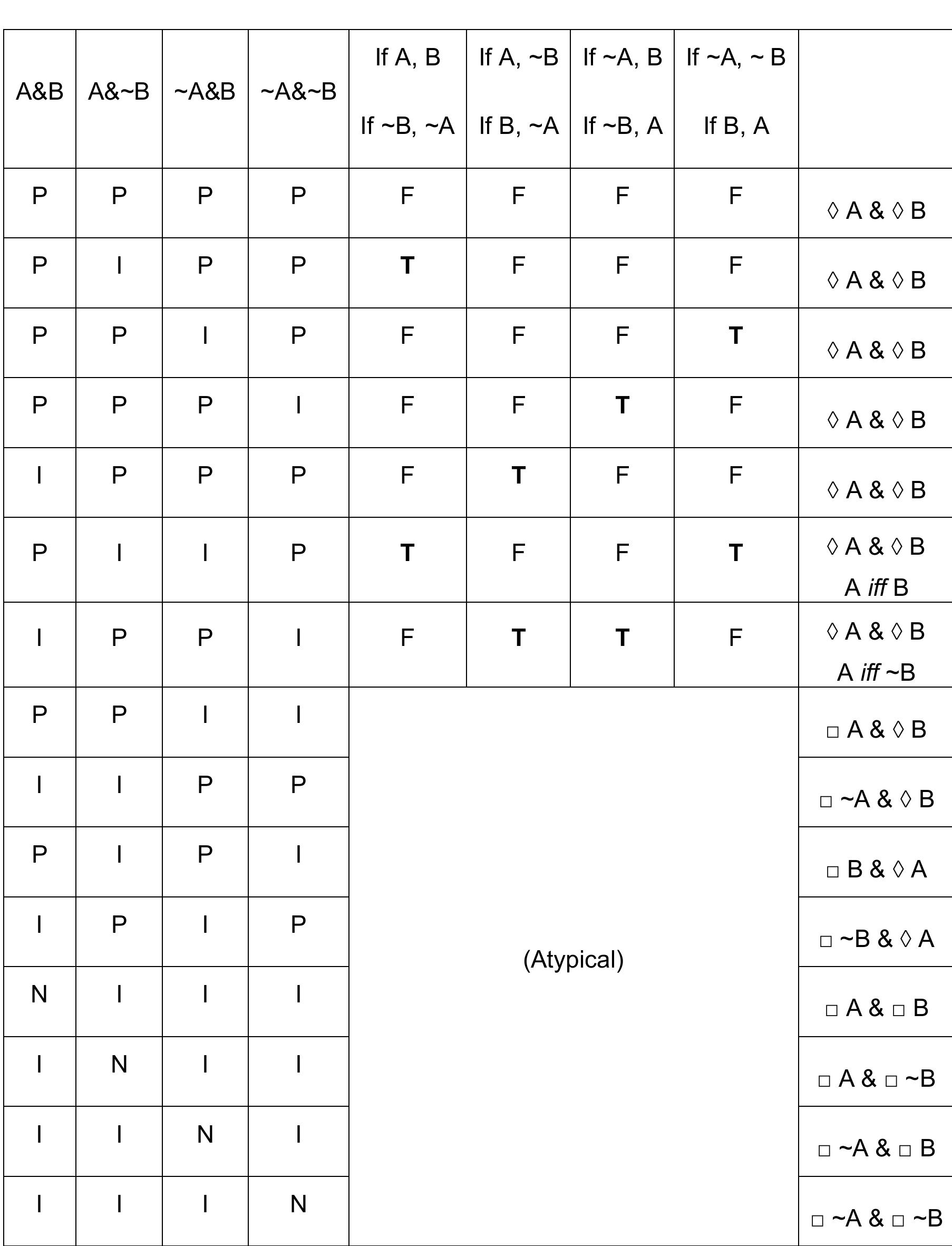
First, this paper proposes a new classification of ordinary language conditionals and discusses some of their properties. My approach is fundamentally based on the classical view that a conditional involves a sufficient condition (the antecedent) and a necessary condition (the consequent). Since the truth of the consequent is necessary for the truth of the antecedent, it is also an integral property of a typical conditional that the falsity of the consequent is sufficient for the falsity of the antecedent. Then the paper goes into the much discussed question of the truth conditions of a conditional. Some authors maintain that conditionals are not propositions and are not bearers of a truth-value.1 Contrary to these claims, I consider ordinary language conditionals as statements that are considered true or false by the speaker and the addressee and express propositions that may be true or false. Since it involves sufficiency and necessity, a conditional is seen here as a complex sort of modal statement. ‘If’ is considered as an ordinary language operator that establishes a triple modal relation between two propositions. The paradoxes of the material conditional are avoided, as well as some problems of the alternative theories of the conditional. On the other hand, as any theory, the present one has its own problems, which, for lack of space, I will not explore in this article.

AI


2009
Abstract It is known that indicative and subjunctive conditionals interact differently with a rigidifying “actually” operator. The paper studies this difference in an abstract setting. It does not assume the framework of possible world semantics, characterizing “actually” instead by the type of logically valid formulas to which it gives rise.
2006
Conditional sentences are difficult to analyse and the literature on this topic is so abundant that I do not dare to mention any title except for those mentioned for the specific purposes of this paper. The difficulty starts already at classificational and typological levels. The purpose of this paper is to analyse conditional sentences (CSs, for short) in which specific items, so-called categorially polyvalent particles, CCPs for short, occur. CPPs are functional expressions which can have as their possible arguments expressions of different grammatical categories. Grammatically such expressions are usually modifiers, that is functional expressions of the category C/C for various categories C.The interest of CCPs is that in spite of the fact that they can apply to expressions of various categories (in that sense they are categorially polyvalent) they usually have in some sense a constant meaning across categories. So it might be interesting to see whether this constancy of meaning ...
Synthese, 2020
The aim of this paper is to give a general solution to the paradoxes of the material conditional, including the paradoxes generated by embedded conditionals. The solution consists in a pragmatic reinterpretation of the formal languages of classical logic LK and relevant logic LR (which rejects the validity of weakening and splits the connectives into two) as presented in Paoli [2002],[2007]. In particular I argue that the material conditional in the classical logic LK captures the truth conditions of "if...then", but ignores certain pragmatic enrichments that are associated to it, while relevant logic LR can give a systematic diagnostic of the cases in which a conditional is pragmatically enriched and those cases in which it is not. This diagnostic shows the reason why the paradoxes seem unacceptable and why they are, nevertheless, truth-preserving. This reinterpretation will also cover the solution that Paoli [2005] gives to McGee's paradoxes of the Modus Ponens.
2013
Grice argues that indicative conditionals ‘if p then q’ have conventional, truth conditional meaning according to the material conditional ‘p q’. In order to explain away the known paradoxes with this interpretation, he distinguishes between truth conditions and assertion conditions, attempting to demonstrate that the assumed connection between ‘p’ and ‘q’ (the Indirectness Condition) is a conversational implicature; hence a matter only relevant for the assertion conditions of a conditional. This paper argues that Grice fails to demonstrate i) that the Indirectness Condition is cancellable, hence a conversational implicature, ii) that the Indirectness Condition is not part of the conventional, truth-relevant meaning of ‘if’, and accordingly, iii) semantic or logical equivalence between indicative and material conditionals.
In this paper I will propose a refinement of the semantics of hypervaluations (Mura 2009), one in which a hypervaluation is built up on the basis of a set of valuations, instead of a single val-uation. I shall define validity with respect to all the subsets of valua-tions. Focusing our attention on the set of valid sentences, it may easily shown that the rule substitution is restored and we may use valid schemas to represent classes of valid sentences sharing the same logical form. However, the resulting semantical theory TH turns out to be throughout a modal three-valued theory (modal sym-bols being definable in terms of the non modal connectives) and a fragment of it may be considered as a three-valued version of S5 system. Moreover, TH may be embedded in S5, in the sense that for every formula ϕ of TH there is a corresponding formula ϕ' of S5 such that ϕ' is S5-valid iff ϕ is TH-valid. The fundamental property of this system is that it allows the definition of a purely semantical relation of logical consequence which is coextensive to Adams’ p-entailment with respect to simple conditional sentences, without be-ing defined in probabilistic terms. However, probability may be well be defined on the lattice of hypervaluated tri-events, and it may be proved that Adam’s p-entailment, once extended to all tri-events, coincides with our notion of logical consequence as defined in purely semantical terms.
There is a profound, but frequently ignored relationship between logical consequence (formal implication) and material implication. The first repeats the patterns of the latter, but with a wider modal reach. It is argued that this kinship between formal and material implication simply means that they express the same kind of implication, but differ in scope. Formal implication is unrestricted material implication. This apparently innocuous observation has some significant corollaries: (1) conditionals are not connectives, but arguments; (2) the traditional examples of valid argumentative forms are metalogical principles that express the properties of logical consequence; (3) formal logic is not a useful guide to detect valid arguments in the real world; (4) it is incoherent to propose alternatives to the material implication while accepting the classical properties of formal implication; (5) some of the counter-examples to classical argumentative forms and known conditional puzzles are unsound.
Logic and Logical Philosophy, 2025
This paper compares two logical conditionals which are strengthenings of the strict conditional and avoid the paradoxes of strict implication. The logics of both may be viewed as extensions of KT, and the two conditionals are interdefinable in KT. The implicative conditional requires that its antecedent and consequent be both contingent. The consequential conditional may be viewed as a weakening of the implicative conditional, insofar as it also admits the case in which the antecedent and the consequent are strictly equivalent (either both necessary or both impossible). The two conditionals share a number of properties, among them Transitivity, Contraposition, Aristotle's Thesis, Weak Boethius' Thesis and Aristotle's Second Thesis. They also share some restricted principles such as Possibilistic Monotonicity, Possibilistic Simplification and Possibilistic Right Weakening. They differ in relation to Identity, which is validated by consequential implication, while the implicative conditional only validates the restricted principle of Possibilistic Identity. The relations between the two conditionals are represented by two Aristotelian cubes of opposition, one involving the contrariety between If A, then B and If A, then ¬B, according to Weak Boethius' Thesis, and the other the contrariety between If A, then B and If ¬A, then B, according to Aristotle's Second Thesis. We also explore the relations between the two logical conditionals and natural language conditionals, emphasizing the dependence of the latter on the context, and the need to distinguish natural language conditionals which may be viewed as consequential or implicative, on one side, and concessive and some other types of conditionals, on the other.
The prevailing viewpoint concerning conditionals asserts two claims: (1) conditionals featuring non-assertive acts in their consequents, such as commands and promises, cannot plausibly be construed as assertions of material implication; (2) the most promising hypothesis for such sentences is conditional-assertion theory, which defines a conditional as a conditional speech act, i.e., the performance of a speech act given the assumption of the antecedent. This hypothesis carries significant and far-reaching implications, as conditional speech acts are not synonymous with a proposition possessing truth conditions. This paper opposes such a view in two steps. Firstly, it presents a battery of objections against conditional-assertion theory. Secondly, it advances the argument that such examples can indeed be convincingly construed as assertions of material implication.
Journal of Pragmatics, 1983
An analysis is offered of the distinctions and similarities between (subtypes of) indicative and subjunctive conditionals in terms of the type of possibility-upperbound and lowerbound indeterminacy and contingency-that is expressed in the antecedent.
AI
The paper reveals that ordinary language conditionals express a modal relationship where a truth condition exists for A implying B, and vice versa, framing this as a compound modal statement.
It demonstrates that the truth of conditionals may shift depending on implicit contextual assumptions, as the truth-value can vary in different contexts of usage.
Typical conditionals must satisfy contraposition validity, while atypical conditionals cannot, indicating differences in their logical structure, as seen in David Lewis's examples.
The study employs a conjoint possibility framework, establishing conditions under which typical conditionals can be determined true or false based on possible worlds semantics.
It categorizes conditionals into factual, counterfactual, and uncertain-fact types, each defined by specific truth conditions regarding the truth-values of A and B in various contexts.

I got my PhD in the University of Paris in 1998. I live in Rio de Janeiro. I work in the Graduate Program for Cognition and Language (PGCL), at UENF (Brazil). In the last 20 years my areas of interest have been: consciousness, free will, conditionals. I have published articles in the following journals: Australasian Journal of Philosophy, Analysis, Cognitive Linguistics, Journal of Pragmatics, Acta Analytica, Logical Investigations, Philosophical Psychology, Consciousness and Cognition, Journal of Consciousness Studies, Behavioral Science and the Law, Erkenntnis, Journal of Philosophical Logic, among others.
Journal of Philosophical Logic, 2015
Semantic universals and universal semantics, 1991
This series of books on the semantics of natural language contains collections of original research on selected topics as well as monographs in this area. Contributions from linguists, philosophers, logicians, computer-scientists and cognitive psychologists are brought together to promote interdisciplinary and international research. Editors Alice ter Meulen Other books in this series: 1. Alice G.B. ter Meulen (ed.) Studies in Mode/theoretic Semantics 2. Jeroen Groenendijk, Theo M.V. Janssen and Martin Stokhof (eds.) Truth, Interpretation and Information 3. Fred Landman and Frank Veltman (eds.) Varieties of Formal Semantics 4. Johan van Benthem and Alice G.B. ter Meulen (eds.) Generalized Quantifiers in Natural Languages 5. Vincenzo Lo Cascio and Co Vet (eds.) Temporal Structure in Sentence and Discourse 6. Fred Landman Towards a Theory of Information 7. Jeroen Groenendijk, Dick de Jongh, Martin Stokhof (eds.) Foundations of Pragmatics and Lexical Semantics 8. Jeroen Groenendijk, Dick de Jongh, Martin Stokhof (eds.) Studies in Discourse Representations Theory 9. Michael Moortgat Categoria I Investigations 10. Irena Bellert Feature System for Quantification Structures in Natural Languages 11. R. Bartsch, J. van Benthem and P. van Emde Boas (eds.)
South African Journal of Philosophy, 2018
Ordinary speakers intuitively assign truth-values to conditional utterances in everyday conversation, but, despite the general ease with which this occurs, it is notoriously difficult to give an account of the implicit logic that is followed in making these truth-value assignments. I propose a twofold logic of the conditional – a relatively simple “factual” logic for conditionals interpreted with regard to what is actually the case, largely following the logic of the material conditional; combined with a variably strict possible-worlds counterfactual logic for conditionals interpreted with regard to with what may be (or may have been) the case, incorporating a ceteris paribus clause. This theory is able to deal with a number of challenges for other prominent views of the conditional, such as counter-intuitive truth-value ascriptions provided by notions of similarity or closeness, and difficulties adequately accounting for phenomena such as reverse Sobel sequences.
Journal of Philosophical Logic, 2023
This paper investigates the implicative conditional, a connective intended to describe the logical behavior of an empirically defined class of natural language conditionals, also named implicative conditionals, which excludes concessive and some other conditionals. The implicative conditional strengthens the strict conditional with the possibility of the antecedent and of the contradictory of the consequent. p ⇒ q is thus defined as ¬ (p ∧ ¬q)∧ p∧ ¬q. We explore the logical properties of this conditional in a reflexive normal Kripke semantics, provide an axiomatic system and prove it to be sound and complete for our semantics. The implicative conditional validates transitivity and contraposition, which we take to be integral parts of reasoning and communication. But it only validates restricted versions of strengthening the antecedent, right weakening, simplification, and rational monotonicity. Apparent counterexamples to some of these properties are explained as due to contextual factors. Finally, the implicative conditional avoids the paradoxes of material and strict implication, and validates some connexive principles such as Aristotle's theses and weak Boethius' thesis, as well as some highly entrenched principles of conditionals, such as conjunction of consequents, disjunction of antecedents, modus ponens, cautious monotonicity and cut.
I argue that indicative conditionals are best viewed as having partial truth conditions: "If A, B" is true if A and B are both true, false if A is true and B is false, and lacks truth value if A is false. The truth conditions are shown to explain a variety of important phenomena regarding indicative conditionals, including Adams' Thesis about the assertability conditions of conditionals, and how indicative conditionals embed in more complex constructions. In particular, the truth conditions are shown to provide the semantic basis for characterising several distinct logics of indicative conditionals, of which the logic of assertion is the main focus of the paper.
2015
In Section 1 I briefly sketch three kinds of theory of conditionals, and show that the third (the Suppositional Theory) avoids problems facing the other two. There emerges a version of the result that on the Suppositional Theory, conditionals cannot be understood in terms of truth conditions. In Section 2 I explore the suggestion that nevertheless some truth values for conditionals are compatible with the Suppositional Theory. In Section 3 I argue that there can be such things as objectively correct conditional judgements, despite their lack of truth values.
Topoi, 2021
The variably strict analysis of conditionals does not only largely dominate the philosophical literature, since its invention by Stalnaker and Lewis, it also found its way into linguistics and psychology. Yet, the shortcomings of Lewis-Stalnaker's account initiated a plethora of modifications, such as non-vacuist conditionals, presuppositional indicatives, perfect conditionals, or other conditional constructions, for example: reason relations, difference-making conditionals, counterfactual dependency, or probabilistic relevance. Many of these new connectives can be treated as strengthened or weakened conditionals. They are definable conditionals. This article develops a technique to infer the logic for such definable conditionals from the known logic of the underlying defining conditional. The technique is applied to central examples. The results show that a large part of the zoo of conditionals arises from a basic conditional-a constant nucleus of the different contextual and conceptual variations of variably strict conditionals.
This is the first part of two in a study on the logic and semantics of the indicative conditional. This first part provides a global expressivist analysis of the indicative conditional along the lines of the Ramsey Test. The analysis is a form of 'global' expressivism in that it supplies acceptance and rejection conditions for all the sentence forming connectives of propositional logic (negation, disjunction, etc.) and so allows the conditional to embed in arbitrarily complex sentences (thus avoiding the Frege-Geach problem). The resulting mental usage semantics is provably not susceptible to triviality results and completely characterises a logic for the indicative conditional that respects many of its well known logical quirks (the failure of modus ponens, etc.). The second part provides a semantic analysis of the resulting structure and logic.
Linguistics and Philosophy, 2014
We bring out syntactic and semantic similarities of two types of conditionals with fronted antecedents (normal indicative conditionals (NCs) and biscuit conditionals (BCs)) and two types of left dislocation constructions in German (German left dislocation and hanging topic left dislocation), which mark two types of topicality (aboutness topicality and relevance topicality). On the basis of these similarities we argue that (the antecedent if-clauses of) NCs and BCs are aboutness topics and relevance topics, respectively. Our analysis extends the approach to aboutness topicality of Endriss (2009) to relevance topics to derive the semantic and pragmatic contribution of left-dislocated DPs and applies it to an analysis of conditionals as (maximal) pluralities of possible worlds. We show how this uniform approach * We would like to thank Michael Franke, Andreas Haida, Klaus von Heusinger, Todor Koev, Sophie Repp, Philippe Schlenker, the audiences at SALT XVIII and the 27th WCCFL for discussions on the issues of this paper. We would further like to thank two anonymous reviewers and the editor Craige Roberts for very detailed comments, which helped to improve the paper considerably. Parts of this work were supported by the German Science Foundation (DFG) funding the Collaborative Research Centres 632, 673 and 732. to the interpretation of topicality accounts for the nominal left dislocation constructions as well as for the semantic and pragmatic effects observed in connection with the two types of conditionals. We furthermore discuss the potential of our proposal to deal with subjunctive biscuit conditionals, if-clauses modifying speech acts different from assertions, conditionals with right-dislocated if-clauses and nested conditionals.
The aim of this article is to examine the possible relations between form and meaning in some formal types of conditionals. To keep the investigation within manageable proportions, the author restricts himself to the three "canonical" forms of conditionals: the types illustrated by 'I will do it if you help me', 'I would do it if you helped me' and 'I would have done it if you had helped me'. The conclusion from the investigation is that these three forms correspond with quite an array of different interpretations -- thirty-nine in all -- even if one limits oneself (as the author does) to the possible-world readings of two types of "case-specifying" conditionals, viz. actualization conditionals like 'You will be punished if you do that' and inferential conditionals like 'If the murder is proved, he will get a life sentence'. All of the thirty-nine interpretations considered belong to six sets of possible-world readings: the conditional clause of such a case-specifying conditional may be factual, neutral, closed, open, hypothetical or counterfactual.
