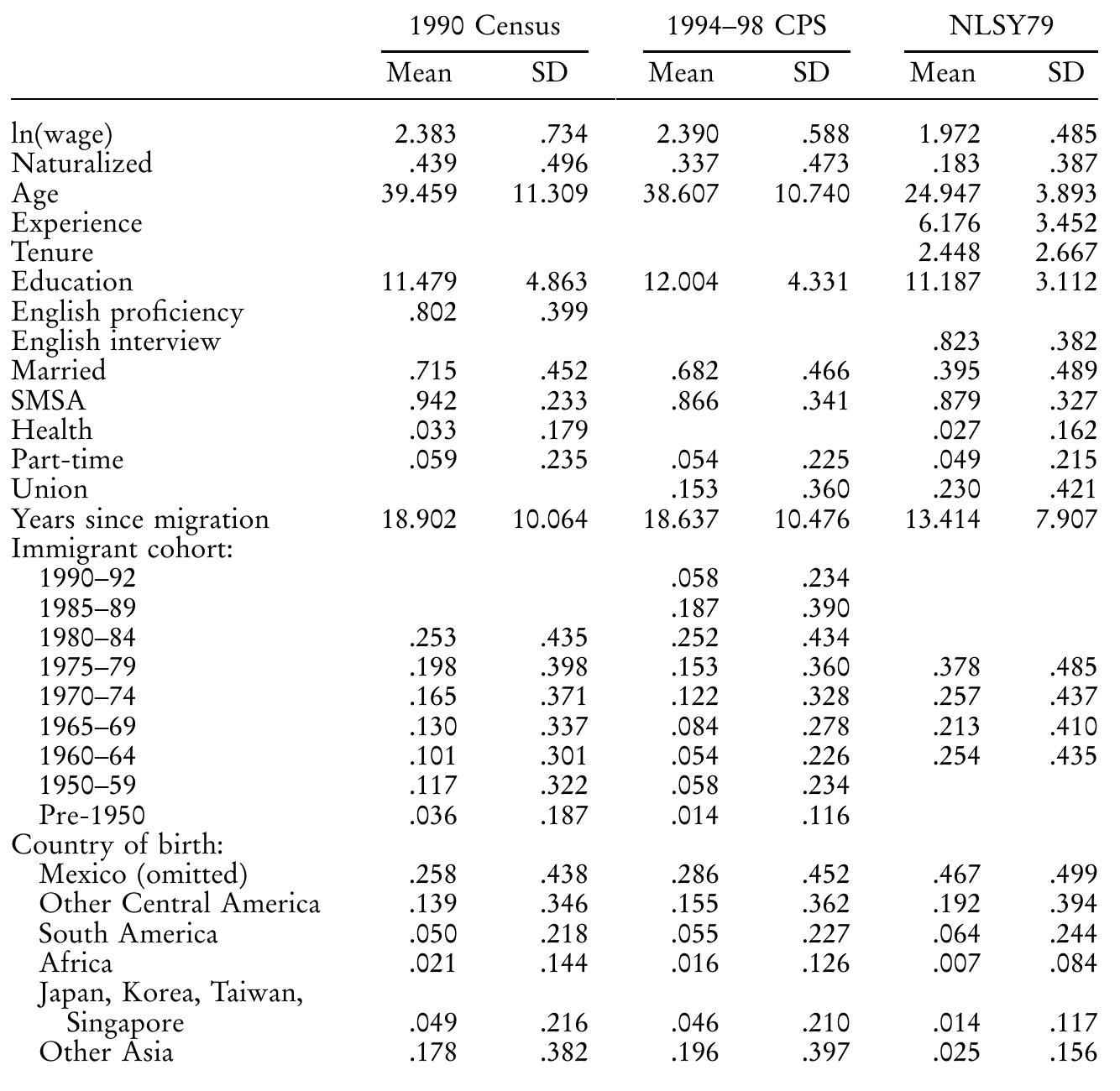
Descriptive Sample Statistics, Immigrant Samples Table Al
subdirectory_arrow_right Figure source:
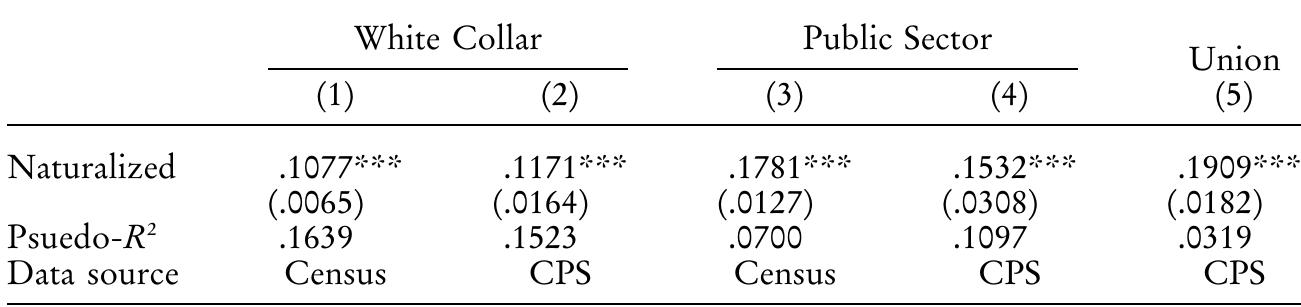
Abstract: For young male immigrants, naturalization facilitates assimilation into the U.S. labor market. Following naturalization, immigrants gain access to public-sector, white-collar, and union jobs, and wage growth accelerates-consistent with removal of employment barriers. The faster wage growth of immigrants who naturalize might alternatively result from greater human capital investment prior to naturalization, stemming from a long-term commitment to U.S. labor markets, but there is no evidence that wage growth accelerates or the distribution of jobs improves until citizenship is attained. Finally, the gains from naturalization are greater for immigrants from less-developed countries and persist when we control for unobserved productivity.
... Read more Related topics:
Economics Labor Economics Applied Economics Demographic economics Human capital Investment Wage Growth Related Papers Abstract: Citizenship brings many benefits to immigrants, the opportunity to participate more fully in our democracy through the right to vote being primary among them. But beyond the clear civic gain is an often overlooked economic benefit: for a variety of reasons, naturalized immigrants are likely to see a boost in their family incomes that can benefit their children, their communities and the nation as a whole.Why is the economic importance of naturalization -- the process by which immigrants become citizens -- so often overlooked? Part of the reason is that much of the heated debate around the economic effects of immigration in the U.S. tends to focus on the unauthorized (or "illegal") population. The economic evidence in this arena points in multiple directions -- positive gains at an aggregate level, negative effects on specific sectors of the labor market, mixed impacts on government coffers -- but lost in that discussion is the fact that nearly three-fourths of all immigran...
... Read more
Abstract: We examine the potential effect of naturalization on the U.S. immigrants's earnings. We find the earning gap between naturalized citizens and non-citizens is positive over many years, with a tent shape across the wage distribution. We focus on a normalized metric entropy measure of the gap between distributions, and compare with conventional measures at the mean, median and other quantiles. In addition, naturalized citizen earnings (at least) second order stochastically dominate non-citizen earnings in many of the recent years. We construct two counterfactual distributions to further examine the potential sources of the earning gap, the "wage structure" effect and the "composition effect". Both of these sources contribute to the gap, but the composition effect, while diminishing somewhat after 2005, accounts for about 3/4 of the gap. The unconditional quantile regression (based on the Recentered Influence Function), and conditional quantile regressions confirm that naturalized citizens have generally higher wages, although the gap varies for different income groups, and has a tent shape in many years.
... Read more