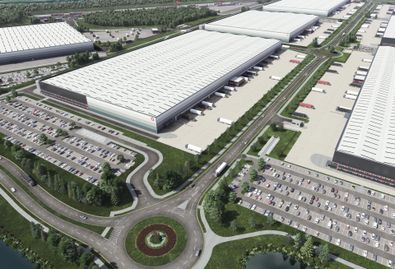
Industrial real estate was the only major U.S. asset class that didn't experience rising asking rents in the second quarter, a sign that the sector is grappling with tariff uncertainty as it works through the aftermath of its pandemic-era e-commerce boom.
:no_upscale():quality(75))
Industrial asking rents grew just 0.1% in the second quarter, the weakest increase since 2020, according to Moody’s preliminary data. As the market continues to digest a historic wave of construction in recent years, demand has softened amid growing macroeconomic uncertainty and tariff pressures.
President Donald Trump’s “Liberation Day” tariffs threw the market into chaos in April, and subsequent policy shifts have added to it. The current tariff blanket rate of 10% on all imports — with higher rates on steel, aluminum and autos — expires July 9. With the exception of a few trade deals, export duties could surge again next week.
The unknown has affected import volumes significantly, dropping roughly 20% in April following a Q1 push for inventory before Trump announced the new tariffs, according to a June Commercial Edge report.
“The uncertainty of the tariff policy may be a heavier burden on decision makers than the weight of the tariffs established thus far,” CommercialEdge Director Peter Kolaczynski said in a statement.
Another wave of imports is expected to be underway as firms rush to get in front of future tariffs ahead of the July 9 deadline, potentially pushing volumes higher than normal as businesses brace for more tariff uncertainty, according to the report.
The policies have disrupted industrial leasing, as companies consider bonded warehouses that allow certain products to avoid the tariffs.
The unpredictability has happened alongside a reversal in the balance between supply and demand. Three years ago, the average Class-A industrial space in the Northeast was leased more than three months before it was available, according to a CBRE report.
As of the second quarter, it now takes nine months to lease available Class-A space, according to CBRE.
Northeast construction starts dropped from 43.3M SF in 2024 to 6.3M in the first quarter, according to Cushman & Wakefield. Still, the region experienced a net occupancy loss during Q1 of 4.1M SF.
More than half of what was built in the first three months of the year was delivered vacant, according to Cushman & Wakefield.
The e-commerce boom that fueled record demand in 2022, when more than 60 deals surpassed 1M SF, has cooled significantly. With absorption slowing sharply and construction declining, data suggests the market may be close to a correction period.