2
A Simple View of Consciousness
Adam Pautz
I will argue for primitivism about sensory consciousness. On primitivism, sensory
consciousness cannot be fully reductively explained in physical or functional
terms. Others have defended primitivist views of color, personal identity, the
intentionality of thought, semantic properties, and goodness.
My argument for primitivism will not be based on the usual a priori con-
siderations, for instance the knowledge argument, the explanatory gap, or the
thesis of revelation. Instead, the argument will be based on a philosophical
claim about the structure of consciousness together with an empirical claim
about its physical basis. The philosophical claim is that having an experience
with a certain phenomenal character is a matter of bearing a ‘consciousness
relation’ to a certain item external to the subject. For instance, intentionalism
about sensory consciousness holds that having an experience with a certain
phenomenal character is a matter of standing in an intentional relation to an
intentional content into which external properties enter. The empirical claim
is that phenomenology can vary due to internal differences. These two claims
create a puzzle and I will argue that the only solution to the puzzle involves
adopting the view that the consciousness relation is a simple relation—one that
cannot be analyzed in terms of an individual’s physical or functional relations to
the external world.
Primitivism does not automatically lead to the rejection of physicalism—at
least if physicalism is a mere thesis of supervenience. G. E. Moore held that
goodness is primitive, yet supervenient on the natural as a matter of metaphysical
necessity. Likewise, one could hold that the consciousness relation is primitive,
yet supervenient on the physical as a matter of metaphysical necessity.
My plan is as follows. In sections 1 and 2 I introduce the two claims that
will play a significant role in my argument. In sections 3–11 I develop the
argument. Finally, in section 12 I briefly address the prospects for the view that
the consciousness relation is primitive yet supervenient on the physical with
metaphysical necessity.
�26 A. Pautz
1 . T H E R E L AT I O N A L S T RU C T U R E O F S E N S O RY
CONSCIOUSNESS
The first claim that will play a significant role in the argument is that a relational
view of sensory consciousness is correct. Suppose you have a visual experience as
of a tomato. A natural view is that having an experience with this phenomenal
character is a matter of standing in a relation to an item that somehow involves
the property of being red and the property of being round. Maybe the relevant
item is a sense datum instantiating the properties, or the tomato instantiating the
properties, or an intentional content that merely attributes the properties. In any
case, the properties are not properties of your experience or your brain. Instead,
they are properties of the object of your experience, if they are properties of
anything at all. The relational view endorses this natural conception of experience.
Say that a property is external iff it is not instantiated by an individual’s experience
or brain. Then the relational view holds that, for some types of experience, to have
an experience with a certain phenomenal character is to stand in a certain relation
to an item involving certain external properties; the phenomenal character of the
experience is determined by the external properties that figure in the item. The
argument I will be developing requires that the relational view applies to color
experience, taste experience, and pain experience.
The relational view goes beyond the uncontroversial claim that in non-
hallucinatory experience we are related to external items. On the relational
view, phenomenal character is at least sometimes constituted by our relations to
external properties, rather than by properties of our brains or experiences. For
instance, on typical sense datum theories, having a visual experience with a certain
phenomenal character is a matter of sensing mental objects whose properties
determine the phenomenal character of the experience, for instance color and
shape properties. These properties qualify as external in my sense, since they
are not instantiated by the experience itself or by the brain. Disjunctive theories
hold that the property of having an experience with a certain phenomenal
character is the disjunctive property of standing in a certain relation to physical
objects instantiating certain external properties or being in some other state.
Disjunctive theories are akin to sense datum theories in holding that in some cases
phenomenal character is determined by our relation to objects having external
properties. Intentionalist theories are importantly different from sense datum and
disjunctivist theories, but still count as relational in my sense. Whereas sense
datum and disjunctivist theories hold that the determinants of phenomenology
are concreta involving external properties, intentionalist theories hold that they
are abstracta involving external properties. In particular, intentionalist theories
have it that the determinants of phenomenology are intentional contents which
involve external properties in the sense that the contents attribute them to
� A Simple View of Consciousness 27
external objects. On most versions of intentionalism, the relevant contents are
propositions. On another version of intentionalism, the property-complex theory,
the contents are not propositions but complex properties or property-structures
built up from external properties and spatial relations. In non-veridical cases
the property-structures are not instantiated before one, but one is still related
to them. I favor intentionalism and in this chapter I will be working with the
property-complex version of intentionalism for convenience.¹
There are also prominent theories which reject the relational view. The identity
theory is one. On this theory, having an experience with a certain phenom-
enal character does not incorporate any external properties; it is necessarily
identical with the property of being in a certain internal neural state. Phenom-
enal differences are always constituted by differences in non-relational neural
properties.
One argument for the relational view of phenomenology is semantic: it
provides the best explanation of why we use expressions for external properties,
expressions such as round, red, or in my foot, to characterize phenomenology.
For instance, we might truly say of two individuals undergoing hallucinations
that one is conscious of every shape the other is conscious of; and the truth
of such a report seems to supervene on the phenomenal characters of their
experiences alone. We need a relation to serve as a semantic value of the
expression x is conscious of y which occurs in this statement. Another argument
is introspective: the relational view agrees with the transparency observation that
when we try to focus on what our experiences are like we focus on external
properties ostensibly instantiated by external objects or bodily regions. I think
that the best argument is epistemic: the relational view is required to explain why
merely having an experience with a certain phenomenal character necessarily
grounds the capacity to have beliefs involving external properties, for instance
shapes, colors, and properties ostensibly located in bodily regions. These are
certainly not properties of our experiences or brains. I will not develop these
arguments here. Suffice it to say that there are strong arguments for the relational
view.²
As mentioned, I favor intentionalism and in this chapter I will be working
with the property-complex version of intentionalism for convenience. I will call
the relation we bear to the properties the consciousness relation and I will call the
external properties the consciousness of which determines phenomenal character
the sensible properties.
Some comments. First, I hold that the relational view is correct for all aspects
of sensory phenomenology. But some disagree, holding for instance that the
relational view is incorrect in the case of blurriness. And some hold that the
¹ For a defense of intentionalism, see Pautz (2007a) and Pautz (2008). For the property-complex
theory in particular, see Johnston (2004).
² For a defense of the relational view, see Pautz (2007a) and Pautz (2008).
�28 A. Pautz
relational view fails for some types of non-sensory experiences, for instance
moods and emotions. But, as we shall see, such exceptions would not matter
to the argument. It is enough that the relational view is correct for color, taste,
and pain experience. This is why above I equated the relational view with a
restricted thesis only about these types of experiences. Second, some hold that the
colors, tastes, and pains presented in experience are response-dependent properties
in the sense that they are properties of objects or bodily regions concerning how
they affect the nervous system. I will remain neutral on this view, but at one
point my argument requires that this view cannot be extended more generally
to all the sensible properties (see the discussion of the manifestation relation in
section 7). The argument for this assumption is that having a series of visual
experiences, even hallucinatory, is enough to give one the capacity to have beliefs
involving geometrical properties, which evidently cannot also be identified with
response-dependent properties of this form. So the epistemic argument for the
relational view supports the additional claim that not all the sensible properties
are such response-dependent properties.
2 . T H E PH Y S I C A L B A S I S O F S E N S O RY C O N S C I O U S N E S S
There are obviously actual cases of perceptual variation, and they are much
discussed by philosophers. The second claim that will play a large role in my
argument for primitivism about sensory consciousness is that a certain type of
perceptual variation is possible, but it is not one of the uncontroversial types
of variation which philosophers typically discuss. Further clarification will be
provided later on, but to a first approximation my second claim is that there are
possible cases in which individuals bear the consciousness relation to different
ostensible external properties of objects even though their physical relations to
external properties are the same. In these cases the individuals involved are
conscious of different external properties owing to internal differences between
them. Now in the present section I only intend to introduce the claim; exactly
how this claim will contribute to the case for primitivism will be revealed in the
next section of the chapter, section 3.
I said that my second claim is that there are possible cases in which individuals
bear the consciousness relation to different ostensible external properties of
objects even though their physical relations to external properties are the same.
In particular, I will argue that there are possible cases in which two individuals
bear the consciousness relation to different ostensible external properties of
objects even though they bear the optimal cause relation to the same properties
of those objects. I choose to focus on the optimal cause relation because, as
we will see in section 3, some philosophers have attempted to reduce the
consciousness relation to this relation. The optimal cause relation may be defined
as follows:
� A Simple View of Consciousness 29
The optimal cause relation: x is in a state that plays the e-role and that would be caused by
(for short, would track) the instantiation of external property y were optimal conditions
to obtain.
The e-role is the functional role characteristic of brain states that realize exper-
iences. On one view, the e-role is being poised to influence the formation of
beliefs and desires. The notion of optimal conditions might be defined in different
ways. Here I will equate them with conditions in which the sensory systems
operate in accordance with design and result in adaptive behavior.
My argument that the relevant type of variation is possible will not be based
on intuition. Indeed, because there are no a priori links between phenomenal
and physical concepts, I do not think that issues concerning the physical basis
of consciousness can be decided a priori. Rather my argument will based on the
empirical finding that the phenomenology of our experiences is poorly correlated
with the external properties we bear the optimal cause relation to when we
have those experiences, and is much better correlated with the internal neural
goings-on taking place in us then. I will express this by saying that there is bad
external correlation and good internal correlation. I will provide examples involving
color, pain, and taste experience. Then I will clarify the relevant type of variation,
and argue that the empirical findings support its possibility.³
First, consider color experience. Some color experiences are of unitary colors.
Some shades of red, green, yellow, and blue are unitary colors: they do not
contain any hint of any other shades. All other color experiences are of binary
colors: shades of orange, for instance, contain hints of red and yellow, and shades
of purple contain hints of red and blue. In addition, color experiences resemble
one another more or less closely, depending on the degree to which the colors
presented in them resemble. But psychophysics has revealed that there is no
simple relationship between the character of color experience and the reflectance
properties we bear the optimal cause relation to when we have those color
experiences. When we have unitary experiences there is nothing unitary about
the reflectance properties that we then bear the optimal cause relation to, and
when we have binary ones there is nothing binary about the reflectance properties
we then bear the optimal cause relation to. And resemblances among color
experiences are not matched by resemblances among the reflectance properties
we bear the optimal cause relation to when we have those color experiences.
By contrast, neuroscience has revealed a very modest relationship between
the activity of red-green (R-G) and yellow-blue (Y-B) neurons in the lateral
geniculate nucleus (a kind of halfway house between the eyes and the visual
cortex) and the character of color experience. Some models have it that in the
³ The empirical results concerning color vision I will present come from Werner and Wooten
(1979), Hunt (1982), Hardin (1988), De Valois and De Valois (1993); those concerning taste
come from Stevens (1975), Borg et al. (1967), and Smith et al. (2000); and those concerning pain
come from Stevens (1975) and Coghill (1999).
�30 A. Pautz
visual cortex there is a much better correlation. Granted, the details remain
poorly understood. But given that the explanation of color structure is not to
be found in the physical properties we bear the optimal cause relation to, the
explanation must lie in the brain. When one has a unitary experience there is
something special about the processing occurring in one then, and when one
has a binary experience there is something binary about the processing occurring
in one then. And resemblances among one’s color experiences are matched by
resemblances among the processing occurring in one then, even though they
are not matched by the reflectance properties one then bears the optimal cause
relation to.
In the case of pain, the situation is much the same. First, there is bad external
correlation. Psychophysics has revealed that in the case of pain there is response
expansion. There is a non-linear, exponential relationship between intensity of
bodily disturbance and pain intensity. So if John’s pain is twice as great as Jim’s,
then the bodily disturbance that John bears the optimal cause relation to might
well be much less than twice as great as the one that Jim bears the optimal cause
relation to. Why then is his pain twice as great? In the case of pain the evidence
of good internal correlation is stronger than it is in the case of color vision.
The neural response is amplified further downstream. So John’s somatosensory
neural discharge rates are twice as great as Jim’s. It is only in the brain that
we find a nice correlation between pain intensity and anything in the physical
world. Indeed, there is a linear relationship between pain intensity and neuronal
discharge frequency rates in many areas of the primary somatosensory cortex.
Likewise, in the case of taste, there is a non-linear correlation between the
character of our taste experiences and the character of the chemical properties we
then bear the optimal cause relation to. By contrast, there is a linear correlation
between perceived sweetness and neural response, and resemblances among tastes
are matched by resemblances among so-called across-fiber patterns in the brain.
In general, when we have experiences the external properties we bear the
optimal cause relation to are a mess. The nervous system transforms the mess
into something more manageable, and it is only in the brain that we find a nice
correlation between experience and anything taking place in the physical world.
I will now develop a two-stage argument from this to the second claim that
will play a significant role in my argument for primitivism. This is the claim
that there are possible cases in which individuals bear the consciousness relation
to different ostensible external properties of objects even though their physical
relations to external properties are the same.
In the first stage, I will argue for the physical possibility of coincidence cases.
These are cases in which the following two physical conditions co-obtain.
First, the properties two individuals bear optimal cause relation to (in a certain
sense-modality) exactly coincide. Second, at the same time the individuals vary
� A Simple View of Consciousness 31
individual a individual b
processing a processing b
behaviors a, b, c . . . behaviors x, y, z . . .
p
Fig. 2.1. The structure of a coincidence case.
profoundly in neural processing and functional organization. In particular, they
are in quite different neural states, which play quite different output oriented
functional roles with respect to behavior (see Figure 2.1). The possibility of
such cases should be uncontroversial. Note that the first stage will be neutral
on whether the individuals in such cases have the same experience or different
experiences. This issue will be left open until the second stage.
In the second stage, I will use ‘good internal correlation’ and ‘bad external
correlation’ to argue that, given that the individuals in coincidence cases differ
profoundly in neural processing and functional organization, the most reasonable
view concerning these cases is that in at least some of them an additional
phenomenal condition obtains, namely, that the individuals also have different
experiences. This is so despite the fact that they bear the optimal cause relation
to the same external properties. Given good internal correlation and bad
external correlation, the internal and functional differences are better evidence of
phenomenal difference than the sameness of tracking is evidence of phenomenal
sameness. This will provide an argument that does not rely on untutored
intuition for the claim that experience can vary independently of optimal cause
relations and other such relations to external properties. I will call this coincidental
variation.
We begin, then, with the first stage. Unfortunately there are no obvious actual
coincidence cases. As noted at the outset, the form of variation argued for here
is importantly different from the forms of actual variation that philosophers
typically discuss. To see this, consider interspecies variation first. Humans and
pigeons differ profoundly in color processing and functional organization. But,
since they have different receptor systems, they bear the optimal cause relation
to different ranges of reflectances. So the second condition of coincidence cases,
namely that the properties tracked are the same, is not met in this case. Consider
standard variation next. On viewing a color chip with a certain reflectance
property, Jack and Jill are put into different opponent processing states and
differ functionally. So, in this one case, the neural states they are in are caused by
�32 A. Pautz
the same reflectance property. Since, we may suppose, the differences are within
the range of normal, optimal conditions obtain, this looks like a coincidence
case. But it might be argued that if we look at how their neural states respond
to external properties under all optimal conditions, we find that under those
conditions those neural states track overlapping but distinct ranges of reflectances.
If so, then, on viewing the color chip, they might be in states that are actually
caused by the same reflectance property, but they bear the optimal cause relation
to distinct but overlapping reflectance properties. So these are not obviously
coincidence cases.⁴ Fortunately, it should be uncontroversial that there are
possible coincidence cases, and this is all my argument will require. I will describe
three. In the rest of the chapter, I will make essential use of all three of these cases
in my argument for primitivism.
Mabel and Maxwell. Mabel and Maxwell occupy the same possible world but
belong to different species that evolved on separate continents. By chance, Mabel
and Maxwell evolved identical receptors systems. On viewing a fruit, they bear
the optimal cause relation to exactly the same reflectance property, r. However,
the fruit is an important food-source to Maxwell’s species but not to Mabel’s.
So they evolved different postreceptoral wiring, with the result that r normally
produces quite different color processing in Mabel and Maxwell. For instance, we
might suppose that r normally produces ‘unitary’ opponent processing in Mabel
that might underlie a vivid unitary color experience (for instance a unitary red
experience), while it normally produces ‘binary’ opponent processing in Maxwell
that might underlie a dull binary color experience (for instance, a desaturated
red-yellow experience). We may also suppose that Mabel is easily able to pick out
the fruit from the background foliage, while Maxwell has difficulty in this task.
I will call the opponent channel state Mabel is in u and the different opponent
channel state Maxwell is in b, because I will argue in the second stage of the
argument that in at least some scenarios of this kind Mabel has a unitary color
experience while Maxwell has a binary one.
Likewise in general. On viewing the same objects, Mabel and Maxwell bear
the optimal cause relation to exactly the same ranges of reflectances, but they
are put into neural states which differ in two ways. First, they differ in whatever
neural respect underlies the distinction between the experience of unitary colors
like red and the experience of binary colors like red-yellow. Second, they fall
into different internal resemblance-orderings. So, for instance, if both Mabel
and Maxwell look at the same two objects consecutively, Mabel might be
put into two radically different neural states, while Maxwell is put into two
similar neural states. In consequence, they differ markedly in their sorting,
discrimination, recognition and other color-related behavior with respect to the
⁴ This is explained more fully in Pautz (MSb); see also section 4 of the present chapter. It follows
that, contrary to Byrne and Tye (2006: 250), coincidence cases such as the one developed in Pautz
(2006) cannot be assimilated to cases of standard variation.
� A Simple View of Consciousness 33
same objects. But when they track the same properties by way of different
internal processing, optimal conditions obtain. Their visual systems operate
differently, but when they do so they are operating exactly as they were designed
by evolution to operate. And their behavioral dispositions, although different, are
adaptations to different selection pressures. Thus, Mabel and Maxwell constitute
a coincidence case, because they bear the optimal cause relation to properties that
exactly coincide, but they vary profoundly in neural processing and functional
organization.
Yuck and Yum. Yuck and Yum belong to different species. If they taste the
same foodstuff under optimal conditions, then their taste systems respond to
the same chemical property of that foodstuff, c. So, they bear the optimal cause
relation to the same property, c. However, the foodstuff is poisonous to Yuck but
not poisonous and indeed an important food-source to Yum. In consequence,
they so evolved as to respond to c with different across-fiber patterns (which,
as we saw above, are well-correlated with taste experiences in the actual world)
and different affective reactions. For instance, Yuck withdraws from it violently,
while Yum is drawn to it. I will call the across-fiber pattern Yuck undergoes d
and the one Yum undergoes p, because the second stage of the argument I will
argue that in at least one scenario of this kind the patterns realize a displeasing
and pleasing taste experience, respectively.
Likewise in general. When Yuck and Yum taste the same foodstuffs, they
bear the optimal cause relation to the same properties of those foodstuffs, but
they undergo quite different across-fiber patterns and exhibit different taste-
related affective and sorting behaviors. The neural and behavioral differences do
not impugn the assumption of optimality. These differences evolved naturally.
Moreover, they are adaptive, since the same foodstuffs have different nutritional
values for Yuck and Yum. I believe that there are actual cases of roughly this
kind. But, to avoid controversy, I will continue with the hypothetical case.
It may be said that in this scenario Yuck and Yum do not bear the optimal
cause relation to exactly the same properties, contrary to what I have said. In
particular, on tasting the foodstuff, Yuck bears the optimal cause relation to the
dispositional property of being poisonous for Yuck and Yum bears the optimal
cause relation to the dispositional property of being healthy for Yum. But this
is ruled out if we make an additional supposition. Suppose that the foodstuff
has two chemical properties, c and c.! The property which is responsible for the
foodstuff ’s being poisonous for Yuck and for its being healthy for Yum is c.!
However, c ! has no causal effect on their taste systems. A fortiori, the foodstuff’s
being poisonous or healthy has no causal effect on their taste systems. Instead,
only the other chemical property c has a causal effect on their taste systems. Since
the optimal cause relation is defined in causal terms, it follows that Yuck and
Yum do not bear the optimal cause relation to the foodstuff ’s being poisonous or
healthy. Instead, they only bear the optimal cause relation to the causally relevant
chemical property c, as originally stipulated.
�34 A. Pautz
Mild and Severe. Two communities of pain-perceivers evolve separately. Mild
belongs to one community and Severe belongs to the other community. Both
occasionally experience bodily disturbance d in the leg. In Mild’s community,
d is not very dangerous. So d normally puts his primary somatosensory cortex
into state m involving a certain mild rate of firing of neurons. Recall that in our
own case there is a linear correlation between the neural discharge frequencies of
the relevant neurons and pain intensity. By contrast, in Severe’s community, d is
much more dangerous. For instance, maybe it is more susceptible to dangerous
infections in this community because the community occupies an environment
in which bacteria are more plentiful. In consequence, in Severe, d normally
causes somatosensory state s, involving a rate of firing of somatosensory neurons
which is twice as great as that which is involved in m. As a result, Severe attends
to his leg with greater urgency than does Mild. But optimal conditions obtain
in each case, because the different behaviors are completely adaptive given the
noted difference in the significance of the damage to them. So, Mild and Severe
bear the optimal cause relation to the same property, d , but they differ radically
in pain processing and behavior.
Of course, there are indefinitely many such possible cases in which two
individuals differ profoundly in neural processing and functional organization
but bear the optimal cause relation to the same external properties. Everyone
must accept the physical possibility of coincidence cases, for these two physical
conditions are certainly compossible. The real question is not whether such cases
are possible, but whether the individuals in some such cases have the same or
different experiences.
Now for the second stage of the argument. I will argue that the best view is
that in at least one such coincidence case an additional phenomenal condition
obtains: the individuals involved have different experiences. This is so despite the
fact that they bear the optimal cause relation to the same properties. This yields
coincidental variation. Of course, I think that this is true in many such cases. But,
as we will see in section 4, my argument only requires that it is true in one. I
offer two arguments for this claim.
First, as we have seen, experiential properties are very well correlated with
neural properties and very poorly correlated with the external properties we bear
the optimal cause relation to. This suggests that, if two individuals stood in the
optimal cause relation to the same external properties but differed in the relevant
neural properties, then they would have different experiences. In other words,
translating from counterfactual language into the language of possible worlds, in
at least some nearby possible worlds in which coincidence cases actually obtain,
the individuals have different experiences, even though they bear the optimal
cause relation to the same properties. What is being invoked here is a general
principle: if we know that magnitudes x and y are well correlated but x and z are
not, then we have some reason to believe that, if two objects differed on y but
were the same on z, they would still differ on x.
� A Simple View of Consciousness 35
Second, the individuals in the cases exhibit robust and systematic differences
in color-related, taste-related, and pain-related behavior. We may suppose that
the differences are not learned but innate. And we may suppose that they are
widespread in the relevant populations.⁵ To explain these behavioral differences,
the opponent of coincidental variation might say that the individuals involved
have experiences with the same phenomenal characters, but have systematically
different beliefs and desires about the same objects. But this is a poor explanation
because the behavioral differences are supposed to be innate and widespread. Fur-
ther, if the individuals involved do not have different experiences, there would be
no explanation of why they have systematically different beliefs and desires about
the same objects. The only reasonable explanation is that in at least some of the
cases they have different experiences, in accordance with coincidental variation.
The alternative to accepting coincidental variation is holding that the indi-
viduals in every possible coincidence case have the same experiences in spite of the
vast neural and behavioral differences between them (or else are Zombies who
have no experiences at all, a possibility I will ignore). This is simply unbelievable.
Imagine meeting Yuck and Yum, Mild and Severe, or Mabel and Maxwell. To
say that they have the same experiences in spite of all the evidence against this
would be unreasonable.
Coincidental variation says that, in some possible coincidence cases, internal
and functional differences are accompanied by phenomenal differences. It would
be a mistake to confuse coincidental variation with the much-discussed thesis of
internalism. Internalism says that only internal factors are relevant to phenomen-
ology, so that, in every possible case, internal sameness guarantees phenomenal
sameness. As we will see at the end of section 7, some might say that there are
functionalist reasons to doubt this pure internalism. Coincidental variation is
quite consistent with the externalist view that sensory consciousness is somehow
determined jointly by the properties tracked on the input side, internal factors,
and behavioral dispositions on the output side. This would yield a form of exter-
nalism, but with internal as well as external factors playing a role. My argument
for primitivism only requires coincidental variation. The issue of internalism is
not relevant here, and I am neutral between pure internalism and some form of
externalism.
Coincidental variation says that in at least one coincidence case the individuals
involved have different color, taste, or pain experiences in spite of bearing the
optimal cause relation the same external properties. On a non-relational view
such as the identity theory, their having different experiences simply consists in
their having different internal neural states. This is not so on a relational view. For
instance, on the property-complex version of intentionalism assumed here, their
having different experiences consists in their bearing the consciousness relation to
⁵ My thanks to Fred Dretske for pointing out that the argument is stronger if it is supposed that
the behavioral differences are innate and widespread.
�36 A. Pautz
different external color, taste, or pain properties. (Coincidental variation is neutral
on the issue of whether these different properties are different response-dependent
properties of objects and bodily regions, or different projected properties that
the objects and bodily regions do not actually have.) So, on a relational view,
coincidental variation means that in at least one coincidence case two individuals,
a and b, bear the consciousness relation to different color, taste or pain properties
x and y, despite bearing the optimal cause relation to the very same property
p. Those who combine the relational view and variation will say that this is
somehow owing to the internal or functional differences between them. Diagrama-
tically:
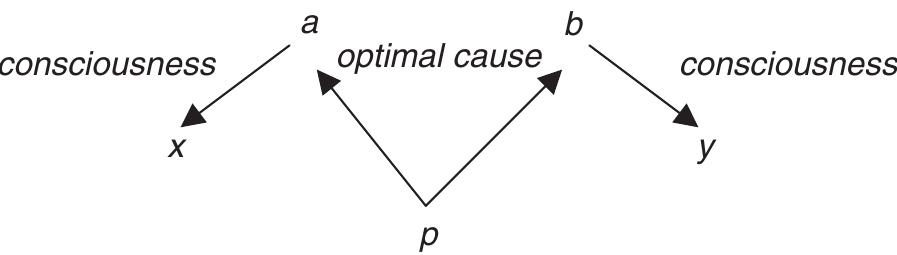
a b
consciousness optimal cause consciousness
x y
p
Fig. 2.2. The relational view and coincidental variation entail that the depicted situation
obtains in some coincidence cases.
On a non-relational view such as the identity theory, coincidental variation
is not puzzling. On such a view, the individuals’ having different experi-
ence simply consists in their being in different neural states. By contrast, the
combination of a relational view and coincidental variation creates a puzzle.
On this combination of views, two individuals can be conscious of different
external properties owing to internal or functional differences between them.
In other words, the consciousness relation is at once externally directed and
internally sensitive. Now I do not say that this is incoherent. On the contrary,
since we have good reasons to accept both the relational view and coincid-
ental variation, I believe that it is true. That it is not incoherent may be
brought out with an analogy. The relation x has mass-in-grams y is a relation
between objects and numbers which are ‘‘external’’ to objects, but what numbers
objects bear this relation to is sensitive to the ‘‘internal’’ mass properties of
those objects. Still, I admit that the combination of the relational view and
coincidental variation is puzzling. I will argue that the only solution to the
puzzle involves adopting a primitivist view of sensory consciousness according
to which the consciousness relation is a primitive relation that cannot be ana-
lyzed in terms of an individual’s physical or functional relations to the external
world.
The argument applies to any version of the relational view. It may seem that
the argument does not apply to disjunctivism because the disjunctivist has a
radically externalist view of consciousness that is inconsistent with coincidental
� A Simple View of Consciousness 37
variation. Elsewhere I attempt to show this is not the case: the argument applies
to disjunctivism as well.⁶ The disjunctivist can and indeed must accommodate
coincidental variation, and the only way they can do so is by adopting a primit-
ivist view of consciousness. However, as noted in the previous section, here I will
focus on how the argument plays out on the type of intentionalist view I favor.
3 . T H E S T RU C T U R E O F T H E A RG U M E N T
By primitivism about a property (or a relation, that is, a polyadic property)
I just mean the denial of reductionism. Reductionism about a property holds
that it is a complex property constructible from the fundamental physical and
functional properties of the world. Here I will use ‘physical property’ to mean
all and only such complex properties. So I understand reductionism broadly to
include the various forms of functionalism, even though others would consider
them to be non-reductionist views. And I understand primitivism about sensory
consciousness to be the strong claim that some properties or relations involved
in sensory consciousness are properties or relations over and above all those
constructible from the fundamental physical and functional properties of the
world. How do the relational view and coincidental variation create an argument
for primitivism about sensory consciousness? In the present section, I will indicate
the structure of the argument that I will be developing.
On a relational view, every episode of sensory consciousness has two compon-
ents: the consciousness relation and the complex of sensible properties to which
we bear this relation. In the history of philosophy perceptual variation has often
been used to draw conclusions about the nature of the sensible properties. By
contrast, I will use a unique type of perceptual variation, coincidental variation,
to draw a conclusion about the nature of the consciousness relation, namely that it
is primitive. I will set aside the second component of sensory consciousness, the
sensible properties that are relata of the consciousness relation. I will give to the
reductionist about sensory consciousness any view of the sensible properties they
wish: they might identify them with response-independent physical properties,
response-dependent physical properties, or primitive properties. My argument
will be entirely neutral on this issue.
The argument for primitivism about the consciousness relation will take the
form of a dilemma. We may divide all physical relations into two categories.
Our most promising reductive theories of the consciousness relation identify it
with a physical relation that the individuals in coincidence cases bear to the same
properties. For example, one such theory identifies the consciousness relation
with the optimal cause relation. I will call such physical relations A-type relations.
⁶ See section 12 of Pautz (2007b).
�38 A. Pautz
The idea is that the mind’s capacity to be conscious of the external items can
be explained in terms of a causal process from those items to minds. Indeed, it
is very difficult to see how else we might reductively explain the consciousness
relation. But, as we will see, there are also physical relations that the individuals
in coincidence cases bear to different properties. I will call such physical relations
B-type relations.
I will argue that there is principled reason to believe that the consciousness
relation cannot be an A-type or B-type relation. Since these exhaust all physical
relations, this will be an argument against reductionism and for primitivism.
The argument will unfold as follows. Previously, I argued for a relational view
of sensory consciousness and for coincidental variation. These two claims entail
that there is a consciousness relation with the following two properties:
Relationality In at least some cases, the consciousness relation holds between individuals
and external properties, for instance shapes, colors, pains felt in bodily regions, and tastes
felt in the tongue.
Variation The consciousness relation is such that some pairs of individuals in coincidence
cases bear it to different external properties.
These properties yield constraints on the reduction of the consciousness relation.
Evidently, they immediately entail that the consciousness relation is not an
A-type relation, thereby ruling out our most promising reductive theories of
this relation. Such relations satisfy the relationality constraint: they are relations
between individuals and external properties. But, by definition, they do not
satisfy the variation constraint. For instance, in at least some coincidence cases
two individuals bear the consciousness relation to different sensible properties, but
they bear the optimal cause relation to the very same property (see Figure 2.2).
So far, I have focused on the optimal cause relation. But I will generalize the
argument to other A-type relations. This will be the easy part of the argument.
The larger and more difficult part of the argument will involve showing that
the consciousness relation cannot be identified with a B-type relation. To rule out
B-type relations, the relationality constraint and the variation constraint will be
insufficient. By definition, B-type relations satisfy the variation constraint. And,
as we will see, some satisfy the relationality constraint as well. So we will have to
rely on considerations that have not yet been introduced. I will argue that these
relations are ruled out by two other properties of the consciousness relation:
Scrutability The consciousness relation is the subject of our talk and thought about
consciousness.
Extensionality The consciousness relation has a certain actual-world extension—individu-
als bear it to countless shapes, colors, and so on.
As we will see, B-type relations may be subdivided into two categories: those
defined in internal terms and those defined in functional terms. I will argue that
there is principled reason to think that B-type relations defined in internal terms
� A Simple View of Consciousness 39
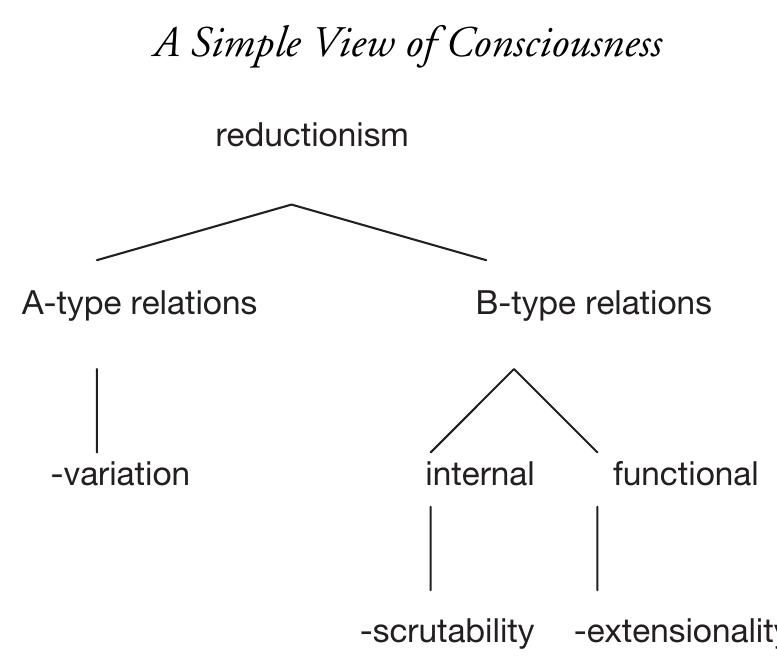
reductionism
A-type relations B-type relations
-variation internal functional
-scrutability -extensionality
Fig. 2.3. The structure of the variation argument against reductionism and for primitiv-
ism.
fail to satisfy the scrutability constraint and B-type relations defined in functional
terms fail to satisfy the extensionality constraint. So the complete structure of the
argument is represented in Figure 2.3.
Coincidental variation plays a key role in this argument. It rules out our
otherwise most promising theories of the consciousness relation, namely A-type
theories. For this reason I will call it the variation argument for primitivism.
4 . A - T Y PE R E L AT I O N S FA I L TO S AT I S F Y T H E
VA R I AT I O N C O N S T R A I N T
The most common reductions of the consciousness relation are A-type. The idea
is that sensible properties like colors, tastes, and pains are physical properties
that external objects and bodily regions actually possess. And the consciousness
relation is some A-type relation between individuals and such properties. Here are
several A-type relations that the consciousness relation might be identified with:
The optimal cause relation: x is in an internal state that plays the e-role and that would be
caused by the instantiation of external property y were optimal conditions to obtain.
The indication relation: x is in an internal state plays the e-role and that has the biological
function of indicating external property y.
The asymmetric relation: x is in an internal state that plays the e-role and whose tokening
asymmetrically depends on the instantiation of y.
The input–output relation: x is in an internal state that plays the e-role and that under
optimal conditions tracks the instantiation of y and that in turn enables x to distinguish
objects that have y from objects that do not.⁷
⁷ For these relations, see, respectively, Tye (2000), Dretske (1995), Fodor (1990), and Armstrong
(1968).
�40 A. Pautz
Actual forms of variation are not a problem for these theories. Consider a case
of standard variation. On viewing a chip, John and Jane bear the consciousness
relation to different color properties, namely unitary blue and green-blue, owing
to internal differences. But, as we saw in section 2, it might be said that John and
Jane also bear the optimal cause relation to different but overlapping reflectance
properties r and r ! of the chip. Likewise for the other A-type relations on the
list. This would mean that this case is not a coincidence case in my sense. And
it would mean that the case is not a problem for the view that the consciousness
relation is the optimal cause relation. The optimal cause theorist could say that
the consciousness relation is the optimal cause relation, that r is unitary blue, and
that r ! is green-blue. This entails that the chip is unitary blue and green-blue, and
that John is conscious of the first color while Jane is conscious of the second color.
In general, the combination of the relational view and actual cases of standard
variation is not problematic because it can be said that what is going on is that
every object has a set of multiple colors, and on viewing the objects different
individuals bear the optimal cause relation to colors in the set.⁸ The same strategy
applies to interspecies variation and indeed all actual forms of variation in color
experience. On this view, colors are response-independent properties, and objects
have many of them. So this is a kind of color pluralism.⁹ One could imagine
similar views of taste and pain.
By contrast, the relational view and hypothetical coincidence cases create
a decisive argument against A-type theories. This argument is just the two
stage argument for coincidental variation presented in section 2. The first stage
established the physical possibility of coincidence cases: there are possible coincidence
cases in which two individuals bear the optimal cause relation to exactly the same
properties, but vary profoundly in internal neural processing and behavior. The
idea is that, even though objects and bodily regions have multiple properties,
the individuals in these cases bear the optimal cause relation to the very same
properties of those objects or bodily regions. A moment’s reflection will reveal
⁸ See Pautz (MSb). This is how the intentionalist who accepts the optimal cause theory can solve
Johnston’s (MS, chapter 5) selection problem.
⁹ For color pluralism about interspecies variation cases, see Byrne and Hilbert (2003) and Tye
and Bradley (2001). For color pluralism about standard variation cases such as John and Jane,
see Byrne and Hilbert (1997: 273) and Tye (2000: 91). It should be noted that, while these
philosophers continue to accept color pluralism in cases of interspecies variation, they now reject it
in cases of standard variation: they now maintain that different minimal colors within human color
space are incompatible, so that in these case at least one individual must get it wrong. Pautz (MSb)
argues these philosophers would do better to accept color pluralism in both cases, as they once did.
For, as we have seen, in both cases color pluralism follows from the optimal cause theory; indeed,
it follows from all available reductive theories of our consciousness of colors. But, as I am about to
explain in the text, color pluralism does not help the reductionist about the consciousness relation
when it comes to hypothetical coincidence cases. For in these cases, even if objects have many colors,
the individuals involved bear A-type physical relations to exactly the same colors of objects, yet it
is reasonable to suppose that they bear the consciousness relation to different ostensible colors of
those objects.
� A Simple View of Consciousness 41
that the individuals also bear the other A-type relations listed above to the
same properties. The first stage of the argument should be uncontroversial. The
second stage argued for coincidental variation: in view of the profound neural and
behavioral differences, the most reasonable view is that in at least one such case
the individuals involved have different experiences and so bear the consciousness
relation to different properties. The most reasonable view, then, is that the
consciousness relation is not identical with the optimal cause relation or any of
the other A-type relations on the list (see Figure 2.2). This is an argument against
A-type theories that does not rely on the mere intuition that phenomenology
could vary independently of A-type relations.¹⁰
It might be objected that the optimal cause relation and the other relations
on the list are vaguely specified. Maybe, then, there is some precisification
of the optimal cause relation or one of the other relations on the list that is
not vulnerable to the argument. In response, what we have here is a general
¹⁰ Kalderon (2007) has taken up the view that Byrne and Hilbert (1997, 2003) and Tye (2000)
once accepted (see the previous note): color pluralism in cases of both interspecies variation and
standard variation. He also accepts selectionism, which is a view concerning what determines what
colors of objects we are conscious of. He writes that ‘the relation between object, perceiver, and
circumstances of perception . . . determines the perceptual availability of [one of the many colors of
an object]’ (2007: 577). Later he says that the determination proceeds by way of something about
color similarity: ‘given the nature of Norm’s visual system, Norm’s visual system selects certain
relations as relations in color similarity and, hence, which colors are perceptually available to Norm’
(2007: 593). The selectionist component of Kalderon’s view is difficult to understand, but I think
that coincidence cases may create a problem for it. What is it to select a relation as a relation of
color similarity? And how precisely does the visual system determine what colors are perceptually
available by determining what relations are relations of color similarity? In the first quote, Kalderon
speaks of a relation between the object and the perceiver as determining what color of the object the
perceiver is conscious of, but does not specify what this relation is. On one natural interpretation of
selectionism, the relevant relation is a causal relation: the mechanism of selection is causation. Then
selectionism is very similar to Tye’s optimal cause theory. Humans and pigeons are conscious of
different colors of the same objects because, owing to their different receptor systems, their visual
systems are causally sensitive to different colors of those objects. The pigeons but not the humans
are causally sensitive to ultraviolet light ( Tye and Bradley 2001). The optimal cause theory entails
a similar story about cases of standard variation such as John and Jane, as I explained in the text.
(In the previous note, I explained that Tye previously accepted such a parallel pluralist view of
standard variation, but that he now rejects it in favor of an inegalitarian view, even though this seems
inconsistent with his optimal cause theory.) But if selectionism is explained in terms of causation
(and it is hard to see how else it might be explained), so that it is like the optimal cause theory,
then it is also refuted by coincidence cases, in which two individuals are relevantly causally related
to exactly the same color properties of objects and relations among objects, but it is nevertheless
reasonable to hold that they bear the consciousness relation to different ostensible color properties
of those objects. Of course, the two views endorsed by Kalderon are separable. One could accept
a pluralist response-independent view of color and reject a selectionist view of color-consciousness
(if such an account is indeed inconsistent with coincidental variation). Instead, one could combine
color pluralism with a broadly internalist view of color consciousness. By a broadly internalist view, I
mean one that entails that, on viewing the same objects, Maxwell and Mabel bear the consciousness
relation to different colors owing to internal differences, even though their visual systems respond
to the same chromatic properties of those objects. (As noted in section 2, such an account is not
committed to pure internalism.) But I believe that, once we accept a more internalist view of
color-consciousness, an epistemic problem arises for the pluralist response-independent view (see
note 21).
�42 A. Pautz
recipe for refuting the view that the consciousness relation can be identified
with any relation of this kind. Let r be any physical relation within the general
ballpark of the relations listed above. There will always be a class of possible
cases in which two individuals bear r to the same external properties, but differ
profoundly in neural processing and functional organization. The claim that the
individuals in at least one of these cases have different experiences and so bear the
consciousness relation to different properties will always be more plausible than
the philosophical theory that the consciousness relation is identical with r.¹¹
5. ARE THE CASES POSSIBLE?
Responding to an earlier presentation of this argument directed specifically against
the optimal cause theory, some commentators have objected that coincidence
cases are impossible.¹² Presumably, they do not mean to reject the physical possibility
of coincidence cases: that there are possible cases in which two individuals track
the same properties under optimal conditions while differing profoundly in
internal processing and functional organization. As we saw in the first stage of the
argument of §2, this claim ought to be uncontroversial. On the only reasonable
¹¹ Lycan (2000), who says he tends to accept the present argument against the optimal cause
theory, helpfully made the suggestion of presenting the argument in this way: the argument is that
the claim of coincidental variation that in at least some coincidence cases the individuals involved
have different experiences is more plausible than any philosophical theory, such as the optimal cause
theory, which delivers the contrary verdict.
¹² The earlier presentation is Pautz (2006; see also Pautz (2003) and the commentators are
Byrne and Tye (2006). Byrne and Tye raise four further objections to the earlier presentation of
the argument, the first two of which rely on misunderstandings. First, in the earlier presentation, I
introduced the thesis of Dependence and said that it has the consequence that in coincidence cases
the individuals involved have different experiences. Byrne and Tye consider two interpretations of
Dependence and argue that on neither does it have this consequence. My reply is that neither of
these interpretations is correct. On the correct interpretation, Dependence is equivalent to the thesis
that in coincidence cases the individuals involved have different experiences, so that the entailment
is trivial (Pautz 2006: 207). Here I have used the more appropriate title of coincidental variation
for this thesis, and I have offered a different, two-stage formulation of my argument for this thesis
and against A-type theories such as the optimal cause theory. Second, Byrne and Tye object that
the failure of existing A-type theories would not show that externalism about phenomenology is
false and internalism is true because externalism is not committed to any particular reductive theory
(2006: 251). This objection, too, relies on a misunderstanding, because in the earlier presentation
of the argument I did not take myself to have shown that externalism is false and internalism is
true, but only that all of the versions of externalism I considered in the paper are false (2006: 228).
Given my language in the earlier presentation, the misunderstanding was natural. I now call these
theories A-type theories to remove the impression that my target is externalism in general. In fact, in
my (2006) and in the present chapter, I take no stand on the issue of externalism versus internalism
(see section 2 of the present chapter). Third, Byrne and Tye (2006: 252) point out that A-type
theories are often vague, which makes it unclear whether they are refuted by coincidental variation. I
addressed this objection at the end of section 4 in the present chapter. Fourth, Byrne and Tye argue
that the failure of every existing reductive theory of the consciousness relation would not show that
reductionism fails (2006: 252). In other words, we could take the view that the correct reductive
theory is unknown. I call this view mysterian reductionism and argue against it in section 11.
� A Simple View of Consciousness 43
interpretation, they are rejecting coincidental variation. In other words, they are
rejecting the further claim argued for in the second stage of the argument that in
some of these cases an additional phenomenal condition obtains: the individuals
involved bear the consciousness relation to different sensible properties. If they
are right in rejecting this claim, then of course my argument fails. Their rejection
of coincidental variation requires their acceptance of the radical view that in every
coincidence case the individuals involved bear the consciousness relation to the
same sensible properties in spite of the profound neural and functional differences
between them. (I ignore the view that the individuals are not conscious of any
sensible properties at all.)
Of course this radical view follows from the philosophical theory that the
consciousness relation is the optimal cause relation, but one would like a non-
question-begging argument for it. The argument seems to be as follows. If, for
instance, Mabel and Maxwell bear the consciousness relation to different color
properties on viewing the fruit, then at least one of them must be conscious of
a color that the fruit does not have, because such color properties are mutually
exclusive. But this is incompatible with the condition that they track the same
external properties under optimal conditions. According to the objection, contrary
to coincidental variation, the only verdict compatible with this condition is that
they bear the consciousness relation to the very same color and so have the same
color experience. This is so despite the fact that there are profound differences
between them in opponent processing and color-related behavior. So this is the
verdict we should accept. Call this the argument from error against phenomenal
variation in coincidence cases.
Now, since coincidental variation (and hence my argument against the optimal
cause theory) only requires phenomenal variation in one coincidence case, the
argument from error against coincidental variation is successful only if it is
general. For instance, it must also be assumed that, if Yuck and Yum bear the
consciousness relation to different tastes on tasting the same food, one must be
wrong about the food’s true taste, so that this verdict is inconsistent with the
optimality condition. In that case, as against coincidental variation, we must
accept the implausible verdict that they are conscious of the same taste, in spite
of the radical neural and behavioral differences between them.
One problem with the argument from error against coincidental variation is
the implausibility of its key assumption that phenomenal variation in these cases
requires error. Those who provide pluralistic theories of color would deny this
in the case of color vision. Indeed, as I explained in section 4, I think that the
optimal cause theorists themselves should deny that variation requires error in
cases such as John and Jane. For my part, I hold that phenomenal variation
requires error in the case of color vision because I accept a general color exclusion
principle. Indeed I accept a projectivist theory of color according to which all
color experience involves error. But I reject the assumption in the cases of taste
and pain. Here the assumption is very implausible. Why couldn’t individuals
�44 A. Pautz
from different communities have different taste or pain experiences in response
to the same stimulus, and yet both have true beliefs about the tastes of things in
their communities or about the pains they feel in their bodies? So the argument
from error against coincidental variation cannot succeed because the assumption
that phenomenal variation entails error does not hold in general.
But I think that there is a more basic problem with the argument from error
that applies even if the assumption is granted. The problem is that the optimality
condition and error are incompatible only if optimal conditions are defined as
conditions in which there is no error, that is, in which individuals are conscious of
properties that objects actually have. But, since the defender of the optimal cause
theory is attempting a reduction of this intentional relation, they cannot define
optimal conditions in terms of notions such as error which are explained in terms
of that very relation. Instead, they must define optimal conditions in terms notions
such as adaptive fitness, design, and so on.¹³ So even if we grant the implausible
assumption that phenomenal variation would in every case entail error on the part
of one of the parties involved, there is no reason to think that it is inconsistent
with their tracking the same properties under optimal conditions. Indeed, we can
imagine many possible cases of adaptive error. So why cannot coincidence cases
be cases of this kind? Of course, if the optimal cause theory were correct, there
could not be cases of this kind, for it is a kind of verificationist theory of sensory
content according to which tracking under optimal conditions is inconsistent
with error. But I am offering an argument against this theory. In view of the
arguments offered in section 2, the claim that there is phenomenal variation in at
least some coincidence cases is the most reasonable one to make, even if it means
that at least one of the individuals is in error. It is much more reasonable than the
alternative view that in all such cases the individuals involved have the very same
experiences in spite of the radical neural and functional differences between them.
So the original argument succeeds. The individuals in coincidence cases bear
the optimal cause relation and the other A-type relations to the same properties.
But, in view of the profound internal and functional differences between them,
the most reasonable view is that some such individuals have different experiences
and so bear the consciousness relation to different properties. So the consciousness
relation cannot be identical with the optimal cause relation or any other A-type
relation.
6 . N O B - T Y PE R E L AT I O N S AT I S F I E S T H E OT H E R
C O N S T R A I N TS
This brings us to B-type relations. The individuals in coincidence cases bear such
relations to different properties. So such relations satisfy the variation constraint
¹³ For this point, see also Chalmers (2005).
� A Simple View of Consciousness 45
on the reduction of the consciousness relation. This means we need another
argument to rule out B-type relations.
As I already mentioned, my argument is that B-type relations either fail to
satisfy the scrutability constraint or the extensionality constraint. The individuals
in coincidence cases differ only in two respects. First, they differ internally, in
particular in neural processing. Second, they differ functionally, in particular in
how their internal states guide their behaviors. So B-type relations fall into two
categories. The first category contains B-type relations defined in internal terms
and the second category contains B-type relations defined in functional terms.
I will provide general reasons to think that B-type relations belonging to the
first category fail to satisfy the scrutability constraint and those belonging to the
second fail to satisfy the extensionality constraint (see again Figure 2.3).
7 . R E L AT I O N S D E F I N E D I N T E R N A L LY
The view that the consciousness relation can be identified with such a relation
is very unpromising and to my knowledge no one has advocated such a view.
But we must get the view out of the way before considering the view that the
consciousness relation can be defined functionally.
An initial hurdle is to see how a relation defined in internal terms might satisfy
the relationality constraint. Consider:
The brain state relation: x is in a brain state that plays the e-role and that has internal
neural property y.
The problem with this relation is the reverse of the problem with A-type relations.
It satisfies the variation constraint and hence is a B-type relation. But it fails
to satisfy the relationality constraint. The semantic, introspective and epistemic
arguments mentioned in section 1 show that to have an experience with a certain
phenomenal character is to stand in a relation to shapes, colors, pains felt in
bodily regions, tastes felt in the tongue, and so on. These properties are not all
neural properties instantiated in the brain. If they are instantiated at all, they are
instantiated by external objects or bodily regions, not by parts of the brain. So the
consciousness relation at least sometimes holds between individuals and external
properties. By contrast, the brain state relation never holds between individuals
and external properties; it always holds between individuals and neural properties
of their own brains. So the consciousness relation is distinct from the brain state
relation.¹⁴
¹⁴ Alex Byrne proposed in discussion that the optimal cause theorist could handle the cases of
Yuck and Yum and Mild and Severe by claiming that these individuals bear the optimal cause
relation and hence the consciousness relation to different neural properties instantiated by their
own brains. The trouble is that, like the brain state view, this proposal violates the relationality
constraint, because it entails that the phenomenology of experience is always constituted by the
�46 A. Pautz
To obtain a relation that satisfies both the relationality constraint and the
variation constraint, the reductionist needs an algorithm that goes from internal
states to external properties and that is sensitive to the internal or functional
properties of those states. We are now after an algorithm that is sensitive to the
internal properties of those states. I do not suppose that the algorithm must be
specifiable in some relatively compact way. But I do require that it satisfies all
four constraints on the reduction of the consciousness relation.
The reductionist might rely on the analogy with the mass-in-grams relation
mentioned at the end of section 2. It is a relation between objects and numbers
which are ‘external’ to objects, and yet it is sensitive to the ‘internal’ mass
properties of objects. And it can be defined in terms of a kind of structural
isomorphism between masses and numbers. Likewise, the reductionist might
claim that there are structural isomorphisms between our internal states and the
external properties we are conscious of, and claim that the consciousness relation
is definable in terms of these isomorphisms. As noted in section 2, neuroscience
has revealed a very modest relationship between the activity of R-G and Y-B
neurons in the lateral geniculate nucleus and the degree to which the colors we
are conscious of are reddish, greenish, yellowish and bluish. And there appears to
be a linear relationship between neural discharge frequencies of neurons in the
primary somatosensory cortex and the intensity of the pains we are conscious of.
Now, presumably, there are infinitely many or at least very many possible but
non-actual sense modalities, and corresponding to each of them there might be
a different algorithm of this kind. We could truly say of any creature possessing
such an alien sense-modality that it is conscious of properties that we are not
conscious of. This leads to the idea that the consciousness relation might be
identified with:
The infinitely disjunctive relation: x is in a color state c and f (c) = y or x in is in a pain
state p and g(p) = y or x is in some alien state a and h(a) = y or x is in some alien brain
state a! and i(a! ) = y or . . . and so on for every possible sense-modality.
However, there are a few reasons to doubt that there are any such modality-
specific algorithms as f, g, h, i, . . . First, neuroscience has only revealed a very
imperfect relationship between the activity of R-G and Y-B neurons in the lateral
geniculate nucleus and the degree to which the colors we are conscious of are
reddish, greenish, yellowish and bluish. Some hold that the discrepancies are
corrected further downstream, but there is no evidence of this. If anything, it
is more confusing as we move to the cortex. Second, sensible properties are not
consciousness of internal rather than external properties. So it is inconsistent with the arguments for
accepting a relational view such as intentionalism mentioned in section 1: the semantic argument,
the phenomenological argument, and the epistemic argument. The proposal is especially implausible
in other cases. For instance, it would be very implausible to suggest that colors are neural properties
and Mabel and Maxwell have different color experiences because they bear the optimal cause relation
and hence the consciousness relation to different neural properties of their own brains.
� A Simple View of Consciousness 47
easily quantifiable, so it is difficult to believe that there might be algorithms
concerning them. Think of tastes and sounds, for instance. Third, we are not
merely conscious of sensible properties; we are conscious of property-structures in
which properties are presented at various locations. So the relevant algorithms
would have to go from intrinsic neural properties to spatially arrayed property-
structures. But it is very hard to imagine such algorithms. In humans, there is
topographical mapping, but it is much too rough to provide such an algorithm.
The absence of algorithms would obviously not be inconsistent with my claim
in section 2 that internal factors explain some aspects of phenomenology, so that
internal differences, when accompanied by functional differences, are evidence of
phenomenal differences. Here I take no stand on whether or not there are such
algorithms.
If it should turn out that there are no algorithms, then the reductionist who
hankers after an internal definition of the consciousness relation has no choice
but to define the conscious relation in terms of an infinitely long list:
The infinitely disjunctive relation II: x is in total internal state b1 and y = property structure
s1 or x is in total internal state b2 and y = property structure s2 or . . ., and so on for every
possible property-structure.
So now we have before us two infinitely disjunctive relations. Evidently there
are relations of this kind which satisfy the relationality constraint, the variation
constraint and the extensionality constraint. When individuals are in different
internal states b1 and b2 , they bear this relation to different property structures
s1 and s2 , which might involve different external color, taste, or pain properties.
Could the consciousness relation be identical with either of these relations?
The problem is that these relations do not satisfy the scrutability constraint. There
are many infinitely disjunctive relations r1 , r2 , r3 , . . . with different extensions.
For instance, consider the brain state b! of a creature, Blurg, we have never before
encountered. These different infinitely disjunctive relations r1 , r2 , r3 , . . . map b!
onto different sensible properties. The problem is that none of the infinitely
disjunctive relations r1 , r2 , r3 , . . . could be the semantic value of our predicate x
is conscious of y. This follows from a theory that the semantic value of a predicate
is the most natural property or relation that fits our use of the predicate.¹⁵ For all
of these relations r1 , r2 , r3 , . . . fit actual use, and they are equally natural because
they share the same very low degree of naturalness. What could make it the
case that the semantic value of x is conscious of y is one of these relations to the
exclusion of the others? Indeed, none of these relations is a relation we could think
about. By contrast, the consciousness relation is evidently the semantic value of
x is conscious of y. And it is a relation we can think about. So the consciousness
relation cannot be identical with any one of these infinitely disjunctive relations.
Nor would it do to say that x is conscious of y indeterminately refers to all of these
¹⁵ This is an oversimplified version of Lewis (1983a).
�48 A. Pautz
relations, so that there are no determinate truths about what properties Blurg is
conscious of. There are such truths, even if we do not know what they are.
At this point, the reductionist seeking a definition of the consciousness relation
in internal terms might appeal to a trick in order to avoid infinitely disjunctive
relations. In particular, he or she might adopt a kind of global response-dependent
theory according to which the sensible properties one and all are relational, dispos-
itional properties of the form normally causes internal state s. If the external prop-
erties we are conscious of are relational properties whose relata are internal states,
then it is easy to specify an algorithm going from internal states to such properties.
In particular, the consciousness relation might simply be identified with:
The manifestation relation: x is in internal state s that plays the e-role and y = the property
of normally causing s.
In other words, the idea is that we can simply say that a person is conscious
of such a sensible disposition just in case they are in the internal state which is
the manifestation of that sensible disposition. On this view, when Mabel is in u
and Maxwell in b, Mabel bears the manifestation relation to normally causing u
and Maxwell bears the manifestation relation to normally causing b. The colors
they are conscious of are identical with these relational, dispositional properties.
Likewise for Yuck and Yum and Mild and Severe. So this is a B-type relation
that satisfies the variation constraint. Further, one might think that it could be
the semantic value of x is conscious of y and hence could satisfy the scrutability
constraint, on the grounds that it is the most natural relation that fits our use of
this expression.
The problem is that this relation does not satisfy the extensionality constraint.
As noted at the end of section 1, it is a fact about the actual extension of
the consciousness relation that not all the properties we are conscious of are
response-dependent properties of the form normally causes internal state s. For
instance, having an experience with a certain character is enough to ground the
capacity to have thoughts involving shapes. And shapes are not properties of this
form, since it is obvious that objects might have shapes while entirely lacking
such properties. For instance, objects might have had shapes, even if creatures
with internal states had never evolved. And, in the actual world, objects that are
too small to have an effect on perceivers have shapes but lack properties of this
form. So this trick fails and the original conclusion stands.
Therefore there is a principled reason to think that relations defined in internal
terms are bound to fail to satisfy the scrutability constraint. The reason is that
there is an abundance of equally natural infinitely disjunctive algorithms going
from the internal properties of an individual to external properties.
There is another potential problem with the view that the conscious relation
is definable in internal terms. Those with functionalist intuitions will say that
the idea that our internal neural properties alone determine what properties
we are conscious of is somewhat implausible. Consider a twist on the case of
� A Simple View of Consciousness 49
Mild and Severe. Two species are hardwired so that the same rate of firing
among somatosensory neurons produces in them radically different pain-related
behavior, and in general plays quite different functional roles in them. Theories
according to which the consciousness relation is definable in purely internal
terms entail that they are conscious of the same pain. Or consider a brain in a
vat belonging to no actual species with no sense organs or motor-output system,
and so without even the potential to act on the world. Theories according to
which the consciousness relation is definable in purely internal terms entail that
the brain in a vat has a vivid inner life. Or imagine some somatosensory neurons
firing in a Petri dish, completely functionally isolated. Some (but not all) theories
according to which the consciousness relation is definable in internal terms
might entail that the Petri dish is conscious of pain properties! Reductionists with
functionalist tendencies will reject such theories and adopt a theory according to
which the consciousness relation is defined at least in part in functional terms.
Whereas the problem with relations defined in internal terms was that they
fail to satisfy the scrutability constraint, the chief problem with relations defined
in functional terms will be that they fail to satisfy the extensionality constraint. I
will consider the consumer relation and the interpretation relation.
8 . R E L AT I O N S D E F I N E D F U N C T I O N A L LY: T H E
C O N S U M E R R E L AT I O N
On the consumer theory, the consciousness relation is identical with:
The consumer relation: x is in an inner state s that plays the e-role and that represents
property y, where s represents a property y iff, in the past, when an object was present with
property y, and the consumer devices used s to perform output behaviors a, b, c, . . . these
behaviors frequently had advantageous results because an object with property y was
present, so that now individuals have consumer devices that might use s to perform
a, b, c,. . .¹⁶
This relation is defined in functional terms inasmuch as it appeals to how our
internal states are used to guide behavior. Unlike many of the A-type theories we
have considered, it is not an entirely input-based theory.
The stock illustration of this theory is the frog. A frog state b is caused by flies
and causes tongue-darting. On the consumer theory, it does not represent the
property of being a black dot. The instantiation of this property does not enter
¹⁶ See Millikan (1989) for a consumer theory of intentional relations in general. Lycan (2006)
says that the consumer theory is likely to deliver the correct verdict that in coincidence cases the
individuals are conscious of different properties. Against this, in what follows I argue that the
consumer theory does not deliver correct verdicts in coincidence cases. I should mention that Lycan
does not go so far as to defend the consumer theory. Instead, he appears to endorse what I will call
in section 12 mysterian reductionism.
�50 A. Pautz
into an explanation of why tongue-darting was beneficial in the past. Rather,
it represents the response-dependent, biologically significant property of being
frog-food. It is this property which enters into the explanation.
The evaluation of the consumer theory is complicated by the fact it is very
difficult to see what types of properties individuals bear the consumer relation
to in more complex cases, in particular in coincidence cases. There are two
interpretations. On the first, the consumer relation fails to satisfy the variation
constraint. On the second, it fails to satisfy both the variation constraint and the
extensionality constraint.
On the first interpretation, the individuals in coincidence cases bear the
consumer relation to the same response-independent physical properties, that
is, the same reflectance properties, chemical properties, and bodily disturbance
properties. The idea is that, although they exhibit different behavioral patterns,
the same external properties enter into the explanation of the evolution of those
behavioral patterns.
This interpretation is arguably incorrect. For instance, Mabel is in u and
Maxwell is in b. By contrast to the frog’s internal state, in the past, these states
were used to perform a great variety of behaviors, such as picking out a fruit,
finding a mate, avoiding a predator, and so on. Intuitively, on none of these
occasions was the behavior advantageous because the presented food or individual
had reflectance property r. This is simply not a true because-statement. Maybe r
is correlated with properties that enter into true because-statements, such as being
healthy food, being a potential mate, being a predator. But r itself does not enter
into such a true because-statement. The same problem applies in the cases of
Yuck and Yum and Mild and Severe.
Nevertheless, suppose this interpretation is correct for the sake of argument.
Then the consumer relation is just another A-type relation which fails to satisfy
the variation constraint. On this interpretation the individuals in coincidence
cases bear the consumer relation to the same response-independent physical
properties, just as they bear the optimal cause relation to the same response-
independent physical properties. But the most reasonable view is that in at least
some coincidence cases the individuals involved bear the consciousness relation
to different properties. So on this interpretation the consciousness relation is not
identical with the consumer relation.
On a second interpretation, on tasting the foodstuff, Yuck bears the consumer
relation to the response-dependent property being poisonous to his kind and
Yum bears it to the response-dependent property being healthy to his kind. The
consumer theorist might say that these properties just are the different taste
properties they are conscious of. Then, in this case at least, the consumer relation
satisfies the variation constraint.¹⁷
¹⁷ The suggestion that the different properties Yuck and Yum are conscious of are properties of
this sort was made by Andy Egan in discussion.
� A Simple View of Consciousness 51
This interpretation is more plausible than the first. Intuitively, it is these
biologically significant properties which explain why in the past avoidance-
behavior was advantageous to members of Yuck’s species and why pro-behavior
was advantageous to members of Yum’s species. And this interpretation is in
better accord than the first with what consumer theorists say about the frog. The
frog does not represent the response-dependent property being a black dot that
his visual system tracks, but the untracked response-dependent property being
food for frogs which enters into the explanation of the relevant behavioral pattern.
But under the second interpretation the consumer relation fails to satisfy
the variation constraint in cases other than Yuck and Yum. For instance, what
different coarse-grained response-dependent properties do Mabel and Maxwell
bear the consumer relation to as they view the fruit? Indeed, they arguably do
not bear the consumer relation to any properties at all. As noted above, in the
past, u and b were used to produce a variety of behaviors. And a variety of
different properties explained why these different behaviors were advantageous.
There is no single property which frequently explained why these behaviors were
advantageous. So in this case there is no property which satisfies the consumer
theorist’s formula.
Consider next Mild and Severe. What different properties do they bear the
consumer relation to? Being a dangerous case of bodily damage and being an
even more dangerous case of bodily damage? These do not seem to be very good
candidates for the different properties they are conscious of.
Finally, consider adaptively neutral coincidence cases. It is obvious that a
creature’s internal processing and overall functional organization are not rigidly
determined by selection pressures. So we can imagine cases in which two creatures
respond to the same external properties, and are under roughly the same selection
pressures, but in which they evolved different internal processing and functional
organizations by chance. In these cases, the same objects have the same coarse-
grained, biologically significant properties with respect to the two creatures.
On the second interpretation, then, the individuals involved cannot bear the
consumer relation to different such properties. But the most plausible view is
that they bear the consciousness relation to different properties.¹⁸
Another problem with the consumer relation under the second interpretation
is that it fails to satisfy the extensionality constraint. To see this, suppose as
before that Yuck tastes a foodstuff with chemical property c and undergoes
across-fiber pattern d . But now suppose that Yuck takes another taste of the
foodstuff, this time from a different part of the same foodstuff which has a
slightly different chemical property c.! We might suppose that c is the property
of having a certain concentration of a certain type of molecule and that c !
is the property of having a slightly greater concentration of the same type of
¹⁸ For an adaptively neutral coincidence case involving color vision, see Pautz (2003) and Pautz
(2006).
�52 A. Pautz
molecule. As a result, Yuck now undergoes slightly different across-fiber pattern
d ,! and withdraws from the foodstuff even more violently than before. On the
second interpretation, in each case Yuck bears the consumer relation to the same
coarse-grained response-dependent property, namely being poisonous to his kind.
But, in view of his different internal processing and behavior, the best view is that
on the different occasions he bears the consciousness relation to slightly different
taste properties, the second more displeasing than the first. There are actual cases
of this kind. For instance, on the second interpretation, when a bird takes two
bites of a poisonous dart frog and gets a greater concentration of batrachotoxin
on taking the second bite, the bird bears the consumer relation to the same
property being poisonous to its kind on both occasions, but arguably bears the
consciousness relation to slightly different tastes.
It may be said that there is a third interpretation of the consumer theory.
On this interpretation, individuals bear the consumer relation to fine-grained
response-dependent properties. For instance, in the case just mentioned, on
the different occasions, Yuck bears the consumer relation to the property of
normally causing across-fiber pattern d and then the property of normally
causing across fiber pattern d .! So on this interpretation the consumer relation
might satisfy the extensionality constraint. But this interpretation cannot be
correct. Consider the case of color vision. Previously, I argued that no external
properties satisfy the consumer theorist’s formula in the case of color vision,
because there are no properties that frequently explained the advantageousness of
the many behaviors we used the color vision system to perform in our evolutionary
past. If so, then on viewing objects individuals bear the consciousness relation
to a myriad of colors, but there are no properties at all that they bear the
consumer relation to. In particular, they do not bear the consumer relation
to such fine-grained response-dependent properties as the property of normally
causing opponent channel state u or the property of normally causing opponent
channel state b. Or consider the case of Yuck again. Here again the interpretation
fails. In the past, d was used by members of Yuck’s kind to avoid the relevant
foodstuff. But this behavior was never advantageous because the foodstuff had
the property of normally causing that very brain state, d .! There is simply no
sense in which this is a true because-statement. If anything, it was advantageous
because it had the property of being poisonous to Yuck’s kind. Therefore, when
he undergoes across-fiber pattern d Yuck certainly does not bear the consumer
relation to the property of normally causing that very brain state, d . If Yuck
bears the consumer relation to any property, it is the property of being poisonous
to Yuck’s kind, as on the second interpretation. But, as we have seen, on this
interpretation, the consciousness relation cannot be identified with the consumer
relation, for the reasons explained previously.¹⁹
¹⁹ The success theory of Papineau (1993) has some similarities to the consumer theory. In the
case of the belief relation, it holds that A has a belief according to which state s obtains just in case s is
� A Simple View of Consciousness 53
9 . R E L AT I O N S D E F I N E D F U N C T I O N A L LY: T H E
I N T E R P R E TAT I O N R E L AT I O N
On the interpretation theory, the consciousness relation is identical with:
The interpretation relation: x is in internal state s and the best interpretation of the members
of k (where k is the kind or species to which x belongs) assigns to s the experience of
y, where the best interpretation of the members of k is the one that best satisfies the
constraints on interpretation, given the functional roles of their internal states.²⁰
This needs to be unpacked. Functional roles are second-order properties of
internal states to do with their interactions with the external world, their inter-
actions with other inner states, and their interactions with behavior. Constraints
on interpretation are principles taken from our common sense theory of persons
about how mental states change as a result of evidence from the external world,
and how they combine to produce behavior. They include the following general
principles. Rationalization: assign beliefs, desires and other mental states so as to
rationalize behavior. Humanity: assign beliefs that are reasonable on the evidence,
and desires that reflect sane values. Eligibility: all else equal, assignments are to
be preferred that assign contents involving natural properties. Roughly, the best
interpretation is the assignment of mental states—beliefs, desires, and experi-
ences—to the internal states of members of k which best satisfies the constraints
on interpretation, given the functional roles of those states.
I have formulated the interpretation theory in a way that requires a unique
best interpretation. The interpretationist might instead claim that there might
be several interpretations that are tied for best. But I will continue to assume a
formulation in terms of a unique best interpretation. Afterwards we will see that
the problems I will raise apply even if we allow for multiple best interpretations.
In coincidence cases, the individuals involved exhibit radically different color-
related, taste-related and pain-related behaviors on the output side. So they differ
functionally on the output side. This will mean that, if there are such things
as best interpretations of them, they will assign to their brain states experiences
of quite different external color properties, taste properties, and pain properties,
despite the fact that they track the same properties on the input-side. Whether
the state of the world which would guarantee that A’s belief, in combination with different desires,
would lead to actions that satisfy those desires. But the theory does not apply to the consciousness
relation. When a person is conscious of a shade of orange, he or she has no desires that are so
specific that their satisfaction requires that the viewed object instantiate that very shade of orange.
Even if he or she did—for instance, even if he or she had the desire to have an object with that
very color —its content would derive from the content of his or her experience. So, one could
not without circularity explain the fine-grained content of his or her experience in terms of the
fine-grained content of such a desire.
²⁰ See Lewis (1983b).
�54 A. Pautz
these properties are response-dependent properties, primitive properties, or
whatever, need not concern us. So it might be thought that the interpretation
relation satisfies both the relationality constraint and the variation constraint.
But there are four problems. The first is familiar. Let unique functional role be
the claim that, for every different possible experience, there is a unique functional
role that belongs to it necessarily. There are reasons to think that this is false. Two
individuals might have different experiences that have the same functional roles.
For instance, there might be functionally identical individuals with different
color experiences, as in spectrum inversion. Or there might be two simple
creatures who have different pain experiences, but who are so wired that their
pain experiences play exactly the same input–output functional role. Since the
detail in sensory experience is so vast (think of listening to music, for example), it
seems easy to imagine other cases of phenomenal differences between individuals
without even potential functional differences. Even if functional role contributes
to determining what properties we are conscious of, it is not the whole story.
Internal factors play a role as well. But if unique functional role is false and such
cases are possible, then the consciousness relation cannot be the interpretation
relation. For, since the best interpretation of a population of individuals is only
sensitive to the functional roles of their states, the best interpretations of the
individuals in such cases would assign the individuals experiences of the same
properties. So they would bear the interpretation relation to the same properties
but bear the consciousness relation to different properties.
The second and third problems are independent of the well-trodden problem
posed by spectrum inversion and other such problem-cases for unique functional
role. If the functionalist rejects the relational view of sensory consciousness, and
only recognizes monadic experiential properties, then once he or she establishes
unique functional role the functionalist is home free. For then he or she can identify
these monadic experiential properties with properties of the form: being in a state
which plays functional role f . By contrast, on a relational view, even if unique
functional role is true, the functionalist with reductive aspirations faces a difficult
further issue. For, on a relational view, there also exists a dyadic consciousness
relation to external properties which is involved in every sensory episode. As we
have seen, there are good semantic, phenomenological, and epistemic reasons
for believing that there is such a relation. Here I have been assuming an
intentionalist version of the relational view according to which the relevant
relation is an intentional relation between individuals and contents, in particular
property-structures. So, on a relational view, the truth of unique functional role
would not automatically vindicate reductionism about sensory consciousness.
There would remain the problem of reducing the consciousness relation. The
reductive functionalist must make it plausible that there is a relation defined in
terms of functional role that satisfies the four constraints on the reduction of
the consciousness relation, so that the consciousness relation might be identified
with it. To make this plausible, he or she must be able to at least gesture at
� A Simple View of Consciousness 55
an algorithm, a, for going from the functional roles of any actual or possible
individual’s internal states to the external properties the individual is conscious
of. Then the reductive functionalist may say that the consciousness relation is
identical with a relation of the following form: x is in a state with some functional
role f and a(f ) = y. The only way to define such an algorithm is via the notion
of the best interpretation of a population. So the interpretation relation is the only
relation of this form with which the consciousness relation might be identified.
The second and third problems concern the notion of a best interpretation.
The second problem is that the interpretation relation is defined in terms of
the property of being the best interpretation. But it is not even clear that there
is such a property. So it is not even clear that there is such a relation as the
interpretation relation.
Some philosophers have advocated best system theories of laws. Systems of
generalizations vary in simplicity and strength. Since simplicity and strength are
variable magnitudes, we might think that there is such a property as being the
best system, although there are serious problems concerning when the virtues
of simplicity and strength add up to an overall best system. But what variable
magnitude do candidate interpretations of persons vary along such that the best
interpretation may be defined as the one that maximizes this magnitude?
Let me rule out some suggestions. First, the interpretationist cannot identify
the property of being the best interpretation with the property of being the
correct interpretation, on pain of circularity. Second, some interpretations are
more reasonable than others, so one might think that the property of being the
best interpretation is the property of being the most reasonable interpretation
light of the functional evidence. But this would undercut the reductive aspirations
of the theory, for now it is appealing to an unreduced notion of reasonableness
of interpretation. In addition, this would make the interpretation theory very
implausible, for we may imagine cases in which the most reasonable interpretation
is mistaken. For instance, if an unfortunate species is so wired up that when
it has an experience of an object straight ahead, it is disposed to reach slightly
to the right, the most reasonable interpretation will be mistaken. Third, the
property of being the best interpretation might be identified with the property
of doing the best job overall of conforming to the constraints on interpretation.
But this is not much of an advance. Since the constraints on interpretation are
ceteris paribus (indeed, they are so vague it is not even clear that they express
propositions), it is clear that different interpretations, which are intuitively not
equally good, might all satisfy the few constraints on interpretation. So we would
need an explanation of the key notion invoked here, the notion that some
interpretations better conform to the constraints on interpretation. Since there
is no account of the property of being a best interpretation, I think that the
interpretation theory cannot even get off the ground. Nevertheless, I will raise a
third and final problem, which applies even if this initial problem can somehow
be overcome.
�56 A. Pautz
The third problem is as follows. Grant that there is such a property as
the property of being the best interpretation, and so such a relation as the
interpretation relation. I will argue that there is no interpretation of any
human or non-human population that has the property of being the unique best
interpretation. Since the interpretation relation is defined in terms of the notion of
the best interpretation, it follows that individuals do not bear it to any properties.
In other words, it is entirely without application. But, of course, individuals bear
the consciousness relation to many properties. So even if there is such a thing
the interpretation relation, it fails to satisfy the extensionality constraint.
Consider humans first. For example, suppose Mabel is disposed to sort two
objects together. There are many different interpretations: she is conscious of
two shades of red and desires to sort red objects together; she is conscious of
two shades of green and desires to sort green objects together; she is conscious
of two unitary colors and desires to sort objects with unitary colors together. In
fact, once we remember that interpretations can differ in fine-grained ways—one
might assign the experience of red17 and another might assign the experience
of red18 —we see that the number of different possible interpretations that
rationalize the sorting behavior perfectly well is fantastically large. There are two
reasons to believe that none of these interpretations has the property of being the
uniquely best interpretation. First, it is simply unbelievable. True, exactly one of
the interpretations has the property of being the correct interpretation. However
the property of being the best interpretation cannot be the property of being the
correct interpretation, on pain of circularity. So the interpretation theory requires
that there is some other property such that exactly one of the interpretations has
this property and all the others lack it. But it is clear that there is no such property.
Second, by their nature, the constraints on interpretation are insufficient to whittle
down the interpretations to a single best interpretation. It is well-known that
Rationality is insufficient on its own. If a man goes to a bar, one interpretation
that rationalizes his behavior is that he wants a saucer of mud and believes he
can get one at a bar. To rule out such perverse interpretations, defenders of the
interpretation theory must appeal to another constraint, Humanity. We should
assume that individuals have reasonable beliefs given the evidence available to
them, and that they have desires that reflect the same values that we have. But in
the case of sensory content this fix fails. As we have seen, in the case of sensory
content as in the case of belief and desire content, there are indefinitely many
interpretations that rationalize the individuals’ behaviors. And here Humanity
is inapplicable because it makes no sense to say that certain experiences are
unreasonable on the basis of an individual’s evidence while others are reasonable.
So there is no constraint on interpretation available to whittle down all of these
interpretations to a single best interpretation.
The problem extends to animals and aliens. Imagine that we discover a species
on earth or on an alien planet that has sophisticated sensory systems and exhibits
behavior that is finely tuned to its environment. But suppose its sensory systems
� A Simple View of Consciousness 57
and behavior are radically different from ours. For instance, sometimes members
of the species turn purple and expand. Now there is reason to believe that a
member of this population, for instance Blurg, is conscious of indefinitely many
fine-grained sensible properties, perhaps ones belonging to alien quality spaces.
In the formal mode, if we were to say Blurg is conscious of indefinitely many
fine-grained sensible properties, we would express a truth. So if x is conscious of
y picks out the interpretation relation, as defenders of the interpretation theory
say, then Blurg must bear this relation to indefinitely many fine-grained sensible
properties that we cannot imagine. That is to say, the best interpretation of Blurg
and the others in the population must assign to their brain states experiences of
indefinitely many sensible properties. But, again, there is no such thing as the
best interpretation. There are many interpretations that rationalize the bizarre
behavior more or less well. Some differ radically: they assign experiences of
different sensible properties from entirely disjoint quality spaces to the same
brain states. Some interpretations differ less radically: they assign experiences of
quite different sensible properties from the same quality space to the same brain
states. Others differ less radically: they assign experiences of sensible properties
that differ only in fine-grained ways to the same brain states. Nevertheless,
many of these different interpretations could rationalize the strange behavior
equally well. For the same two reasons given above in connection with humans,
it is simply unbelievable that the functional roles of their brain states and the
constraints on interpretation could determine that among these interpretations
one that stands out as the uniquely best one.
The defender of the interpretation theory might reply that, in the human
case and the alien species case, exactly one interpretation has the property of
being the unique best interpretation, and attempt to explain our reluctance
to believe this by saying that what interpretation has this property is deeply
epistemically opaque. But this does not answer the problem. What could this
nebulous property being the best interpretation be? As we have seen, exactly one
interpretation has the property of being the correct one, but the defender of
the interpretation theory cannot explain the property in this way, on pain of
circularity. What the interpretation theory requires is that there is some other
property that exactly one interpretation has and all the others lack. For the two
reasons given above, the claim is completely unbelievable, and the present reply
does nothing to make it more believable.
Another reply is that the best interpretation is determined by input-oriented
functional role. Mabel and Maxwell bear the optimal cause relation to r, Yuck and
Yum bear the optimal cause relation to c, and Mild and Severe bear the optimal
cause relation to d . According to the present reply, the best interpretation will
accordingly assign to them experiences of r, c, and d . But evidently this will not
be the best interpretation. If there is a best interpretation, it will assign to them
experiences of different external properties of objects and bodily regions, so as to
provide the best rationalization of their radically different behaviors on the output
�58 A. Pautz
side. (Incidentally, it is unclear what these different properties of the objects and
bodily regions might be: response-dependent properties, primitive properties, or
whatever.) As we have seen, there is no best interpretation of this kind.
I have formulated the interpretation theory in terms of a unique best interpret-
ation. The interpretationist might instead claim that there can be several different
interpretations that are tied for best. An initial problem with this proposal is
that, even if there were a unique set of interpretations that are tied for best, the
arguments given previously show that they could radically differ as regards what
properties an individual experiences. Depending on what the interpretationist
says about such cases, the interpretation theory would entail that the individual
is conscious of no properties at all, or that the individual is conscious of many
properties, or that it is radically indeterminate what properties the individual is
conscious of. None of these consequences agrees with fact. But there is a more
serious problem. Not only is there no such thing as a single best interpretation,
there is no such thing as a single set of interpretations that are tied for best. There
will simply be many interpretations that rationalize individuals’ behaviors. For
the two reasons given above, no subset of these stands out as the interpretations
that are tied for best.
So the third problem is that, even if the second problem can be overcome and
some account of the property of being the best interpretation can be provided,
individuals do not bear the interpretation relation to any properties at all. But,
of course, individuals bear the consciousness relation to many properties. So
even if there is such a relation as the interpretation relation, it fails to satisfy the
extensionality constraint.
I conclude that there is principled reason to think that relations defined in
functional terms will fail to satisfy the extensionality constraint. The problem
with relations defined in purely internal terms was that there is no scrutable
algorithm from the purely internal properties of any actual or possible individual
to the external properties that the individual is conscious of. The problem with
relations defined in purely functional terms is that there is no algorithm at all
for going from the functional roles of any actual or possible individual to the
external properties the individual is conscious of. The only possible algorithm
proceeds via the defunct notion of a best interpretation. It might be said that I
have forgotten algorithms defined in terms of both internal factors and functional
factors. But such algorithms will simply face both of these problems.
1 0 . H OW A P R I M I T I V E R E L AT I O N M I G H T S AT I S F Y T H E
C O N S T R A I N TS
By contrast, a primitive relation might easily possess all four of the properties
possessed by the consciousness relation: relationality, variation, scrutability, and
extensionality. This, together with the fact that there are systematic reasons to
� A Simple View of Consciousness 59
think that no physical relation possesses these properties, gives us excellent reason
to think that the consciousness relation is a primitive relation.
A primitive relation could obviously be a relation between minds and external
property-structures. So it could satisfy the relationality constraint. In addition,
what property-structures we bear it to might partly depend on internal and
functional factors, and not depend only on what properties are tracked in the
external world. (Whether the dependence here holds with metaphysical or merely
nomological necessity is an issue addressed in section 12.) So, unlike A-type rela-
tions, it could also satisfy the variation constraint. The fine-grained internal
processing and functional organization of an individual might fully determine
what fine-grained properties the individual bears the relevant primitive relation
to. So, unlike B-type relations defined in functional terms, it might satisfy the
extensionality constraint. Finally, unlike an infinitely disjunctive B-type relation
defined in internal terms, a primitive relation might satisfy the scrutability con-
straint. On one view, which was mentioned in section 7, the semantic value of x
is conscious of y is the most natural relation that fits our use. The relevant primitive
relation fits our use. And it is perfectly natural. Of course, it might supervene
on an infinitely disjunctive, extremely unnatural relation of the kind discussed
in section 7. On a more externalist view, it might supervene on a combination
of internal factors and external factors. But the relation itself, as opposed to its
supervenience-base, is perfectly natural. Since it is bound to be the most natural
relation that fits our actual use of x is conscious of y, it is bound to be the semantic
value of this expression. Once use plus naturalness determine that the expression
x is conscious of y refers to this primitive relation, we will then be able to use it to
state truths about instantiation of this relation in cases such as the case of Blurg
(discussed in sections 7 and 10) which lie outside of actual use.
For reasons that I will not go into here, primitivism about the consciousness
relation goes best with primitivism about colors, tastes, and pains. In principle,
it might be combined with any of three versions of primitivism. In the case
of color, they are as follows. First, response-independent primitivism. On this
view, objects have certain response-dependent primitive colors, and they had
these primitive colors prior to the evolution of color vision. However, this view
faces an epistemic problem. On an A-type theory, misperception under optimal
conditions is not possible. If we evolved so that we bear the optimal cause relation
to a color of an object, we are bound to be conscious of that color. But, given
coincidental variation, such A-type theories are mistaken. Internal factors play
some role in determining what colors we are conscious of, so that misperception
under optimal conditions is possible. For instance, if we evolved so that we bear
the optimal cause relation to a dull color of an object, we might be conscious
of a bright color, owing to our internal processing. That might be so if the
object is an important food source. Now what internal wiring we evolved is
insensitive to the response-independent primitive colors that objects had prior
to the evolution of color vision. Instead, it was determined by the unique
�60 A. Pautz
set of selection pressures that operated on our ancestors, determined by their
habits, dietary needs, and environments. So if we evolved internal wiring that
makes us conscious of colors that occasionally coincide with the true response-
independent colors of objects, then this can only be a lucky accident. Intuitively,
this means that response-independent primitivism has the drawback of entailing
that we cannot be credited with knowledge of the response-independent colors
of objects in our environment, even if by a lucky accident we so evolved that
we occasionally have true beliefs about the colors of those objects. In addition,
response-independent primitivism is implausible for tastes and pains. Second,
response-dependent primitivism. On this view, necessarily, an object has a primitive
color just in case it is disposed to cause individuals to bear the consciousness
relation to that primitive color under normal conditions. So, for instance, if on
viewing a fruit Mabel is conscious of unitary red and Maxwell is conscious of
red-yellow, then the fruit instantiates both of those primitive colors. Color vision
and the primitive colors of external objects co-evolved. This view avoids the
consequence of response-independent primitivism that we can only veridically
perceive by accident, and so is compatible with the claim that we know the
colors of things. But it violates our intuitions about color incompatibility, and
it is unattractively complicated. Third, projectivist primitivism. On this view,
which is the view I favor, we bear the consciousness relation to primitive colors,
but nothing at all instantiates them. Colors live only in the contents of our
experiences. I take a similar view of tastes and pains. It may be the common
sense view that experience provides us with knowledge of the mind-independent
sensible properties of things. On none of these three versions of primitivism
about the sensible properties is this common sense view correct. The failure of
the common sense view is an inevitable consequence of the combination of the
relational view and coincidental variation.²¹
²¹ For response-independent primitivism, see Campbell (1993). For response-dependent primit-
ivism, see McGinn (1996). For projectivist primitivism, see Pautz (2006: 235), Pautz (MSa), Pautz
(MSb), and Chalmers (2006). It should be noted that the epistemic problem raised in the text
for the response-independent view applies equally to a pluralistic version of this view according to
which before the evolution of color vision every object had a cluster of similar response-independent
colors, but not every single color: for instance, on this view, an object might have various shades of
red, but no shades of green, yellow, or blue (Kalderon 2007: 581). Given the role of internal factors
in determining color-consciousness, we might have so evolved that, on viewing an object, we bear
the consciousness relation to color properties that lie entirely outside of its color cluster. And if we
so evolved that occasionally we bear the consciousness relation to properties lying within the color
clusters of objects, this must be counted a lucky accident. So this view entails that we can never be
said to have knowledge of the colors of things. (Of course, the problem is avoided by an even more
radically pluralist response-independent view which makes veridicality assured by holding that every
object has every color, but such a view is not to be taken seriously.) The pluralist version also violates
our intuitions about color-exclusion because it holds that objects have all the colors different normal
perceivers perceive them to have. One possible reply is that different perceivers are always conscious
of colors from disjoint color families, and that color exclusion only holds within a color family
(Kalderon, 2007: 583). But since some of the primitive colors one person perceives will exactly
resemble some of the primitive colors another person perceives, this view goes against the principle
� A Simple View of Consciousness 61
1 1 . W H AT S H O U L D W E C O N C LU D E ?
There are principled reasons to think that reductionism about the consciousness
relation is false and primitivism is true. But sometimes it is not reasonable
to follow an argument wherever it leads. The reductionist might say that the
argument for reductionism is stronger than the argument I have presented
against it. There are two reductionist views which might be adopted in face of
the variation argument: mysterian reductionism and compromise reductionism.
Mysterian reductionism is the conjunction of three claims. First, there is a
consciousness relation, and the constraints on its reduction I have put forward
are correct. Second, reductionism is correct: there is a physical relation which
satisfies the constraints, and with which the consciousness relation is identical.
Third, we cannot even gesture at what this physical relation is because we are still
in the early days of the reductionist program.²²
To evaluate this response to the variation argument against reductionism,
we must consider the argument for mysterian reductionism and the argument
against it. The chief argument for mysterian reductionism is that the rival view of
primitivism requires danglers (brute laws connecting the internal and functional
properties of individuals with what sensible properties they bear the primitive
consciousness relation to) and faces problems with mental causation. So even if we
cannot come close to finding a physical relation that satisfies the four constraints,
maybe we should simply conclude that we have not looked hard enough.
Another argument is that existing theories show promise in handling simple
cases and this provides reason to think a suitably elaborate and detailed descendant
of one of these theories will work for the more complicated examples.²³ Consider
the optimal cause theory. And consider a simple case concerning belief rather
than sensory consciousness. Jack and Jill view a cow. Jack sees it from close up
and says that is a cow. Jill sees it from far away and says that is a horse. Intuitively,
the right verdict in this case Jack and Jill bear the belief relation to different
propositions. The optimal cause theory applied to belief accommodates this
intuition. In the case of Jack, optimal conditions obtain, so the content of that
that for universals exact resemblance entails identity. And in any case it is not clear how it answers
the intuitive objection. To take an example from section 4, intuitively, the unitary blue color that
John is conscious of and the green-blue color that Jane is conscious of exclude, even if we say that
they are from different families. These problems cast doubt on the claim that color pluralism is the
best view of variation consistent with our pretheoretical conception of colors (Kalderon 2007: 584).
Further, in its primitivist version, it is extremely complicated, requiring a kind of dualism at the
surfaces of objects. Again, in my view, projectivism is the most reasonable view on color.
²² For mysterian reductionism, see Byrne and Tye (2006: 252) and Lycan (2006). This form of
mysterianism must be distinguished from that of McGinn (1989), which is instead a view about a
priori deducibility.
²³ See Byrne and Tye (2006: 253–4).
�62 A. Pautz
is a cow in his belief-box is that there is a cow there. In the case of Jill, optimal
conditions do not obtain. She is viewing the cow from far away. But if they did,
that is a horse would only be tokened in her belief-box if there really had been
a horse there, so this is the content of this sentence in her belief-box. But this
provides no reason to believe that the optimal cause relation satisfies the variation
constraint in the coincidence cases I have presented. In the case of Jack and Jill,
the optimality clause saves the day. Not so in coincidence cases. For in these
cases the relevant individuals track the same properties under optimal conditions.
This is so however the vague notion of optimal conditions is elaborated. But
the most reasonable view is that in at least some of these cases the individuals
involved bear the consciousness relation to different properties. So even if the
optimal cause theory handles simple cases, there is absolutely no chance that a
suitably elaborate version will handle coincidence cases.
So the chief argument for mysterian reductionism is that the rival view of
primitivism requires danglers and faces problems with mental causation. But
there is also an argument against it. As we have seen, all the physical relations we
can think of fail to satisfy one or another of the four constraints (see Figure 2.3).
So mysterian reductionism requires that the alleged macro-level physical relation
which satisfies the constraints, and with which the consciousness relation is
identical, is a relation which we cannot presently think of. And there is a problem
with this view. Occasionally, mysterians about the mind–body link say that
we cannot form concepts of certain hidden micro-level physical properties, the
categorical bases of microphysical dispositions. This is not entirely implausible
because there is a sense in which the categorical bases of microphysical dispositions
are undetectable. But the mysterianism being contemplated now is implausible
because macro-level physical relations are perfectly detectable. So the mysterian
reductionist’s claim that the consciousness relation is identical with a macro-level
physical relation that we cannot think of is very implausible. What could prevent
us from thinking of it?
In response, the defender of mysterian reductionism might attempt to provide
an alternative explanation of why we cannot think of the alleged hidden physical
relation which satisfies the four constraints. The explanation is provided by the
fantastic complexity of the sensory systems, the fact that there are huge gaps in
our knowledge of how sensible properties are represented in the brain, and of the
selection pressures driving the evolution of sensory systems.²⁴
Against this, no discovery of what happens in the brain will enable us to
think of a physical relation between individuals and external properties that
we could not think of before and with which the consciousness relation might
be identified. Such discoveries may tell us a great detail about the details of
the neural content-carriers; but they will not tell us anything about how these
content-carriers get their contents. Consider an analogy: no amount of studying
²⁴ This is almost a direct quote from Byrne and Tye (2006: 252).
� A Simple View of Consciousness 63
of the shapes of Chinese characters will enable one to discover what makes it the
case that those characters carry the meanings they do among Chinese speakers. As
for discoveries of the selection pressures driving evolution, it is impossible to see
how they might reveal anything relevant here. In coincidence cases, the relevant
differences are adaptations to different selection pressures, so that the sensory
systems of the relevant individuals, although different, operate in accordance
with design. Surely such cases are possible. Nothing we could discover about
our actual evolutionary history could cast doubt on the claim that such cases are
possible. I conclude that mysterian reductionism must be rejected.
Compromise reductionism is more concessive than mysterian reductionism. The
compromise reductionist grants an inconsistency between the four constraints
and reductionism about the consciousness relation. There is, on this view, no
unknown physical relation that satisfies all the constraints. Since the extensionality
constraint and the scrutability constraint are non-negotiable, this means we
must choose between the relationality constraint, the variation constraint, and
reductionism. But, whereas I hold that the most reasonable course is to keep
the relational view and coincidental variation and give up reductionism, the
compromise reductionist holds that the most reasonable course is to keep
reductionism and give up the relational view or coincidental variation. For
instance, he or she might keep reductionism and give up the relational view. Then
the compromise reductionist would have no problem with coincidental variation.
In particular, he or she might say that experiences are necessarily identical with
internal brain states, which differ between the individuals in coincidence cases. Or
he or she might keep reductionism, and reject coincidental variation rather than
the relational view. In particular, the compromise reductionist might say that the
consciousness relation is an A-type relation such as the optimal cause relation
that is held constant in coincidence cases. This would entail that coincidental
variation is false. In every possible coincidence case, on this view, the individuals
involved bear the consciousness relation to exactly the same properties and
have exactly the same experiences, in spite of the radical neural and functional
differences between them.
But we cannot make sense of the phenomenological, semantic, and epistemic
facts about sensory consciousness unless we accept the relational view. And I
cannot bring myself to deny coincidental variation. Imagine meeting Yuck and
Yum, Mild and Severe, or Mabel and Maxwell. To say that they have the same
experiences in spite of all the evidence against this would be unreasonable. So
the case for combining the relational view and coincidental variation is over-
whelming.²⁵ By contrast, reductionism is an extremely speculative metaphysical
²⁵ This is one problem with combining a relational view such as intentionalism with an A-type
reductive theory of the consciousness relation such as the optimal cause theory. Bad external
correlation creates another, independent, problem that does not involve hypothetical coincidence
cases. Given bad external correlation, a person might judge that one of his or her pains is twice as
�64 A. Pautz
claim. The chief argument for it is that it avoids danglers, providing a pleasingly
simple view of the world. But it would be dogmatic to suppose that our world
must be simple in this respect. So given the conflict between the relational view,
coincidental variation and reductionism, I believe that the reasonable course is
to keep the relational view and coincidental variation and to reject reductionism.
1 2 . C O N C LU D I N G R E M A R K
Primitivism does not automatically lead to the rejection of physicalism—at
least if physicalism is a mere thesis of supervenience. G. E. Moore held that
goodness is primitive yet supervenient on the natural as a matter of metaphysical
necessity. Likewise, one could hold that the consciousness relation is primitive yet
supervenient on the physical with metaphysical necessity. On this view, Zombies
are impossible. This would yield what we might call primitivist physicalism.
On this view, the consciousness relation is not a physical relation in the sense
introduced at the beginning of section 3. It is not a complex relation constructible
from the fundamental physical and functional relations of the world. It is an
extra relation. But if primitivist physicalism is true, then the consciousness
relation qualifies as physical in a broader sense because on this view it supervenes
with metaphysical necessity on the physical way the world is. Alternatively,
once one accepts primitivism, one could hold that the primitive consciousness
relation supervenes on the physical with only nomological necessity. On this
view, Zombies are possible. This would yield property dualism. Ontologically,
primitivist physicalism and property dualism are identical, since both admit that
the consciousness relation is an extra element of the world. They differ only
modally. Which of these views should the primitivist adopt?
Some hold that reductionism about manifest properties fails in general in
the sense that manifest properties cannot be identified with hugely complex
properties built up from the fundamental physical and functional properties
of the world. As noted, Moore held that reductionism fails in the case of the
property of being good. And some would say that it fails even in the case of such
great as a second pain, even though the bodily disturbance the person bears the optimal cause relation
to in having the first pain is less than twice as great as the bodily disturbance he or she bears the
optimal cause relation to in having the second pain. Even under optimal conditions, there is response
expansion (section 2). On a relational view such as intentionalism, truths about phenomenology are
truths about content. So this combination of views runs the risk of entailing that John’s introspective
judgment about the phenomenal relationship among his pains is false. Since there is bad external
correlation in general, the problem is general. For instance, such a combination of views also runs
the risk of entailing that our introspective judgments about the resemblances among our color
experiences and their unitary-binary structure are false. For a reply to this problem in the case of the
unitary-binary character of color experience that involves complicated non-linear functions, see Tye
and Bradley (2001). They do not explain how their reply applies to judgments about resemblances
among color experiences or colors; nor do they address the problem as it arises for pain and taste.
� A Simple View of Consciousness 65
unexciting properties as the property of being a mountain. But they still believe
that there is an argument for believing that they supervene (with metaphysical
necessity). Likewise, it might be said that, even if sensory consciousness fails to
reduce, there is an argument for believing that it supervenes.
But this is a mistake. I do not think that the property of being good or the
property of being a mountain fails to reduce. But if even we knew that they fail to
reduce, we would have an a priori justification for believing that they supervene.
It is inconceivable that a world that is a physical or natural duplicate of our
world should differ from our world with respect to pattern of instantiation of the
property of being a mountain or the property of being good. But consciousness
is an exception. In the case of consciousness, we lack such a priori justification
for supervenience.
In fact, I believe that reflection reveals that in the case of consciousness the
only possible argument for supervenience proceeds by way of reduction. In
slogan form: no justification without reduction. The argument from simplicity
(avoiding danglers) and the causal exclusion argument might give us reason
to accept reductionism about consciousness in a broad sense that includes
reduction to functional properties. And reductionism entails supervenience.
These arguments do not support supervenience independently of reductionism;
they do not support primitivist physicalism. For, since primitivism is like property
dualism, it faces the same problems about danglers and mental causation, as we
shall see.
Now I have argued that reductionism about sensory consciousness fails. Even if
one rejects my argument, one must at least admit that we are not overall justified
in accepting reductionism. At the very least, we should suspend judgment. So
if the only argument for supervenience proceeds by way of reductionism, we
are left without any argument for accepting supervenience in the crucial case of
consciousness. So we are left without any argument for even a minimal form of
physicalism. We are also left without an argument for accepting what we might
call mysterian primitivist physicalism, which has recently been defended by some
philosophers.²⁶ This view combines primitivist physicalism with the claim that
the supervenience of consciousness on the physical is not a priori to us now but
would be a priori if only we knew more about the physical world. (Of course,
this view must be distinguished from mysterian reductionism discussed in section
11.) Once we accept primitivism, there is no argument for accepting this view
because there is no argument for accepting supervenience in the first place.²⁷
²⁶ McGinn (1996) defends primitivist physicalism, and McGinn (1989) defends mysterianism.
²⁷ One might think that I have overlooked an argument: all other properties and relations of
the manifest image supervene with metaphysical necessity, so we have inductive reason to think
that the consciousness relation supervenes as well—even if it fails to reduce. This argument fails
for two reasons. First, it is not clear that all other properties and relations of the manifest image
supervene with metaphysical necessity. Consider sensible properties like color, sound, and taste:
the gap between the ostensible sensible properties of external objects and physical properties is
�66 A. Pautz
In fact, I think we can say something stronger. Once we accept primitivism,
there are two reasons for preferring property dualism over primitivist physicalism.
First, we have the intuition that Zombies are possible. On any view, this provides
some evidence that supervenience fails. Now, typically, defenders of supervenience
respond that we have countervailing reasons to accept supervenience and to doubt
this intuition. But, as we have seen, once we accept primitivism, we have no
countervailing reasons to accept supervenience. So we no longer have any
reason to doubt this intuition. Second, there is the Humean dictum against
necessary connections between wholly distinct existences. Perhaps there are
counterexamples to this dictum (for instance, being red seems to necessitate
being extended), but one might think that in those cases where we have no
reason to believe that distinct existences are necessarily connected we are justified
in believing that the connection is only contingent.
But I should say that I do not find the modal issue between primitivist
physicalism and property dualism very interesting, because these views are very
similar and face the same problems. Property dualism requires nomological
danglers: fundamental laws that dangle from the rest of the body of nomological
truths. Primitivist physicalism requires modal danglers: necessary connections
between wholly distinct properties that dangle from the rest of the body of modal
truths. So the views seem on a par with respect to complexity. And, unlike some
reductionist views, both views face the dilemma between overdetermination
and epiphenomenalism. Of course, there are proposals on how to dodge this
dilemma, but they seem available to the property dualist as well as the primitivist
physicalist.²⁸
In my view, the real interesting issue is the one that divides reductionism and
primitivism. The views provide radically different pictures of our world. Here I
have argued for the relational view and coincidental variation, and I have argued
that these claims lead to primitivism.²⁹
just as wide as the gap between consciousness and physical properties. Second, the properties of
the manifest image that supervene also arguably reduce. So once we accept primitivism about the
consciousness relation, we are admitting that it is very different from other properties and relations
of the manifest image, and this considerably weakens the inductive inference.
²⁸ See Bealer (2007).
²⁹ Earlier versions of this chapter were presented at the New York University Friday Forum in
2002; at the universities of Michigan, Iowa, Texas, Arizona, Massachusetts, and Colorado in 2004;
and at the inauguration of the Centre for Consciousness at the Australian National University in
2004. Thanks to the audiences on those occasions. I would especially like to thank David Barnett,
George Bealer, Anna Bjurman-Pautz, Ned Block, David Chalmers, Rob Koons, Stephen Schiffer,
and Michael Tye for comments and other help.
�


 Adam Pautz