




In 2017, TRON entered the blockchain world with an ambitious goal: to decentralize the web. Fast forward today, and that mission is more alive than ever. TRON has evolved from a content-focused blockchain to a high-performance Layer-1 platform, hosting a thriving ecosystem of decentralized applications, stablecoin activity, and cross-border payments. This article dives into the most up-to-date statistics surrounding TRON’s performance, user growth, token economy, and how it compares to its peers in the blockchain space.
Editor’s Choice
- TRON processed over 10 billion transactions by Q2 2025, marking a 19% increase year-over-year.
- The total number of wallet addresses on TRON reached 276 million, solidifying its role as one of the most used blockchains globally.
- TRON’s TVL surged to $9.3 billion, ranking 2nd among non-Ethereum blockchains.
- In 2025, over 75% of all Tether (USDT) transfers are executed via the TRON network.
- Daily active users surpassed 2.8 million, with consistent on-chain activity driving stable transaction fees.
- TRX price touched $0.125 in April 2025, supported by network demand and increased DeFi utility.
- The TRON DAO Treasury grew to manage over $1.1 billion in crypto assets, primarily in TRX, BTC, and USDT.
Most Used TRON Smart Contracts
- Tether (USDT) dominated the TRON network with 291.1 million transfers, making it the most used contract by a wide margin in 2025.
- Wrapped TRX (WTRX) followed far behind with 2.52 million transfers, showing strong utility but still a fraction of USDT’s volume.
- PayNet Coin secured third place, recording 1.39 million transfers, an emerging player in TRON’s contract ecosystem.
- Decentralized USD (USDD) had a solid presence with 443K transfers, reflecting consistent usage as a stablecoin on TRON.
- JUST contracts were used 225.8K times, maintaining a niche yet active user base.
- BitTorrent (BTT) transactions reached 207.4K, highlighting ongoing activity around TRON’s file-sharing platform integration.
- Sundog (SUNDOG) registered 185.1K transfers, showing notable traction within a smaller ecosystem.
- HTX contracts were used 157.8K times, indicating consistent but moderate engagement.
- HTXunion followed closely with 138.1K transfers, reflecting related but distinct usage from HTX.
- szn rounded out the list with 116.1K transfers, showing growing adoption potential.

Overview of the TRON Blockchain Ecosystem
- TRON’s mainnet uptime remains at 100% since its launch in 2018, highlighting robust system stability.
- The network currently sustains 2,000+ nodes across 40+ countries, enhancing decentralization and global participation.
- In 2025, the TRON ecosystem supports more than 1,900 active DApps, spanning DeFi, NFTs, and gaming.
- TRON operates under a Delegated Proof-of-Stake (DPoS) model with 27 Super Representatives.
- BitTorrent Chain (BTTC), launched under TRON’s umbrella, now supports multi-chain interoperability with Ethereum and BNB Chain.
- TRON’s core architecture allows for block finality within 3 seconds, making it suitable for real-time applications.
- Total data throughput peaked at 1,200 TPS (transactions per second) in stress tests during early 2025.
TRON Network Growth and User Adoption
- The number of new wallet addresses created monthly averages around 6.5 million.
- In 2025, TRON consistently ranks in the top 3 blockchains by daily user count, behind only BNB Chain and Ethereum.
- The Asia-Pacific region accounts for 60% of new wallet creation, reflecting regional interest in low-fee networks.
- Over 68% of users interact with TRON via mobile wallets, emphasizing its accessibility in emerging markets.
- TRON has formed integration partnerships with 30+ fintech platforms in 2025, expanding retail adoption.
- TRON Passport, a blockchain identity tool, now has 4.3 million verified users as of May 2025.
- Weekly active developers increased by 11%, indicating sustained grassroots engagement.
- The TRON Academy initiative, launched in late 2024, has trained over 7,000 developers in blockchain basics and smart contracts.

Stablecoin Distribution on TRON Blockchain
- USDT dominates the TRON blockchain with a massive 92.6% share, clearly leading the stablecoin market on the network.
- USDC holds the second position with a 3.47% share, showing modest adoption relative to USDT.
- USDD, TRON’s native algorithmic stablecoin, accounts for 2.40% of the distribution.
- TUSD captures 0.83%, maintaining a minor presence on the network.
- USDJ follows closely with 0.38%, highlighting low but notable usage.
- Other stablecoins make up the remaining 0.32%, reflecting very limited activity beyond the major tokens.

TRON Daily Active Addresses and Transactions
- As of May 2025, TRON sees an average of 2.5 to 3 million daily active addresses.
- The network handles more than 7.2 million daily transactions, with transaction volumes steadily rising.
- Over 800 million transactions were processed in Q1 2025 alone.
- Gaming DApps account for 28% of daily address activity, fueled by low-latency performance.
- TRON consistently maintains a low average fee per transaction (~$0.0003), which drives high throughput usage.
- The network reached an all-time high of 8.1 million transactions in a single day in March 2025.
- TRONScan reports that smart contract interactions now make up over 45% of all transactions.
- USDT-related transactions on TRON surpass 4.5 million per day, making it the dominant medium for stablecoin transfers.
- Daily bandwidth consumption has doubled since mid-2024, yet remains within network capacity due to recent scaling improvements.
TRON Smart Contract Deployments and Usage
- In Q1 2025 alone, over 220,000 new smart contracts were deployed on the TRON network.
- TRON’s cumulative smart contract count crossed 1.9 million contracts by April 2025.
- DeFi protocols account for 62% of all new smart contracts deployed in 2025.
- TRON introduced support for WASM-based contracts in early 2025, boosting cross-chain DApp portability.
- Average daily smart contract interactions hit 3.8 million, up 13% from the previous year.
- JustLend DAO, TRON’s top lending protocol, surpassed $3.2 billion in borrowing volume through its smart contracts.
- Over 90% of TRON-based DApps utilize smart contracts for staking, governance, or token issuance.
- NFT-related contracts now represent 9% of total contract deployments, reflecting steady growth in creator economies.
- The TRON Virtual Machine (TVM) underwent a performance upgrade in Q1 2025, reducing execution gas costs by up to 18%.
- TRON’s developer incentives led to a 27% increase in smart contract deployment compared to the same time in 2024.
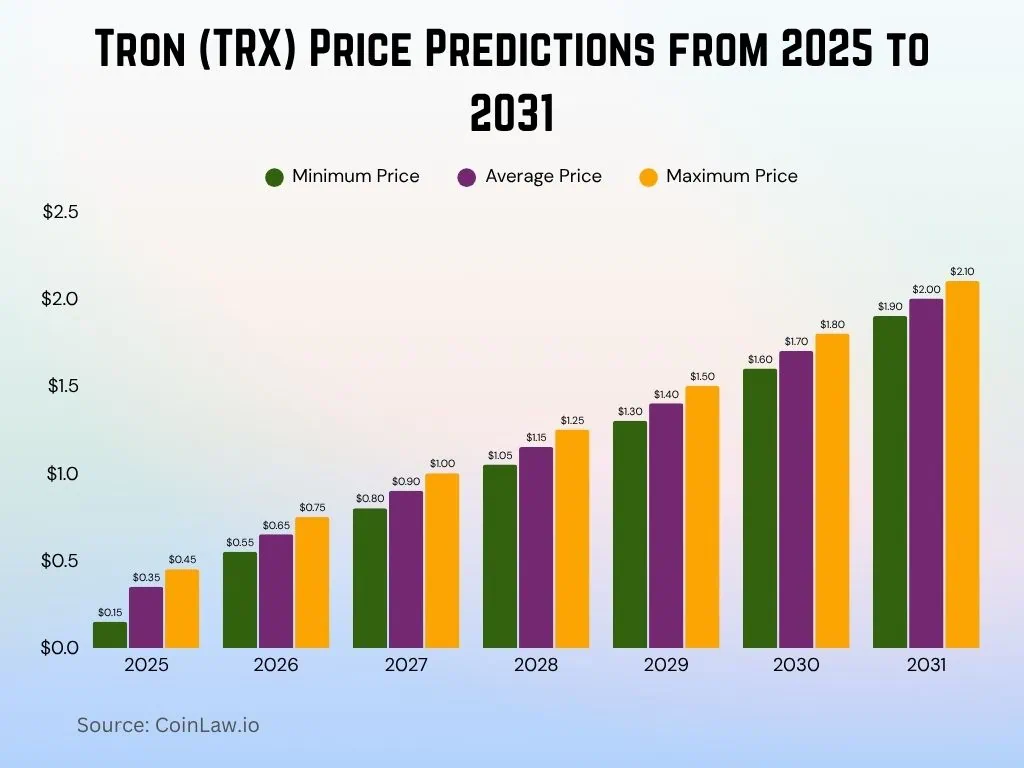
Tron (TRX) Price Predictions from 2025 to 2031
- In 2025, Tron is projected to reach a minimum price of $0.15, with an average of $0.35 and a maximum of $0.45.
- By 2026, TRX could climb to a minimum of $0.55, with a $0.65 average and a $0.75 max forecasted.
- For 2027, price estimates suggest a minimum of $0.80, an average of $0.90, and a maximum of $1.00.
- In 2028, the TRX price could hit $1.05 at minimum, $1.15 on average, and peak at $1.25.
- 2029 projections show TRX trading between $1.30 and $1.50, with an average price of $1.40.
- By 2030, Tron may rise to $1.60 minimum, with a $1.70 average and $1.80 max.
- In 2031, TRX is expected to reach a minimum of $1.90, an average of $2.00, and potentially $2.10 at its peak.
TRON vs. Other Layer-1 Blockchains
- As of mid-2025, TRON ranks #2 in daily transactions, only behind Solana, and ahead of Ethereum.
- TRON’s average transaction fee is $0.0003, compared to Ethereum’s $2.45 and BNB Chain’s $0.08.
- In terms of daily active wallets, TRON (2.8M) edges out Ethereum (1.9M) and rivals BNB Chain (3.1M).
- TRON supports a TPS of over 2,000, while Ethereum averages 30 TPS and Solana reaches 4,000+ TPS.
- TRON’s TVL of $9.3 billion places it in the top 5 Layer-1 blockchains by locked value in 2025.
- Compared to Avalanche and Cardano, TRON boasts greater stablecoin velocity and DApp user engagement.
- TRON leads the stablecoin transaction volume segment, processing more than 75% of USDT volume globally.
- The TRON Foundation’s 2025 report highlighted a 90% uptime advantage over networks like Polygon during Q1 congestion events.
- Gasless transaction incentives on TRON helped drive a 13% increase in new user onboarding, outperforming Fantom and Harmony.
- TRON remains one of the few Layer-1s operating entirely under a DAO governance model as of 2025.
TRON Token Metrics and Circulating Supply
- The total supply of TRX is capped at 100 billion, with a circulating supply of 89.3 billion TRX as of May 2025.
- TRX inflation remains at zero, as block rewards are distributed solely through transaction fees.
- Over 51% of TRX is staked, indicating strong community participation in network validation.
- TRX burn mechanisms eliminated over 7.1 billion TRX since inception, including 820 million in 2025 alone.
- TRON DAO Reserve currently holds 1.5 billion TRX, used for ecosystem support and liquidity provisions.
- TRX staking APY averages 4.1%, driven by network fees and governance allocations.
- TRX trading volume averages $900 million daily, with deep liquidity across major centralized and decentralized exchanges.
- TRX remains in the top 15 by market cap, with a total valuation of approximately $11.2 billion in mid-2025.
- Wallet distribution analysis reveals that the top 10 wallets control less than 7% of TRX, suggesting a relatively decentralized holding pattern.
- In 2025, TRX is accepted by 400+ vendors globally through payment integrators such as NOWPayments and BitPay.
Public Expectations for the Crypto Market
- Among current crypto owners, a strong 83% expect the market to increase, while only 13% think it will stay the same, and just 3% predict a decline.
- Non-owners are more cautious, with 56% expecting an increase, 31% expecting it to stay the same, and 13% anticipating a decline.
- Overall, 67% of informed adults believe the market will increase, 24% expect no change, and 9% foresee a decline.

TRX Price Trends and Market Capitalization
- As of June 2025, TRX trades at approximately $0.123, up 18% year-to-date.
- The 2025 Q1 price low was $0.096, while the April peak reached $0.128, reflecting steady market confidence.
- TRX’s market cap stands at $11.2 billion, keeping it in the top tier of crypto assets.
- Since January, TRX price volatility has decreased by 23%, improving its profile as a stable medium for value transfer.
- The 30-day moving average of TRX increased by 12%, showing healthy long-term support levels.
- Institutional activity in TRX futures has grown, with a 40% rise in open interest on platforms like Binance and Bitget.
- The correlation between TRX and Bitcoin has dropped to 0.58, signaling TRX’s growing independence from broader market swings.
- In 2025, TRX ranked among the top 3 tokens by on-chain transaction count, behind only USDT and SOL.
- TRON’s native token saw 6.2 billion tokens moved on-chain daily, representing one of the highest usage rates across Layer-1 tokens.
- Analysts cite TRON’s low-fee, high-speed value proposition as a key reason for TRX’s sustained resilience.
TRON’s Role in Stablecoin Transfers (USDT, USDC)
- TRON processes 75% of global USDT transfers, with daily volume exceeding $25 billion.
- By May 2025, more than $62 billion in USDT will circulate on the TRON network alone.
- USDC adoption on TRON increased by 210% in the last 12 months, following integrations with leading DeFi protocols.
- TRON now hosts over 60% of all stablecoin transactions by volume, dominating peer networks.
- TRON wallets facilitate 5.5 million USDT transfers per day, making it the leading payment rail for stablecoin remittances.
- The average transaction fee for stablecoin transfers is less than $0.001, boosting merchant and remittance use cases.
- In 2025, TRON became the primary blockchain for Latin American crypto remittance corridors, surpassing Ethereum.
- TRON-based stablecoins are used in over 50 fintech apps, including services in Asia, Africa, and South America.
- The TRON DAO’s fiat-stablecoin integration initiative onboarded 8 new partners in Q1 2025, extending its financial reach.
- Decentralized exchanges on TRON now handle $3.2 billion in stablecoin volume weekly, with USDT pairs leading liquidity.
TRON Whale Movements in the Last 24 Hours
- The largest transaction was a Transfer (Outflow) totaling $4.95 million, showing significant whale movement out of TRON.
- A major Accumulation (Inflow) followed, with $3.52 million moving into wallets, suggesting strategic buying activity.
- Another Transfer (Outflow) recorded $3.13 million, adding to the sizable outbound TRX activity.
- Smaller but notable Accumulation (Inflow) of $2.31 million indicated continued investor interest in TRON.
- The smallest whale activity noted was a Transfer (Outflow) worth $2.06 million, still a substantial amount by market standards.

TRON DeFi Activity and TVL (Total Value Locked)
- As of Q2 2025, TRON’s TVL reached $9.3 billion, placing it firmly among the top 5 DeFi ecosystems.
- JustLend DAO remains TRON’s largest DeFi protocol with $3.7 billion in TVL.
- JustStables, a decentralized stablecoin protocol, surpassed $1.2 billion in locked assets.
- TRON’s top three DEXs, SunSwap, SocialSwap, and UniFi, collectively process $1.1 billion in weekly volume.
- Over 5.1 million unique wallets interacted with at least one DeFi protocol on TRON in the last 12 months.
- Staking, lending, and yield farming protocols now represent over 60% of TRON’s DeFi economy.
- Daily transactions involving DeFi contracts exceed 2.3 million, boosted by low fees and quick settlement.
- USDT and USDC make up nearly 80% of collateral pools across TRON-based DeFi platforms.
- TRON DeFi gas fees average under $0.001, allowing micro-yield strategies to thrive.
- The launch of liquid staking protocols on TRON in early 2025 added $500 million in staked value within three months.
TRON’s Energy and Bandwidth Metrics
- Each TRON transaction consumes just 0.0000015 kWh, making it among the most energy-efficient blockchains.
- Bandwidth and energy allocation models continue to subsidize user transactions through staking rewards.
- In 2025, TRON distributed over 1.9 trillion bandwidth points and 950 billion energy units to users.
- Staking 1,000 TRX grants approx. 500 energy and 600 bandwidth daily, enough for multiple smart contract actions.
- TRON upgraded its energy fee market in Q1 2025, resulting in a 12% increase in contract processing efficiency.
- 85% of daily active users receive subsidized transaction costs through voting-based energy redistribution.
- Energy costs for complex contracts dropped by 8.2%, due to the implementation of more efficient TVM bytecode structures.
- In May 2025, TRON introduced a dynamic bandwidth pricing model, adjusting quotas based on network load.
- TRON users burned 18 billion TRX worth of energy credits in the first half of 2025.
- The network’s green profile supports ongoing collaborations with sustainability-aligned blockchain initiatives.
RPC API Usage Share by Blockchain
- Tron leads in RPC API usage with a dominant 36.9% share, showing its popularity among developers and dApps.
- Ethereum comes second, capturing 21.4%, maintaining a strong position despite growing competition.
- Solana holds a solid 16.1% share, benefiting from its high-speed transaction capabilities.
- Ton secures 13.7% of RPC usage, reflecting rising adoption and interest.
- BSC (Binance Smart Chain) rounds out the list with 11.9%, still a notable portion in the multi-chain ecosystem.

TRON DAO Governance Participation
- As of mid-2025, over 1.3 million wallets have voted at least once in TRON DAO governance rounds.
- The average number of voters per proposal is 75,000+.
- 27 Super Representatives are elected through on-chain votes every 6 hours, maintaining a dynamic governance structure.
- TRON DAO launched the “Proposal Accelerator Program”, which boosted proposal submissions by 32% in Q1 2025.
- 80% of TRX used for voting is staked, promoting long-term holder alignment in network decisions.
- Top governance topics in 2025 included gas subsidy allocation, node expansion, and ecosystem grants.
- The average voter reward yield is 3.2% annually, encouraging continued participation.
- TRON’s governance UI was overhauled in 2025, leading to a 47% improvement in user engagement.
- Proposal approval rate stands at 64%, with technical proposals receiving the highest support.
- In May 2025, the TRON DAO treasury allocated $95 million to fund community and developer proposals.
Developer Activity on the TRON Network
- TRON averaged 950+ weekly active developers as of May 2025, a 14% year-over-year increase.
- The TRON Academy Program has certified 7,000+ developers globally, creating a robust pipeline of contributors.
- 3,800 new smart contracts are pushed to GitHub monthly under TRON-related repositories.
- TRON’s developer documentation portal had 1.1 million page views in Q1 2025, up 23% from the previous quarter.
- The TRON Developer Hub now supports multi-language SDKs, including Python, JavaScript, Rust, and Go.
- HackaTRON 2025, TRON’s flagship global hackathon, attracted over 5,200 participants across 40+ countries.
- Over $3.5 million in grants were distributed to builders in the first half of 2025 alone.
- TRON became a top 5 blockchain on GitHub by code commits in April 2025.
- TRON Studio, an all-in-one development environment, saw a 160% increase in monthly users following its early 2025 release.
- The TRON Foundation offers free infrastructure credits and API tools to developers building on BTTC or TVM.
Recent Developments in the TRON Ecosystem
- In March 2025, TRON launched zkTRON, its own zero-knowledge rollup testnet for private transactions.
- BTTC Bridge volume tripled in Q1 2025, with over $2.1 billion in assets bridged between TRON, Ethereum, and BNB Chain.
- TRON Wallet v5.0 launched in April 2025, featuring multi-chain support and integrated DeFi dashboards.
- TRON’s partnership with Alibaba Cloud introduced enterprise-level blockchain APIs to over 1 million SME users.
- In 2025, TRON began compliance integrations with Chainalysis and Elliptic for optional transaction monitoring.
- TRON integrated account abstraction (ERC-4337 style) features to support wallet automation and social recovery.
- USDT auto-conversion functionality was added to major exchanges via TRON Protocol Layer updates.
- $150 million in ecosystem grants were disbursed in the first 5 months of 2025 to accelerate DApp adoption.
- The TRON Foundation appointed a new DAO Advisory Board, with members from top crypto, fintech, and legal institutions.
- TRON’s ecosystem report for 2025 highlighted 16 strategic partnerships, including regional CBDC pilots in Southeast Asia.