Papers by Mohamed Chtatou
LE MONDE AMAZIGH, 2024
Abbas Abu Al-Qâsim Ibn Firnâs Ibn Wirdâs at-Takurînî est né en 810 à Korah Takrna près d’une vill... more Abbas Abu Al-Qâsim Ibn Firnâs Ibn Wirdâs at-Takurînî est né en 810 à Korah Takrna près d’une ville espagnole aujourd’hui appelée Ronda. C’était l’époque où les meilleurs ingénieurs, architectes et scientifiques du monde se réunissaient dans les principales universités et centres d’apprentissage d’Andalousie et contribuaient de manière significative au développement scientifique et à l’essor de la civilisation européenne. Ibn Firnâs était l’un d’entre eux et a consacré toute sa vie à la science. Il a écrit plusieurs livres sur les mathématiques, la physique, l’astronomie et l’ingénierie. C’est lui qui a marqué l’histoire de l’aviation en réalisant le premier vol contrôlé de l’histoire de l’humanité.

International Journal of Berber/Amazigh Research -IJBAR-, 2024
La langue amazighe dans le Rif est intrinsèquement culturelle, car elle reflète les normes et les... more La langue amazighe dans le Rif est intrinsèquement culturelle, car elle reflète les normes et les facteurs de manière à la fois subtile et explicite. En effet, elle est une composante essentielle de la culture amazighe et joue un rôle crucial dans la façon dont les Imazighen perçoivent et comprennent le monde qui les entoure. La langue amazighe n'est pas seulement un moyen de communication, c'est aussi un réservoir de connaissances, de valeurs et de croyances qui se transmettent de génération en génération. La langue amazighe, dans cette région, du Maroc amazigh, procure également un sentiment d'appartenance et de communauté parmi ces locuteurs. Elle facilite la socialisation et permet aux individus de participer aux pratiques sociales et culturelles de leur communauté. En outre, cette langue peut influencer la façon dont les gens pensent, perçoivent et interprètent le monde qui les entoure. Ce travail se concentre exclusivement sur le concept de l'identité chez les Rifains nkwath, la notion d'appartenance au groupe, le pouvoir symbolique de la langue maternelle, la pertinence de la trinité amazighe dans sa forme des 3 T : tamazight(langue amazighe), tamount (parenté et solidarité), et Tamourt/tamazirt (terre), l'histoire et la littérature orale, la culture matérielle et la place des femmes dans la communauté rifaine.

Eurasia Review, 2024
From Antiquity to the present day, the art of literary translation has always been a fundamental ... more From Antiquity to the present day, the art of literary translation has always been a fundamental element in the transmission of knowledge from one language to another.
Translation is serious interactive conversational and communicative work, which requires great mastery of the target language and the source language being translated. Indeed, translating a literary text requires great linguistic, artistic and socio-cultural skills capable of transcending the slightest vicissitudes of the original text and its slightest emotions.
Translation here must take into account the aesthetics of the text, but also its semantic essence, knowing how to transmit its style and keep its soul. The translator is not a simple receiver, he is an intermediary and a second author, who must guarantee the exact transmission of a message intended to be understood and well assimilated. Any semantic confusion can divert the original message or disfigure it.

Eurasia Review, 2024
The notion of cultural transfer refers to a process of adoption of cultural phenomena between dif... more The notion of cultural transfer refers to a process of adoption of cultural phenomena between different cultures, for example between different countries or between different social groups.
Translation is an integral part of the cultural transfer which marks the passage of a work from one culture to another. This passage can be represented by several translations and by other types of transfers, different re-readings, etc.
In today's translation studies, the translated text is considered as a whole complex of semantics which is part of the linguistic, historical and political contexts of the arrival culture. Any translation is never isolated; it is related to other texts, other speeches which are intimately linked to the cultural experience of a certain country, to the history of a people, to a vision and perception of the world. Each translator is looking for a key available to him in his own culture to access the literary text of the Other.
Le Monde Amazigh, 2024
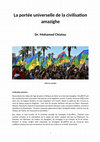
Descendants des tribus de l'âge de pierre d'Afrique du Nord, les récits des Imazighen ⵉⵎⴰⵣⵉⵖⵏ ont... more Descendants des tribus de l'âge de pierre d'Afrique du Nord, les récits des Imazighen ⵉⵎⴰⵣⵉⵖⵏ ont été mentionnés pour la première fois dans les écrits égyptiens anciens. À partir d'environ 2000 avant notre ère, les langues berbères se sont répandues vers l'ouest, depuis la vallée du Nil, à travers le nord du Sahara jusqu'au Maghreb. Une série de peuples berbères tels que les Mauri, Masaesyli, Massyli, Musulamii, Gaetuli et Garamantes ont donné naissance à des royaumes berbères, comme la Numidie et la Maurétanie. D'autres royaumes apparaissent dans l'Antiquité tardive, comme ceux de l'Altava, de l'Aurès, de l'Ouarsenis et du Hodna.
Cet article ambitionne de montrer que la civilisation amazighe a une portée universelle dans la sense qu'elle exhibe des valeurs telles que: le dialogue des cultures et religion, le respect de l'autre, la qualité de convivialité, la coexistence, etc.
Encounters with American Anthropologists in Morocco
Hespéris, Tamuda, 2020
The Moroccan-Israeli Geostrategic Relationship: From a Harmonious Past to a Promising Future
Orbis, 2023
A Moroccan success story tainted with some shortcomings
Региональное Управление Модели Технологии Коммуникации Ч 1 Екатеринбург 2013, 2013

Eurasia Review, 2022
Relations between Jews and Muslims began in the seventh century with the birth and expansion of I... more Relations between Jews and Muslims began in the seventh century with the birth and expansion of Islam in the Arabian Peninsula. The two religions share similar values, principles, and rules. Islam also incorporates Jewish history as part of its own. The concept of the children of Israel has an important place in Islam.
Is the Koran anti-Semitic? Does Islam convey a "hatred of the Jew" that makes it incompatible with Western values? The viewpoint of an Islamologist is essential to dispel the bias in the debate and to get away from sweeping judgments. Without hiding the most problematic aspects, the great scholar Meïr M. Bar-Asher takes stock of this burning issue. He reviews the image of the "sons of Israel" and the "Jews" in the Qur'an and the Hadîth, as well as the Qur'anic basis for the status of dhimmi. It also examines the extraordinary contribution of Jewish tradition to Muslim exegesis of the Qur'an, as well as the parallels between Jewish and Muslim religious laws, halakha, and sharia. Above all, it shows that the question of the relationship of the Islamic tradition to the figure of the Jew and to Judaism is a complex one and that it cannot be reduced to the caricature given by Islamist preachers and Islamophobes alike. Moses, the most important prophet in Judaism, is also considered a prophet and a messenger in Islam. He is mentioned more than anyone else in the Qur'ân, and his life is told and recounted more than that of any other prophet. There are about forty-three references to the Israelites in the Qur'ân (not counting references to the prophets), and many in the hadith. Some more recent rabbinic authorities or Jewish thinkers, such as Maimonides, have debated the relationship between Islam and Jewish law. Maimonides himself was, according to some, influenced greatly by Islamic legal thought.
Probing the Muslims' attitude toward Judaism as a special case of their view of other religious minorities in Islamic countries, Bernard Lewis demolishes two competing stereotypes: the fanatical warrior, sword in one hand and Qur'ân in the other, and the Muslim designer of an interfaith utopia. His portrayal of the Judeo-Islamic tradition is set against a vivid background of Jewish and Islamic history.
Article 19-ma, 2022
Le capitalisme et la démocratie suivent des logiques différentes : droits de propriété inégalemen... more Le capitalisme et la démocratie suivent des logiques différentes : droits de propriété inégalement répartis d'un côté, droits civiques et politiques égaux d'autre part ; commerce axé sur le profit au sein du capitalisme par opposition à la recherche du bien commun au sein de la démocratie ; le débat, le compromis et la prise de décision à la majorité au sein de la politique démocratique par opposition à la prise de décision hiérarchique par les gestionnaires et les propriétaires du capital. Le capitalisme n'est pas démocratique, la démocratie n'est pas capitaliste.
The purpose of this thesis is to carry out a phonemic analysis of a specific Berber dialect so as... more The purpose of this thesis is to carry out a phonemic analysis of a specific Berber dialect so as to be able to commit spoken material from this dialect to written form. The main aim therefore was to lay the foundations for a practical orthography for synchronic purposes. The dialect chosen for study is that of the investigator, namely of the village of Ajdir in the igyzannayan tribal area of North Eastern Morocco. In addition to the main body of lexical items based on the investigator's own experience as a native speaker, a quantity of taped material was also collected in the field and subjected to phonemic analysis in terms of the investigator's own idiolect. A description of the system was then carried out on the basis of minimal pairs. All lexical items used for the description of the sounds and for the establishment of minimal oppositions were tape-recorded and are reproduced on a cassette which accompanies the thesis.

Eurasia Review, 2022
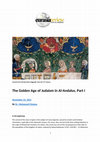
The arrival of the Jews in Spain is the subject of many legends, spread by Jewish and Christian c... more The arrival of the Jews in Spain is the subject of many legends, spread by Jewish and Christian chroniclers, especially in the sixteenth century. For some, they arrived at the time of King Solomon in the wake of Phoenician travelers; for others, the event was one of the consequences of the exile of the population of the kingdom of Judea, ordered by Nebuchadnezzar (1125–1104 BC). Historians tell us that the first Jews arrived in a more or less organized manner after the destruction of the Temple in Jerusalem in 70 CE.
They first settled on the Mediterranean coast and then gradually spread throughout the Iberian Peninsula. The oldest evidence of Jewish presence in Spain is a trilingual inscription in Hebrew, Latin and Greek on a child’s sarcophagus found in Tarragona and dating from the Roman period (now on display at the Sefardí Museum in Toledo). In addition, the mosaic of Elche (first century) was undoubtedly the floor of a synagogue, which is evidenced by the Greek inscriptions, as well as the geometric designs that compose it. Finally, texts reveal a Jewish presence in Spain at the same time: The War of the Jews by Flavius Josephus (VII, 3, 3), The Mishna (Baba Bathra, III, 2).
Eurasia Review,, 2022
The arrival of the Jews in Spain is the subject of many legends, spread by Jewish and Christian c... more The arrival of the Jews in Spain is the subject of many legends, spread by Jewish and Christian chroniclers, especially in the sixteenth century. For some, they arrived at the time of King Solomon in the wake of Phoenician travelers; for others, the event was one of the consequences of the exile of the population of the kingdom of Judea, ordered by Nebuchadnezzar (1125–1104 BC). Historians tell us that the first Jews arrived in a more or less organized manner after the destruction of the Temple in Jerusalem in 70 CE.
They first settled on the Mediterranean coast and then gradually spread throughout the Iberian Peninsula. The oldest evidence of Jewish presence in Spain is a trilingual inscription in Hebrew, Latin and Greek on a child’s sarcophagus found in Tarragona and dating from the Roman period (now on display at the Sefardí Museum in Toledo). In addition, the mosaic of Elche (first century) was undoubtedly the floor of a synagogue, which is evidenced by the Greek inscriptions, as well as the geometric designs that compose it. Finally, texts reveal a Jewish presence in Spain at the same time: The War of the Jews by Flavius Josephus (VII, 3, 3), The Mishna (Baba Bathra, III, 2).

Eurasia Review, 2022
The geographical limits of the Maghreb are difficult to define. A distinction is made between a c... more The geographical limits of the Maghreb are difficult to define. A distinction is made between a central Maghreb composed of Morocco, Algeria and Tunisia, which covers an area of 3 million square kilometers, or more than five times the size of France, and a large Maghreb that covers, with Mauritania and Libya in addition, an area of approximately 5.7 million square kilometers. The term Maghreb – and not North Africa, which includes Egypt but excludes Mauritania – generally refers to the central Maghreb, which forms a relatively homogeneous whole; but it also sometimes refers to the greater Maghreb, which has been an institutional reality since the creation of the Arab Maghreb Union (AMU) in 1989. This Maghreb group, concentrated on the northwestern part of the African continent, is marked by its proximity to Europe and its membership in the Mediterranean civilization.
Eurasia Review, 2022
Terminology is the field of lexicology (or the study of lexicon) that deals with specialized voca... more Terminology is the field of lexicology (or the study of lexicon) that deals with specialized vocabularies and sets of terms related to particular fields (aviation terminology, medical terminology, stylistics, agriculture, etc.). Terminology as a new academic field is located at the boundary among linguistics, logic, theory of existence, information science and specialized areas of science and technology, and in the interdisciplinary area.
Eurasia Review, 2022
The term Maghreb (Arabic for “the Sunset”) refers to the countries of the Sunset – the North Afri... more The term Maghreb (Arabic for “the Sunset”) refers to the countries of the Sunset – the North African West – as opposed to Mashreq (“the Levant”), which refers to the countries of the Rising Sun – the Arab East. In its traditional sense, the Maghreb includes Morocco, Algeria and Tunisia, three ancient Amazigh/Berber countries, Islamized and Arabized. In 1989, the Arab Maghreb Union (AMU) was created, which includes, in addition to these countries, Libya and Mauritania.
Eurasia Review, 2022
It was on the evening of March 2, 2020 that the Ministry of Public Health announced the registrat... more It was on the evening of March 2, 2020 that the Ministry of Public Health announced the registration of the first positive case out of 29 suspected cases. He was a Moroccan resident in Italy who was treated immediately at the Moulay Youssef hospital in Casablanca.
Morocco declared a state of public health emergency and lockdown at 6 p.m. on Friday, March 20, 2020 to contain the spread of Covid-19, after the country registered its first positive case on March 2. The government very quickly decided on a series of measures, which were put in place in European countries only at stage 2 or 3 of the pandemic.
Eurasia Review, 2022
It was on the evening of March 2, 2020 that the Ministry of Public Health announced the registrat... more It was on the evening of March 2, 2020 that the Ministry of Public Health announced the registration of the first positive case out of 29 suspected cases. He was a Moroccan resident in Italy who was treated immediately at the Moulay Youssef hospital in Casablanca.
Morocco declared a state of public health emergency and lockdown at 6 p.m. on Friday, March 20, 2020 to contain the spread of Covid-19, after the country registered its first positive case on March 2. The government very quickly decided on a series of measures, which were put in place in European countries only at stage 2 or 3 of the pandemic.
Eurasia Review, 2022
The Arab world is one of the most volatile regions in the world and plays a central role in globa... more The Arab world is one of the most volatile regions in the world and plays a central role in global politics today. With its great diversity of peoples, languages, and cultures, it is also home to the fastest-growing religion in the world: Islam. Add to that immense socio-economic and political transformation, the highest percentages of youth in the world, and massive financial and strategic mineral resources, it certainly is one of the most crucial areas of global studies today


Uploads
Papers by Mohamed Chtatou
Translation is serious interactive conversational and communicative work, which requires great mastery of the target language and the source language being translated. Indeed, translating a literary text requires great linguistic, artistic and socio-cultural skills capable of transcending the slightest vicissitudes of the original text and its slightest emotions.
Translation here must take into account the aesthetics of the text, but also its semantic essence, knowing how to transmit its style and keep its soul. The translator is not a simple receiver, he is an intermediary and a second author, who must guarantee the exact transmission of a message intended to be understood and well assimilated. Any semantic confusion can divert the original message or disfigure it.
Translation is an integral part of the cultural transfer which marks the passage of a work from one culture to another. This passage can be represented by several translations and by other types of transfers, different re-readings, etc.
In today's translation studies, the translated text is considered as a whole complex of semantics which is part of the linguistic, historical and political contexts of the arrival culture. Any translation is never isolated; it is related to other texts, other speeches which are intimately linked to the cultural experience of a certain country, to the history of a people, to a vision and perception of the world. Each translator is looking for a key available to him in his own culture to access the literary text of the Other.
Cet article ambitionne de montrer que la civilisation amazighe a une portée universelle dans la sense qu'elle exhibe des valeurs telles que: le dialogue des cultures et religion, le respect de l'autre, la qualité de convivialité, la coexistence, etc.
Is the Koran anti-Semitic? Does Islam convey a "hatred of the Jew" that makes it incompatible with Western values? The viewpoint of an Islamologist is essential to dispel the bias in the debate and to get away from sweeping judgments. Without hiding the most problematic aspects, the great scholar Meïr M. Bar-Asher takes stock of this burning issue. He reviews the image of the "sons of Israel" and the "Jews" in the Qur'an and the Hadîth, as well as the Qur'anic basis for the status of dhimmi. It also examines the extraordinary contribution of Jewish tradition to Muslim exegesis of the Qur'an, as well as the parallels between Jewish and Muslim religious laws, halakha, and sharia. Above all, it shows that the question of the relationship of the Islamic tradition to the figure of the Jew and to Judaism is a complex one and that it cannot be reduced to the caricature given by Islamist preachers and Islamophobes alike. Moses, the most important prophet in Judaism, is also considered a prophet and a messenger in Islam. He is mentioned more than anyone else in the Qur'ân, and his life is told and recounted more than that of any other prophet. There are about forty-three references to the Israelites in the Qur'ân (not counting references to the prophets), and many in the hadith. Some more recent rabbinic authorities or Jewish thinkers, such as Maimonides, have debated the relationship between Islam and Jewish law. Maimonides himself was, according to some, influenced greatly by Islamic legal thought.
Probing the Muslims' attitude toward Judaism as a special case of their view of other religious minorities in Islamic countries, Bernard Lewis demolishes two competing stereotypes: the fanatical warrior, sword in one hand and Qur'ân in the other, and the Muslim designer of an interfaith utopia. His portrayal of the Judeo-Islamic tradition is set against a vivid background of Jewish and Islamic history.
They first settled on the Mediterranean coast and then gradually spread throughout the Iberian Peninsula. The oldest evidence of Jewish presence in Spain is a trilingual inscription in Hebrew, Latin and Greek on a child’s sarcophagus found in Tarragona and dating from the Roman period (now on display at the Sefardí Museum in Toledo). In addition, the mosaic of Elche (first century) was undoubtedly the floor of a synagogue, which is evidenced by the Greek inscriptions, as well as the geometric designs that compose it. Finally, texts reveal a Jewish presence in Spain at the same time: The War of the Jews by Flavius Josephus (VII, 3, 3), The Mishna (Baba Bathra, III, 2).
They first settled on the Mediterranean coast and then gradually spread throughout the Iberian Peninsula. The oldest evidence of Jewish presence in Spain is a trilingual inscription in Hebrew, Latin and Greek on a child’s sarcophagus found in Tarragona and dating from the Roman period (now on display at the Sefardí Museum in Toledo). In addition, the mosaic of Elche (first century) was undoubtedly the floor of a synagogue, which is evidenced by the Greek inscriptions, as well as the geometric designs that compose it. Finally, texts reveal a Jewish presence in Spain at the same time: The War of the Jews by Flavius Josephus (VII, 3, 3), The Mishna (Baba Bathra, III, 2).
Morocco declared a state of public health emergency and lockdown at 6 p.m. on Friday, March 20, 2020 to contain the spread of Covid-19, after the country registered its first positive case on March 2. The government very quickly decided on a series of measures, which were put in place in European countries only at stage 2 or 3 of the pandemic.
Morocco declared a state of public health emergency and lockdown at 6 p.m. on Friday, March 20, 2020 to contain the spread of Covid-19, after the country registered its first positive case on March 2. The government very quickly decided on a series of measures, which were put in place in European countries only at stage 2 or 3 of the pandemic.