Papers by Michael Grasa
Michael Grasa, 2026
This preliminary roadmap introduces the next stage of the ML Grasa Method for Indus seal research... more This preliminary roadmap introduces the next stage of the ML Grasa Method for Indus seal research, moving from single-seal motif overlay toward bounded motif comparison and falsifiability-based review. It does not claim a decipherment of the Indus script. Instead, it proposes a disciplined framework for testing whether selected seal images or motifs may function as structured interpretive evidence when compared against fixed, provisional baselines and reviewed through bounded claim reco

Indus Seals:The Clay Preservation, and the Problem of Missing Canvases, 2026
his working paper examines Indus seals, clay sealings, and preservation bias in the archaeologica... more his working paper examines Indus seals, clay sealings, and preservation bias in the archaeological interpretation of the Indus Valley Civilization. It asks whether the clay-dominated surviving record of the Indus script should be treated as evidence for the full limits of Indus communication, or whether it primarily reflects the survival of the most durable medium–canvas pair. The paper argues that clay sealings securely document an important administrative channel, but that clay-only interpretations risk equating what survives with what existed. Because the Indus script remains undeciphered, the absence of surviving non-clay evidence should carry less interpretive weight than it would in a deciphered writing system where textual references to lost media can be checked. Drawing on the medium–canvas distinction, preservation bias, undeciphered-script caution, Asko Parpola’s allowance for possible perishable supports, Jonathan Mark Kenoyer’s broader framing of Indus script use, and a comparative Mesopotamian analogue, the paper proposes an Indus Beyond-Clay Model. This model does not deny the central role of clay in Indus administration; instead, it limits the certainty with which clay can be treated as the full boundary of the Indus communicative system. The paper concludes with testable expectations for future research, including micro-residue analysis, seal-groove residue study, wear signatures, clay impression analysis, and site-level seal-to-sealing mismatches that may help identify indirect traces of lost media.
Michael Grasa, 2025
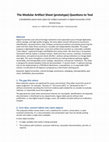
The Modular Artifact Sheet is a falsifiability-first prototype from Echoes of the Script, designe... more The Modular Artifact Sheet is a falsifiability-first prototype from Echoes of the Script, designed to turn artifact-level assertions into structured, versioned, and peer-checkable “claim objects.” This open framework supports transparent metadata, responsible reuse, and collaborative review across institutions.
While digitization has expanded access to images and object records, many catalogs still preserve conclusions—identification, culture, findspot, dating—without preserving the minimum viable evidence needed for independent verification. This tool addresses that gap by modularizing each assertion into a bounded claim format requiring:
• Sources
• Method notes
• Uncertainty/confidence
• Alternatives
• Reviewer outcomes (R1/R2)
The sheet is stakeholder-safe, modular, and supports low-friction implementation:
• PDF/Word attachment
• Spreadsheet form
• Exportable JSON-style schema
A two-reviewer PeerCheck model supports light-touch outcomes: Confirmed / Needs Evidence / Not Supported. Visual features include a three-color confidence scale and an AI traffic-light layer (Green/Yellow/Red) to encourage transparent machine–human collaboration.
Built for phased adoption:
Internal use → second-check workflow → optional sharing
The Modular Artifact Sheet is attached on this page for direct use.
Open Participation & DOI Logging
This prototype is part of an open Zenodo group archive:
Echoes of the Script: OpenLab for Ancient Writing
https://zenodo.org/communities/echoes-openlab/
If you test the sheet and want to contribute a reviewed object, you can upload your results to the group. I review/approve submissions for inclusion to keep the archive clean and usable. Each contribution can:
• Include your completed Modular Artifact Sheet
• Be assigned its own DOI
• Document peer outcomes and confidence
• Join a growing catalog of open claim reviews
Participation is open to individuals, labs, and institutions. You don’t need special approval to try the tool—just a structured, public result. The goal is to normalize transparent, falsifiability-first claim documentation in digital heritage.
For questions or pilot contributions,
contact: [email protected]

Abstract (finalized with Version 4.1):
This paper presents an evidence-first auditing workflow f... more Abstract (finalized with Version 4.1):
This paper presents an evidence-first auditing workflow for ancient script claims, designed to make proposed readings testable without requiring trust in the author or assertions of full decipherment. Each proposed interpretation is converted into a bounded, versioned “claim object” (Version 4.1) supported by public, checkable evidence (object identifiers, permitted image crops, sign-list references, and citations/URLs) and explicitly labeled to separate what can be directly verified (evidence) from what is proposed beyond the visible record (hypothesis). Claims are evaluated through a standardized two-rater review model (R1/R2) using fixed outcomes (Confirmed / Needs Evidence / Not Supported), producing a compact audit trail that outsiders can independently reproduce. An optional AI “traffic-light” flag may assist initial triage, but it is strictly non-authoritative and never overrides human-led evidence review. The resulting protocol functions as a method-neutral test bench for collaborative verification—supporting future decipherment work by prioritizing transparency, comparability, and falsifiability across inscriptions, collections, and research communities.

Michael Grasa, 2025
This paper introduces a neutral, collaboration-ready falsifiability ledger designed to make
Indus... more This paper introduces a neutral, collaboration-ready falsifiability ledger designed to make
Indus script claims comparable, reproducible, and peer-checkable without requiring
agreement on a single decipherment. Version 2 established the claim-by-claim ledger
approach: isolate a claim, log the specific evidence used, and record outcomes in a
structured, auditable format. Version 3 expands the system into a collaboration surface by
separating transcription from word-level claims, adding anchoring categories (P/A/O),
introducing traffic-light confidence for key decisions, and requiring a two-rater peer
check with explicit disagreement handling.
Companion worked examples (including CL2 “Buffalo”) will be published separately
(v3.2) to demonstrate the scoring workflow using this framework.
Public-interest dissemination / fiscal sponsor: Echoes of the Script (Fractured Atlas) —
https://fundraising.fracturedatlas.org/echoes-of-the-script-public-decoding-pop-ups
Released for open peer use and adaptation under CC BY 4.0.
Indus Valley Script Falsifiability Ledger v3: Collaboration-Ready Multi-Rater Sheet for CL2 (Buffalo) and Related Seals
A Neutral Falsifiability Ledger for Indus Script Research

Michael L Grasa, 2025
This record shares a collaboration-ready falsifiability ledger (v3) for Indus Valley script resea... more This record shares a collaboration-ready falsifiability ledger (v3) for Indus Valley script research, designed around the CL2 “buffalo” seal but reusable across the corpus. The one-page sheet standardizes ORI/OVR choices, separates transcription from word-level claims (T/W), tracks persons/animals/objects (P/A/O), and uses simple High/Medium/Low traffic lights with a neutrality rule and paired peer checks (R1/R2) so agreement and disagreement become visible data.
Author: Michael Grasa is an independent researcher and creator of the Indus Script Falsifiability Ledger, an Emergent Ventures Fellow (Mercatus Center, George Mason University), and presenter of this framework at the 2025 “Discipline of Ancient Scripts” conference in New Delhi.
This project is fiscally sponsored by Fractured Atlas, a 501(c)(3) non-profit arts service organization. Tax-deductible contributions to support this work can be made at: your link here.
Michael Grasa, 2025
This concept paper proposes a Ventris-inspired, testable framework for Indus script inquiry. It p... more This concept paper proposes a Ventris-inspired, testable framework for Indus script inquiry. It pairs a compact falsifiability sheet with a short, proof-of-concept pilot to invite peer review, replication, and incremental improvement. The approach emphasizes cultural respect, clear metadata, evidence checklists, a minimal peer-agreement outcome (2 7 1 3 / 2 7 1 7 / →), and optional sequence/structure tests. The goal is to replace debate-centric habits with a small, shared method that surfaces where readings converge or fail, and makes progress legible over time.
Michael Grasa, 2025
This paper flags a small but striking anomaly in late Yuan China (c. 1290–1360): copper items tha... more This paper flags a small but striking anomaly in late Yuan China (c. 1290–1360): copper items that look too pure and too clearly hammered to match the usual Chinese supply routes, showing up at the same time as very short, “direction-only” delegation notices. Instead of treating this as a curiosity, I frame it as a falsifiable materials problem: if we test the surviving pieces for (1) hammered/cold-worked microstructure, (2) unusually high copper purity and non-local lead isotopes, and (3) contemporaneous coinage or price shifts, the anomaly will either collapse or hold. If it holds, late Yuan economic history has to make room for a narrow, high-quality copper inflow that current narratives don’t explain — and it strengthens the case for re-reading 13th–14th c. East–West exchanges through materials, not just texts.

Michael Grasa, 2025
This study tests whether disruptions linked to the Santorini/Thera eruption align better with a l... more This study tests whether disruptions linked to the Santorini/Thera eruption align better with a late 13th–early 12th c. BCE window (~1175–1225 BCE) than a mid-16th c. BCE placement. To avoid circularity, Aegean datasets (Mycenaean/Minoan) are excluded. Instead, independent non-Aegean archives from Central Anatolia (Hittite), the Ugarit coastal corridor, Ramesside Egypt, and Cyprus (LC IIC–IIIA) are compared using a simple window-overlap test (±25 yr) on published stratigraphy, textual synchronisms, and paleoclimate proxies. All four regions show convergent late-band signals (imperial/palatial contraction, maritime shock, administrative silence) with minimal support for a mid-16th-century anchor. This is a synchronization test, not a re-date of the eruption, but the cross-regional consistency warrants re-examining chronology without Aegean priors. Limitations and falsification paths (tephra correlations, Bayesian joint models) are noted. The paper closes by flagging the intentional omission of Aegean series as a guardrail for separate treatment.
The ML Grasa Method — CL2 (Buffalo) Directional Reading, Overlay Choice (OVR), and Falsifiability Scoring, 2025
This paper introduces the ML Grasa Method, a newly developed, dual-layer decoding system for the ... more This paper introduces the ML Grasa Method, a newly developed, dual-layer decoding system for the Indus script. Built on the phonetic grid established by Susanna Redalia, the method adds a symbolic overlay drawn from animal iconography, directional grammar, and regional cultural comparanda. Together, these layers are applied in a disciplined way to produce traceable, repeatable readings. A decisive shift led to this framework: an earlier model (RSPM-49), though structured, proved difficult to teach and impractical for broader engagement. In its place, the ML Grasa Method fixes the phonetic line with Redalia's values (treated as a foundational grid) and then tests an animal-based semantic overlay in two placements: Method 1 = animal overlay meaning + text = translation 1 (overlay-left / animal-first), and Method 2 = text + animal overlay meaning = translation 2 (overlay-right / text-first). Glosses remain fixed. Orientation/facing are treated as coded inputs, not engines of meaning. A falsifiability trigger-if the same sign row reads cleaner with a different animal-requires re-weighing placement, not changing glosses. This paper presents a single case study-seal CL2 (buffalo)-as a proof-of-concept. The result is a transparent ledger entry that keeps both translations while stating a one-sentence preference with rationale, showing how the method scales by adding cases rather than inflating claims. At the time of submission, the method is fully defined and under active development; the author is seeking formal collaboration with Susanna Redalia to recognize her phonetic grid as the baseline. A teaching guide and decoding walkthrough are in preparation ahead of the conference. Rather than a closed theory, the ML Grasa Method invites dialogue, careful experiment, and symbolic reflection. It aims to honor scholarly rigor, respect regional cultural patterns, and help reanimate the silent script of the Indus Valley for a new generation of interpreters.
Conference Presentations by Michael Grasa
Presented at Manuscript Heritage Conf., Sept 2025 (New Delhi), 2025
The Indus script remains undeciphered, and the <ield is often fragmented by theory-<irst approach... more The Indus script remains undeciphered, and the <ield is often fragmented by theory-<irst approaches that are dif<icult to compare or reproduce. This paper presents a neutral falsi<iability ledger-implemented as a compact, shareable sheet-that enables scholars to document readings, evidence, and peer checks without endorsing any single theory. The method standardizes metadata, clari<ies interpretive lenses, and records peer agreement outcomes, while preserving room for annotations and optional sequence/structure tests. We also outline a 30-day pilot program designed to compare readings across 12 inscriptions and publish agreement rates and failure modes as a citable outcome.


Uploads
Papers by Michael Grasa
While digitization has expanded access to images and object records, many catalogs still preserve conclusions—identification, culture, findspot, dating—without preserving the minimum viable evidence needed for independent verification. This tool addresses that gap by modularizing each assertion into a bounded claim format requiring:
• Sources
• Method notes
• Uncertainty/confidence
• Alternatives
• Reviewer outcomes (R1/R2)
The sheet is stakeholder-safe, modular, and supports low-friction implementation:
• PDF/Word attachment
• Spreadsheet form
• Exportable JSON-style schema
A two-reviewer PeerCheck model supports light-touch outcomes: Confirmed / Needs Evidence / Not Supported. Visual features include a three-color confidence scale and an AI traffic-light layer (Green/Yellow/Red) to encourage transparent machine–human collaboration.
Built for phased adoption:
Internal use → second-check workflow → optional sharing
The Modular Artifact Sheet is attached on this page for direct use.
Open Participation & DOI Logging
This prototype is part of an open Zenodo group archive:
Echoes of the Script: OpenLab for Ancient Writing
https://zenodo.org/communities/echoes-openlab/
If you test the sheet and want to contribute a reviewed object, you can upload your results to the group. I review/approve submissions for inclusion to keep the archive clean and usable. Each contribution can:
• Include your completed Modular Artifact Sheet
• Be assigned its own DOI
• Document peer outcomes and confidence
• Join a growing catalog of open claim reviews
Participation is open to individuals, labs, and institutions. You don’t need special approval to try the tool—just a structured, public result. The goal is to normalize transparent, falsifiability-first claim documentation in digital heritage.
For questions or pilot contributions,
contact: [email protected]
This paper presents an evidence-first auditing workflow for ancient script claims, designed to make proposed readings testable without requiring trust in the author or assertions of full decipherment. Each proposed interpretation is converted into a bounded, versioned “claim object” (Version 4.1) supported by public, checkable evidence (object identifiers, permitted image crops, sign-list references, and citations/URLs) and explicitly labeled to separate what can be directly verified (evidence) from what is proposed beyond the visible record (hypothesis). Claims are evaluated through a standardized two-rater review model (R1/R2) using fixed outcomes (Confirmed / Needs Evidence / Not Supported), producing a compact audit trail that outsiders can independently reproduce. An optional AI “traffic-light” flag may assist initial triage, but it is strictly non-authoritative and never overrides human-led evidence review. The resulting protocol functions as a method-neutral test bench for collaborative verification—supporting future decipherment work by prioritizing transparency, comparability, and falsifiability across inscriptions, collections, and research communities.
Indus script claims comparable, reproducible, and peer-checkable without requiring
agreement on a single decipherment. Version 2 established the claim-by-claim ledger
approach: isolate a claim, log the specific evidence used, and record outcomes in a
structured, auditable format. Version 3 expands the system into a collaboration surface by
separating transcription from word-level claims, adding anchoring categories (P/A/O),
introducing traffic-light confidence for key decisions, and requiring a two-rater peer
check with explicit disagreement handling.
Companion worked examples (including CL2 “Buffalo”) will be published separately
(v3.2) to demonstrate the scoring workflow using this framework.
Public-interest dissemination / fiscal sponsor: Echoes of the Script (Fractured Atlas) —
https://fundraising.fracturedatlas.org/echoes-of-the-script-public-decoding-pop-ups
Released for open peer use and adaptation under CC BY 4.0.
Author: Michael Grasa is an independent researcher and creator of the Indus Script Falsifiability Ledger, an Emergent Ventures Fellow (Mercatus Center, George Mason University), and presenter of this framework at the 2025 “Discipline of Ancient Scripts” conference in New Delhi.
This project is fiscally sponsored by Fractured Atlas, a 501(c)(3) non-profit arts service organization. Tax-deductible contributions to support this work can be made at: your link here.
Conference Presentations by Michael Grasa