Videos by Paul M Redding
This five-minute video was a contribution (one of fifty) to a project organized by Thomas Mayer a... more This five-minute video was a contribution (one of fifty) to a project organized by Thomas Mayer and Tobias Rosefeldt (Humboldt University of Berlin) and Dina Emundts (Free University of Berlin) to celebrate Hegel's 250th birthday. All 50 five-minute videos can be viewed at <https://5minutenhegel.de/>. In this contribution I suggest that Hegel was alert to the origins of logic in the musical theories of Pythagorean contemporaries of Plato and Aristotle. 81 views
Books by Paul M Redding
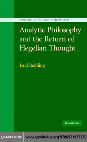
This book examines the possibilities for the rehabilitation of Hegelian thought within current an... more This book examines the possibilities for the rehabilitation of Hegelian thought within current analytic philosophy. From its inception, the analytic tradition has in general accepted Bertrand Russell's hostile dismissal of the idealists, based on the claim that their metaphysical views were irretrievably corrupted by the faulty logic that informed them. But these assumptions are challenged by the work of such analytic philosophers as John McDowell and Robert Brandom, who while contributing to core areas of the analytic movement, nevertheless have found in Hegel sophisticated ideas that are able to address problems which still haunt the analytic tradition after a hundred years. Paul Redding traces the consequences of the displacement of the logic presupposed by Kant and Hegel by modern post-Fregean logic, and examines the developments within twentieth-century analytic philosophy which have made possible an analytic re-engagement with a previously dismissed philosophical tradition.
University of Chicago Press, 2023
Conceptual Harmonies develops an original account of G. W. F. Hegel’s perplexing Science of Logic... more Conceptual Harmonies develops an original account of G. W. F. Hegel’s perplexing Science of Logic from a simple insight: philosophical and mathematical thought have shaped each other since classical times. Situating the Science of Logic within the rise of modern mathematics, Redding stresses Hegel’s attention to Pythagorean ratios, Platonic reason, and Aristotle’s geometrically inspired logic. He then explores how later traditions shaped Hegel’s world, through both Leibniz and new forms of algebraic geometry. This enlightening reading recovers an overlooked stream in Hegel’s philosophy that remains, Redding argues, important for contemporary conceptions of logic.
An advance on recent revisionist thinking about Hegelian philosophy, this book interprets Hegel’s... more An advance on recent revisionist thinking about Hegelian philosophy, this book interprets Hegel’s achievement as part of a revolutionary modernization of ancient philosophical thought initiated by Kant. In particular, Paul Redding argues that Hegel’s use of hermeneutics, an emerging way of thinking objectively about intentional human subjects, overcame the major obstacle encountered by Kant in his attempt to modernize philosophy. The result was the first genuinely modern, hermeneutic, and “nonmetaphysical” philosophy.
Most attempts to trace the roots of current scientific approaches to the mind have ignored the co... more Most attempts to trace the roots of current scientific approaches to the mind have ignored the contributions of post-Kantian German idealism. Paul Redding here shows the relevance of this philosophical tradition to an understanding of the mind and its embodiment as well as the relation of feeling to cognition.
Most attempts to trace the roots of current scientific approaches to the mind have ignored the co... more Most attempts to trace the roots of current scientific approaches to the mind have ignored the contributions of post-Kantian German idealism. Paul Redding here shows the relevance of this philosophical tradition to an understanding of the mind and its embodiment as well as the relation of feeling to cognition.
Standard accounts of nineteenth-century German philosophy often begin with Kant and assess philos... more Standard accounts of nineteenth-century German philosophy often begin with Kant and assess philosophers after him in light of their responses to Kantian idealism. In Continental Idealism, Paul Redding argues that the story of German idealism begins with Leibniz.
Redding begins by examining Leibniz’s dispute with Newton over the nature of space, time and God, and stresses the way in which Leibniz had incorporated Platonic and Aristotelian elements into his distinctive brand of idealism. Redding shows how Kant’s interpretation of Leibniz’s views of space and time consequently shaped his own “transcendental” version of idealism. Redding then argues that the idealisms of Fichte, Schelling and Hegel, on the one hand, and metaphysical sceptics such as Schopenhauer and Nietzsche, on the other, continued to wrestle with a form of idealism ultimately derived from Leibniz.
BLURB: Standard accounts of nineteenth-century German philosophy often begin with Kant and assess... more BLURB: Standard accounts of nineteenth-century German philosophy often begin with Kant and assess philosophers after him in light of their responses to Kantian idealism. In Continental Idealism, Paul Redding argues that the story of German idealism begins with Leibniz.
Redding begins by examining Leibniz’s dispute with Newton over the nature of space, time and God, and stresses the way in which Leibniz had incorporated Platonic and Aristotelian elements into his distinctive brand of idealism. Redding shows how Kant’s interpretation of Leibniz’s views of space and time consequently shaped his own “transcendental” version of idealism. Redding then argues that the idealisms of Fichte, Schelling and Hegel, on the one hand, and metaphysical sceptics such as Schopenhauer and Nietzsche, on the other, continued to wrestle with a form of idealism ultimately derived from Leibniz.
Continental Idealism offers not only a new picture of one of the most important philosophical movements in the history of philosophy, but also a valuable and clear introduction to the origins of Continental and European philosophy.

After a period of neglect, the idealist and romantic philosophies that emerged in the wake of Kan... more After a period of neglect, the idealist and romantic philosophies that emerged in the wake of Kant’s revolutionary writings have once more become important foci of philosophical interest, especially in relation to the question of the role of religion in human life. By developing and reinterpreting basic Kantian ideas, an array of thinkers including Schelling, Hegel, Friedrich Schlegel, Hölderlin and Novalis transformed the conceptual framework within which the nature of religion could be considered. Furthermore, in doing so they significantly shaped the philosophical perspectives from within which later thinkers such as Feuerbach, Kierkegaard, Wagner and Nietzsche could re-pose the question of religion. This volume explores the spaces opened during this extended period of post-Kantian thinking for a reconsideration of the place of religion within the project of human self-fashioning.

This book examines the possibilities for the rehabilitation of Hegelian thought within current an... more This book examines the possibilities for the rehabilitation of Hegelian thought within current analytic philosophy. From its inception, the analytic tradition has in general accepted Bertrand Russell's hostile dismissal of the idealists, based on the claim that their metaphysical views were irretrievably corrupted by the faulty logic that informed them. But these assumptions are challenged by the work of such analytic philosophers as John McDowell and Robert Brandom, who while contributing to core areas of the analytic movement, nevertheless have found in Hegel sophisticated ideas that are able to address problems which still haunt the analytic tradition after a hundred years. Paul Redding traces the consequences of the displacement of the logic presupposed by Kant and Hegel by modern post-Fregean logic, and examines the developments within twentieth-century analytic philosophy which have made possible an analytic re-engagement with a previously dismissed philosophical tradition.
Thoughts, Deeds, Words and World examines key features of Hegel’s philosophy as giving expression... more Thoughts, Deeds, Words and World examines key features of Hegel’s philosophy as giving expression to a response—both idealist and systematic—to the so-called “metacritical” attack on Kant’s revolutionary form of idealism. This metacritical attack, which appeared in the late 18th century in different forms in works by J. G. Hamann and his follower J. G. von Herder, was based on the thesis that language was, in Hamann’s words, “the only, first, and last organon and criterion of reason, with no credentials but tradition and usage”. This style of thesis, stressing the dependency of thought on the conventions of language, has been echoed in more recent times by similarly conceived attacks on systematic philosophy.
Thoughts, Deeds, Words and World examines key features of Hegel’s philosophy as giving expression... more Thoughts, Deeds, Words and World examines key features of Hegel’s philosophy as giving expression to a response—both idealist and systematic—to the so-called “metacritical” attack on Kant’s revolutionary form of idealism. This metacritical attack, which appeared in the late 18th century in different forms in works by J. G. Hamann and his follower J. G. von Herder, was based on the thesis that language was, in Hamann’s words, “the only, first, and last organon and criterion of reason, with no credentials but tradition and usage”. This style of thesis, stressing the dependency of thought on the conventions of language, has been echoed in more recent times by similarly conceived attacks on systematic philosophy.

Religion After Kant: God and Culture in the Idealist Era
After a period of neglect, the idealist and romantic philosophies that emerged in the wake of Kan... more After a period of neglect, the idealist and romantic philosophies that emerged in the wake of Kant’s revolutionary writings have once more become important foci of philosophical interest, especially in relation to the question of the role of religion in human life. By developing and reinterpreting basic Kantian ideas, an array of thinkers including Schelling, Hegel, Friedrich Schlegel, Hölderlin and Novalis transformed the conceptual framework within which the nature of religion could be considered. Furthermore, in doing so they significantly shaped the philosophical perspectives from within which later thinkers such as Feuerbach, Kierkegaard, Wagner and Nietzsche could re-pose the question of religion. This volume explores the spaces opened during this extended period of post-Kantian thinking for a reconsideration of the place of religion within the project of human self-fashioning.
Journal Articles by Paul M Redding
Philosophies, 2026
The paper starts by questioning the highly influential but extremely misleading characterizations... more The paper starts by questioning the highly influential but extremely misleading characterizations of Plato and Hegel by Bertrand Russell and Karl Popper. It is argued that mathematical assumptions concerning the ancient problem of the incommensurability of continuous and discrete quantities underlie the ways in which Russell and Popper portray the metaphysics of Plato and Hegel-Popper explicitly, and Russell implicitly, presupposing a particular response to this problem by broadening the concept of number to include irrational numbers. Recent work on Plato, however, suggests a different strategy for responding to this ancient conundrum, one that involves a mediated "duality" of the continuous and discrete that Hegel would later generalize to a duality of determinate and indeterminate aspects of cognition more generally. This Platonic alternative had originated with the Pythagorean natural philosopher Philolaus of Croton and would later be expressed in modern mathematics in a non-Cartesian way of applying numerical metrics to geometric figures in disciplines such as projective geometry. Such an alternative approach to both quantitative and conceptual incommensurability, I claim, had influenced Plato's later conception of philosophical method that would be adopted by Hegel via the intermediary of Leibniz, the first modern "idealist". Understanding the actual mathematics modeling philosophical concepts for Plato and Hegel becomes crucial for understanding the philosophical claims of modern idealism.

Journal of Philosophical Investigations, 2026
Gottfried Ploucquet, a teacher at the Tubingen seminary when Hegel was a student there, had been ... more Gottfried Ploucquet, a teacher at the Tubingen seminary when Hegel was a student there, had been one of the few philosophers to take up Leibniz's mathematized logic, including his project of reducing logic, and thought itself, to computational processes. In his Science of Logic, Hegel briefly discusses this project when expanding on his own "subjective" logic. The general tenor of the response is predictable. Computational logic seeks to mechanize conceptual processes, but conceptuality itself distinguishes free spiritual beings from machines. Beneath the surface, however, Hegel's attitude to the relation of computation to conceptual reasoning is more complex. Here I argue that in Book I of his Logic, Hegel, following the approach of Plato in his late dialogues, treats a certain mathematical conception of number, the Neopythagorean triadic monad, as a model for the concept itself. In the section Quantity, Hegel focuses on the incommensurability between discrete and continuous quantities, the numbers of arithmetic and the lines, areas and volumes of geometry. This incommensurability had been discovered by the Pythagoreans and in his later writings, Plato had adopted a proposal for mediating it, attempting to generalize it to a solution of the conceptual incommensurability between the eternal realm of being and the transient realm of becoming. In line with Plato's attempt, Hegel presents an account of the development of mathematical practices in which the concept of number from mere counting unit to a triadic form mediating numbers and geometric continua. This structure will in turn provide a model for his own later syllogism. This role for mathematics for Hegel is to be understood as in line with Plato's later attempts to mediate being and becoming in ways in which eternal Ideas can be approximated in the form of worldly surrogates manifesting this triune structure. Conceptuality cannot be reduced to computation, but relations among computational processes nevertheless reveal much about the nature of conceptuality.

philosophies, 2025
Aristotle is often regarded as providing a potentially appropriate model for a naturalistic human... more Aristotle is often regarded as providing a potentially appropriate model for a naturalistic human psychology that is able to reconcile the commonly opposed normative or "manifest" and factual or "scientific" images of the world and restore to the world the qualities that constitute its value. Such Aristotelian features were taken up after Newton by Goethe in his Theory of Color in his attempt to restore the actual color to the world that had seemingly been drained of it by Newtonian science. Here, I argue that beneath the "modificationalist" elements that Goethe took from Aristotle lies a mathematical approach to color originating in Plato that exploits similarities between color and tonal consonances and dissonances. The logical structure of Goethe's color theory has recently been investigated by proponents of "universal logic", but only when this theory is viewed against the background of Plato's appropriation of Pythagorean harmonic theory does its full explanatory potential become apparent.

Histories, 2025
While Kepler is regarded as a major figure in standard historical accounts of the scientific revo... more While Kepler is regarded as a major figure in standard historical accounts of the scientific revolution of early modern Europe, he is typically seen as having one foot in the new scientific culture and one in the old. In some of his work, Kepler appears, along with Galileo, to be on a trajectory towards Newton's celestial mechanics. In addition to his advocacy of Copernicus's heliocentrism, he appealed to physical causes in his explanations of the movements of celestial bodies. But other work appears to express a neo-Platonic "metaphysics" or "mysticism", as most obvious in his embrace of the ancient tradition of the "music of the spheres". Here I problematize this distinction. The musical features of Kepler's purported neo-Platonic "metaphysics", I argue, was also tied to Platonic and neo-Platonic features of the methodology of a tradition of mathematical astronomy that would remain largely untouched by his shift to heliocentrism and that would be essential to his actual scientific practice. Importantly, certain features of the geometric practices he inherited-ones later formalized as "projective geometry"-would also carry those "harmonic" structures expressed in the thesis of the music of the spheres.

HOPOS, 2024
While Hegel is generally not known as a philosopher of mathematics, he maintained a deep interest... more While Hegel is generally not known as a philosopher of mathematics, he maintained a deep interest in the history of mathematics, especially in its transformations between antiquity and the modern age. Charles S. Peirce, who was the son of a distinguished mathematician and was involved in developments in mathematics in the second half of the nineteenth century, was critical of what he perceived as Hegel’s lack of mathematical acumen. Nevertheless, he
recognized in Hegel’s Science of Logic, structural features of his own mathematically
informed philosophy.
In this paper I look to Hegel’s discussion of magnitude in The Science of Logic, and especially to his conception of the relation between continuous and discrete magnitudes, in order to articulate a solution he might offer to difficulties encountered by Peirce in his opposition to Cantor’s set-theoretical analysis of the continuum. It is argued that Hegel’s interest in the ancient Platonic/Pythagorean tradition in mathematics provided him with crucial resources in this regard.

Philosophies, 2024
In this paper, I approach Hegel’s philosophy under the banner of a “Keplerian Revolution”, the i... more In this paper, I approach Hegel’s philosophy under the banner of a “Keplerian Revolution”, the implicit reference being, of course, to Kant’s supposed Copernican philosophical revolution. Kepler had been an early supporter of the Copernican paradigm in astronomy, but went well beyond
his predecessor, and so is invoked here in an attempt to capture some of the important ways in which Hegel attempted to go beyond the philosophy of Kant. To make these issues more determinate, however, Hegel’s Keplerian orientation will not be presented in its contrast to Kant’s “Copernicanism” as such, but as contrasted with that of another early follower of Copernicus, Giordano Bruno, and this Brunian orientation will be used to characterize Kant’s philosophy as seen from Hegel’s rival
Keplerian point of view. Interpreting Hegel as a philosophical Keplerian will require that we broach those worrisome aspects of Kepler’s astronomy, namely his support for Plato’s cosmology and the tradition of the “music of the spheres”, but this will be shown to have connections to Hegel’s own
approach to logic. This in turn will help shed light on the meaning of Hegel’s form of idealism and, in particular, on its usually unacknowledged Platonic dimensions

Journal of Philosophical Investigations, 2024
In this paper I return to the familiar territory of the Lord-Bondsman "dialectic" in Hegel's Phen... more In this paper I return to the familiar territory of the Lord-Bondsman "dialectic" in Hegel's Phenomenology of Spirit in order to raise the question of the relation of Hegel's use of the theme of recognition there to Fichte's. Fichte had introduced the notion of recognition in his Foundations of Natural Right, to "deduce" the social existence of humans within relations of mutual recognition as a necessary condition of their very self-consciousness. However, there it also functioned as part of a solution to a problem within the work on which the theory of rights was meant to be based, the earlier Foundation of the Complete Wissenschaftslehre of 1794-5. In Hegel's classic account in chapter 4 of the Phenomenology we find recognition offered as a solution to a problem within an account of "self�consciousness" that has a number of clearly Fichtean features. But I suggest that to the degree that the lord-bondsman episode there expresses any "theory of recognition", it is not Hegel’s own theory but rather his interpretation of Fichte's, a theory of which he is critical. Freed from this misleading assumption that the "lord-bondsman dialectic" represents something deep about Hegel's own philosophy, we might then be more able to get clearer about Hegel's actual views about recognition and the role it plays in his own philosophy.


Uploads
Videos by Paul M Redding
Books by Paul M Redding
Redding begins by examining Leibniz’s dispute with Newton over the nature of space, time and God, and stresses the way in which Leibniz had incorporated Platonic and Aristotelian elements into his distinctive brand of idealism. Redding shows how Kant’s interpretation of Leibniz’s views of space and time consequently shaped his own “transcendental” version of idealism. Redding then argues that the idealisms of Fichte, Schelling and Hegel, on the one hand, and metaphysical sceptics such as Schopenhauer and Nietzsche, on the other, continued to wrestle with a form of idealism ultimately derived from Leibniz.
Redding begins by examining Leibniz’s dispute with Newton over the nature of space, time and God, and stresses the way in which Leibniz had incorporated Platonic and Aristotelian elements into his distinctive brand of idealism. Redding shows how Kant’s interpretation of Leibniz’s views of space and time consequently shaped his own “transcendental” version of idealism. Redding then argues that the idealisms of Fichte, Schelling and Hegel, on the one hand, and metaphysical sceptics such as Schopenhauer and Nietzsche, on the other, continued to wrestle with a form of idealism ultimately derived from Leibniz.
Continental Idealism offers not only a new picture of one of the most important philosophical movements in the history of philosophy, but also a valuable and clear introduction to the origins of Continental and European philosophy.
Journal Articles by Paul M Redding
recognized in Hegel’s Science of Logic, structural features of his own mathematically
informed philosophy.
In this paper I look to Hegel’s discussion of magnitude in The Science of Logic, and especially to his conception of the relation between continuous and discrete magnitudes, in order to articulate a solution he might offer to difficulties encountered by Peirce in his opposition to Cantor’s set-theoretical analysis of the continuum. It is argued that Hegel’s interest in the ancient Platonic/Pythagorean tradition in mathematics provided him with crucial resources in this regard.
his predecessor, and so is invoked here in an attempt to capture some of the important ways in which Hegel attempted to go beyond the philosophy of Kant. To make these issues more determinate, however, Hegel’s Keplerian orientation will not be presented in its contrast to Kant’s “Copernicanism” as such, but as contrasted with that of another early follower of Copernicus, Giordano Bruno, and this Brunian orientation will be used to characterize Kant’s philosophy as seen from Hegel’s rival
Keplerian point of view. Interpreting Hegel as a philosophical Keplerian will require that we broach those worrisome aspects of Kepler’s astronomy, namely his support for Plato’s cosmology and the tradition of the “music of the spheres”, but this will be shown to have connections to Hegel’s own
approach to logic. This in turn will help shed light on the meaning of Hegel’s form of idealism and, in particular, on its usually unacknowledged Platonic dimensions