The WordPress core development team builds WordPress! Follow this site for general updates, status reports, and the occasional code debate. There’s lots of ways to contribute:
After a livelydiscussion about the ideology of the leadership structure for minor releases during the August 29 dev chat, and following through on our effort to develop a broader group of people who can lead releases, @antpb and @schlessera will serve as co-leads for 4.9.9. @sergeybiryukov will assist with commits. There were 21 emoji reactions to this message in Slack, so it’s official. No takesies backsies.
A tentative schedule will be announced once release leads can align schedules for the next 6-8 weeks.
4.9.9 Inclusions
@youknowriad mentioned it would be lovely for these two REST API issues to land in 4.9.9:
#44862: Create REST API endpoints to lock, release and takeover post edition
#44758: The REST API is not respecting the user’s locale properly
If you have other issues you’d like to see in 4.9.9, come on over to next week’s chat. We’ll keep the lights on for ya.
Focus Lead & Component Maintainer Updates
Gutenberg
We’ve got a 3.7 release! This version includes clarifications for some core interactions, expanding the Unified Toolbar mode, squashing Gutenbugs and SO. MUCH. MORE.
Please continue to provide us with feedback via testing and block usage.
I personally appreciate any and all Gutenberg puns. Thanks in advance!
During the August 29 dev chat, we notified the channel that we had volunteers to host a second dev chat at a different time on Wednesdays. The goal of having a second dev chat is to see if expanding dev chat across another set of time zones would be more inclusive of the non-U.S. based WordPressers.
Following a lively discussion, those who volunteered to lead the second chat are drafting a proposal that is still a WIP. We’ll open up the discussion again during next week’s dev chat.
Merge Proposal: Dark Mode
@danieltj is here 100% here for our eyeballs with Dark Mode. His merge proposal answers what Dark Mode is and isn’t, especially the big question about why it isn’t a color scheme. You have to click to find out. I’m not spoiling it here.
Further testing and feedback is needed, so please help out if you can.
HTTPS
tl;dr – This conversation has moved over to #core-http in Slack and is being self-organized by those involved. And yes we know that channel name is not secure!
Chrome stepped their game up when it comes to flagging non-SSL sites, so @westonruter suggested we do the same when encouraging users to enable HTTPS whenever possible.
Gutenberg has a policy where deprecated functionality is kept for two additional minor versions to allow time for plugin developers to move away. As we start deprecating functionality in the published npm modules, the idea of tying to Gutenberg version doesn’t make a whole lot of sense, as these packages could be used independently of Gutenberg or WordPress.
It was raised by many that our packages should just follow semver. The most likely scenario for the 5.0 merge will be that the JavaScript will still be maintained on Github and included in WordPress through npm. The aforementioned deprecation policy is mostly something that applies to the Gutenberg / WordPress context then. The initial idea in terms of flow looks somewhat like this:
Packages follow semver, so something could be removed in a major version, ie. 3.0
Then the package adds a deprecation warning in a minor version before that, ie. 2.x
The deprecated call as used by packages wouldn’t include anything specific about Gutenberg, but somehow Gutenberg extends the message it logs (by filter), analyzes the generic deprecation version (the npm SemVer) and maps it back to an equivalent Gutenberg / WordPress release.
Actions
Explore extensibility of deprecated to allow Gutenberg to define its domain-specific messaging (@aduth, @youknowriad)
(Re-)consider how and where to define boundaries between packages and core-specific JavaScript (proposal by @atimmer, @omarreiss)
The build step that was introduced in #43055 seems to cause quite some friction for PHP development, since now you also need to build to see a change in the PHP reflected. This turns out to be a weird experience for PHP development, since there’s no real reason why it needs to be built. A solution that allows for building with symlinked PHP files was pursued in #44492, but seems to run into a dead end. @omarreiss is now working on a grunt build:dev task which allows to build into src after all and asked if anyone had any input / objections.
It was raised that some PHP files (ie. formatting.php) need to be built right now and this is really confusing. Since PHP is a dynamic server language, we should look if we can avoid any PHP from being built statically. Apart from this there seemed to be no objections to the approach.
Currently it’s not clear if plugin developers should consume WordPress packages through the wp global or by importing them from the @wordpress/ namespace. Documentation and guidelines about this are currently lacking. It was raised that different approaches are probably needed in different scenario’s. Factors that play a role are:
if the plugin author needs to backport these API’s or not in order to support classic editor.
If the plugin author uses ES2015 or older versions of JS.
If the plugin author uses a build proces.
Actions
@atimmer will work on a guideline for the plugin development handbook in which he plans to document different scenario’s and approaches.
Updates from focus leads and component maintainers
General announcements
If you have anything to propose to add to the agenda or specific items related to the above, then please leave a comment below. Either way, we look forward to seeing you at the devchat this week!
Our final update for August aims to add further clarity to some core interactions, as well as fixing many issues. Notably, we are expanding on the previously called “Fixed Toolbar” mode — now named Unified Toolbar — as an optional mode for a more traditional writing environment. In our testing, this mode tends to be preferred by more experienced users who don’t mind the disconnect between the tools and the content blocks. There’s also an additional setting which focuses the editing experience on a single block at a time, as well as de-emphasizing some of the block boundaries. These tools can be combined at will to better suit personal preferences and creative workflows.
There are many improvements to individual blocks, conversions, templates, and interactions. We want to say thank you again to everyone who is engaging, raising concerns or making suggestions, and collaborating in making the project better with each release.
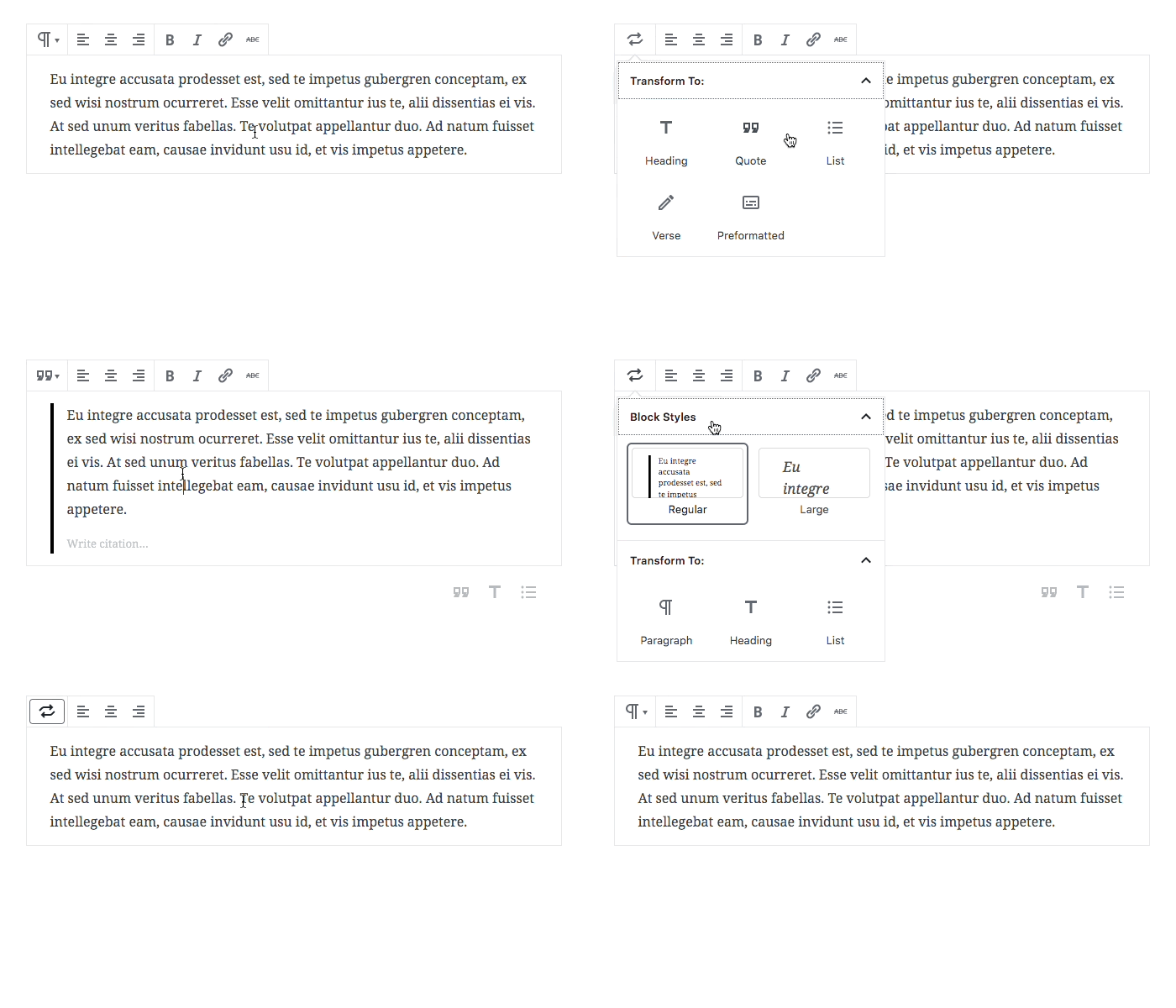
Updates to the Block Switcher Menu
3.7 🛵
New “Spotlight Mode” that focuses on a single block at a time and an updated “Unified Toolbar” design. Both can be combined.
Resolve an issue where removing all blocks from a post with a template assigned would reintroduce the template blocks after saving and reloading the editor.
Resolve an issue where a filter responsible for stripping dynamic blocks from excerpts was never properly removed. Causing blocks like “Latest Posts” not rendering under some circumstances.
Dark Mode has become a rapidly popular feature to many online tools and services in recent years and it’s about time WordPress joins in on this trend as well. Many websites such as Twitter, YouTube, Reddit and even macOS Mojave, Apple’s newest operating system have adopted this feature as one to help user’s who are looking at screens for long periods of time. Traditionally we’re use to seeing light backgrounds and dark text in a high contrast environment which can be damaging for the eyes.
If you have ever found yourself working on something late at night and having to make adjustments so the bright light doesn’t hurt your eyes so much, you’re in for a treat!
Say good evening to… Dark Mode
Dark Mode transforms the colours of the WordPress dashboard from bright white and grey colours to dark grey and black instead. This means you no longer need to squint or turn down your brightness setting trying to avoid things like headaches and eyestrain.
Whilst Dark Mode is a great way to personalise your setup, there’s a few things that it’s not. These include but is not limited to:
It is not a high contrast mode for accessibility needs
It is not a new admin colour scheme for WordPress
It is not a tool to aid in any health issues you may have (poor vision etc)
Your Questions Answered
1. What is Dark Mode? Dark Mode is a new option available for each individual user of your WordPress website to change the dashboard style to a darker design, steering away from the classic white and grey design we’re all use to.
2. Why should this be in Core? WordPress has always made use of lighter colours within the dashboard. Whilst this may be fine for many, some users may find it harder to read text on the page and it gives people the opportunity to experience their settings in a much nicer, and more comfortable design.
3. How would this be maintained in Core? As this affects the entire WordPress experience in the dashboard, it would require at least a small group of people to actively maintain it as a component and would need continuous input between developers and designers when new features are rolled out.
4. Will this support Gutenberg? No, Dark Mode supports TinyMCE (not the theme editable areas) but will not support Gutenberg right now. This is something that should be worked on in tandem with the Gutenberg core team. It’s been decided that a merge proposal with Gutenberg support is the most beneficial way forward at the moment. This is partly due to the nature of rapid weekly updates and changes that Gutenberg is facing which would make it difficult to properly maintain at the moment.
5. Which plugins will be supported? / How can plugins support Dark Mode? Please refer to the plugin compatibility guide on the GitHub repository for more information on this. For most plugins, this will be a case of using an action hook to include the third party plugin’s Dark Mode stylesheet which is triggered when the current user has confirmed they’d like to use Dark Mode.
Currently, the only plugin which is natively supported by the Dark Mode plugin is Gutenberg. This is because Gutenberg is a feature plugin which will become part of the WordPress core and must be supported by default. No other plugins are to be supported at this time. Plugin developers wishing to save themselves time should try to use the default WordPress UI elements as much as possible.
And for the most important and most asked question of all…
6. Why isn’t this a colour scheme? Admin Colour Schemes, since being added in WordPress 3.x change the colour of the admin toolbar and the side menu within the dashboard. Colour schemes, generally (and should only) change these two elements and nothing else. Dark Mode doesn’t affect either of these two elements. In fact, the sole purpose of Dark Mode is to change the style of the main content area in the dashboard. This means you can have a custom admin colour scheme enabled alongside Dark Mode if you really wanted to.
Testing & Merging
Dark Mode has already been thoroughly tested but should have further testing before merging to ensure that every element is styled just right. As it currently stands, Dark Mode has been designed in a class model which enables it to be placed within core very easily with the use of hooks.
Whilst there may be some changes required to port it over into the core stack, the current files required for it to actually work are only 2. The PHP code to check the user preference and the CSS file containing the styles meaning the task of actually merging could be relatively quick.
If you do find any issues, please report them by opening a new issue on GitHub.
Thank You!
I would like to give a big thank you to everyone who has helped get Dark Mode to where it is today. The development of the the plugin started on the 3rd October 2017. Since then, the plugin has seen contributors of various levels assist in testing, coding and designing the product we have now. Yay for open source communities!
Updates from focus leads and component maintainers
General announcements
Discuss second dev chat proposal (for our non-20:00 UTC friends)
If you have anything to propose, to add to the agenda, or specific items related to the above, please leave a comment below. Either way, we look forward to seeing you at the devchat this week!
Experiment with the following steps to see how this works: WordPress side: – Gutenberg packages stay where they are – Gutenberg’s PHP (script registration and bootstrapping) move to core. – Webpack config to alias wp.* to npm dependencies moves to Core’s webpack config. Gutenberg side: – Kept as plugin for ease of maintenance, updates. – Plugin re-register’s the scripts (overriding wp’s registrations) – No more php bootstrapping in the Gutenberg repository.
Some experimentation could involve consuming packages in WordPress core.
Example: Usage of shortcodes.js could be replaced with @wordpress/shortcodes
edit-post needs to be moved to a package.
Resolve componentsand block-library which have some code that lives outside packages.
Decision: Ship packages without any polyfills, then bundle all polyfills in WordPress core. Documentation will include something like this:
This package assumes that your code will run in an ES2015+ environment. If you’re using an environment that has limited or no support for ES2015+ such as lower versions of IE then using core-js or @babel/polyfillwill add support for these methods. Learn more about it in Babel docs.
Most importantly, we are grateful that we’re receiving so much feedback, and genuinely empathize with the inevitable frustration that accompanies developing and using new features.
Unfortunately, we have to address some of the unproductive communication contained in some feedback submissions, even going as far as to personally attack Gutenberg contributors. It’s easy to submit negative feedback when you don’t have to look someone in the eye, but there are IRL humans with IRL feelings who receive and address those tasks.
If you are providing feedback please follow the WordPress Etiquette and Support Forum Guidelines. Utilizing respectful, productive phrasing is also a fantastic way to ensure your submissions are taken seriously and acted on swiftly.
4.9.9 Planning & Lead Nominations
We don’t have a hard timeline yet for 5.0, so once we select leads for 4.9.9 it’s looking like a regular 6-8 week maintenance cycle.
This is likely the last week for 4.9.9 lead nominations. Non-engineers can be leads, too! Nominate your pals or nominate yourself – by leaving a comment here or DMing @jeffpaul
Focus Lead & Component Maintainer Updates
Gutenberg
So many enhancements and Guten-bug* fixes over the last few weeks:
The REST API team met earlier this month to discuss 5.0 planning, meta handling and authentication.
If you’re interested and available, the REST API team is looking for a lead contribution for the authentication plugins. Hit up @kadamwhite directly or mosey on over to the #core-restapi channel.
JavaScript
More chats!
August 14, 2018 | Highlights: Optimizing WordPress package distribution using NPM
August 21, 2018 | Highlights: Use of globals, lodash import, polyfills for built-ins, a proposal for managing packages, and including vendor scripts in plugins.
Tide is a series of automated tests run against every plugin and theme in the directory and then displays PHP compatibility and test errors/warnings in the directory.
The Tide team can be found at #tide in Slack, and welcomes input for release candidate inclusions for an eventual 1.0.0 release.
*I’m sorry.
General Announcements
It’s been awhile since we evaluated the weekly <dev chat> schedule, so here we are. Some options discussed included:
Alternating time zones every other week
Having two chats in one day at different times
Moving everyone to NYC and @joemcgill will pay all expenses
This is a call for a lovely person or two to help us coordinate a second/alternate <dev chat> time.
Comment on this post or message @jeffpaul and/or me in Slack.
The next <dev chat> will take place on Wednesday, August 29, 2018 20:00 UTC in the #core Slack channel. Please drop in with any updates or questions. If you have items to discuss, drop a comment on next week’s agenda post, so we can take them into account.
This recap is a summary of our previous PHP meeting. It highlights the ideas and decisions which came up during that meeting, both as a means of documenting and to provide a quick overview for those who were unable to attend.
We specifically looked at the closing section that acts as a summary, wondering whether it could be highlighted more or whether it is even needed. In the end it was decided to keep it as it is, as web readers typically expect a conclusion to occur at the end of a resource. Furthermore it leaves them with a positive attitude about their (future) achievement.
There were two comments about redundancy of paragraphs describing what would be the topic of the respective next section, since they are followed by a heading telling the same thing. However, as linking paragraphs they improve the reading flow and therefore should remain present.
A couple of minor wording improvements were discussed and applied.
It was agreed that the only outstanding change is the removal of all the hosting-specific tutorial links. They should be replaced with a single link to an external resource containing those links, similar how it is in the current live version of the page. A long list of links would distract readers, furthermore a single external resource allows for more flexibility on how this is managed. For now, the single link should point to the hosting-specific tutorials list in the Servehappy resources repository. Once this change is present, the content of the Google document can go live, replacing the current Update PHP page content.
Before the meeting, at WordCamp Brighton, a new idea of coming up with a documentation pattern and distributing it to hosts in order to get them provide guides on how to update PHP on their environment was discussed. The idea was appreciated by everyone. While an involved task, it will iterate on the already present crowd-sourced resources repository.
It would make sense to use GitHub Pages for such a repository. Pointing to a repository directly would easily confuse non-technical users, and a simple website fetching the content from GitHub Markdown files would improve that greatly.
A consideration is the URL to use for that. GitHub Pages URLs for organization repositories contain both the organization name and the repository name, so for the servehappy resources directory, it would be WordPress.github.io/servehappy-resources, which is not very obvious for what it contains. A repository named update-php or update-php-resources would be a better alternative. Alternatively, a custom domain could be used. This needs to be carefully evaluated.
Agenda: Further discuss the approach for streamlining hosts’ PHP update tutorials and using GitHub Pages (or possible alternatives) for those resources.
If you have suggestions about this but cannot make the meeting, please leave a comment on this post so that we can take them into account.
Updates from focus leads and component maintainers
General announcements
If you have anything to propose to add to the agenda or specific items related to the above, then please leave a comment below. Either way, we look forward to seeing you at the devchat this week!