Books by Gregory M Nixon

University of Lethbridge Archives, Theses and Project, Spring 1990, 1990
This document consists of two parts: one is a creative work (a full-length play) and the other is... more This document consists of two parts: one is a creative work (a full-length play) and the other is an introduction to and a commentary upon my experience of the creative process. The play, Shiva's Dance, is an attempt to understand--from within, as it were--varous individuals' encounters with the miraculous. I understand the miraculous to mean that which is inexplicable in any rational or past-experiential sense. My play is set in Sri Lanka, near the village of Kataragama where the annual firewalking ceremonies take place even today. Firewalking is the central "miracle" of the play, but it symbolically represents much more: It is an intiation of consciousness and only those who are ready for the sacred experience of silent awareness can succeed at it. There are various representatives of Western Culture present in Sri Lanka for various reasons in my play. There is a Protestant Christian missionary and his frustrated wife. There is an agricultural technologist who is the voice of reason and science. And there is a CUSO teacher: she grows into the focal point of the play and she discovers her own resources in the face of terror. Yes, terror: The play is set in Sri Lanka, so other difficulties arise from these circumstances. The Sri Lankan civil war comes to the corner where these individuals are working out their destinies and terrorists play a role in the events' unfolding. Furthermore, there is the "old" versus the "new" conflict between two other characters--a father and a son--who are Sr i Lankan. And, lastly, at the most obvious level, the play involves us in questions of cross-cultural education and/or indoctrination. It forces each of us (I hope) to question the cultural imperatives which we take for granted and to realize that these imperatives must be deconstructed to awaken to new self-created potentials. Because Shiva's Dance was written in isolation, I naturally had to deal with the impact of its unveiling to other minds. I write about this in my Introduction in a general way, and in a longer Appendix in a more personal manner. In these parts, I attempt to study the process of creating characters who sometimes act against the writer's intentions and with the writer's assumed need to prevent this. I also deal openly with the process of continual rewrites and dealings with friendly critics and my review committee.

Louisianan State University Dissertation on File, 1992
Autobiography in curriculum theory and practice is being more and more acknowledged as a major fo... more Autobiography in curriculum theory and practice is being more and more acknowledged as a major force leading toward the development of reflectively analytical teachers, reflexive practitioners, and discursively self-aware individuals. I look to explore a vital aspect of this self-narration.
I speak of memory, without which narrative continuity would be impossible. Memory is as involved with learning as it is with storytelling, and I agree with Krell (1978) that “inquiry into memory and the theory of pedagogy go hand in hand” (p. 131). I eschew the models of memory provided by the behavioral sciences, empirical psychology, cognitive psychology, and the memory-as-a-mechanism model of neurophysiology for all these models end-up vanishing into metaphor. I embrace metaphor and attempt a more open-ended approach through phenomenology to the experience of memory. I freely employ the literary arts for their evocation of long-term memory (as opposed to the basically short-term studies of psychology).
I maintain that memory opens out far deeper than the consciousness of the daily self. It becomes limited within this self as sensory input from socially constructed semiosis restricts imagination. Memory may reach beyond this self through the strange images which, for example, irradiate our dreams or become narrated as myths. Myth as present in the seams between daily words and actions is traced through semiotics and the work of archetypal psychology. Remembering mythically is epistrophe (Hillman, 1979a). I use such epistrophe to explore the meaning of a memory which must recoil against action to see through the self. It is this recoil against time which may illuminate the imagination and emotion hidden in the well of memory.

Makyo Press, 1995
Autobiography in curriculum theory and practice is being more and more acknowledged as a major fo... more Autobiography in curriculum theory and practice is being more and more acknowledged as a major force leading toward the development of reflectively analytical teachers, reflexive practitioners, and discursively self-aware individuals. I look to three vital aspects of self-narration to explore.
I speak firstly of memory, without which narrative continuity would be impossible. Memory is as involved with learning as it is with storytelling, and I agree with Krell (1978) that “inquiry into memory and the theory of pedagogy go hand in hand” (p. 131). I eschew the models of memory provided by the cognitive sciences, empirical psychology, and the memory-as-objective-data model of neurophysiology for all these models end-up vanishing into metaphor (despite their best intentions). I embrace metaphor and attempt a more open-ended approach through phenomenology to the experience of memory. I freely employ the literary arts for their evocation of long-term memory (as opposed to the basically short-term studies of experimental psychology).
I maintain that memory is encoded as deep within language as the self and that it leads finally to the primordial narratives we call myths. Secondly, then, myth as foundational to both how and what we remember, and myth as present in the seams between words, is traced through language and the work of archetypal psychology. Remembering mythically is epistrophe (Hillman, 1979a). I use such memory and such myth to suggest the insubstantiality of the ego and of the subject that remembers, and to explore the meaning of a memory which must recoil against action to see through the self.
Lastly, I seek the sources of memory beyond the self, in the field in which the body itself finds itself implicated. Is there a sense when in a state of receptivity (sometimes lifewriting) we open ourselves to Great Memory? Instead of a self freely remembering past events as though they were recorded on banks of neural chips, is there a sense of attunement in which we may find ourselves remembered as interiorized language? The phenomenon of memory is explored as the self-creative force par excellence—the force which draws together events against the uncoiling spiral of time to give each of us that self-identity, that contained labyrinth we call consciousness, which can only exist in the immediate, but still receding past.

Three Pines Press, 2019
A collection of essays that explores the many dimensions of the mystical, including personal, th... more A collection of essays that explores the many dimensions of the mystical, including personal, theoretical, and historical.
Kohav, a professor of philosophy at the Metropolitan State College of Denver and the editor of this collection, provocatively asks why mysticism is such an "objectionable" topic and considered intellectually disreputable. Borrowing from Jacques Derrida's distinction between aporia (or unsolvable confusion) and a solvable problem, the author suggests mystical phenomena are better understood through the lens of mysterium, that which is beyond the categories of reason and can only be captured by dint of intuition and personal experience. In fact, the contributors to this intellectually kaleidoscopic volume present several autobiographical accounts of precisely such an encounter with the mystically inscrutable. For example, in one essay, Gregory M. Nixon relates "the shattering moment in my life when I awoke from the dream of self to find being as part of the living world and not in my head." The religious dimensions of mystical experience are also explored: Buddhist, Christian, and Judaic texts, including the Bible, are examined to explicate and compare their divergent interpretations. Contributor Jacob Rump argues that the ineffable is central to Wittgenstein's worldview, and Ori Z. Soltes contends that philosophers like Socrates and Spinoza, famous for their valorization of reason, are incomprehensible without also considering the limits they impose on reason and the value they assign to ineffable experience. The collection is precisely as multidisciplinary as billed. It includes a wealth of varying perspectives, both personal and scholarly. Furthermore, the book examines the application of these ideas to contemporary debates. Richard H. Jones, for instance, challenges that mysticism and science ultimately converge into a single explanatory whole. The prose can be prohibitively dense--much of it is written in a jargon-laden academic parlance--and the book is not intended for a popular audience. Within a remarkably technical discussion of the proper interpretive approach to sacred texts, contributor Brian Lancaster declares: "For these reasons I propose incorporating a hermeneutic component to extend the integration of neuroscientific and phenomenological data that defines neurophenomenology." However, Kohav's anthology is still a stimulating tour of the subject, philosophically enthralling and wide reaching. An engrossing, diverse collection of takes on mystical phenomena.
- Kirkus Reviews
The volume investigates the question of meaning of mystical phenomena and, conversely, queries the concept of “meaning” itself, via insights afforded by mystical experiences. The collection brings together researchers from such disparate fields as philosophy, psychology, history of religion, cognitive poetics, and semiotics, in an effort to ascertain the question of mysticism’s meaning through pertinent, up-to-date multidisciplinarity. The discussion commences with Editor’s Introduction that probes persistent questions of complexity as well as perplexity of mysticism and the reasons why problematizing mysticism leads to even greater enigmas. One thread within the volume provides the contextual framework for continuing fascination of mysticism that includes a consideration of several historical traditions as well as personal accounts of mystical experiences: Two contributions showcase ancient Egyptian and ancient Israelite involvements with mystical alterations of consciousness and Christianity’s origins being steeped in mystical praxis; and four essays highlight mysticism’s formative presence in Chinese traditions and Tibetan Buddhism as well as medieval Judaism and Kabbalah mysticism. A second, more overarching strand within the volume is concerned with multidisciplinary investigations of the phenomenon of mysticism, including philosophical, psychological, cognitive, and semiotic analyses. To this effect, the volume explores the question of philosophy’s relation to mysticism and vice versa, together with a Wittgensteinian nexus between mysticism, facticity, and truth; language mysticism and “supernormal meaning” engendered by certain mystical states; and a semiotic scrutiny of some mystical experiences and their ineffability. Finally, the volume includes an assessment of the so-called New Age authors’ contention of the convergence of scientific and mystical claims about reality. The above two tracks are appended with personal, contemporary accounts of mystical experiences, in the Prologue; and a futuristic envisioning, as a fictitious chronicle from the time-to-come, of life without things mystical, in the Postscript. The volume contains thirteen chapters; its international contributors are based in Canada, United Kingdom, and the United States.
DokNyx Publications, 2022
Back Cover:
A historically-based novel with authentic, legendary, & fictional characters interac... more Back Cover:
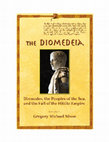
A historically-based novel with authentic, legendary, & fictional characters interacting across the extraordinary panorama of the Bronze Age Collapse in the Hittite Empire between the Aegean and eastern Mediterranean seas. Diomedes, previously a hero of the Trojan War, and the polyglot Peoples of the Sea raid inland into the Hittite Empire during its final months. It is both a study of ancient mythic consciousness and an exciting adventure of love, character, destruction, desperate survival, and the lived mystery of pagan rituals. It was a time of such chaos, royalty was overthrown, palaces and temples were burnt, and the power of the gods was thrown into doubt, yet the ancient Great Goddess, who had been suppressed, began to regain her former dominance.
Diomedes, though prominent in Homer's Iliad — a warrior the equal of Hektor or Achilleus, a thinker as cunning as Odysseus and as wise as Nestor, and the only man who dared wound gods — has seldom, if ever, been the chief protagonist in literature. He is given his due within. His own wandering adventures and suffering after the destruction of Ilios are traced as far north as Kolkhis (Colchis) in the Black Sea, through involvement with the last Hittite royal family in Anatolia, and as far south as Alasiya (Cyprus) in the Mediterranean. He ascends the heights of glory but also must descend into the dark Underworld in the attempt to save the one he loves.
Book Reviews by Gregory M Nixon

Book Review of Haggerson & Bowman, Eds. *Informing Educational Policy and Practice through Interpretive Inquiry*
Teaching Education, 1992
Haggerson and Bowman have collected 12 essays gnerically referred to as “interpretive inquiry.” T... more Haggerson and Bowman have collected 12 essays gnerically referred to as “interpretive inquiry.” They recognize that sll research is interpretive to some degree but that the “Rational/Theoretical” paradigm—the objecttive data-collecting approach most commonly employed—is only mnimally interpretive in that the researcher herself is assumed to be an impartial observer and the human study-samples are treated as interchangeable statistics. Because of the “scientistic” closure, rational/theoretical research is not equated with a more ongoing inquiry and is not included in their book. Condensing the four earlier categories of James MacDonald into three, the editors divide the essays into the paradigms of the “Mythological/Practical,” “Evolutionary/Transformational,” and the “Normative/Critical.”
Journal of Consciousness Studies, 1998
Terrence Deacon has constructed a tome in which he unleashes his considerable learning in quest o... more Terrence Deacon has constructed a tome in which he unleashes his considerable learning in quest of several answers to the question, “What are we?” He is uniquely qualified to take an approach which details the origin and development of, first, language, then the brain, and, lastly, their “co-evolution”. Described on the jacket as “a world-renowned researcher in neuroscience and evolutionary anthropology,” all of his background is called upon at various times to pull together the mass of data and supposition that Deacon brings to the table.
Journal of Consciousness Studies, 1999
The Warner Books back cover proclaims: ‘In the tradition of Oliver Sach’s [sic] bestselling The M... more The Warner Books back cover proclaims: ‘In the tradition of Oliver Sach’s [sic] bestselling The Man Who Mistook His Wife for a Hat...’ The manner and misspelling signify that Cytowic himself had nothing to do with such publishing hucksterism. However, one thing is clear upon reading this book: Richard Cytowic, M.D., is no Oliver Sacks. Though, as will be seen, there is much in here to recommend itself, his stilted reproduction of conversations which or may not have taken place and his ‘Creative Fiction 100’ characterizations (i.e., Dr. Wood’s continual inhalation of smoke or food) strike the experienced reader as painfully contrived, as though Cytowic were doing his level best to imitate Sacks and reach that always-elusive ‘wider audience’.
Journal of Consciousness Studies, 1999
J. J. O’Donnell is one those scholars whose learning is assumed rather than displayed. As a resul... more J. J. O’Donnell is one those scholars whose learning is assumed rather than displayed. As a result, his brief approach to the long-terms effects of the computer revolution on reading and higher education feels like a bracing, sophisticated exchange of ideas. Like conversation, O’Donnell’s thesis is not terribly unified or orderly. He often makes sidetracks from his focus on high technology and literacy into explaining such interesting things as how we choose our cultural ancestry instead of merely evolving out of it, the errors of current education, and perhaps more than you ever wanted to know about other avatars of the word such as St. Jerome, St. Augustine, and Cassiodorus. Great cover too.
Journal of Consciousness Studies, 2000
This is a fine book. In what has become a crowded field, it stands out as direct, deep, and darin... more This is a fine book. In what has become a crowded field, it stands out as direct, deep, and daring. It should place Max Velmans amongst the stars in the field like Chalmers, Dennett, Searle, and Churchland who are most commonly referenced in consciousness studies books and articles. It is direct in that the de rigueur history and review of the body-mind problem is illuminating and concise. It is deep in that Velmans deconstructs the usual idea of an objective world as distinct from our experienced world. It is daring in that in his last chapter he comes out on the side of consciousness co-evolving with the universe rather than arising at some point within it (though he insists that such speculation is beyond the more empirical intent of his earlier chapters).
Journal of Consciousness Studies, 2001
Of the many books I have read this past year, only this one would I call beautiful. It is not jus... more Of the many books I have read this past year, only this one would I call beautiful. It is not just a read but an encounter with a deeply inspiring being who seems to become an actual presence herself—someone to guide us back toward consciously awakening to the wondrous, sensuous world around us. Far beyond the information purveyed or even the stories told, Laura Sewall herself emerges from her luminous prose as though to point with a gentle smile to the doorway which will lead us from our self-made enclosure, from the prison of our own device.
Journal of Consciousness Studies, 2003
Christian de Quincey, Managing Editor of the IONS (Institute of Noetic Sciences) Review and advoc... more Christian de Quincey, Managing Editor of the IONS (Institute of Noetic Sciences) Review and advocate for a unified view of consciousness, cosmology, and spirituality should be well-known to the readers of this journal. He has placed his endorsement of panexperientialism — the view that physical nature experiences — in opposition to the perspectives of Colin McGinn (1994), Nick Humphrey (2000a), and Ken Wilber (2000b) in three JCS articles (much of which is repeated here). Panexperientialism is a bracing notion, one in which human consciousness arises from the natural life of the universe without the explanatory gap of traditional materialism or the need for any sort of supernatural miracle.

Journal of Consciousness Studies, 2004
What happens when a worldly Israeli cognitive psychologist goes to the Amazon Basin where he inge... more What happens when a worldly Israeli cognitive psychologist goes to the Amazon Basin where he ingests the famed psychotropic concoction Ayahuasca (the ‘vine of the dead’) again and again and again? Our intrepid philosophical psychologist is no longer a sprightly youth, maddened for adventure. He is instead an accomplished theoretician with widely published articles (several in this journal) and a noted book (Shanon, 1993) that speak the from the perspective of cognitive (or phenomenological, for Shanon) psychology against the reductive tendency to view the mind’s activities as created by the the brain’s activities. Even before his Amazonian quest, he placed himself in the Gibsonian camp seeing the mind as dynamic intermediary between organism and environment and active participant in both. What did happen is this extraordinary book, a scientific analysis of his own visions and the education of both Shanon’s views and, perhaps, his soul.
Journal of Consciousness Studies, 2005
At last, a worthy antidote to the noxious trend that explains all human consciousness and behavio... more At last, a worthy antidote to the noxious trend that explains all human consciousness and behaviour in terms of the evolution and activities of the brain alone! Cognitive science, evolutionary psychology, and neurophilosophy, while adding complexity, have embraced the assumption that life unfolds primarily on the basis of evolving, interacting genes. But this view is unbalanced at best. Greenspan and Shanker remind us that opposition to it need not imply mysticism, idealism, or anything spooky. They state the predominance of cultural learning passed on from generation to generation, its content always changing and never complete.
Journal of Consciousness Studies, 2007
Martin Jay, renowned intellectual historian from UC Berkeley, here examines these questions in a ... more Martin Jay, renowned intellectual historian from UC Berkeley, here examines these questions in a grand survey of the term’s use throughout the intellectual history of what was once called Western Civilization. Beginning with the ancient Greeks (of course), he reviews the surprising number of variations employed and assumed by philosophers, theologians critical theorists, and right up to the poststructuralists. Jay knows his territory and reading this survey of it — for anyone with any sort of background in the history of philosophy — is often as pleasant as hearing a familiar symphony well-played in a unique way.
Journal of Consciousness Studies, Sep 2009
Is the great god Pan reborn? For a while there, it seemed every intellectual movement began with ... more Is the great god Pan reborn? For a while there, it seemed every intellectual movement began with the prefix ‘post’, implying non-totality, but now there are indications that ‘pan’ (all) is returning to provide another answer to one of the most basic of ontological questions: What is the relationship of mind to matter? In this important book with 17 different authors, panpsychism is given its due.

Journal of Consciousness Exploration & Research, 2011
The purpose of this review article is to attempt to come to grips with the elusive vision of Gord... more The purpose of this review article is to attempt to come to grips with the elusive vision of Gordon Globus, especially as revealed in this, his latest book. However, one can only grip that which is tangible and solid and Globus's marriage of Heideggerian anti-concepts and "quantum neurophilosophy" seems purposefully to evade solidity or grasp. This slippery anti-metaphysics is sometimes a curse for the reader seeking imagistic or conceptual clarity, but, on the other hand, it is also the blessing that allows Globus to go far beyond (or deep within) the usual narrative explanations at the frontiers of physics, even that of the quantum variety.
The Transparent Becoming of the World is a short book at 154 pages of text, but it is long read. At first reading, I confess I found it numbingly frustrating because the use of Heidegger’s invented terminology shaken and stirred in with the already ambiguous terminology of quantum neurophilosophy (itself an intermingling of quantum physics, neuroscience and free speculation) simply did not compute. Trying to grasp what Globus is getting at often seemed like the proverbial attempt to hold a rushing stream in one’s hand. I confess I had to put the book aside for a time. However, when I realized that Globus seemed to be relying on spatial metaphors when what he was really referencing was time, the second reading bore more fruit (even it was a strange fruit indeed).
Journal of Consciousness Studies, 2016
This is a fine book by an extraordinary author whose literary followers have awaited a definitive... more This is a fine book by an extraordinary author whose literary followers have awaited a definitive statement of his views on consciousness since his participation in the important book on biological autopoiesis, *The Embodied Mind* (Varela, Thompson, & Rosch, 1991) and his recent neurophenomenology of biological systems, *Mind in Life* (2007). In the latter book, Thompson demonstrated the continuity of life and mind, whereas in this book he uses neurophenomenology as well as erudite renditions of Buddhist philosophy and a good dash of personal experience to argue for the reality of altered states of consciousness, but also that these states are not distinct from the physical systems that subtend them. He must have touched a nerve, for Waking, Dreaming, Being continues to be read and widely discussed by the literate public.

Journal of Consciousness Studies, Aug 2017
This book arrives with a reputation. Apparently, it is the first book on psi and other anomalous ... more This book arrives with a reputation. Apparently, it is the first book on psi and other anomalous human experiences to be published by the rather traditionalist APA (American Psychological Association). If this is true, this is likely due to the fact that much of the book relies on carefully monitored and repeated experiments to demonstrate the statistical veracity of such things as precognition, remote viewing, clairvoyance, mental telepathy, and even psychokinesis. This is the key to the authors' claim of empirical testing and scientific proof. This is not a long book, consisting of only eight self-contained chapters that work in concert to lead toward the implication of a kind of idealist ultimate reality. Despite its size, it seems they manage to cover all aspects of psi, including post-mortem communication with 'discarnate entities', and they cite nearly all the well-known authors in this field over the past decades and earlier.
Metascience, 2017
To begin, the editors cite their approved very general definition of their central term: “Panpsyc... more To begin, the editors cite their approved very general definition of their central term: “Panpsychism is the doctrine that mind is a fundamental feature of the world which exists throughout the universe” (p. 1). However, this generic definition says nothing about the size, shape, or nature of the original or primal “minds” or “mind” from which all other minds derive. This question of the fundamental nature of experiencing entities or fields seems to be the major one being addressed in these pages.


Uploads
Books by Gregory M Nixon
I speak of memory, without which narrative continuity would be impossible. Memory is as involved with learning as it is with storytelling, and I agree with Krell (1978) that “inquiry into memory and the theory of pedagogy go hand in hand” (p. 131). I eschew the models of memory provided by the behavioral sciences, empirical psychology, cognitive psychology, and the memory-as-a-mechanism model of neurophysiology for all these models end-up vanishing into metaphor. I embrace metaphor and attempt a more open-ended approach through phenomenology to the experience of memory. I freely employ the literary arts for their evocation of long-term memory (as opposed to the basically short-term studies of psychology).
I maintain that memory opens out far deeper than the consciousness of the daily self. It becomes limited within this self as sensory input from socially constructed semiosis restricts imagination. Memory may reach beyond this self through the strange images which, for example, irradiate our dreams or become narrated as myths. Myth as present in the seams between daily words and actions is traced through semiotics and the work of archetypal psychology. Remembering mythically is epistrophe (Hillman, 1979a). I use such epistrophe to explore the meaning of a memory which must recoil against action to see through the self. It is this recoil against time which may illuminate the imagination and emotion hidden in the well of memory.
I speak firstly of memory, without which narrative continuity would be impossible. Memory is as involved with learning as it is with storytelling, and I agree with Krell (1978) that “inquiry into memory and the theory of pedagogy go hand in hand” (p. 131). I eschew the models of memory provided by the cognitive sciences, empirical psychology, and the memory-as-objective-data model of neurophysiology for all these models end-up vanishing into metaphor (despite their best intentions). I embrace metaphor and attempt a more open-ended approach through phenomenology to the experience of memory. I freely employ the literary arts for their evocation of long-term memory (as opposed to the basically short-term studies of experimental psychology).
I maintain that memory is encoded as deep within language as the self and that it leads finally to the primordial narratives we call myths. Secondly, then, myth as foundational to both how and what we remember, and myth as present in the seams between words, is traced through language and the work of archetypal psychology. Remembering mythically is epistrophe (Hillman, 1979a). I use such memory and such myth to suggest the insubstantiality of the ego and of the subject that remembers, and to explore the meaning of a memory which must recoil against action to see through the self.
Lastly, I seek the sources of memory beyond the self, in the field in which the body itself finds itself implicated. Is there a sense when in a state of receptivity (sometimes lifewriting) we open ourselves to Great Memory? Instead of a self freely remembering past events as though they were recorded on banks of neural chips, is there a sense of attunement in which we may find ourselves remembered as interiorized language? The phenomenon of memory is explored as the self-creative force par excellence—the force which draws together events against the uncoiling spiral of time to give each of us that self-identity, that contained labyrinth we call consciousness, which can only exist in the immediate, but still receding past.
Kohav, a professor of philosophy at the Metropolitan State College of Denver and the editor of this collection, provocatively asks why mysticism is such an "objectionable" topic and considered intellectually disreputable. Borrowing from Jacques Derrida's distinction between aporia (or unsolvable confusion) and a solvable problem, the author suggests mystical phenomena are better understood through the lens of mysterium, that which is beyond the categories of reason and can only be captured by dint of intuition and personal experience. In fact, the contributors to this intellectually kaleidoscopic volume present several autobiographical accounts of precisely such an encounter with the mystically inscrutable. For example, in one essay, Gregory M. Nixon relates "the shattering moment in my life when I awoke from the dream of self to find being as part of the living world and not in my head." The religious dimensions of mystical experience are also explored: Buddhist, Christian, and Judaic texts, including the Bible, are examined to explicate and compare their divergent interpretations. Contributor Jacob Rump argues that the ineffable is central to Wittgenstein's worldview, and Ori Z. Soltes contends that philosophers like Socrates and Spinoza, famous for their valorization of reason, are incomprehensible without also considering the limits they impose on reason and the value they assign to ineffable experience. The collection is precisely as multidisciplinary as billed. It includes a wealth of varying perspectives, both personal and scholarly. Furthermore, the book examines the application of these ideas to contemporary debates. Richard H. Jones, for instance, challenges that mysticism and science ultimately converge into a single explanatory whole. The prose can be prohibitively dense--much of it is written in a jargon-laden academic parlance--and the book is not intended for a popular audience. Within a remarkably technical discussion of the proper interpretive approach to sacred texts, contributor Brian Lancaster declares: "For these reasons I propose incorporating a hermeneutic component to extend the integration of neuroscientific and phenomenological data that defines neurophenomenology." However, Kohav's anthology is still a stimulating tour of the subject, philosophically enthralling and wide reaching. An engrossing, diverse collection of takes on mystical phenomena.
- Kirkus Reviews
The volume investigates the question of meaning of mystical phenomena and, conversely, queries the concept of “meaning” itself, via insights afforded by mystical experiences. The collection brings together researchers from such disparate fields as philosophy, psychology, history of religion, cognitive poetics, and semiotics, in an effort to ascertain the question of mysticism’s meaning through pertinent, up-to-date multidisciplinarity. The discussion commences with Editor’s Introduction that probes persistent questions of complexity as well as perplexity of mysticism and the reasons why problematizing mysticism leads to even greater enigmas. One thread within the volume provides the contextual framework for continuing fascination of mysticism that includes a consideration of several historical traditions as well as personal accounts of mystical experiences: Two contributions showcase ancient Egyptian and ancient Israelite involvements with mystical alterations of consciousness and Christianity’s origins being steeped in mystical praxis; and four essays highlight mysticism’s formative presence in Chinese traditions and Tibetan Buddhism as well as medieval Judaism and Kabbalah mysticism. A second, more overarching strand within the volume is concerned with multidisciplinary investigations of the phenomenon of mysticism, including philosophical, psychological, cognitive, and semiotic analyses. To this effect, the volume explores the question of philosophy’s relation to mysticism and vice versa, together with a Wittgensteinian nexus between mysticism, facticity, and truth; language mysticism and “supernormal meaning” engendered by certain mystical states; and a semiotic scrutiny of some mystical experiences and their ineffability. Finally, the volume includes an assessment of the so-called New Age authors’ contention of the convergence of scientific and mystical claims about reality. The above two tracks are appended with personal, contemporary accounts of mystical experiences, in the Prologue; and a futuristic envisioning, as a fictitious chronicle from the time-to-come, of life without things mystical, in the Postscript. The volume contains thirteen chapters; its international contributors are based in Canada, United Kingdom, and the United States.
A historically-based novel with authentic, legendary, & fictional characters interacting across the extraordinary panorama of the Bronze Age Collapse in the Hittite Empire between the Aegean and eastern Mediterranean seas. Diomedes, previously a hero of the Trojan War, and the polyglot Peoples of the Sea raid inland into the Hittite Empire during its final months. It is both a study of ancient mythic consciousness and an exciting adventure of love, character, destruction, desperate survival, and the lived mystery of pagan rituals. It was a time of such chaos, royalty was overthrown, palaces and temples were burnt, and the power of the gods was thrown into doubt, yet the ancient Great Goddess, who had been suppressed, began to regain her former dominance.
Diomedes, though prominent in Homer's Iliad — a warrior the equal of Hektor or Achilleus, a thinker as cunning as Odysseus and as wise as Nestor, and the only man who dared wound gods — has seldom, if ever, been the chief protagonist in literature. He is given his due within. His own wandering adventures and suffering after the destruction of Ilios are traced as far north as Kolkhis (Colchis) in the Black Sea, through involvement with the last Hittite royal family in Anatolia, and as far south as Alasiya (Cyprus) in the Mediterranean. He ascends the heights of glory but also must descend into the dark Underworld in the attempt to save the one he loves.
Book Reviews by Gregory M Nixon
The Transparent Becoming of the World is a short book at 154 pages of text, but it is long read. At first reading, I confess I found it numbingly frustrating because the use of Heidegger’s invented terminology shaken and stirred in with the already ambiguous terminology of quantum neurophilosophy (itself an intermingling of quantum physics, neuroscience and free speculation) simply did not compute. Trying to grasp what Globus is getting at often seemed like the proverbial attempt to hold a rushing stream in one’s hand. I confess I had to put the book aside for a time. However, when I realized that Globus seemed to be relying on spatial metaphors when what he was really referencing was time, the second reading bore more fruit (even it was a strange fruit indeed).