Papers by Edward N Wilson
Abstract. We introduce new ideas to treat the problem of connectiv-ity of wavelets. We develop a ... more Abstract. We introduce new ideas to treat the problem of connectiv-ity of wavelets. We develop a method which produces intermediate paths of Tight Frame Wavelets (TFW). Using this method we prove that a large class of TFW-s, with only mild conditions on their spectrum, are arcwise connected. 1.
The traditional study of reproducing systems involves the Gabor systems, that are generated by th... more The traditional study of reproducing systems involves the Gabor systems, that are generated by the action of translations and modulations on a single or finite family of functions in L 2 (R n), and the affine systems, where the dilations are used rather than the modulations. In this paper, we show that the interplay of all three operators yield a wide variate of reproducing systems, and we employ the term wave packet systems, which has been used by other authors, to describe those function systems generated by the combined action of a class of translations, modulations and dilations on a finite family of functions. We will examine in detail both the continuous and discrete versions of these systems. We shall show that these systems can be studied by using a unified approach that the authors have developed in some of their previous work.
We study Parseval frame wavelets in L2(Rn) with matrix dilations of the form(Df )(x) = √2f (Ax), ... more We study Parseval frame wavelets in L2(Rn) with matrix dilations of the form(Df )(x) = √2f (Ax), whereA is an arbitrary expanding n × n matrix with integer coefficients, such that |detA| = 2. We show that each A-MRA admits either Parseval frame wavelets, or Parseval frame bi-wavelets. The minimal number of generators seval frame associated with an A-MRA (i.e. 1 or 2) is determined in terms of a scaling function. All Parseval fra (bi)wavelets associated with A-MRA’s are described. We then introduce new classes of filter induced wavele bi-wavelets. It is proved that these new classes strictly contain the classes of all A-MRA Parseval frame wavelet and bi-wavelets, respectively. Finally, we demonstrate a method of constructing all filter induced Parseva (bi)wavelets from generalized low-pass filters. 2005 Elsevier Inc. All rights reserved.
Glasnik matematicki, 2011
The paper studies orthonormal wavelets in L 2 (R n) with dilations induced by expanding matrices ... more The paper studies orthonormal wavelets in L 2 (R n) with dilations induced by expanding matrices with integer coefficients of arbitrary determinant. We provide a method of construction of all scaling sets and, hence, of all orthonormal MSF wavelets with the additional property that the core space of the underlying multiresolution structure is singly generated. Several examples on the real line and in R 2 are included. We also prove that all MSF orthonormal wavelets whose dimension function is essentially bounded by 1 are obtained by our construction method.
Memoirs of the American Mathematical Society, 1976
This paper solves the problem of determining which Lie groups act simply transitively on a Rieman... more This paper solves the problem of determining which Lie groups act simply transitively on a Riemannian manifold with negative curvature. The results obtained extend those of Heintze for the case of strictly negative curvature.

A Panorama of Sampling Theory
Excursions in Harmonic Analysis, Volume 1, 2012
By a sampling function we mean a member \(\varphi \) of a vector space V of, preferably, continuo... more By a sampling function we mean a member \(\varphi \) of a vector space V of, preferably, continuous, \(\mathbf{C}\)-valued functions on a topological space X for which there is an orbit \(G \cdot {x}_{0}\) of a countable abelian group G acting continuously on X, and each f∈V is the sum of the terms \(f(k \cdot {x}_{0})\varphi (k \cdot x)\), \(k \in G\). Such a recovery formula generalizes the well-known Shannon sampling formula. This chapter presents a general discussion of sampling theory and introduces several new classes of sampling functions \(\varphi : \mathbf{R} \rightarrow \mathbf{C}\) for sampling sets of the form \(\mathbf{Z} + {x}_{0}\). In Sect.2 we discuss the very close connection between general convolution idempotents and sampling functions. In Sect.3 we review the properties of the Zak transform and use it to construct a large family of continuous sampling functions \(\varphi \in {L}^{2}(\mathbf{R})\) where \(\{{T}_{k}\varphi : k \in \mathbf{Z}\}\) is a frame for the principal shift-invariant space \({V }_{\varphi } =\langle \varphi \rangle\) generated by \(\varphi \). This family includes all band-limited sampling functions as well as all continuous sampling functions \(\varphi \in {V }_{\psi }\), \(\psi \in {C}_{c}(\mathbf{R})\). In Sect.4 we look at a class of continuous functions \(\psi \) which do not generate (via the Z-transform) any square-integrable sampling functions and use the Laurent transform (or Z-transform) to show how \(\psi \) generates a possibly infinite family of non-square-integrable sampling functions. In Sect.5 we sketch the manner in which purely algebraic tools lead to construction of a very large class of convolution idempotents and associated sampling functions that cannot be obtained by Zak or Laurent transform methods.
Wavelets and Multiscale Analysis, 2011
Journal of Differential Geometry, 1984
Transactions of the American Mathematical Society, 1985
Let M be a connected homogeneous Riemannian manifold, G the identity component of the full isomet... more Let M be a connected homogeneous Riemannian manifold, G the identity component of the full isometry group of M and H a transitive connected subgroup of G. G = HL. where L is the isotropy group at some point of M. M is naturally identified with the homogeneous space H/H n L endowed with a suitable left-invariant Riemannian metric. This paper addresses the problem: Given a realization of M as a Riemannian homogeneous space of a connected Lie group H, describe the structure of the full connected isometry group G in terms of H. This problem has already been studied in case H is compact, semisimple of noncompact type, or solvable. We use the fact that every Lie group is a product of subgroups of these three types in order to study the general case.

Revista De La Union Matematica Argentina, 2011
In engineering and applied mathematics, Zak transforms have been effectively used for over 50 yea... more In engineering and applied mathematics, Zak transforms have been effectively used for over 50 years in various applied settings. As Gelfand observed in a 1950 paper, the variable coefficient Fourier series ideas articulated in Andre Weil's famous book on integration lead to an exceedingly elementary proof of the Plancherel Theorem for LCA groups. The transform for functions on R appearing in Zak's seminal 1967 paper is actually a special case of the LCA group transforms earlier introduced by Weil; Zak states this explicitly in his 1967 paper but the mathematical community nonetheless chose to name the transform for him. In brief, the properties of Zak transforms are simply reflections of elementary Fourier series properties and the Plancherel Theorem for non-compact LCA groups is an immediate consequence of the fact that Fourier transforms are averages of Zak transforms. It is remarkable that only a small handful of mathematicians know this proof and that all textbooks continue to give much harder and less transparent proofs for even the case of the group R. Generalized Zak transforms arise naturally as intertwining operators for various representations of Abelian groups and allow formulation of many appealing theorems.
Wavelets and Sparsity XV, 2013
Shift invariant spaces are common in the study of analysis, appearing, for example, as cornerston... more Shift invariant spaces are common in the study of analysis, appearing, for example, as cornerstones of the theories of wavelets and sampling. The interplay of these three notions is discussed at length over R, with the one-dimensional study providing motivation for later discussions of R n , locally compact abelian groups, and some non-abelian groups. Two fundamental tools, the so-called "bracket" as well as the Zak transform(s), are described, and their deep connections to the aforementioned areas of study are made explicit.
Wavelets and Multiscale Analysis, 2011
Journal of Geometric Analysis, 2007
An orthonormal wavelet system in R d , d ∈ N, is a countable collection of functions {ψ j,k },
Applied and Numerical Harmonic Analysis
A wavelet with composite dilations is a function generating an orthonormal basis or a Parseval fr... more A wavelet with composite dilations is a function generating an orthonormal basis or a Parseval frame for L 2 (R n) under the action of lattice translations and dilations by products of elements drawn from non-commuting matrix sets A and B. Typically, the members of B are shear matrices (all eigenvalues are one) while the members of A are matrices expanding or contracting on a proper subspace of R n. These wavelets are of interest in applications because of their tendency to produce "long, narrow" window functions well suited to edge detection. In this paper, we discuss the remarkable extent to which the theory of wavelets with composite dilations parallels the theory of classical wavelets, and present several examples of such systems.
Notices of the American Mathematical Society, 2015
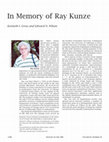
Photo taken by Ken Gross. Ray Kunze Ray Alden Kunze passed away on May 21, 2014, after a lengthy ... more Photo taken by Ken Gross. Ray Kunze Ray Alden Kunze passed away on May 21, 2014, after a lengthy illness. Ray was a longtime member of the AMS, served on the AMS Council and a number of American Mathematical Society committees, and was selected as an Inaugural Fellow in 2012. He published over fifty research articles, among which were seminal results of primary importance in representation theory and harmonic analysis. As well, his classic textbook on linear algebra, co-authored with Kenneth Hoffman, was translated into many languages and used around the world. Ray was born March 7, 1928, in Des Moines, Iowa, but lived much of his youth in the area around Milwaukee, Wisconsin. He received his bachelor of science and master of science degrees in mathematics from the University of Chicago. A talented tennis player, he was captain of the University of Chicago tennis team. He played competitive tennis and then table tennis all of his life. His graduate studies were interrupted during the early 1950s by military service, during which period he served as a mathematical analyst in the Department of Defense. Upon completion of his tour of duty he returned to his doctoral studies at the University of Chicago and in 1957 received his doctor of philosophy degree in mathematics. Ray began his mathematics career on the faculty of MIT and over the ensuing years served on
… analysis—a celebration (Il Ciocco, 2000), 2001
We present an overview of some aspects of the mathematical theory of wavelets. These notes are ad... more We present an overview of some aspects of the mathematical theory of wavelets. These notes are addressed to an audience of mathematicians familiar with only the most basic elements of Fourier Analysis. The material discussed is quite broad and covers several topics involving wavelets. Though most of the larger and more involved proofs are not included, complete references to them are provided. We do, however, present complete proofs for results that are new (in particular, this applies to a recently obtained characterization of "all" wavelets in section 4).
The Journal of Geometric Analysis
We present a survey of research on orbits of unitary representations developed under the guidance... more We present a survey of research on orbits of unitary representations developed under the guidance and leadership of Guido Weiss in the last 20 years. This line of research started via the study of wavelets and other reproducing function systems. It emphasizes the role of translations in such systems and leads naturally to the study of shift invariant spaces. The algebraic properties of integers influence many results in such spaces and suggest a more abstract nature of the entire approach. Unitary representations of various discrete groups provide far reaching generalizations of basic results. This topic is currently actively pursued by numerous authors, many of them being Guido's collaborators for years.
Applied and Computational Harmonic Analysis, 2014
A classical theorem attributed to Naimark states that, given a Parseval frame B in a Hilbert spac... more A classical theorem attributed to Naimark states that, given a Parseval frame B in a Hilbert space H, one can embed H in a larger Hilbert space K so that the image of B is the projection of an orthonormal basis for K. In the present work, we revisit the notion of Parseval frame MRA wavelets from [11] and [12] and produce an analog of Naimark's theorem for these wavelets at the level of their scaling functions. We aim to make this discussion as self-contained as possible and provide a different point of view on Parseval frame MRA wavelets than that of [11] and [12].
Applied and Computational Harmonic Analysis, 2014
A classical theorem attributed to Naimark states that, given a Parseval frame B in a Hilbert spac... more A classical theorem attributed to Naimark states that, given a Parseval frame B in a Hilbert space H, one can embed H in a larger Hilbert space K so that the image of B is the projection of an orthonormal basis for K. In the present work, we revisit the notion of Parseval frame MRA wavelets from [11] and [12] and produce an analog of Naimark's theorem for these wavelets at the level of their scaling functions. We aim to make this discussion as self-contained as possible and provide a different point of view on Parseval frame MRA wavelets than that of [11] and [12].
Glasnik Matematicki, 2003
We introduce new ideas to treat the problem of connectivity of wavelets. We develop a method whic... more We introduce new ideas to treat the problem of connectivity of wavelets. We develop a method which produces intermediate paths of Tight Frame Wavelets (TFW). Using this method we prove that a large class of TFW-s, with only mild conditions on their spectrum, are arcwise connected.


Uploads
Papers by Edward N Wilson