

 abdul wahid Hasyim
580 California St., Suite 400
San Francisco, CA, 94104
2012
…
7 pages

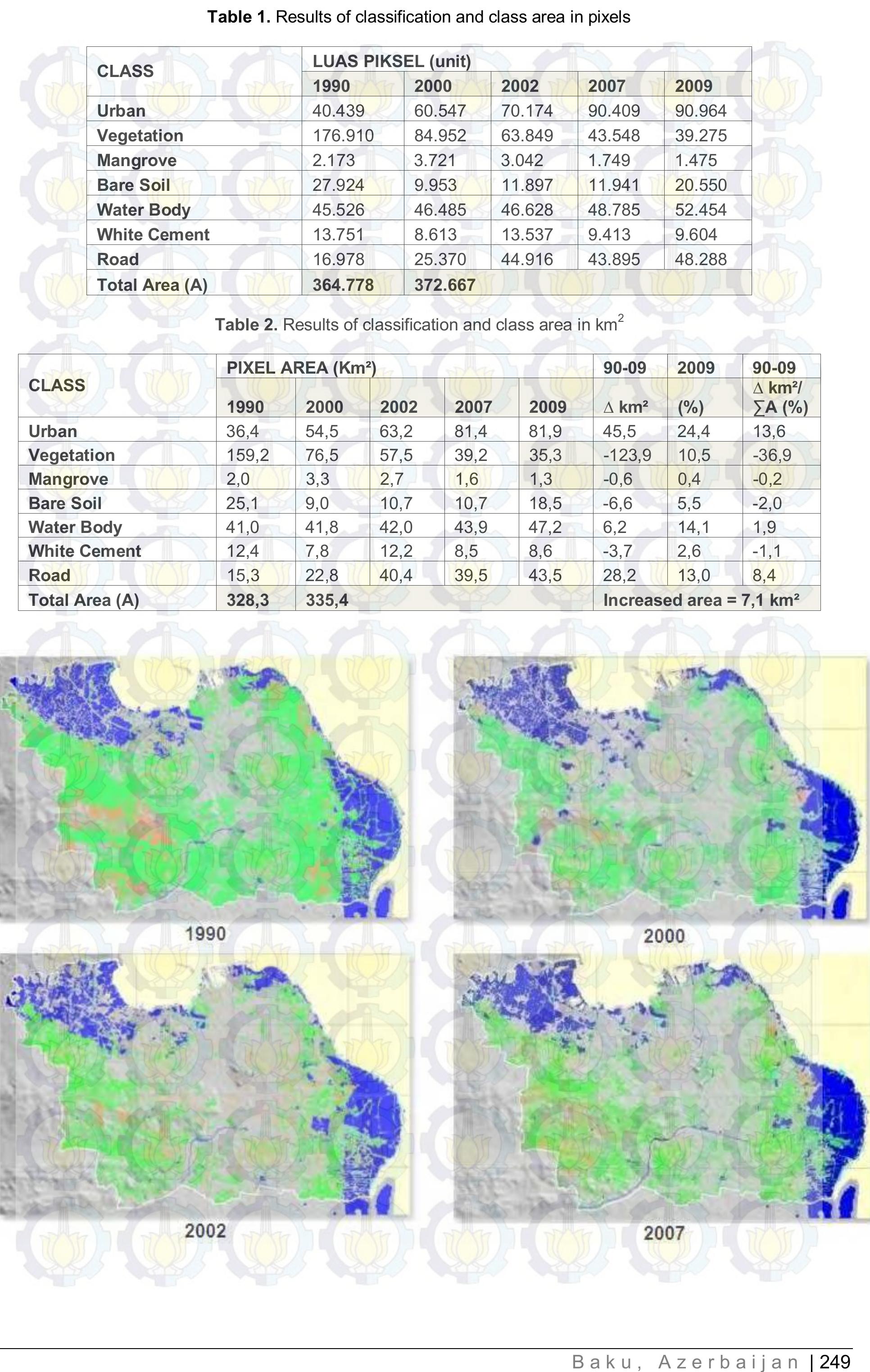
As the second largest city in Indonesia, Surabaya city with a population of more than 3 million people that has a function as a center of business, commerce, industry, and education in Eastern Indonesia into a strong attraction for the urban thereby providing an increasing number of residents each year. Based on Landsat TM and Landsat 7 ETM+ Surabaya city has an area of 372.667 pixels or 335.4Km 2, physically experiencing very rapid growth of the city for almost 20 years (1990-2009) 55.5% and 13.6% of the total area of the city. Most shape of growing cities in Indonesia, where are always faced with problems with the shrinking of the green area. Through remote sensing and GIS technologies, carried out the stages of processing of Landsat TM (1990) and Landsat 7 ETM years 2000-2009, where Landsat imagery in 2007 and 2009 should be processed first, for the missing data can be improved, needs to be done charging referred to as the filling scan gap. Performed supervised classification usi...

AI




International Journal of Image, Graphics and Signal Processing, 2014
In this paper, urban growth of Bangalore region is analyzed and discussed by using multi-temporal and multi-spectral Landsat satellite images. Urban growth analysis helps in understanding the change detection of Bangalore region. The change detection is studied over a period of 39 years and the region of interest covers an area of 2182 km 2 . The main cause for urban growth is the increase in population. In India, rapid urbanization is witnessed due to an increase in the population, continuous development has affected the existence of natural resources. Therefore observing and monitoring the natural resources (land use) plays an important role. To analyze changed detection, researcher's use remote sensing data. Continuous use of remote sensing data helps researchers to analyze the change detection. The main objective of this study is to monitor land cover changes of Bangalore district which covers rural and urban regions using multi-temporal and multi-sensor Landsat -multi-spectral scanner (MSS), thematic mapper (TM), Enhanced Thematic mapper plus (ETM+) MSS, TM and ETM+ images captured in the years
Distribution of land uses and knowledge on area plays an important role in urban planning. In this study, an attempt has been made to detect the land use and land cover changes of Barisal District of Bangladesh from 1988 to 2018. Two set of satellite image was collected from website of USGS with interval of 30 years. One the Landsat-5 TM data captured in 1988, 1998, 2008 and another is Landsat-8 OLI data captured in 2018. Unsupervised classification method is used for classification. Image difference technique is used to evaluate the change between two images and areas of different class are calculated via Erdas Imagine 2014. Finally comparison and final layout is made by ARCGIS 10.3 software. The land cover types analyzed here are: Settlement, Arable Land, Vegetation, Water bodies and Bare Land. Settlement shows increment rate of 22.85% while Arable Land, Vegetation, Water bodies and Bare Land show a decrement rate of 8.82%, 6.90%, 0.31% and 60.28% .This result is obtained due to the change in Settlements and another significant cause is natural calamities as cyclone, riverbank erosion and deposition.
Environmental Earth Sciences, 2009
Land surface temperature (LST) plays an important role in local, regional and global climate studies. LST controls the distribution of the budget for radiation heat between the atmosphere and the earth's surface. Therefore, it is important to evaluate abrupt changes in land use/land cover (LULC). Penang Island, Malaysia has been experiencing a rapid and drastic change in urban expansion over the past two decades due to growth in industrial and residential areas. The aim of this study was to investigate and evaluate the impact of LST with respect to land use changes in Penang Island, Malaysia. Three supervised classification techniques known as maximum likelihood, minimum distance-to-mean and parallelepiped were applied to the images to extract thematic information from the acquired scene by using PCI Geomatica 10.1 image processing software. These remote sensing classification techniques help to examine land-use changes in Penang Island using multi-temporal Landsat data for the period of 1999-2007. Training sites were selected within each scene and seven land cover classes were assigned to each classifier. The relative performance of each technique was evaluated. The accuracy of each classification map was assessed using a reference data set consisting of a large number of samples collected per category. Two Landsat satellite images captured in 1999 and 2007 were chosen to classify the LULC types using the maximum likelihood classification method, determined from visible and nearinfrared bands. The study revealed that the maximum likelihood classifier produced superior results and achieved a high degree of accuracy. The LST and normalised difference vegetation index (NDVI) were computed based on changes in LULC. The results showed that the urban (highly built-up) area increased dramatically, and grassland area increased moderately. Inversely, barren land decreased obviously, and forest area decreased moderately. While urban (minimally built-up) area decreased slightly. These changes in LULC caused at significant difference in LST between urban and rural areas. Strong correlation values were observed between LST and NDVI for all LULC classes. The remote sensing technique used in this study was found to be efficient; it reduced the time for the analysis of the urban expansion, and it was found to be a useful tool to evaluate the impact of urbanisation with LST.
2014
Bandung is one of the major city in Indonesia with high growth economic and population. Economic and population growth can effect to land use/land cover change. Information of land use/land cover changes is very important for planning and disaster mitigation. The land use/land cover changes can detected by satellite imagery. Object based classification system, a promising method for image classification. This paper discuss the application of Landsat satellite remote sensing image in 1994 until 2013 to identify land use/land cover changes using object based classification approach in Bandung, West Java, Indonesia. The methodology consist of satellite data acquisition, pre-processing, field survey, classification of land use/land cover using object based approach, ground check and analysis. The result shows the land use/land cover changes in Bandung, West Java, Indonesia.
Change detection is the measure of the distinct data framework and thematic change information that can guide to more tangible insights into underlying process involving land cover and land use changes than the information obtained from continuous change. Land use / Land cover analysis of the semi-urban area was carried out using Landsat TM and ETM+ imageries through Remote sensing software for Vellore district in Tamil Nadu, India. This study attempts to explore the changes along the study areas, two sets of Landsat Thematic Mapper (TM) data were used. TM data are useful for this type of study due to its high spatial resolution, spectral resolution and low repetitive acquisition (16 days).This paper discusses the land use/land cover analysis and change detection techniques using temporal multi-spectral data (1991 and 2001) of the LANDSAT TM images, systematically assessed, and checked in field. Initially 18 major classes were observed for both the images. To minimize similar features, relevant classes were reorganized to end up with 8 classes. The overall accuracy for a 1991 image is 78% and for a 2001 image is 80%. The results demonstrate that the study area experienced a rapid, decrease in forest cover, conversion of wetland vegetation to barren / dry farming, rural to urban conversion in town and municipalities resulting in decreasing ground water table in the 10 year period between 1991 and 2001.
International Journal of Environment and Geosciences
Bangli Regency is one of Regency in the Bali Province. The total area of Bangli Regency is 52,081 hectares (9.24%) of total area of Bali Province (563,666 ha). The Growth and the development of the region Bangli Regency the positive impacts on the economy of the community, and the negative impacts on the environment. Land use change is one of the negative issue of development Bangli Regency. This study conduted the calculation of land use change from 1997 to 2014 using Landsat data in Bangli Regency. Landsat 5 TM, Landsat 7 ETM+ and Landsat 8 OLI/TIRS imageries were used to determine the land use map based, on using supervised classification method. The field data set the nine classes were classtuded based, on the classification were fresh water, bare land, forest, residential, bushes, irrigated paddy field, non irrigated paddy field, dry land and plantation. There results showed in land use changes from 1997 to 2014 that plantation increased (19,486.33 ha (36.89%)), and residentia...
Journal of Geographic Information System, 2018
Land use & land cover change detection in rapid growth urbanized area have been studied by many researchers and there are many works on this topic. Commonly, settlement sprawl in area depends on many factors such as economic prosperity and population growth. Iraq is one of the countries which witnessed rapid development in the settlement area. Remote sensing and geographic information system (GIS) are analytical software technologies to evaluate this familiar worldwide phenomenon. This study illustrates settlement development in Sulaimaniyah Governorate from 2001 to 2017 using Landsat satellite imageries of different periods. All images had been classified using remote sensing software in order to proceed powerful mapping of land use classification. Maximum likelihood method is used in the accurately extracted solution information from geospatial imagery. Landsat images from the study area were categorized into four different classes. These are: forest, vegetation, soil, and settlement. Change detection analysis results illustrate that in the face of an explosive demographic shift in the settlement area where the record + 8.99 percent which is equivalent to 51.80 Km 2 over a 16-year period and settlement area increasing from 3.87 percent in 2001 to 12.86 percent in 2017. Accuracy assessment model was used to evaluate (LULC) classified images. Accuracy results show an overall accuracy of 78.83% to 90.09% from 2001 to 2017 respectively while convincing results of Kappa coefficient given between substantial and almost perfect agreements. This study will help decision-makers in urban plan for future city development.
Discrete Dynamics in Nature and Society
Blantyre City has experienced a wide range of changes in land use and land cover (LULC). This study used Remote Sensing (RS) to detect and quantify LULC changes that occurred in the city throughout a twenty-year study period, using Landsat 7 Enhanced Thematic Mapper (ETM+) images from 1999 and 2010 and Landsat 8 Operational Land Imager (OLI) images from 2019. A supervised classification method using an Artificial Neural Network (ANN) was used to classify and map LULC types. The kappa coefficient and the overall accuracy were used to ascertain the classification accuracy. Using the classified images, a postclassification comparison approach was used to detect LULC changes between 1999 and 2019. The study revealed that built-up land and agricultural land increased in their respective areas by 28.54 km2 (194.81%) and 35.80 km2 (27.16%) with corresponding annual change rates of 1.43 km·year−1 and 1.79 km·year−1. The area of bare land, forest land, herbaceous land, and waterbody, respect...
Journal of Geographic Information System, 2016
Rangpur is one of the fastest growing cities of Bangladesh with a dense population. Being the headquarter of a division in Bangladesh, it is experiencing multi-dimensional problems such as over urbanization, traffic congestion, water logging, and solid waste disposal. Rangpur is a sheer example of having poor legislative actions, inefficient management and lack of public awareness, which leads the urbanization to an unplanned and resource consuming development. This study presents an integrated study of land use pattern in Rangpur City, Bangladesh, by using Geographical Information Systems (GIS) and Remote Sensing (RS). The data sources used in this study were Landsat Thematic Mapper (TM) and a Landsat Enhanced Thematic Mapper Plus (ETM+) images taken in 1989, 2000 and 2014, respectively. All images were geometrically and radiometrically corrected and the change detection methods were performed. Then, supervised maximum likelihood classification was used as a cross classification to...
IRJET, 2022
Land Use Land Cover (LULC) change detection study helps to understand the environmental change dynamics to ensure sustainable development. Land cover is what covers the surface of the earth and land use describes how the land is used. This study mainly focuses on the usage of the geographic information system (GIS) and land usage to identify the changes in Varanasi city, which is located in Uttar Pradesh, India. GIS technique provides reliable accurate information for land use mapping through Landsat satellite imagery because it provides a synoptic view. The present study is focused on defining boundaries of different land use / land cover on a landsat satellite Imagery using Erdas Imagine 14 software. The work is done by visual image interpretation. This study mainly focuses on the classification and identification of the changes in Land use/Land cover in the years 2000, 2010 & 2020 based on a multi temporal images gathered from the satellite. The experimental results indicate that over the specified period of study, the rate of increment and decrement in the built-up area, water bodies, crop land, vegetation, fallow land and sandbars that may exhibit a significant impact on the environmental ecosystem and sustainable development.
AI
The study identifies population growth, economic development, and infrastructural demands as primary factors influencing land use changes, resulting in a sharp decrease in green areas.
The research demonstrates that the Maximum Likelihood classification method achieves a root mean square error (RMSE) of ≤ 0.2 pixels, ensuring high accuracy in land use mapping.
This study employed Landsat TM and ETM+ satellite imagery integrated with GIS technology to accurately assess urban land cover changes over 19 years.
By 2009, the green areas in Surabaya constituted only 10.9% of the total city area of 335.4 km², indicating a significant reduction.
Data was gathered using Landsat imagery with geometric corrections and training areas for supervised classification to generate thematic maps of land use changes.

Land use and land cover change has become a central component in current strategies for managing natural resources and monitoring environmental changes. Urban expansion has brought serious losses of agriculture land, vegetation land and water bodies. Urban sprawl is responsible for a variety of urban environmental issues like decreased air quality, increased runoff and subsequent flooding, increased local temperature, deterioration of water quality, etc. In this work we have taken Vijayawada city as case to study the urban expansion and land cover change that took place in a span of 36 years from 1973 to 2009. Remote sensing methodology is adopted to study the geographical land use changes occurred during the study period. Landsat images of TM and ETM+ of Vijayawada city area are collected from the USGS Earth Explorer web site. After image pre-processing, un-supervised and supervised image classification has been performed to classify the images in to different land use categories. Five land use classes have been identified as Urban (Built-up), Water body, Agricultural land, Barren land and Vegetation. Classification accuracy is also estimated using the field knowledge obtained from field surveys. The obtained accuracy is between 73 to80 percent for all the classes. Change detection analysis shows that Built-up area has been increased by 372.28%, agricultural area has been decreased by 65.16% and barren area reduced by 60.98%. Information on urban growth, land use and land cover change study is very useful to local government and urban planners for the betterment of future plans of sustainable development of the city.
International Journal of Innovative Technology and Exploring Engineering, 2020
Abstract: The development of urban areas in the city of Balikpapan increases over time and is characterized by increasing population. The growth and development of urban areas needs to be monitored so that the control function on area spatial can be implemented. This research aims to determine the direction of urban areas and measure the density of the built-up as a leading indicator of the development of urban areas in Balikpapan. The method used in this study is the multispasio-temporal analysis of remote sensing data of Landsat 7 ETM + and Landsat 8 OLI/TIRS which contain a combination of spectral transformation, classification supervised Maximum Likelihood, accuracy assessment and statistical analysis. The results showed the trend of urban development from 2001 to 2019 towards east and northeast with the highest built-up density located in the sub-district of Balikpapan Tengah by 82.07% and followed by the sub-district of Balikpapan Kota by 76.94%. The largest land conversion took place on the bare soil with low vegetation density class to be vegetation with the converted area of 7095.91 ha or approximately 14.10% followed by the bare soil with low vegetation density class to be built-up with the converted area of 5826.86 ha or about 11.58% of the total area of Balikpapan city during the period from 2001 to 2019. The accuracy of urban development map in 2001 reaches 92.39 % and the year 2019 reaches 95.69 %, while the accuracy of land cover map in 2001 reaches 85.57% and the year 2019 reaches 87.28 %.
Middle-East Journal of …, 2012
Urban land use change may influence natural phenomena and ecological processes. Decreasing of cultivated land area in Chengdu is one of the critical problems in recent years. The objective of this study is to detect land use changes between 1990 to 2002 using satellite images of Landsat TM/ETM+. Different existing applicability per year was obtained from the extracted photos and after using LMM model and GIS software for each type of land use. Different classification methods were analyzed in this research and 6 different applicability were extracted for each year. The area of residential places according to this no search has increased from 180.9 to 382.95 hectares in 12 years and about 35% of the total area has under gone changes in the same period, indicating the intensity of human destructions in this short period. LMM model is a simple, but effective method for analyzing applicability changes in district in different periods.
Land-use and land-cover change, as one of the main driving forces of global environmental change, is central to the sustainable development debate. Urban expansion has brought serious losses of agriculture land, vegetation land and water bodies. Urban sprawl is responsible for a variety of urban environmental issues like decreased air quality, increased runoff and subsequent flooding, increased local temperature, deterioration of water quality, etc. In this work we have taken Hyderabad city is taken as a case to study the urban expansion and land cover change that took place in a span of 22 years from 1989 to 2011. Remote sensing methodology is adopted to study the geographical land use changes occurred during the study period. Landsat images of TM and ETM+ of Hyderabad city area are collected from the USGS Earth Explorer web site. After image pre-processing, un-supervised and supervised image classification has been performed to classify the images in to different land use categories. Five land use classes have been identified as Urban (Built-up), Water body, Agricultural land, Barren land and Vegetation. Classification accuracy is also estimated using the field knowledge obtained from field surveys and Google earth. The obtained accuracy is between 80 to 85 percent for all the classes. Change detection analysis shows that Built-up area has been increased by 86.35%, Open land has been increased by 139.6%, Agricultural area has been decreased by 24.25% and water bodies are reduced by 53.41%. Information on urban growth, land use and land cover change study is very useful to local government and urban planners for the betterment of future plans of sustainable development of the city.
Journal of Spatial Science, 2018
This study tests the capacity of Landsat imagery and landscape metrics to explore spatial and temporal dynamics of urban expansion in Jakarta Metropolitan Area (JMA), Indonesia, over 23-year period (1994-2017). Results show that JMA's urban area has doubled in size with average expansion of nearly 40 km 2 per annum, and urban area has grown into sparsely vegetated areas on the outskirts of Jakarta and along the east-west and southern corridors of JMA. Landscape metrics show that urban land cover has evolved into single-connected urban landscape in JMA's core while more fragmented urban pattern in the inner and outer municipalities.
International Journal of Remote Sensing and Earth Sciences (IJReSES)
The Assessment of the physical character of a city is considered relatively easier than the social-cultural aspects. It is important to recognize the type of city form and to predict the behavior of people in the city and its surrounding. Due to those characteristics, the study of the pattern of physical development of the city is required. The objective of research is to analyze the change of spatial pattern of the city due to the city growing by remote sensing. The multitemporal data of Landsat 5/7/8 year 2000, 2006 and 2015 in Jabodetabek area were used. The classification technique had been done and it produced five classes of land uses. Those are water, built-up area, vegetation, other land use and no data. The results of the analysis in Jabodetabek area (Jakarta, Bogor, Depok, Tangerang and Bekasi) show that there was land use changes from vegetation and other land use area to built-up area with an average accuracy of 78% in each year. The pattern of physical development of th...
GRD Journals, 2019
Perennial, historical and current define information about the land use and land cover changes of the Earth's surface is thoroughly essential for any kind of sustainable development program because in which LULC serves as one of the major input criteria. LULC dynamics are analysed by using Remote Sensing and Geographic Information Systems (GIS). This study is an attempt to evaluate the changes in land use/land cover in Surat city situated in the state of Gujarat at western part of India over a 10 year period. The study made use of LandSat imageries of 2006 and 2016 taken from USGS earth explorer. Maximum Likelihood classification method is used to classify the images. Five LULC categories like water, vegetation, built up area and bare land were identified and mapped. The results shows that land cover changes occurred in water, vegetation, built up area and bare land were 3.12%, 15.5%, 12.50%, 24.95% respectively.
2019
Nowadays, land use and land cover (LULC) changes due to both human beings and natural environment. Consequently, LULC changes impact on water resources such as forestry, water bodies, agriculture land, wetland, urbanization, industrialization and so on. The aim of this research is to detect LULC changes in Belin Township. ERDAS IMAGINE 2015 and ArcGIS 10.4.1 have been used to analyze the images processing and classification. LULC conditions of this area for the time periods 1999, 2009 and 2018 have been considered and downloaded from Landsat ETM+ satellites images. Maximum likelihood method has been conducted in supervised image classification technique. The ground truth data or reference points are used to classify the image classification applying Google Earth Pro. Moreover, forest, settlement, water bodies, agriculture and bare land of five LULC classes are identified in this study. Bare land and Settlement are significantly unchanged during two decades. Further, forest area was increased approximately 22.36% between 1999 and 2018. However, the water bodies of this study area were decreased slightly. LULC by agriculture land was decreased between 1999 and 2018. The finding results of this research paper can contribute effectively about LULC change detection and help decision makers to develop plan in this study area.
Land use and land cover (LULC) changes is a dynamic, widespread and accelerating process, mainly driven by natural phenomena and anthropogenic activities, which in turn drives changes that world impact natural ecosystem. Change detection is one of the landscape ecological aims. Main aim of this study is to prepare land use land cover and their change detections by using remote sensing and GIS techniques. This paper presents the land use/land cover changes that have taken place in Bangalore, from 1992 to 2012.The study has been done through Landsat & IRS imagery from and 2012. The land use and land cover classification maps were prepared through remote sensing and GIS technology. The results indicate that there was a significant increasing trend in built up land and decreasing trend in agricultural land.
Arabian Journal of Geosciences, 2013
Hyderabad is one of the fastest growing mega cities in India and it is facing many economic, social and environmental problems due to rapid urban growth. For the better planning of resources and to provide basic amenities to its residents, it is necessary to have sufficient knowledge about its urban growth activities. Also, it is necessary to monitor the changes in land use over time and to detect growth activities in different parts of the city. To accomplish these tasks with greater accuracy and easiest way, remote sensing and geographic information system (GIS) tools proved to be very advantageous. This study makes an attempt towards the mapping of land use classes for different time periods and analysis of apparent changes in land use using the Landsat Thematic Mapper (TM) and Enhanced Thematic Mapper (ETM) data for the urban agglomeration of Hyderabad, India. In this study, three different time
