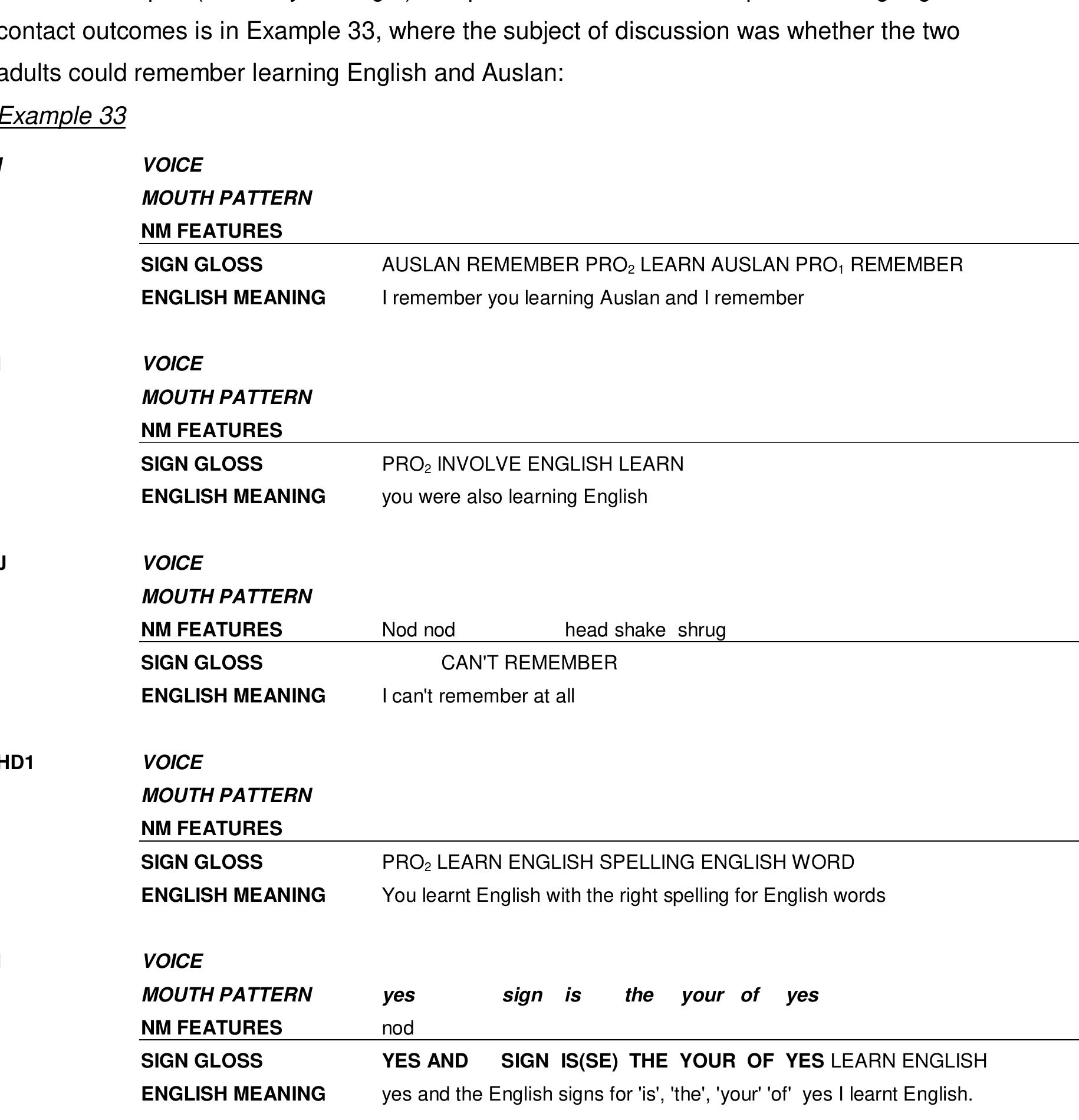
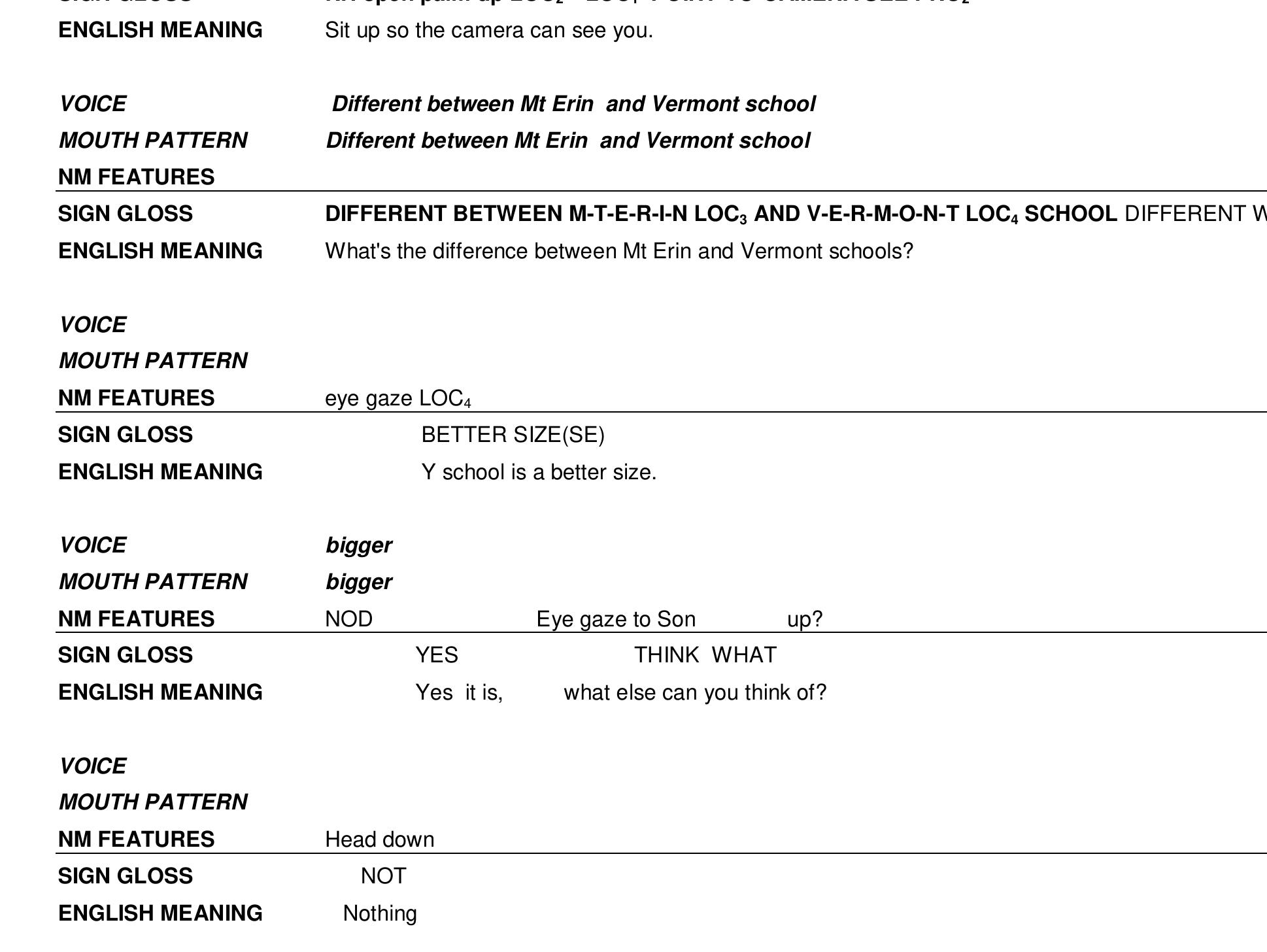
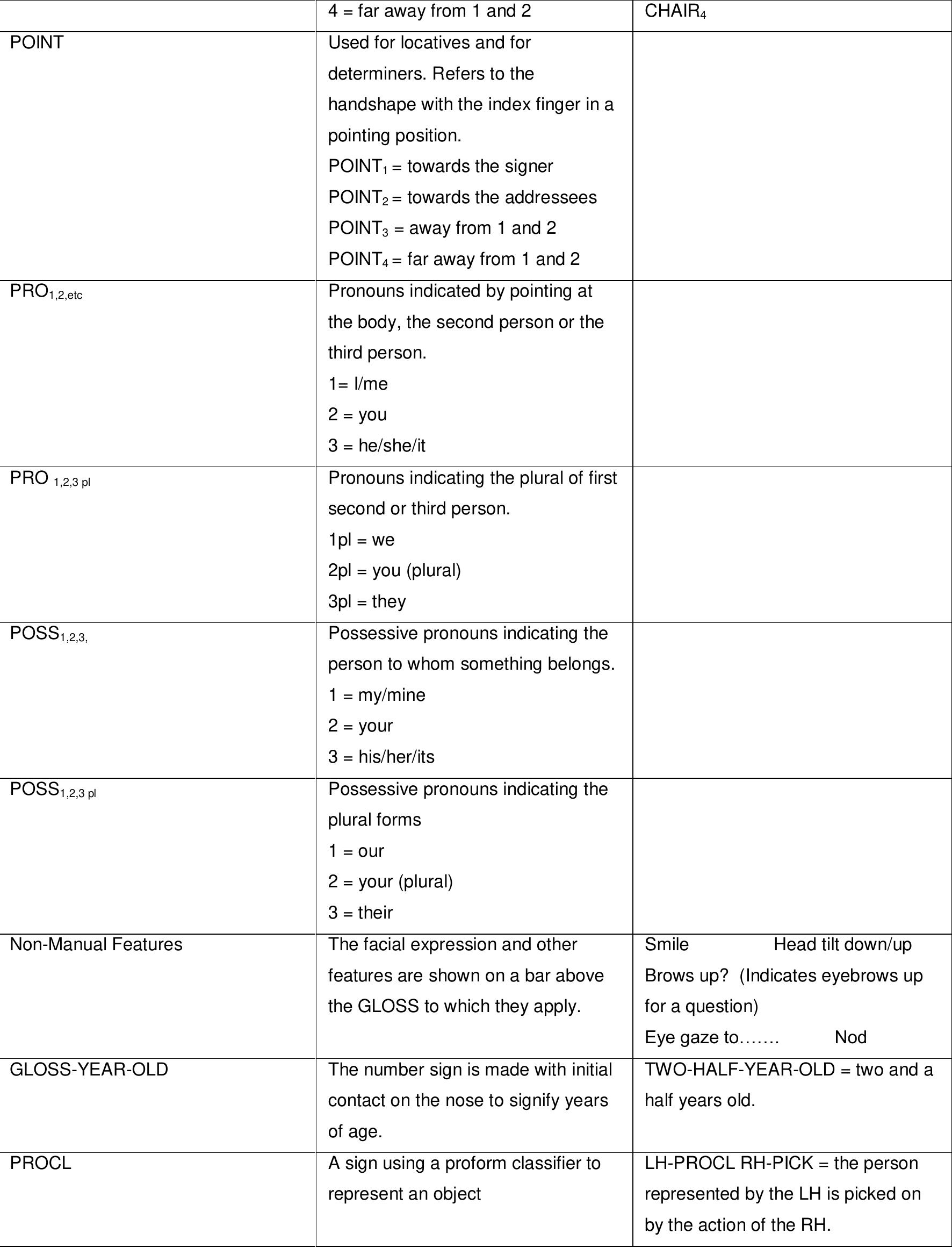
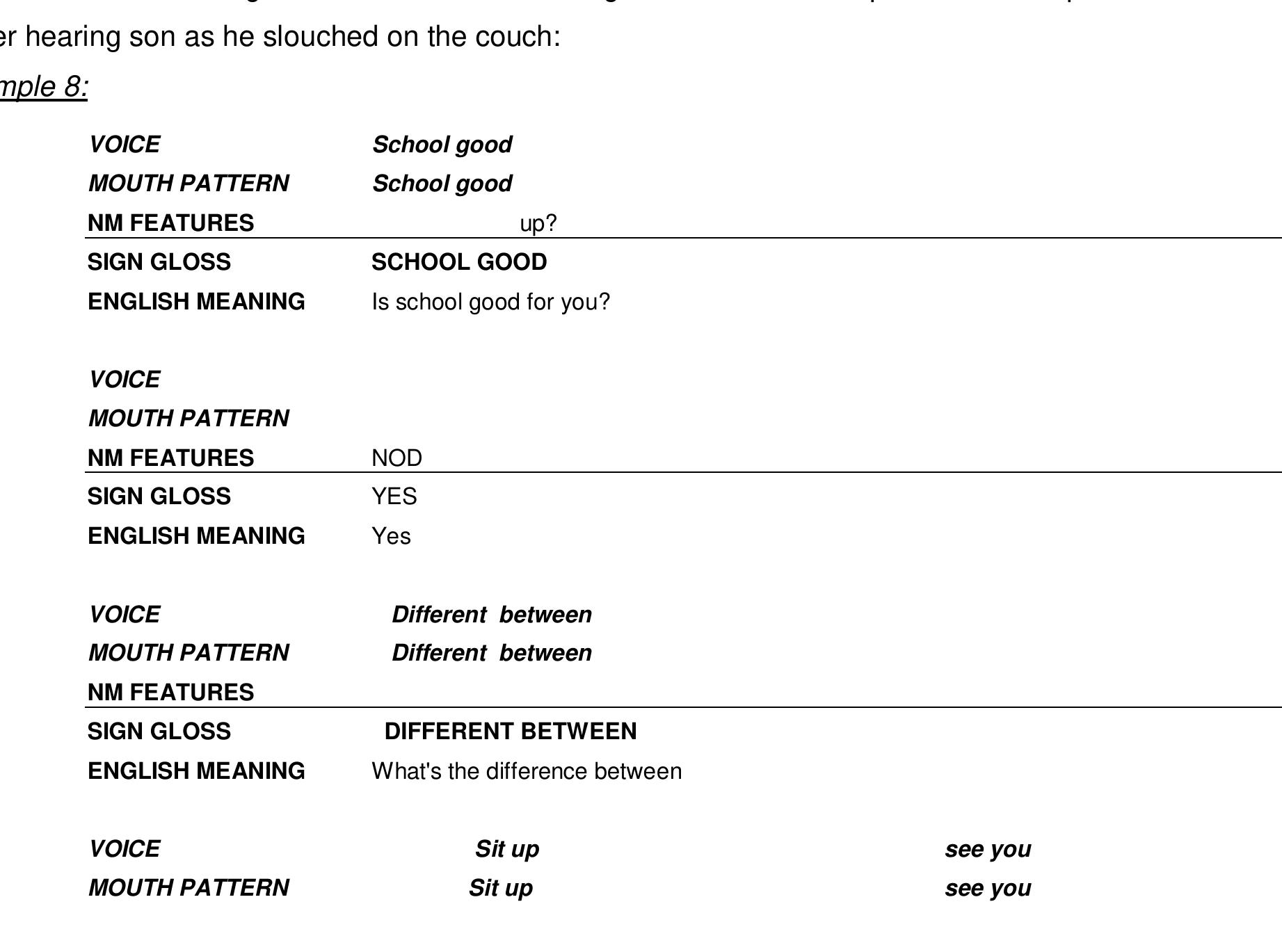
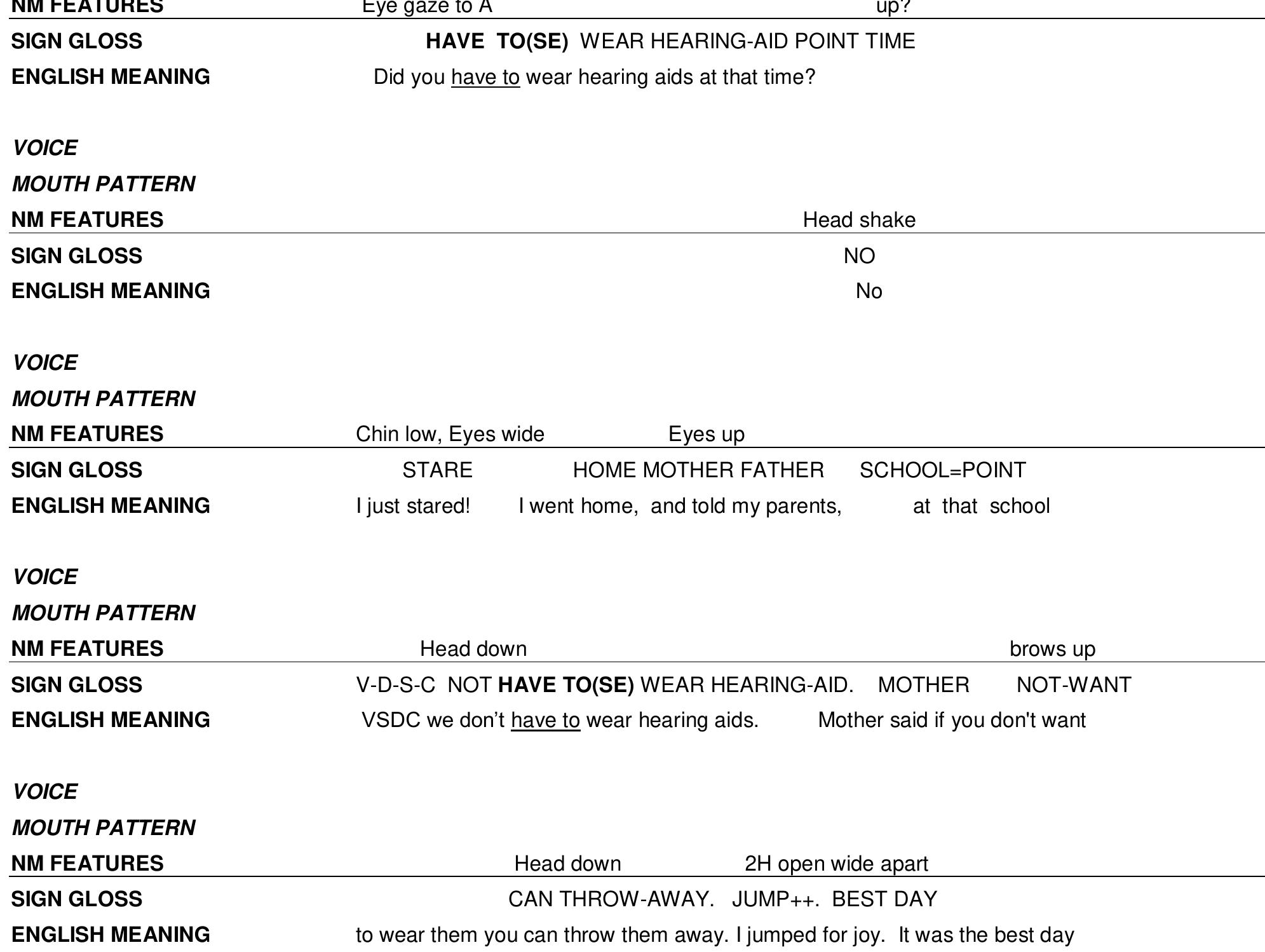
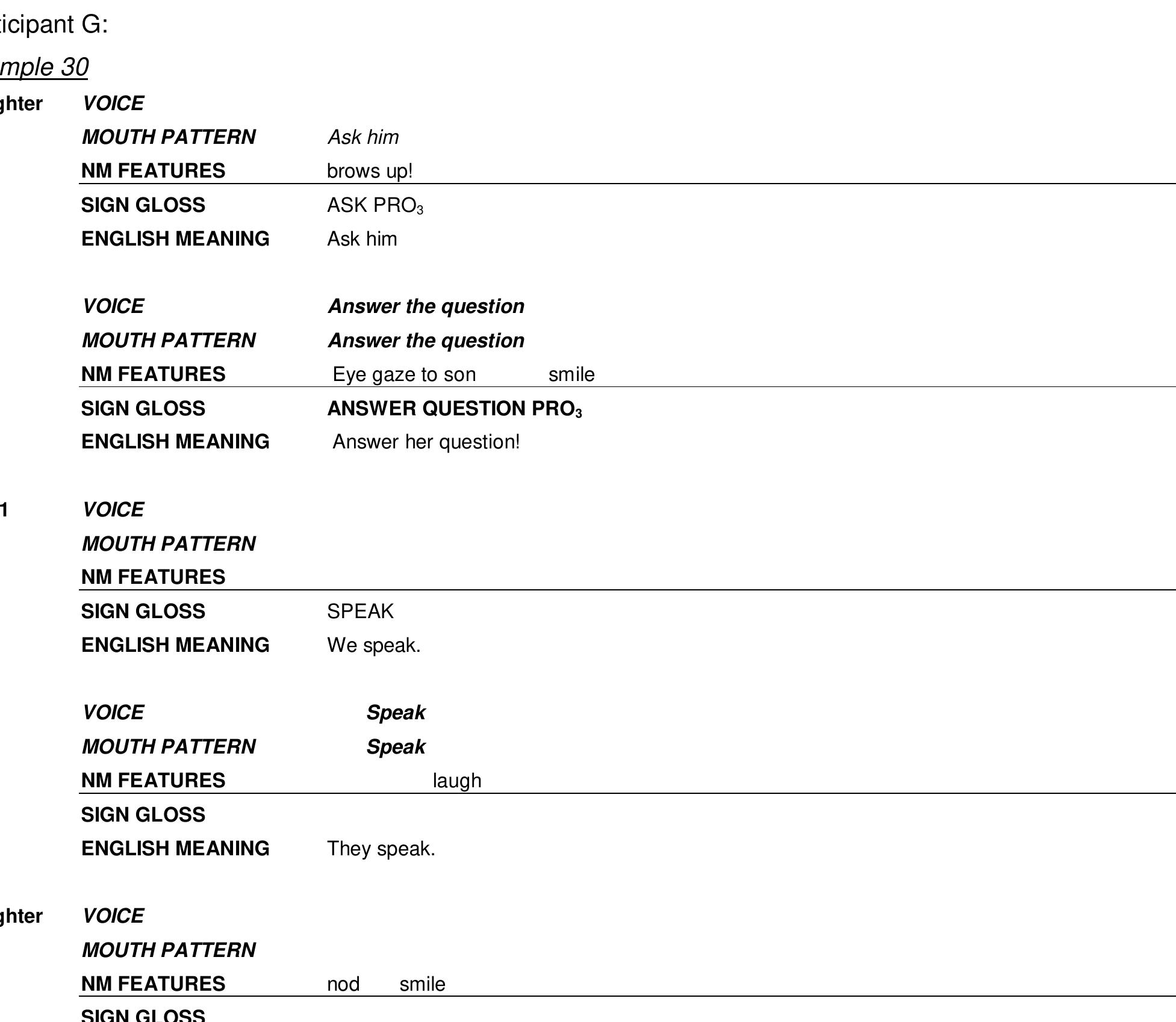
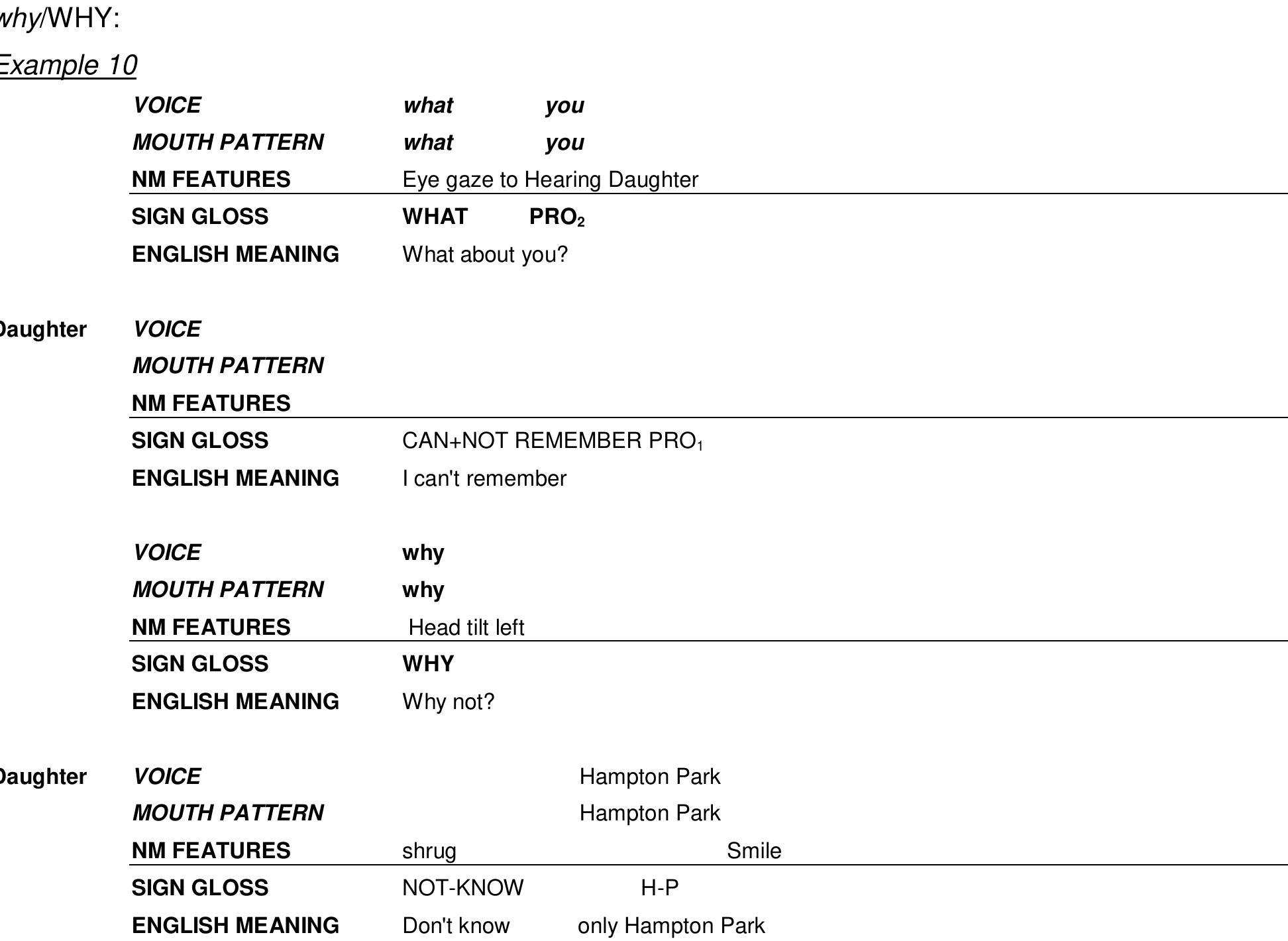
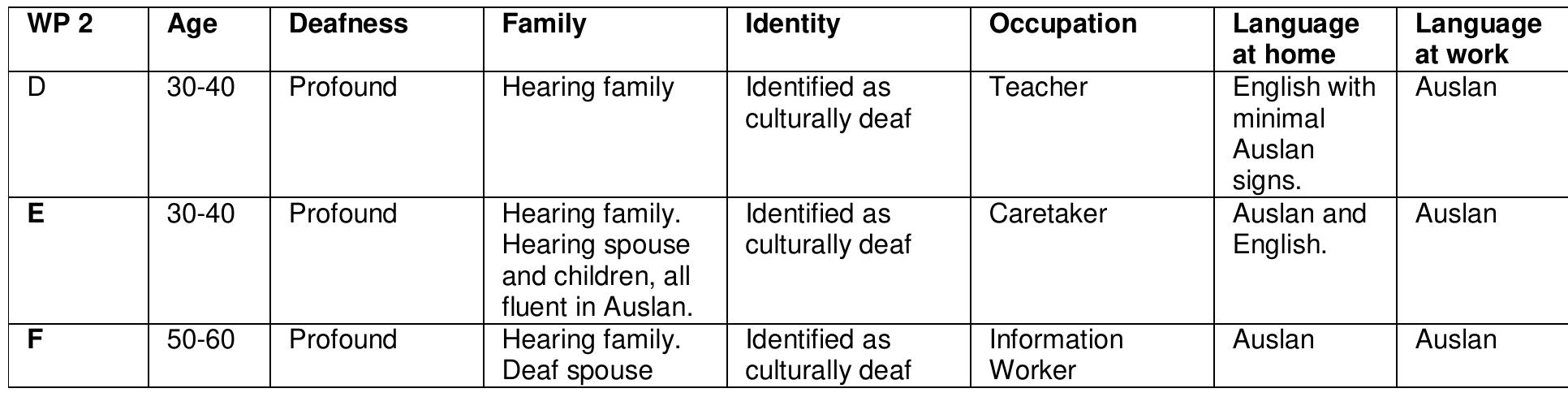
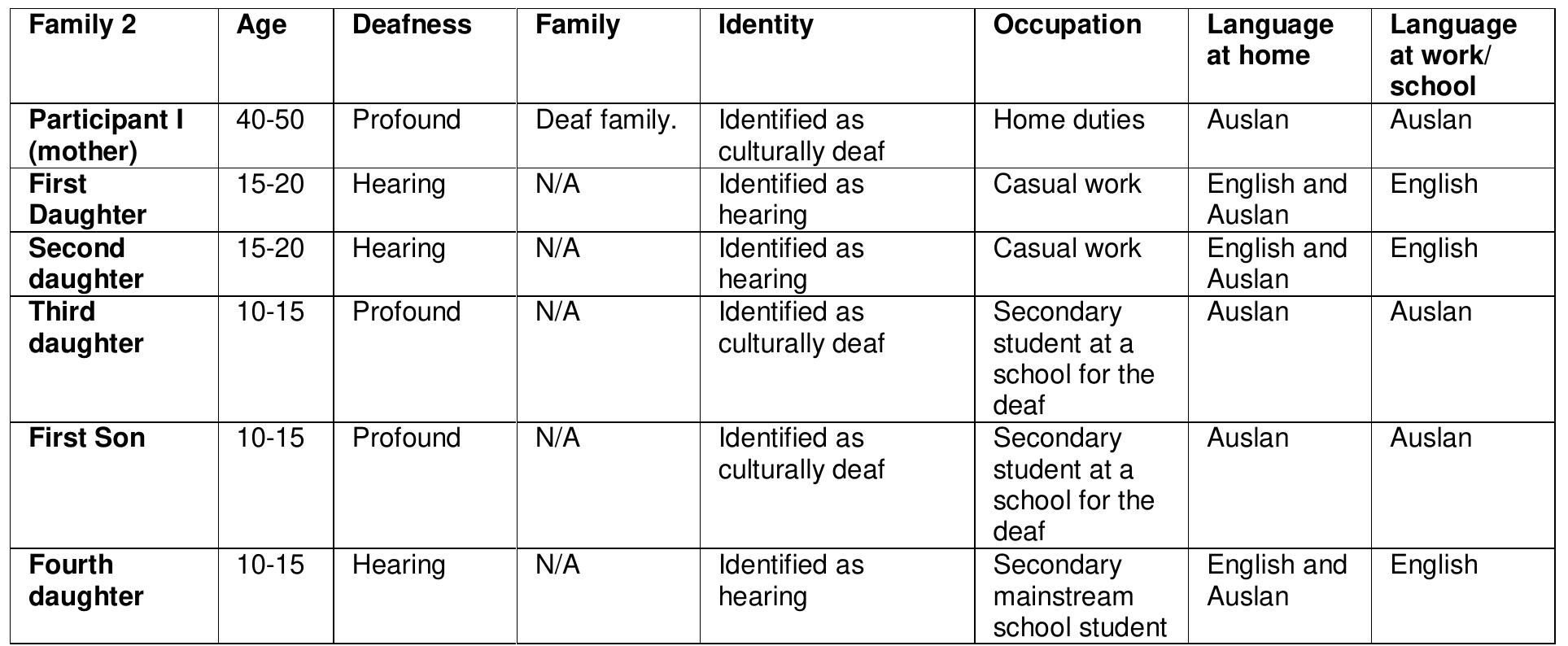
This study investigated the language use of deaf adult bilinguals in conversation with each other in workplace settings, and with their deaf and hearing children in home settings. The aim was to gain insight into the Auslan-English...
moreThis study investigated the language use of deaf adult bilinguals in conversation with each other in workplace settings, and with their deaf and hearing children in home settings. The aim was to gain insight into the Auslan-English language contact outcomes that might be found in these settings, and what factors influenced these outcomes. The results indicated that the most unique use of language by deaf bilinguals was that of simultaneous use of both spoken English and Auslan, and it was this simultaneous use which facilitated the two examples of code-switching (defined as a complete change of language from Auslan to spoken English) that was found in the data. The other two contact outcomes of significance were frequent transference of English into Auslan, and the equally frequent use of fingerspelling, which has a pivotal role in filling the gap in Auslan, a language with no orthographic form. The study also revealed that Auslan (a signed language) was the language in which many issues of identity were expressed by deaf bilinguals, regardless of whether the individual was a first or second language learner of Auslan. The results confirmed that these language and identity factors did influence the language contact outcomes. This is to certify that (1) the thesis comprises only my original work towards the PhD, (2) due acknowledgement has been made in the text to all other material used, (3) the thesis is less than 100,000 words in length, exclusive of tables, maps, bibliographies and appendices. Meredith Bartlett The Australian Deaf Community refers to the community of deaf people in Australia who share the language, Auslan, and identify as being culturally deaf and members of this community. Auslan is the acronym for Australian Sign Language, the language of the Australian deaf community. ASL is the acronym for American Sign Language, the language used by the American deaf community. BSL is the acronym for British Sign Language, the language of the deaf community in Britain. ISL is the acronym for Irish Sign Language, the language of the Irish deaf community. All of the above sign languages are distinct and separate languages, although Auslan is derived from BSL and ISL brought to Australia by deaf convicts and settlers. ASL developed from the French Sign Language taken to the U.S.A. by deaf teachers and priests from France. Chapter 3 contains a brief summary of the history of Australian Sign Language and the stages of development as it grew to become the language Auslan, as it is used today. Native Sign Language is a term used in the literature to refer to a sign language acquired naturally by a deaf or hearing child as their first language. (The implication is that the parents or caregivers of the children are themselves deaf). The natural acquisition of a sign language as a first language can be compared to the way the spoken language of the dominant hearing community is learned with difficulty, as a second language, by a deaf child. It can also be compared to the way a deaf child in a hearing family learns the sign language of the deaf community from peers or with hearing parents who learn Auslan in a community course, and hence provide language modelling in Auslan with great difficulty. Cued Speech is a contrived system of handshapes produced near the mouth to represent speech phonemes, and to assist in the recognition and teaching of spoken English. (See Chapter 3). Signed English is the term used in Australia for the artificial, contrived system of signs that conveys spoken English in English syntax, word for word in a visual form. Simultaneous use or simultaneous communication occurs when an individual signs and speaks simultaneously. It may occur with a single word, where the sign and an equivalent spoken word are produced together, or for a longer utterance, where several words and signs, in a phrase, may be produced simultaneously (Caccamise et al, 1978). The term is often used interchangably with the term ‗total communication' which refers to signing and speaking at the same time but also includes the use of gesture, writing, and any other form of communication which the deaf child may need to draw upon to access full communication with his/her interlocutor (Denton, 1976). Throughout this thesis I have used the term simultaneous use to refer to both the process of signing and speaking simultaneously, and for the result of that process. Segregated schools for the deaf are schools providing education for deaf children only, either government or private (religious) schools. Sometimes referred to as special schools for the deaf, they followed, in the past, a curriculum that focused on the perceived ‗special educational needs' of the deaf students, rather than the curriculum used in regular, mainstream schools. Mainstream schools and colleges refer to schools that educate hearing students and do not usually cater for deaf students in any way. Nowadays, certain mainstream schools and colleges (even those that are private, or have a specialist vocational philosophy) have small deaf facilities, enabling deaf students to participate in the regular classes, while being able to withdraw for specialist intervention within the facility for the deaf. Mouth pattern refers to the movements of the mouth during the signed and/or spoken communication (Boyes-Braem & Sutton-Spence, 2001). If the comment in the data was produced simultaneously in both languages, the transcription in this study shows the words and signs as they were produced. However, if the utterance was only signed and not vocalised, but the signs were accompanied by a mouth movement, whether that was the English lip pattern (mouthing), or whether it was a conventional Auslan mouth movement (sometimes referred to as mouth gesture, I decided to continue to use the term mouth pattern. In the main, the mouth patterns were those of English word forms, even though occasionally not fully articulated. Only one instance of a non-standard mouth pattern with an Auslan sign was observed in this study, so the transcription records both kinds of mouth patterns in the same way, using English orthography. Chapter 5 discusses mouth patterns in more detail. 1.3.3 Transcription conventions Chapter 5 provides a table of the transcription conventions used in this study. As stated by Zeshan (2004: 9)-Given the fact that signed languages involve dynamic movements in threedimensional space and transmit linguistic information simultaneously via several channels (hand movements, facial expressions, head positions, body postures), adequately representing signed languages on paper has always been a major problem in signed language research‖. There are many different ways of transcribing the visual nature of a sign language in a text form, and some conventions have developed, and I have sourced many texts for my method.