Papers by Dr. Purnima Bhardwaj

Daath Voyage: An International Journal of Interdisciplinary Studies in English, 2024
Desai. 'The Inheritance of Loss' is an insightful exploration of cultural displacement and identi... more Desai. 'The Inheritance of Loss' is an insightful exploration of cultural displacement and identity crisis. Its beautifully crafted narrative touches upon universal themes that resonate with readers on a profound level. This research paper delves into the intricate themes of cultural displacement and the quest for identity in Kiran Desai's acclaimed novel, 'The Inheritance of Loss'. Through a comprehensive analysis of the characters and their experiences, this study aims to shed light on the profound impact of migration and cultural conflict on individual identities. The paper examines the lives of characters such as Biju, Sai, and Gyan, who find themselves caught between multiple worlds, grappling with the challenges of cultural displacement and the subsequent identity crises that arise. It explores how their journeys reflect the broader issues faced by individuals in a globalized world, where borders are blurred and cultural assimilation becomes a complex process. Drawing upon literary theories and close textual analysis, the novel investigates how Desai portrays the struggles, conflicts, and transformations of her characters. It explores the themes of cultural assimilation, loss of heritage, and the search for belonging, highlighting the impact of historical, social, and political contexts on individual identities. Examining the nuanced portrayal of cultural displacement and the quest for identity in 'The Inheritance of Loss', presents a deeper understanding of the complexities of migration, cultural conflict, and the human experience in a rapidly changing world. The novel deals with chaos, despair, ethno-racial, and historical relationships between people from different cultures and backgrounds. Love, longing, and losses are dexterously handled in a humane manner articulating the diasporic experiences of the novelist who is an Indian citizen but a : An International Journal of Interdisciplinary Studies in English (A peer reviewed open access journal)

Daath Voyage: An International Journal of Interdisciplinary Studies in English, 2024
Afghan literature is richly influenced by the cultures of Central and South Asia, and it is prima... more Afghan literature is richly influenced by the cultures of Central and South Asia, and it is primarily written in Dari and Pashto, the official languages of Afghanistan. However, it is important to note that Afghanistan has faced significant challenges throughout its history. It has experienced civil wars, foreign invasions, and societal upheavals that have caused displacement, exploitation, discrimination, and immense suffering for its people. In this context, Khaled Hosseini, a prominent Afghan writer, has emerged to shed light on the dark side of Afghan society. His novels, such as "The Kite Runner" (2003), delve into the socio-political climate, traumatic human experiences, cultural conflicts, and grief that Afghans have endured. Through his writing, Hosseini expresses the enduring agony that burdens Afghans, as they navigate the complexities of their existence. "The Kite Runner" specifically explores themes of societal discrimination, emotional conflict, racism, guilt, atonement, and redemption. The novel exposes the inherent evil that can be evoked in human nature, leading to the loss of childhood innocence and the enduring struggles faced throughout one's life. This paper aims to delve into the socio-political turmoil : An International Journal of Interdisciplinary Studies in English (A peer reviewed open access journal)

Bohal Shodh Manjusha, 2024
Arun Joshi, a prominent figure in Indian English literature, delves deep into the themes of exist... more Arun Joshi, a prominent figure in Indian English literature, delves deep into the themes of existential absurdity and alienation in his novels. Through an analysis of the protagonists' struggles with identity, cultural dislocation, and societal expectations, this paper aims to illustrate how Joshi's narratives reflect the broader existential dilemmas faced by individuals in a rapidly changing world. By employing philosophical frameworks and literary critiques, this study reveals the profound implications of alienation and absurdity in shaping human experience and understanding. This research paper explores the themes of existential absurdity and alienation in the novels of Arun Joshi, a prominent Indian author known for his insightful depiction of human emotions and struggles. Through a detailed analysis of select works by Joshi, this paper delves into the existential crises faced by his characters, their experience of alienation in a rapidly changing society, and the profound implications of their search for meaning in a seemingly meaningless world. Drawing upon existentialist philosophy and literary theory, this paper aims to shed light on the timeless relevance of Joshi's exploration of these themes and their impact on contemporary readers.

Research Journal of English Language and Literature (RJELAL), 2024
Since the dawn of civilization, a perpetual struggle for equality and freedom has raged on among ... more Since the dawn of civilization, a perpetual struggle for equality and freedom has raged on among societies worldwide. One noteworthy aspect of this enduring battle is the commendable efforts made by numerous countries across Europe and Asia to enshrine principles of liberty and equality within their constitutions, particularly in regard to the rights of women. Over time, these nations have adapted and refined their laws and societal norms to better reflect the evolving needs and aspirations of their female citizens. However, amidst the progress and evolution seen in various parts of the world, Afghanistan stands as a poignant reminder of a nation where the journey towards gender equality and empowerment is still fraught with challenges. Attaining equal rights between the sexes-man and woman, has become a global phenomenon. Women across the world are chained under the patriarchal society and are still treated as the "weaker sex". They struggle to accomplish their target of achieving women's rights, respect, and proper recognition. This is because women's identity has been exploited and abused, which made them initiate and involved in a movement calling for women's liberation. The lives of women around the world are incredibly diverse, with significant variations in right and opportunities from one country to another. While all women inhabit the same planet, they face vastly different challenges and experiences. The concern of the study is to compare the lives of Afghan women to those in other Muslim majority countries and highlights their dire circumstances in the era of globalization, where there is no hope for betterment. The life of women in Afghanistan is filled with

International Journal of English Literature and Social Sciences, 2024
Jayanta Mahapatra is widely celebrated as an iconic figure and revered as the Father of Modern an... more Jayanta Mahapatra is widely celebrated as an iconic figure and revered as the Father of Modern and post-modern Indian English poetry. He is known for his unique blend of imaginative realism and profound philosophical insights in his poetry. This research paper presents a comprehensive exploration of the visionary poet Jayant Mahapatra's literary works, focusing on the intertwining themes of realism and philosophy within the rich tapestry of Indian literature. His profound poetical works serve as a cornerstone in any discourse on Indian English Poetry, vividly portraying themes of social discrimination and the erosion of moral values. Internationally acclaimed, Mahapatra's masterpieces such as "Hunger," "Myth," and " Summer" are hailed as flawless examples of majestic poetry that compel readers to grapple with profound societal truths. Delving deeper into his repertoire, his philosophical musings in poems like "The Moon Moments" and "Total Solar Eclipse" resonate with a stark realism that captivates and mesmerizes audiences worldwide. An immersive and enlightening reading of Mahapatra's poetic oeuvre, sheds light on how his imaginative realism and philosophic insights offer a deep understanding of contemporary Indian society, its complexities, and the human condition at large. His poetry is remarkable for its profound depth of emotions and true poetic imagination, which spans a wide variety of themes. His work evokes intense emotional connections with the world around him, as he skillfully transforms everyday events into verse. To quote Robert Frost: "Poetry is when an emotion has found its thought and the thought has found words." Mahapatra's imaginative canvas powerfully delves into the human condition, where a brooding landscape, heavy bodily passions, and interior compulsions intertwine with the agonizing strands of human existence, offering a profound and thought-provoking exploration of our innermost struggles. He himself stated "I fell in love with English. I played with words, turning them over and over again until they were heavy with meaning."

Journal of Interdisciplinary and Multidisciplinary Research (JIMR), 2024
To quote Gunter Grass: “Translation is that which transforms everything so that nothing changes.”... more To quote Gunter Grass: “Translation is that which transforms everything so that nothing changes.”In
today's increasingly interconnected and multicultural world, there is a pressing need to critically evaluate
the cultural dimensions and diversities of a new literary canon. As global literary landscapes continue to
evolve, the role of translation emerges as a pivotal factor in mediating cross-cultural literary experiences
and expanding the boundaries of literary canons. Translation plays a vital role in bridging the gap
between languages, ensuring that the originally felt emotions and perspectives are effectively
communicated. In the context of Indian literature, particularly Indian English literature, translation has
been integral, providing opportunities for audiences to understand diverse viewpoints. In the era of
globalization, translators are widely recognized as artists on par with authors in any genre. Henry
Wordsworth Longfellowhas excellentlydescribed the role of the translator: “A Translator, like a witness
on the stand, should hold up his right hand and swear to “tell the truth, the whole truth and nothing
but the truth. ”A remarkable translation goes beyond mere literal interpretation; it involves skillfully
rewriting the original text to resonate with and captivate its audience. This research paper explores the
integral part played by translation in forming and evolving literary canons, emphasizing the cultural
dimensions that underpin this dynamic process. Drawing upon case studies and theoretical frameworks, it
investigates how translations facilitate the exchange of ideas, narratives, and cultural perspectives across
linguistic borders. This research paper aims to provide a comprehensive analysis of the multifaceted role
played by translation in reshaping literary canons within a multicultural context. By emphasizing its
influence on cultural representation, diversity, and inclusivity, this study explores the transformative
potential of translated texts in shaping the global literary landscape, fostering intercultural dialogue, and
embracing diverse cultural perspectives.

International Journal of English Literature and Social Sciences, 2023
Chitra Banerjee's novel "Independence" is an innovative perspective about independence as a
be... more Chitra Banerjee's novel "Independence" is an innovative perspective about independence as a
beacon of martyrdom on the golden occasion of India's 75 years of independence. To quote Amitav Ghosh:
“ A spellbinding saga of the decolonization and partition of the Indian subcontinent, with a case of vividly
drawn, compelling characters.” The novel delves into the tumultuous phases of human life, exploring themes
such as the mob mentality, heinous attacks on women, and the clash of traditional, societal, and cultural
norms during the partition of India. Throughout human civilization, issues like immigration, communal riots,
and social and cultural conflicts have remained crucial topics of discussion. In today's world, multicultural
societies are a result of global immigration. Migration can be seen as a determining factor in various aspects
such as violent conflict, ethnic tensions, the expansion of national powers, and even economic growth or
stagnation. Diasporic literature often highlights the problems and concerns faced by immigrants. Those who
have migrated to a new culture often experience various forms of stress that can impact their cultural norms,
religious customs, and social support systems. Adjusting to a new culture from one's own can be challenging,
and cultural identity plays a significant role in this process, whether one is an immigrant or a native. This
paper aims to explore the issues of cultural conflicts and immigration as depicted in Chitra Banerjee's
"Independence." By examining the novel's portrayal of these themes, we can gain a deeper understanding of
the challenges faced by individuals in multicultural societies and the impact migration has on their lives.

International Journal of Creative Research Thoughts (IJCRT) , 2023
The world n too much with us late and soon Getting and spending, we lay waste our powers Little w... more The world n too much with us late and soon Getting and spending, we lay waste our powers Little we see in Nature, that is ours.; We have given our hearts sway, a sordid boon " Nature has been so kind to man since man has recognized his existence on this blue planet. To use Wordsworth's words we can say that nature has been a spirit, a guardian, and the anchor of man's purest thoughts. Ever since its appearance on the earth's surface, he has been dependent on nature for his subsistence He needed edible plants and animals. In the initial stages of the history of economic development man identified these natural gifts available around him and he acquired knowledge to use them Everything that comes from nature has some utility for man but its utilization is possible on the availability of appropriate technology. Although natural products existed over the earth's surface even during prehistoric times, man had neither the tools nor the technology to use them, man: Land sunshine, wind, forests, and sites were present in such before the appearance of man on the earth With time he learned to cute the land, grow crops by protecting different plants, and run the wild and water mills by using the wind and water energy 50, we can say that the enormous variety of natural resources on this earth provide everything for the survival of man. Even though, the prehistoric man led a life of hunter and gatherer procuring each and everything for his survival from the forests. Not only this, as Fitzgerald observes: "There is a pleasure in the-pathless woods, There is a rapture on the lonely shore, There is a society, where none intrudes, By the deep sea, and music in its roar: I love not man the less, but Nature more."-F. Scott Fitzgerald

The Criterion: An International Journal in English , 2023
Afghan literature is produced in the Islamic Emirate of Afghanistan, influenced by Central
and ... more Afghan literature is produced in the Islamic Emirate of Afghanistan, influenced by Central
and South Asian literature. The text is primarily written in Dari and Pashto, the official languages
of Afghanistan. Afghanistan, a muslim country, has always been counted as the most barbaric
country for humanity worldwide. Jim Fowler remarks: “There is no country in the world that’s
more devastated from natural resources than Afghanistan”. (web). Since its emergence to power
in the mid-eighteenth century, Afghanistan had come under the monarchial reign of several
monarchs, whose consolidation of power was constantly undermined by civil war and foreign
invasions. “The upheavals in Afghanistan are not an Afghan thing. It had its roots outside the
country, which eventually led the country to be the hub of terrorism,…..who had a different
agenda.” (web). After the upheavals societal displacement, political exploitation, gender
discrimination, cultural chaos, mental, physical, and emotional turmoil, and many other atrocities
have become a common phenomenon in the life of Afghans. These circumstances have shoved
Afghanistan into such a dell of hell that human life cannot even be imagined. Some seeds, which
surmount similar cataclysmic circumstances, blossomed and gave birth to such a literary medium,
which not only voiced out their nostalgic anguish but also unveiled the blemish of contemporary
Afghan society. Khaled Hosseini, who emerged from the sludge of the same morass, exposed the
dark side of the norms, culture, customs, and traditions of his motherland. Khaled Hosseini's novels
articulate the enduring agony of Afghans, who carry the burden of remorse throughout their existence. The paper interprets the socio-political scenario, traumatic and poignant experiences of
human relationships, hollowness of customs, and untold grief of Afghans portrayed in Hosseini’s
novel ‘The Kite Runner’ (2003). Hosseini as a writer has offered his infancy world of Afghanistan
as a background of his fiction. The novel deals with the theme of societal discrimination, emotional
conflict, racism, superego, guilt, atonement, and redemption. It sheds light on human nature by
showing the inherent evil that can be evoked, and how it leads to the impairment of childhood
innocence and the hardships of entire life. The purpose of this paper ruminate on the social and
cultural turmoil of war and foreign invasions and their impact on the lives of ordinary citizens of
Afghanistan, especially the societal conflict of Hazaras, the sexual exploitation of Sanubar, the
physical and mental trauma of Hassan and his son Shorab, and nostalgia of Amir.

Avsar Socio- Economic Journal , 2014
Today's women encounter challenges every day in every sphere of life. Apart from sharing their st... more Today's women encounter challenges every day in every sphere of life. Apart from sharing their struggle within community with limited resources they face systematic discrimination simply by virtue of being female. Although there is nothing new in this prejudiced behaviour but when we are living in the age of information then it's very difficult to stop effects of changes on us. Yet women around the world possess the collective power to change their lives, their communities & the world where we live in. women are constantly developing innovative, effective approach to improve their lives. Empowering women to lead change is designed to support the development of women's skills & to enable them to provide leadership on the issues that concern them. This paper is a study of social condition of Indian women in present scenario and how global changes are playing significant role in the same
International Journal of Society and Humanities , 2015
In India and in the West from ancient to modern times theroists have attempted to shed light on t... more In India and in the West from ancient to modern times theroists have attempted to shed light on those philosophical and religious question which arise from the innate sense of aesthetic perception. itself. In India the earliest vedic accounts of what constitutes drama and poetry includes rasa theory, dhvani theory and riti. The earlier India theorists such as Bharata Bhamaha, Anandavardhana and Abhinavagupta have defined the nature of acsthetic enjoyment and art to a great length. And modern aesthetics thinkers such as Aurobindo, Cooma.uswamy and Ravindra Nath Tagore also played big roles in furthering the philosophical development of Indian aesthetics. In India

Novel is the vital medium for the expression of the spirit of the society. Indian English novel f... more Novel is the vital medium for the expression of the spirit of the society. Indian English novel from its very inception has shown deep involvement with changing national scene and the concern for the destiny of the country. Indian Literature is a phenomenon which about a century was obscure and was legitimately glossed terms like Anglo –Indian Literature and was considered to be the hybrid products. Some critics even remark that this literature was already on decline, however, it has significantly came to be known as ‘ Indian English Literature’ with emphasis on Indian and claiming itself as our literature. The things, techniques and linguistic command of Indian English Literature has gradually broadened out its past which was glorious. Indo–Anglian Literature is now a distinct and respectable entity in world literature. Today a number of eminent Indians writers such as Mulk Raj Anand , R.K. Narayan, Kamala Markandaya , Raja Rao and Anita Desai etc. continue to write English and Indo – Anglian Literature continues to grow and flourish and attain higher and higher peaks of excellence . One may point out that Indo- Anglian Literature has been of immense benefit to readers and creative writers in Indian as well as abroad. According to Prof. V.K. Gokak:
“ Indo –Anglian literature is a curious phenomenon with a fairly long History .”1(Untouchable, Page No.-21)
According to C.R. Reddy,” Indo- Anglian literature has to be contradistinguished from Anglo- Indian Literature.” Indo- Anglian literature is the original literary creation in English language by Indians. The beginning of Indo-Anglian Literature is inexorably linked with the spread of English Language and Western culture in Indian. Indo–Anglian Literature is no longer the literature of the out house , it is now a mature and respectable genre of what is known as commonwealth literature with its inevitable stamp of Indianness . During the last decades it has attracted a great deal of critical attention both from Indian and Foreign critics. R.K. Narayan , Raja Rao ,Mulk Raj Anand , Kamala Markandaya and Anita Desai have made significant contribution to Indo – Anglian fiction. Mulk Raj Anand and Kamala Markandaya both are the shining stars in the galaxy of Indian English Literature.

Madhya Bharti, Humanities and Social Sciences, 2023
The term 'The Waste Land' is a pivotal and grievous abstract idea of the modern era which holds m... more The term 'The Waste Land' is a pivotal and grievous abstract idea of the modern era which holds much structural complexity, obscurity and despairing tone to reflect the embody many of the cultural and intellectual issues of the present age. A well known literary personality of 20 th century , T.S Eliot published "The Waste Land " in 1922 after The Great War. The postwar disillusionment of 1920s led many literary figures to voice out the predicament and moral dilemma that modern life faces. T.S Eliot was one of the eminent figures who was able to depict the crisis time and connect then existing panorama with the modern age. To quote Harold Bloom, The waste land can be read as "a testament to the disillusionment of a generation, an exposition of the manifest despair and spiritual bankruptcy of the years after world war I". Eliot is a stern realist acutely conscious of manifold problems as well as a visionary who looks at life beyond the limits of time and space. A vivid of the uncertain world and the insincere manner of the mind is portrayed carefully in The Waste Land , which refers to the spiritual and intellectual death of the modern world which is in the verge of decay. The poem displays the disillusionment, hopelessness and cynicism of modern life and the world where tension, anxiety, depression, unrest above all an extreme decay of morality. The purpose of this paper is to highlight the social, cultural and moral decay of modern civilization due to the commercialization of life where everything is for sale. Exposing a picture of mundane waste land that symbolically suggest the spiritual death of modern men ,and is expedition of "human failure and of perennial quest for salvation ".
MATADARSH - A Multi Subject Bilingual Peer Reviewed & Refereed Journal, 2023
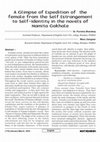
In Indian society , females have been the victims
of exploitation since long time in different f... more In Indian society , females have been the victims
of exploitation since long time in different fields in
every sphere of life. There has been tremendous
paradoxical situation of Females in Indian society
. Not only in pre- independence period but also
in post-independence period , the femalessuffer a
lot by the male dominance of the family and society.
They are some certain hidden forces that work
behind this notion. From time to eternity, efforts
were made to reconsider her identity in relation to
male as wife , mother , daughter, sister but tradition
trains a female to think herself as an inferior being.
Throughout the world various social norms in
some form or other deny females their right to
education, health services, economic opportunities
and political participation. They are common
victims and suppressive as they don’t have the
economic and political power to fight against the
male’s supremacy . They are not able to speak out
their conditions and to present themselves before
the world .The themes of Namita Gokhale’s novels
reveal her keen concern for the self-identity
,exploitation and the condition or the position of
females.This paper explores ‘A glimpse of
expedition of females from the self estrangement
to self-identity in Namita Gokhale’s novels. Paro
: Dream of Passion (1984) and Shakuntala:The play
of Memory(2005) .The plight of the women is one
of the most debating issues in the Indian
subcontinent not only for its religious and
economical code but also for its opperession.
Many of the females characters of her novels
search their self- identity to realise their ability ,
inner desire and short coming .The selected works
of Gokhale are an attempt to give the plight of
females ina very artistic and transparent manner.
Her portrayal of female characters are having very
distinctive and true reflection of the female’s
life.She writes a different point of view about
females lives , self-identity and sufferings with full
conviction.
Saidhantiki -A Multi Subject Bilingual Peer Reviewed & Refereed Journal , 2022
It has been observed since ages that human civilization has been patriarchal or male dominated. T... more It has been observed since ages that human civilization has been patriarchal or male dominated. The world we live in is an ingrained social system that in all aspects of life be it professional, educational, moral, cultural, social or personal is male dominated. A male dominated society is bound to be following a patriarchal societal system where women suffocate physically and mentally. This social system has tied women's existence, their development and their future like such shackles that women have to struggle throughout their life to get rid of these shackles. The social status of women in patriarchal society has been a subject of grave discussion since ages. It encompasses various burning issues of girls and women education, maternal health, economic empowerment of females and the role of women in family, community, politics and more. Throughout the world various social norms in some form or other deny women their right to education, health services, economic opportunities and political participation. The purpose of this paper is to throw light on the plight of women in the patriarchal community, where women have become mere puppets in the hands of intolerable traditions and the prestigious sycophants of the society. The condition of women has been pitiable since ages ,be it Sita in Treta Yuga or Draupadi in Dwapar Yuga or various heroines of modern era portrayed by Namita Gokhale, Chitra Banerjee, Arundhati Roy and more.Our social, cultural, economical and traditional factors of society have become the reason for subjugation women. That is why women have remained subjugated, silenced, oppressed and tortured under patriarchal pressure. In Indian society women are traditionally discriminated against excluded from political and family decisions. They are considered as a property and a means to pleasure. It seems that women always have to fight for their equality with men in societal set up .

International Journal of English Literature and Social Sciences, 2023
Since civilization has started caste system based on profession not by birth. Later on it turns i... more Since civilization has started caste system based on profession not by birth. Later on it turns into a power game and the whole human society were divided into four varnas. Manusmriti, widely regarded to be the important and authoritative book on Hindu law and dating back to at least 1000 years before Christ was born ''acknowledges and justifies the caste system as the basis of order and regularity of society .''(Web) The caste divides Hindu into four main categories-Brahmins, Kshatriyas, Vaishyas and Shudras. Many believe that the groups originated from Brahma , The Hindu God of Creation. They are classified according to occupation and determine access to wealth , power and privilege. In recent years Violence has become a common phenomenon in India. It has engulfed the entire political, social, economic, cultural and even our personal lives. Violence of social justice and caste discriminations of complex characters have added additional burden to our society whereas we Indians have been specially advised to practice "non-violence". The growing trend in violence thus provokes us to talk about non-violence and identify the roots of violence in India. Caste Violence is perhaps one of the most hazardous forms of violence in India. It often intermingles with the most political, social, cultural, and class atrocity. So caste discriminations and atrocities against the socially weaker sections with age-old traditional and unconventional norms deserve a careful historical investigation. Indian Caste system is the most widely discussed subject all over the world. Caste system is a social evil in which the higher caste people exploits and persecutes the lower caste people and forced them to live subhuman lives like beasts. This paper is based on caste and vulgarism of 'Untouchable' and 'Coolie' poignantly portrayed by M R Anand. It is an attempt to explore its origin, nature, gravity, and deprivation.

SHODH SANCHAR BULLETIN AN INTERNATIONAL BILINGUAL PEER REVIEWED REFEREED RESEARCH JOURNAL , 2021
This paper presents The Role of Caste In Female Subaltern perspective which is the most debated i... more This paper presents The Role of Caste In Female Subaltern perspective which is the most debated issue in the Indian Subcontinent, not only its religious and economical code but also its oppression to overcome the subalterns as well as the lower caste people in both ancient and modern Indian society. The novel Untouchable and Coolie present a remarkable opening for the Indian English writer to investigate new world of subalterns. They are common victims and suppressive as they do not have the economic and political power to fight back the upper class people's supremacy. They are not able to get the voice to speak out their condition and portray themselves before the world. The term Subaltern is used in broad perspective as synonyms for minorities, subjugated women, the illiterate female whose voice has been muted. In this paper, an attempt has been made to analyze Mulk Raj Anand's exploration of this idea of subaltern with particular reference to women characters in his novels Untouchable and Coolie.

SHODH SANDARSH, 2018
New woman' is the term that makes us think of the woman who shakes off all the shackles of the pa... more New woman' is the term that makes us think of the woman who shakes off all the shackles of the patriarchal society and comes into the mainstream of the society. The new woman is the one who is uplifting herself from the old thought that a woman can not face the harsh realities. The New woman differs from the conventional ideal woman who was meek, submissive, oppressed and surrendered before the patriarchy. The tendency of introducing the New woman in novels started in India from the time when India got independence. These women characters were termed as the New Woman because they have the capability of opposing the conservative ideas. But when we go back to the old era we find that the concept of New woman can be traced back to the ancient era in our mythologies that narrates the stories of incidents that happened in ancient times. This paper focuses on two such female characters from Indian mythology who were bold, fierce, brave and assertive. They had a broad outlook even in the ancient period. They were ready to oppose and resist the traditional norms whenever necessary. The two female characters discussed in this paper are Urmila from Kavita Kane's 'Sita's Sister' and Paanchali from Chitra Banerjee 's The Palace of Illusions. Both these characters have been portrayed as a woman who is strong, bold, fierce and assertive, having an independent existence. They are capable of making their own decisions and also ready to face the consequences of those decisions. They stood for what they thought was right and resisted what according to them was wrong. The way both the characters have been portrayed, they surely can serve as role models for modern day feminists. Thus it may not be wrong to refer Kavita's Urmila and Chitra's Panchali as the forerunners of the New Woman.

SHODH SARITA AN INTERNATIONAL BILINGUAL PEER REVIEWED REFEREED RESEARCH JOURNAL , 2021
The aim of this paper is to portray the element of
Idealism and nostalgia in the negritude movem... more The aim of this paper is to portray the element of
Idealism and nostalgia in the negritude movement and selected poems
of David Diop. Some critics regard negritude literature was a child of
historical circumstances that gave a voice to francophone students in
France. The concentration of Diop dwell at the extremities to bring
forth the agony of Africans under colonization and the effects that were
to carry on after independence foreseeing a revolt against the colonists
not only in the ground but it’s beginning through art , Negritude
movement negritude is thus at the same time a literary and an
ideological movement. David Diop’s poetry resonates more with
cesaire’s perspectives that his work drew criticism for extremism
portrayed in the tone and denigrating diction he used to describe
colonialists and imperialists. Diop uplift the voice of the society against
the inconvenient atmosphere and system through his poems. Diop’s
poems such as ‘Africa’. ‘Vultures’ and ‘Waves’ are the masterpieces.
Which emphasizes the problems of Africa that brought about by colonialism and shares a message to Africans to bring about change and
get freedom through his thoughts and poems. We find Diop in his
poems. Very angry and revolutionary, yet hopeful and optimistic. David
Diop a great poet of extremity who perhaps creats revolt a protest
through his works against the colonialists.
Conference Presentations by Dr. Purnima Bhardwaj

University of Allahabad, 2024
Jayanta Mahapatra is widely celebrated as an iconic figure and revered as the Father of Modern
... more Jayanta Mahapatra is widely celebrated as an iconic figure and revered as the Father of Modern
and post-modern Indian English poetry. He is known for his unique blend of imaginative realism
and profound philosophical insights in his poetry. This research paper presents a comprehensive
exploration of the visionary poet Jayant Mahapatra's literary works, focusing on the intertwining
themes of realism and philosophy within the rich tapestry of Indian literature. His profound
poetical works serve as a cornerstone in any discourse on Indian English Poetry, vividly portraying
themes of social discrimination and the erosion of moral values. Internationally acclaimed,
Mahapatra's masterpieces such as "Hunger," "Myth," and "A Summer" are hailed as flawless
examples of majestic poetry that compel readers to grapple with profound societal truths. Delving
deeper into his repertoire, his philosophical musings in poems like "The Moon Moments" and
"Total Solar Eclipse" resonate with a stark realism that captivates and mesmerizes audiences
worldwide.


Uploads
Papers by Dr. Purnima Bhardwaj
today's increasingly interconnected and multicultural world, there is a pressing need to critically evaluate
the cultural dimensions and diversities of a new literary canon. As global literary landscapes continue to
evolve, the role of translation emerges as a pivotal factor in mediating cross-cultural literary experiences
and expanding the boundaries of literary canons. Translation plays a vital role in bridging the gap
between languages, ensuring that the originally felt emotions and perspectives are effectively
communicated. In the context of Indian literature, particularly Indian English literature, translation has
been integral, providing opportunities for audiences to understand diverse viewpoints. In the era of
globalization, translators are widely recognized as artists on par with authors in any genre. Henry
Wordsworth Longfellowhas excellentlydescribed the role of the translator: “A Translator, like a witness
on the stand, should hold up his right hand and swear to “tell the truth, the whole truth and nothing
but the truth. ”A remarkable translation goes beyond mere literal interpretation; it involves skillfully
rewriting the original text to resonate with and captivate its audience. This research paper explores the
integral part played by translation in forming and evolving literary canons, emphasizing the cultural
dimensions that underpin this dynamic process. Drawing upon case studies and theoretical frameworks, it
investigates how translations facilitate the exchange of ideas, narratives, and cultural perspectives across
linguistic borders. This research paper aims to provide a comprehensive analysis of the multifaceted role
played by translation in reshaping literary canons within a multicultural context. By emphasizing its
influence on cultural representation, diversity, and inclusivity, this study explores the transformative
potential of translated texts in shaping the global literary landscape, fostering intercultural dialogue, and
embracing diverse cultural perspectives.
beacon of martyrdom on the golden occasion of India's 75 years of independence. To quote Amitav Ghosh:
“ A spellbinding saga of the decolonization and partition of the Indian subcontinent, with a case of vividly
drawn, compelling characters.” The novel delves into the tumultuous phases of human life, exploring themes
such as the mob mentality, heinous attacks on women, and the clash of traditional, societal, and cultural
norms during the partition of India. Throughout human civilization, issues like immigration, communal riots,
and social and cultural conflicts have remained crucial topics of discussion. In today's world, multicultural
societies are a result of global immigration. Migration can be seen as a determining factor in various aspects
such as violent conflict, ethnic tensions, the expansion of national powers, and even economic growth or
stagnation. Diasporic literature often highlights the problems and concerns faced by immigrants. Those who
have migrated to a new culture often experience various forms of stress that can impact their cultural norms,
religious customs, and social support systems. Adjusting to a new culture from one's own can be challenging,
and cultural identity plays a significant role in this process, whether one is an immigrant or a native. This
paper aims to explore the issues of cultural conflicts and immigration as depicted in Chitra Banerjee's
"Independence." By examining the novel's portrayal of these themes, we can gain a deeper understanding of
the challenges faced by individuals in multicultural societies and the impact migration has on their lives.
and South Asian literature. The text is primarily written in Dari and Pashto, the official languages
of Afghanistan. Afghanistan, a muslim country, has always been counted as the most barbaric
country for humanity worldwide. Jim Fowler remarks: “There is no country in the world that’s
more devastated from natural resources than Afghanistan”. (web). Since its emergence to power
in the mid-eighteenth century, Afghanistan had come under the monarchial reign of several
monarchs, whose consolidation of power was constantly undermined by civil war and foreign
invasions. “The upheavals in Afghanistan are not an Afghan thing. It had its roots outside the
country, which eventually led the country to be the hub of terrorism,…..who had a different
agenda.” (web). After the upheavals societal displacement, political exploitation, gender
discrimination, cultural chaos, mental, physical, and emotional turmoil, and many other atrocities
have become a common phenomenon in the life of Afghans. These circumstances have shoved
Afghanistan into such a dell of hell that human life cannot even be imagined. Some seeds, which
surmount similar cataclysmic circumstances, blossomed and gave birth to such a literary medium,
which not only voiced out their nostalgic anguish but also unveiled the blemish of contemporary
Afghan society. Khaled Hosseini, who emerged from the sludge of the same morass, exposed the
dark side of the norms, culture, customs, and traditions of his motherland. Khaled Hosseini's novels
articulate the enduring agony of Afghans, who carry the burden of remorse throughout their existence. The paper interprets the socio-political scenario, traumatic and poignant experiences of
human relationships, hollowness of customs, and untold grief of Afghans portrayed in Hosseini’s
novel ‘The Kite Runner’ (2003). Hosseini as a writer has offered his infancy world of Afghanistan
as a background of his fiction. The novel deals with the theme of societal discrimination, emotional
conflict, racism, superego, guilt, atonement, and redemption. It sheds light on human nature by
showing the inherent evil that can be evoked, and how it leads to the impairment of childhood
innocence and the hardships of entire life. The purpose of this paper ruminate on the social and
cultural turmoil of war and foreign invasions and their impact on the lives of ordinary citizens of
Afghanistan, especially the societal conflict of Hazaras, the sexual exploitation of Sanubar, the
physical and mental trauma of Hassan and his son Shorab, and nostalgia of Amir.
“ Indo –Anglian literature is a curious phenomenon with a fairly long History .”1(Untouchable, Page No.-21)
According to C.R. Reddy,” Indo- Anglian literature has to be contradistinguished from Anglo- Indian Literature.” Indo- Anglian literature is the original literary creation in English language by Indians. The beginning of Indo-Anglian Literature is inexorably linked with the spread of English Language and Western culture in Indian. Indo–Anglian Literature is no longer the literature of the out house , it is now a mature and respectable genre of what is known as commonwealth literature with its inevitable stamp of Indianness . During the last decades it has attracted a great deal of critical attention both from Indian and Foreign critics. R.K. Narayan , Raja Rao ,Mulk Raj Anand , Kamala Markandaya and Anita Desai have made significant contribution to Indo – Anglian fiction. Mulk Raj Anand and Kamala Markandaya both are the shining stars in the galaxy of Indian English Literature.
of exploitation since long time in different fields in
every sphere of life. There has been tremendous
paradoxical situation of Females in Indian society
. Not only in pre- independence period but also
in post-independence period , the femalessuffer a
lot by the male dominance of the family and society.
They are some certain hidden forces that work
behind this notion. From time to eternity, efforts
were made to reconsider her identity in relation to
male as wife , mother , daughter, sister but tradition
trains a female to think herself as an inferior being.
Throughout the world various social norms in
some form or other deny females their right to
education, health services, economic opportunities
and political participation. They are common
victims and suppressive as they don’t have the
economic and political power to fight against the
male’s supremacy . They are not able to speak out
their conditions and to present themselves before
the world .The themes of Namita Gokhale’s novels
reveal her keen concern for the self-identity
,exploitation and the condition or the position of
females.This paper explores ‘A glimpse of
expedition of females from the self estrangement
to self-identity in Namita Gokhale’s novels. Paro
: Dream of Passion (1984) and Shakuntala:The play
of Memory(2005) .The plight of the women is one
of the most debating issues in the Indian
subcontinent not only for its religious and
economical code but also for its opperession.
Many of the females characters of her novels
search their self- identity to realise their ability ,
inner desire and short coming .The selected works
of Gokhale are an attempt to give the plight of
females ina very artistic and transparent manner.
Her portrayal of female characters are having very
distinctive and true reflection of the female’s
life.She writes a different point of view about
females lives , self-identity and sufferings with full
conviction.
Idealism and nostalgia in the negritude movement and selected poems
of David Diop. Some critics regard negritude literature was a child of
historical circumstances that gave a voice to francophone students in
France. The concentration of Diop dwell at the extremities to bring
forth the agony of Africans under colonization and the effects that were
to carry on after independence foreseeing a revolt against the colonists
not only in the ground but it’s beginning through art , Negritude
movement negritude is thus at the same time a literary and an
ideological movement. David Diop’s poetry resonates more with
cesaire’s perspectives that his work drew criticism for extremism
portrayed in the tone and denigrating diction he used to describe
colonialists and imperialists. Diop uplift the voice of the society against
the inconvenient atmosphere and system through his poems. Diop’s
poems such as ‘Africa’. ‘Vultures’ and ‘Waves’ are the masterpieces.
Which emphasizes the problems of Africa that brought about by colonialism and shares a message to Africans to bring about change and
get freedom through his thoughts and poems. We find Diop in his
poems. Very angry and revolutionary, yet hopeful and optimistic. David
Diop a great poet of extremity who perhaps creats revolt a protest
through his works against the colonialists.
Conference Presentations by Dr. Purnima Bhardwaj
and post-modern Indian English poetry. He is known for his unique blend of imaginative realism
and profound philosophical insights in his poetry. This research paper presents a comprehensive
exploration of the visionary poet Jayant Mahapatra's literary works, focusing on the intertwining
themes of realism and philosophy within the rich tapestry of Indian literature. His profound
poetical works serve as a cornerstone in any discourse on Indian English Poetry, vividly portraying
themes of social discrimination and the erosion of moral values. Internationally acclaimed,
Mahapatra's masterpieces such as "Hunger," "Myth," and "A Summer" are hailed as flawless
examples of majestic poetry that compel readers to grapple with profound societal truths. Delving
deeper into his repertoire, his philosophical musings in poems like "The Moon Moments" and
"Total Solar Eclipse" resonate with a stark realism that captivates and mesmerizes audiences
worldwide.