





580 California St., Suite 400
San Francisco, CA, 94104
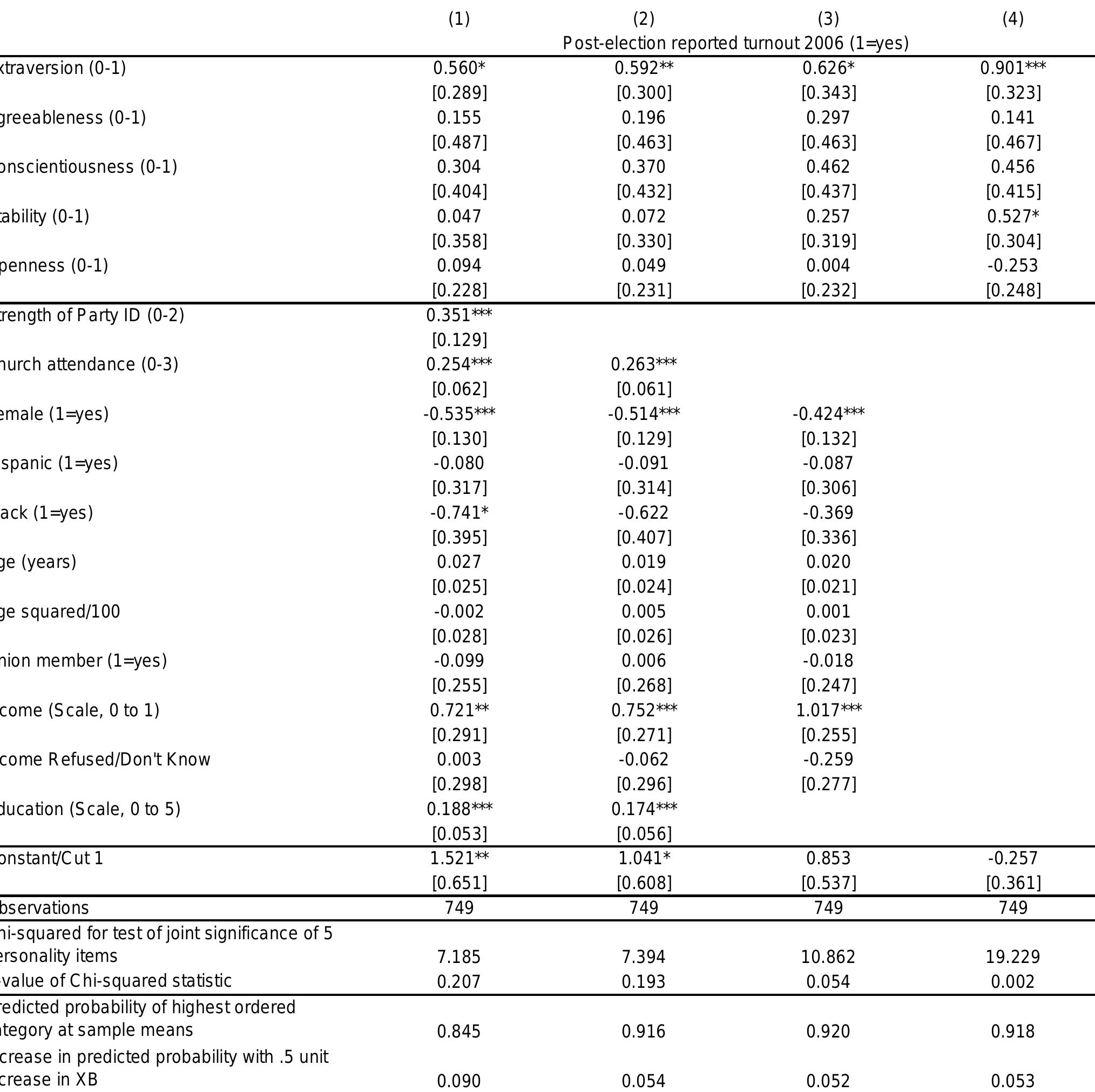
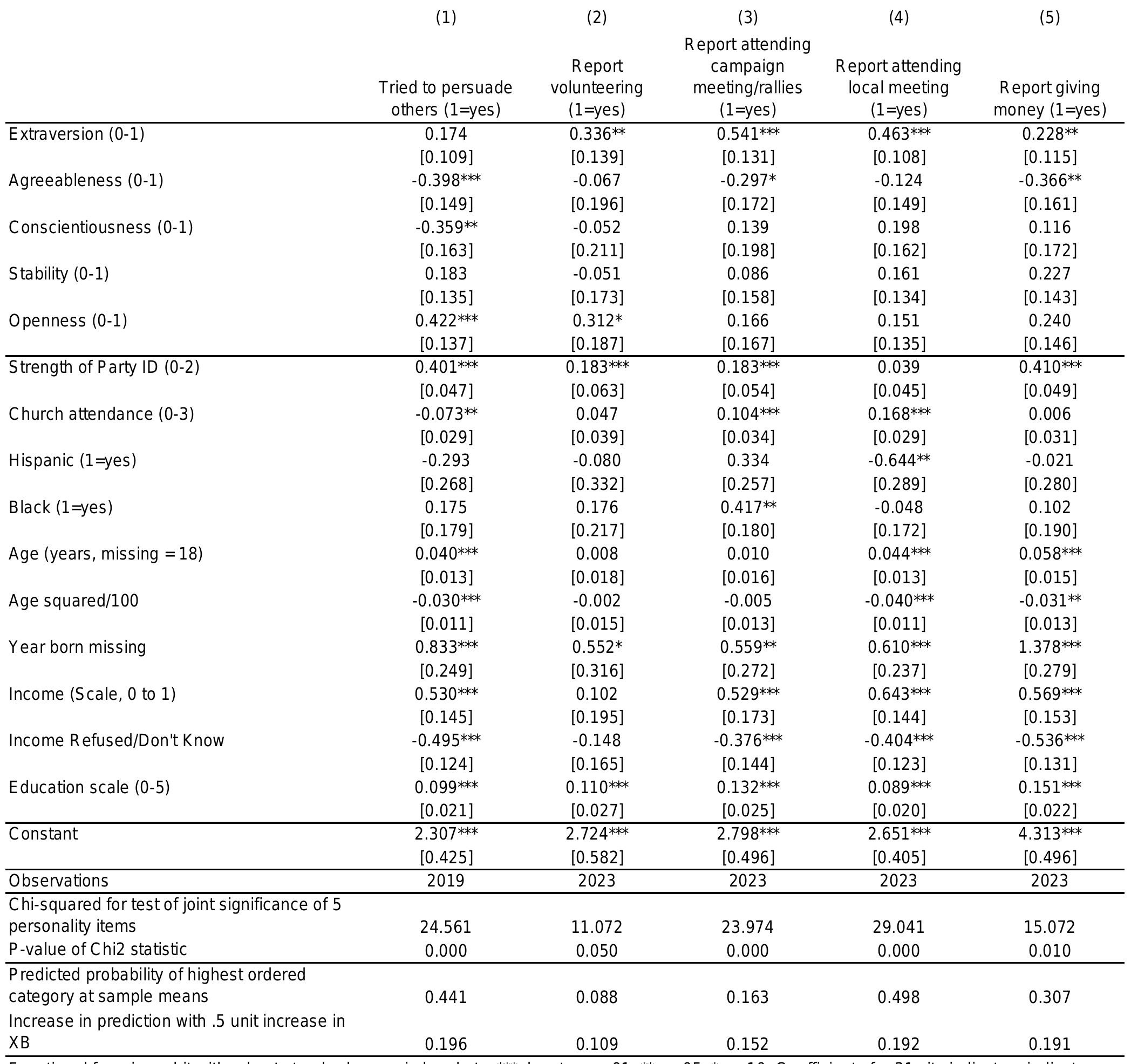
Functional form is probit with standard errors clustered at the state level in brackets. ** denotes p<01, ** p<05, * p<10. Coefficients for 3 region indicators suppressed. Covariates, other than personality, drawn from Rosenstone and Hansen (1993), where available.
Figure source:
Abstract: Using data from two recent surveys, we analyze the relationship between personality traits, as measured by the Five-factor Model, and political participation, political ideology, partisanship, and vote choice. We confirm previous findings, including the strong positive association between the personality trait of Openness and liberalism and between Conscientiousness and conservatism, and also report several new results. We merged administrative records containing actual turnout and party registration status with our survey data. Using this novel approach, we confirm that the strong relationship between personality and politics holds when actual behavior is substituted for survey reports. We also measure the association of personality and several forms of political participation, including voting, contributing, and volunteering. The effect of personality on participation is often comparable to, or larger in magnitude than, the effect of factors that are central in earlier models of turnout, such as religious attendance, age, education, and income. 1 recent decades political science has only rarely taken note of, or contributed research on, the role of personality in political behavior.
