Personality and Political Behavior
Alan Gerber*
Yale University
Professor
Department of Political Science
Institution for Social and Policy Studies
77 Prospect Street, PO Box 208209
New Haven, CT 06520-8209
[email protected]
203- 432-5232 (voice), 203-432-3296 (fax)
Gregory A. Huber
Yale University
Associate Professor
Department of Political Science
Institution for Social and Policy Studies
77 Prospect Street, PO Box 208209
New Haven, CT 06520-8209
[email protected]
203-432-5731 (voice), 203-432-3296 (fax)
Connor Raso
Stanford University
Graduate Student
616 Serra St., Encina Hall West, Room 100
Stanford University
Stanford, CA 94305-6044
[email protected]
Shang Ha
Yale University
Postdoctoral Fellow
Institution for Social and Policy Studies
77 Prospect Street, PO Box 208209
New Haven, CT 06520-8209
[email protected]
Version 1
February 11, 2009
* Corresponding Author
Electronic copy available at: http://ssrn.com/abstract=1412829
Personality and Political Behavior
Abstract: Using data from two recent surveys, we analyze the relationship between personality traits, as
measured by the Five-factor Model, and political participation, political ideology, partisanship, and vote
choice. We confirm previous findings, including the strong positive association between the personality
trait of Openness and liberalism and between Conscientiousness and conservatism, and also report several
new results. We merged administrative records containing actual turnout and party registration status with
our survey data. Using this novel approach, we confirm that the strong relationship between personality
and politics holds when actual behavior is substituted for survey reports. We also measure the association
of personality and several forms of political participation, including voting, contributing, and
volunteering. The effect of personality on participation is often comparable to, or larger in magnitude
than, the effect of factors that are central in earlier models of turnout, such as religious attendance, age,
education, and income.
Electronic copy available at: http://ssrn.com/abstract=1412829
Theophrastus, the immediate successor of Aristotle, was among other things a student of
character. His pioneering character sketches captured the profound insight that an individual’s behavior
across seemingly unrelated domains is often highly correlated (Gosling 2008). These regularities have
been noted by great novelists and playwrights as well as writers of popular entertainment. And it is
evident to almost everyone, even those without exposure to Theophrastus, Molière, “The Odd Couple,” or
“Survivor,” that there are different types of personalities. At the most basic level, people commonly ask:
“what sort of person is she?” and find the answer illuminating. Political scientists, on the other hand, have
typically doubted that such questions were especially useful for understanding and predicting a person’s
political attitudes and behavior.
It is by now, however, well documented that individuals exhibit consistent behavioral tendencies
across a range of contexts. The associations are wide-ranging and sometimes surprising. Recently,
psychologists have found that there are strong linkages between personality measures and how a person
walks, how often they smile, what kind of music they like, and how they dress (Gosling 2008).
Personality also appears to be both fairly stable over time and deeply rooted. Indeed, twin studies suggest
that a substantial portion of personality differences are genetic (Plomin et al. 1990). Psychologists have
developed taxonomies to classify people according to general personality traits that capture commonly
observed patterns. These constructs reduce the complexities of personality to a small number of
dimensions that predict a broad array of behaviors and attitudes, including political attitudes (e.g.,
Rentfrow et al. n.d.; Gosling et al. 2003).
Exploring the origins, development, and influence of personality is an active area of research in
psychology (Funder 2001; Ozer and Benet-Martinez 2006). While political scientists were important
contributors to the early investigations of personality and politics (e.g., Lasswell 1951; Lane 1955;
McClosky 1958), classic accounts of political behavior tended to minimize the role of personality 1 , and in
1
Landmark studies of political behavior suggested that personality has at most a modest impact on partisan choice
(Campbell et al. 1960, 506-7). For instance, analysis of the 1952 election does not support the hypothesis that
authoritarian voters disproportionately supported Eisenhower. Similarly, most issue preferences were not
1
recent decades political science has only rarely taken note of, or contributed research on, the role of
personality in political behavior.
Using data from two recent representative surveys, we examine the relationship between
personality and several key aspects of political behavior: political participation, political ideology, party
identification, vote choice, and political opinions. The first survey is the 2006 Cooperative Congressional
Election Study (CCES), a joint survey fielded during the weeks before and after the November 2006
congressional elections. The second survey is a representative sample of Connecticut residents (CT
Survey) fielded in June 2008. Both surveys include measures of many of the most important forms of
political participation, such as turnout, contributing, and volunteering, as well as of respondent ideology,
issue positions, party identification, and candidate preferences. To assess the relationship between
personality and these political activities and attitudes, we included a standard personality test on the CT
Survey and on our portion of the CCES. Current personality research is oriented around the Five-factor
Model (FFM, aka “the Big Five”), which we will describe in greater detail in the next section. Using the
Ten Item Personality Inventory (TIPI, Gosling et al. 2003), a short battery designed to measure “the Big
Five” personality dimensions, we obtained a measurement of the personality of more than 2,100 CT
Survey and 900 CCES respondents. We investigate how political behavior is associated with these
personality traits.
The particular nature of political choices suggests personality may be especially valuable in
explaining political behavior. Political behavior is commonly analyzed as a choice among the available
alternative actions made by individuals with particular resources and preferences (e.g., Downs 1957). A
well-known challenge in modeling mass political behavior in this way is the weak to non-existent
connection between an individual’s actions and political outcomes. The important private consequences
faced by individuals in other spheres, which would tend to dampen variation in observed behavior (e.g.,
the substantial private consequences that follow the decision to get a job rather than be unemployed
significantly related to authoritarianism after controlling for education (Campbell et al., 1960, 514). Review pieces
by Rossi (1966) and Sears (1969) also conclude that personality has very little effect on vote choice.
2
would tend to make people of all personality types seek employment) are rarely present in the realm of
politics (e.g., consider the insignificant private consequences of the decision to vote rather than abstain).
The weak relationship between political choices and outcomes opens the door especially widely for
psychological dispositions to drive behavior. The standard models of individual vote choice and,
especially, participation, in fact have large prediction errors (Rosenstone and Hansen 1993; Verba,
Schlozman, and Brady 1995).
There is a large literature on personality and attitudes and behavior, including a small but growing
body of work on the connections between personality and political attitudes and behavior. Our paper
makes several contributions to this literature. First, while there is extensive research on personality and
political attitudes, the previous work is based solely on survey responses or other self reported measures.
In effect, the survey based research demonstrates an association between one set of measures generated
by the survey (the personality index) and another (the attitudes and behaviors of interest). Using public
records, we assess the effect of personality on validated measures of voter turnout and party registration.
We find that some, but not all, of the relationships that appear in the survey data also recur for actual
voter behavior. Second, we consider aspects of political behavior neglected in prior research.
Surprisingly, it appears that only one previous study, a recent paper by Mondak and Halperin (2008), has
estimated the effect of the “Big Five” personality dimensions on either party identification or voter
turnout and other key forms of political participation. 2 Existing work in the U.S. context has also
neglected other important dimensions of the connection between personality and politics. Our analysis
contributes an identification of the linkage between personality and (a) additional forms of political
participation (such as persuading others to vote and giving money to campaigns), (b) individual issue
positions, and (c) evaluations of important political figures and vote choice.
Third, we assess the relative importance of personality compared to the variables traditionally at
the heart of analysis of political participation. We find that, even after controlling for the standard set of
2
An unpublished working paper by Whitaker, Fulwider, and Herian (2007) considers the link between partisanship
and personality. That paper employs a non-standard and un-validated measure of personality for a small (N<200)
sample of undergraduates. Our data collection and analysis was conducted independently of theirs.
3
variables indicated by traditional models of participation (e.g., Rosenstone and Hansen 1993), personality
variables are highly important substantively and statistically in predicting voter turnout, campaign
contributions, and other participation measures. We document the magnitude of personality effects on key
dimensions of political participation and show that the effects of personality are frequently more
important than substantial differences in education, age, and income. Those variables have been the
central focus of hundreds of studies of participation, while personality has not even been a footnote in
most prior accounts.
Finally, we confirm and extend the existing findings regarding the role of personality on political
ideology and reported vote choice. Our analysis confirms the most common finding in prior personality
research, which shows the personality trait of Openness to Experience (characterized by stimulus seeking,
curiosity, and creativity) is positively associated with liberal attitudes and Democratic voting, while the
trait Conscientiousness (characterized by an affinity for rule following behavior, being organized, and
orderly) is positively associated with conservative ideology and Republican vote choice. Additionally, we
present evidence that Agreeableness (characterized by warmth and sympathy) is associated with
Democratic party identification and being liberal, while Emotional Stability (in the past referred to by its
inverse: Neuroticism; characterized by low levels of anxiety and an ability to cope with stressful
situations) is associated with Republican party identification and being conservative.
Incorporating personality into our account of political behavior has the potential to reshape our
basic understanding both of why people engage in politics and how they make political choices. If
personality drives political behavior, this suggests rethinking the role political socialization plays in
producing adult political behavior. The classic “Michigan model” assigns early political socialization a
key role in explaining the orientation and stability of political behavior. By contrast, it is thought that
personality is caused by genetics, family socialization, and peers; no research credits political
socialization with a causal role. Theories which root political outlook in early political socialization might
4
therefore be mistaking the general process of personality formation for political socialization. 3 More
generally, if much of politics is rooted in basic personality differences, our search for understanding the
causes of political behavior should be directed away from narrowly focused political influences and
toward holistic accounts of personal psychology in which political behavior is one expression of the broad
pattern of behavior typical of a certain type of person.
Recent work has shown that, like personality, political behaviors and attitudes are also heritable. 4
Political orientations (Alford, Funk, and Hibbing 2005; also see Martin et al. 1986), strength of party
identification (Settle, Dawes, and Fowler n.d.; Hatemi et al. n.d.), and both voter turnout and other forms
of political participation (Fowler, Baker, and Dawes 2008) have been shown to be genetically transmitted.
Scholars have identified the specific genes associated with certain outcomes (e.g., Fowler and Dawes
2008) and identified some potential gene-environment interactions (Settle et al. 2008; Dawes and Fowler
n.d.). Given that we find a link between personality and political outcomes, and that both personality and
political outcomes appear heritable, personality is likely one of the important avenues by which genes
affect political decisions. In other words, personality may play a mediating role between genetics and
politics. Thus, the results presented here, coupled with the results linking genetics to politics, provide an
exciting avenue for future research.
We find that some types of people are much more prone to participate than others, and that
different types of people participate in different ways. Extraverts (characterized by an energetic and
dynamic personality), for example, are prone to high levels of participation overall and are especially
drawn to modes of participation involving direct interaction with others, while those scoring high on
Conscientiousness are less likely to seek to persuade others face-to-face (e.g., Bekkers 2005). This pattern
suggests something more general: that “neutral” political rules may have a disparate impact across
3
Indeed, most families devote far greater attention to shaping the religious beliefs and social practices of their
children than to explicit political indoctrination.
4
See Charney (2008) for a critique of genetic research methods and its use in political science (also see Beckwith
and Morris 2008); see Alford, Funk, and Hibbing (2008) and Hannagan and Hatemi (2008) for responses to Charney
(and Alford et al. 2008 for a response to Beckwith and Morris).
5
citizens with different personalities. The way political institutions might affect different personality types,
however, is entirely neglected in current debates over the merits of alternative institutional arrangements.
If personality drives political attitudes and behavior, this also raises important normative
concerns. At the individual level, documenting the role of personality traits in shaping political views
might provoke introspection. Learning that others with your personality type are prone to hold certain
political views might lead you to question your “gut reactions” to political issues and encourage the
citizen to think more deeply about the basis for his or her political attitudes and behavior (e.g., Devlin
1965, ch. 1). A related question for political theorists concerns the status of “moral intuition.” If
personality traits, which are in large part heritable (e.g., Bouchard 1997; Plomin et al. 1990; Van Gestel
and Van Broeckhoven 2003), are strongly associated with a tendency to form certain political opinions, is
a citizen’s moral intuition about what is fair or just at all related to the actual moral characteristics of a
society or just a mere reflection of the citizen’s personality? In a similar vein, is the normative position of
democratic procedures diminished if election outcomes can be predicted, in part, by simply adding up the
ratios of different personality types in the electorate?
To summarize, we use the recently developed tools of personality psychology to inquire as to
what sort of person tends to participate in politics, how different sorts of people tend to participate, and
what sort of person tends to favor the Democrats or liberal issue positions rather than Republican or
conservative positions. Section 1 briefly describes some of the main themes in the literature on
personality and the literature on personality and politics. Section 2 describes our datasets and the
instrument used to measure personality. Section 3 presents the results; we examine the relationship
between personality and participation, party identification and ideology, and voting behavior and policy
opinions. Section 4 concludes with a discussion of the findings, their limitations, and some suggestions
for further research.
6
1. Personality and Political Behavior
A. Conceptualizing Personality
In psychology the dominant framework for organizing personality traits since the 1990s has been
the Five-factor Model (FFM, a.k.a. the “Big Five”), which partitions personality into five dimensions:
Extraversion, Agreeableness, Conscientiousness, Emotional Stability, and Openness to Experience. The
Big Five is “the most widely used and extensively researched measure of personality” (Gosling,
Rentfrow, and Swann 2003, 506). It emerged from analysis of natural language in which researchers first
gathered lists of words that subjects commonly used to describe personality characteristics and then ran a
factor analysis to discern commonalities from these self-descriptions (Allport 1937). The Five-factor
Model has been found to be reliable across different types of samples, raters, and methodological
variations (John and Srivastava 1999, 9). John and Srivastava (1999, 30) describe the five factors as
follows:
Extraversion implies an energetic approach toward the social and material world and includes
traits such as sociability, activity, assertiveness, and positive emotionality.
Agreeableness contrasts a prosocial and communal orientation towards others with antagonism
and includes traits such as altruism, tender-mindedness, trust, and modesty.
Conscientiousness describes socially prescribed impulse control that facilitates task- and goal-
directed behavior, such as thinking before acting, delaying gratification, following norms and
rules, and planning, organizing, and prioritizing tasks.
Emotional Stability describes even-temperedness and contrasts with negative emotionality, such
as feeling anxious, nervous, sad, and tense.
Openness to Experience (vs. closed-mindedness) describes the breadth, depth, originality, and
complexity of an individual’s mental and experiential life.
The Five-factor model successfully predicts a wide range of behaviors, including job performance, school
performance, juvenile delinquency, overall health, musical tastes, dress, voice, and facial characteristics
(Goldberg 1993, John and Srivasta 1999, Ozer and Benet-Martinez 2006, Gosling 2008). 5
5
Other references commenting on the relationship between personality and specific behaviors include Graziano and
Eisenberg (1997), Hogan and Ones (1997), McCrae (1996), and Watson and Clark (1997). For a recent description
7
B. Personality, Political Ideology, and Vote Choice
The link between personality and political ideology has been studied for decades and predates the
development of the Five-factor model (early work includes Jaensch [1938], Fromm [1947, 1964], Adorno
et al. [1950], McClosky [1958], Tomkins [1963], Brown [1965], Bem [1970], and Wilson [1973]).
Carney et al. (2008) reviews this literature and concludes that, while studies describe personality traits
using a diverse set of categories and measures, a consistent pattern emerges from the work of very
different personality theorists: the personality trait captured in the Big Five by Openness to Experience is
positively related to political liberalism, while Conscientiousness is positively related to conservatism. 6
Recent work on personality and political ideology using the FFM generally confirms this finding.
Liberals score higher than conservatives on Openness to Experience and lower than conservatives on
Conscientiousness. Occasionally there is evidence that other Big Five dimensions are associated with
politics. A series of papers by Caprara and collaborators examines the link between Big Five personality,
political attitudes, and vote choice. Caprara et al. (1999) find that Italian voters scoring high on Openness
and low on Extraversion were likely to prefer the center-left coalition in the 1994 election. Caprara et al.
(2006) use broader samples and find similar results—those voting for the center-left rather than the
center-right in the 2001 Italian elections were higher in Agreeableness and Openness and lower in
Extraversion and Conscientiousness. Schoen and Schumann (2007) conduct a similar analysis using data
from Germany. They find patterns similar to those in Caprara et al. (1999), but unlike the earlier work,
they also find that Emotional Stability is negatively associated with support for parties advocating a
reduction in the pace of social and cultural change (Schoen and Schumann 2007, 471).
While many of the studies of personality and politics examine European electorates, there are
important exceptions. Carney et al. (2008) conduct the most comprehensive empirical investigation of the
relationship between the Big Five and political ideology. Analyzing a number of samples (reaching
of the personality dimensions captured by the Five Factor Model as well as a discussion of its implication for
politics, see Mondak and Halperin (2008).
6
Indeed, the relationship between Openness and liberalism is so well-established that Jost et al. (2003) were able to
compile a meta-analysis of over 80 studies linking Openness to (various measures of) liberalism.
8
almost 20,000 respondents total), they find that in the United States liberals and conservatives differ only
in Openness and Conscientiousness; with liberals more open to new experiences and conservatives more
conscientious. 7 Differences on the other dimensions are not statistically significant. 8
Rentfrow et al. (n.d.) use data from an online survey to estimate Big Five scores for each state,
and then use these estimates to predict the state-level vote in the 1996-2004 presidential elections.
Openness to Experience is strongly associated with Democratic vote choice, while Conscientiousness is a
statistically significant predictor of Republican support. Extraversion is also a weakly significant
predictor of Democratic support.
Recently, Mondak and Halperin (2008) study the effect of Big Five personality differences on
partisanship, political ideology, and presidential approval. They analyze the results of two surveys of the
residents of Tallahassee, Florida and a survey of those called to jury duty in 19 randomly selected
counties. They confirm the previous association between Openness and left leaning political dispositions
and Conscientiousness and right leaning orientation. They also note that there is a tendency for Emotional
Stability to be positively associated with a right leaning and Republican orientation.
C. Personality and Political Participation
There is a limited body of work measuring the effect of personality on political participation.
Bekkers studies the relationship between personality and membership in voluntary organizations (such as
sports and hobby clubs, political parties, and labor unions) among respondents in the Family Survey of
7
A related line of research examines the correlation between perceptions of candidate personality and survey
respondent personality. Following earlier work by Caprara and Zimbardo (2004), Caprara et al. (2007) report that
survey respondents in Italy and the United States favor leaders with personality traits mirroring their own. In the
U.S., they analyze an internet survey convenience sample measuring the personality traits of the respondent and the
respondent’s perceptions of the traits of John Kerry and George Bush. Their results show that respondents support
the candidate that they perceive to hold traits similar to their own. Further, the observed pattern of respondent
personality and political preferences parallels earlier research: Bush voters rank higher on Emotional Stability,
Extraversion, and Conscientiousness.
8
Other studies with similar results include Gosling, Renfrow, and Swann (2003), whose results confirm previous
findings on political ideology and Openness and Conscientiousness, and produce less consistent evidence that
Emotional Stability is correlated with being more conservative, and Barbaranelli et al. (2006), who find that those
rating high in Agreeableness and Openness vote for Kerry, while higher levels of Emotional Stability and
Conscientiousness predict a Bush vote.
9
the Dutch Population. He compiles participation indices and finds that group membership is positively
associated with Extraversion, Emotional Stability, and Openness, and negatively related to
Conscientiousness (Bekkers 2005).
Wolak and Marcus (2007) report the results of a laboratory experiment conducted with
undergraduates for course credit (N=162). Personality measures were obtained for three of the Big Five
(Emotional Stability, Extraversion, and Openness to Experience) and correlated with stated interest in
hypothetical participation scenarios (these included sending a letter, signing a petition, sending or
receiving email, donating money, and participating in a rally). They find no association between these
personality measures and stated desire to participate and conclude that “personality plays little role in
motivating a desire to act” (183).
Mondak and Halperin (2008) examine the association between the Big Five personality traits and
political participation. They find that Extraversion is consistently associated with higher participation in
both electoral and local politics, a weak negative association between Agreeableness and electoral
politics, and a positive association between Agreeableness and reported involvement in local politics
through acts such as attending meetings and signing petitions. However, the authors use an unvalidated
measure of personality—adjective-pairs based on Goldberg’s trait descriptive adjectives (1992) and the
Big-Five Inventory (BFI, John and Srivastava, 1999). Thus, this paper is the first to examine the
relationship between personality and political participation using a validated personality battery.
2. Data and Method
Our analysis is based on the results of two surveys. Our first sample is from a national survey, the
2006 Cooperative Congressional Election Survey (CCES). The CCES is an internet-based survey with
recruitment methods designed to approximate a random digit dialing sample. 9 The CCES was fielded as a
panel survey with the same subjects interviewed before the November 2006 election (the pre-election
9
Complete details about the CCES, including sampling frame, response rates, and codebooks for all common
content questions are available at
http://web.mit.edu/polisci/portl/cces/commoncontent/CCES_2006_GUIDE_3_24.doc.
10
wave) and again after the election (the post-election wave). Questions on both CCES waves were divided
into a group of questions asked of all respondents (the common content) and a group of questions asked
only to 1,000-respondent subsets (the private content). Our analysis draws primarily on those questions
asked in the common content, with one important exception: The specific measure of “The Big Five”
personality types used was asked only on our private content module during the pre-election wave.
There are a variety of tests to measure the Big Five personality dimensions. The 240 item NEO
Personality Inventory measures not only the Big Five, but also many additional facets of each dimension
(Costa and McCrae 1992). For the CCES survey, a much shorter test was needed. Fortunately, Gosling et
al. (2003) have developed the TIPI, which is a quickly administered instrument for situations where
longer batteries are not feasible. Gosling et al. have compared the performance of the 10 question battery
to much longer tests and find that scores obtained from the TIPI are highly correlated (2003, Tables 6 &
9) with those obtained from longer instruments. Not surprisingly, therefore, the TIPI has since been used
extensively in academic research. 10
The TIPI asks respondents to report whether “I see myself as” having a given trait using a seven-
point scale ranked from Disagree Strongly to Agree Strongly. The ten traits are: (1) Extraverted,
enthusiastic (2) Critical, quarrelsome (3) Dependable, self-disciplined (4) Anxious, easily upset (5) Open
to new experiences, complex (6) Reserved, quiet (7) Sympathetic, warm (8) Disorganized, careless (9)
Calm, emotionally stable and (10) Conventional, uncreative. Responses to these ten questions are then
used to score a respondent’s personality in each of the five personality categories of the FFM. 11 Before
proceeding, we note that one of the striking things about the TIPI (and all of the instruments used to
assign scores in the FFM more generally) is that the words listed are not immediately related to political
10
By February 9, 2009 the paper in which the TIPI first appears has been cited 196 times according to Google
Scholar.
11
Response categories are coded as follows: Disagree strongly (0), Disagree moderately (1), Disagree a little (2),
Neither agree nor disagree (3), Agree a little (4), Agree moderately (5), Agree strongly (6). The personality battery
is then calculated for each dimension as the sum of the items listed divided by 12 (to scale each personality
dimension between 0 and 1). Items denoted with R are reverse-scored items, which means you must take the
absolute value of the response category after subtracting 6 [e.g, 0=6, 6=0]): Extraversion: 1, 6R; Agreeableness: 2R,
7; Conscientiousness; 3, 8R; Emotional Stability: 4R, 9; Openness to Experiences: 5, 10R. All other question
wording and variable coding rules appear in the Reviewer’s Appendix.
11
concerns. More directly, there is little reason to believe that these questions are merely rewordings of
common political beliefs, and so responses to them are unlikely to be affected by the political content of
the survey instrument. This is very distinct from personality measures previously used by political
scientists. For example, Altemeyer’s Right-wing Authoritarianism (RWA) scale contains politically-
charged agree/disagree items such as “Government, judges and the police should never be allowed to
censor books” and “What our country really needs is a strong, determined leader who will crush evil, and
take us back to our true path” (Altemeyer and Hunsberger 1992). Not only are these items overtly
political, but responses to them might also be affected by the other political content asked on the survey
instrument.
Table A1 in the Reviewer’s Appendix displays the correlations across the FFM categories.
Confirming prior research, we find a positive correlation among all items, a pattern that is not surprising
given the social desirability of each category in contemporary American culture (Digman 1997). These
correlations range from around .11 (between Extraversion and Agreeableness, Conscientiousness, and
Emotional Stability) to about .32 (between Extraversion and Openness and between Conscientiousness
and Emotional Stability).
In addition to the CCES we fielded a second study in June 2008. We surveyed a random sample
of more than 2,100 Connecticut residents. To facilitate matching with Connecticut voter records, which
list name and address for all registered voters, Survey Sampling Inc. drew a random sample from a
residential phone directory of Connecticut households. In addition to the TIPI and demographic items,
survey respondents were asked about their political participation, party preferences, and political
ideology. Summary statistics for all model variables for both samples are shown in Table 1.
<<Table 1 About Here>>
12
3. Analysis
A. Personality and Turnout
We begin our analysis of the effect of personality on political opinions and behaviors by
considering the relationship between personality and turnout. In our analysis of personality and turnout
we report the results first using the CCES sample and then using the CT sample.
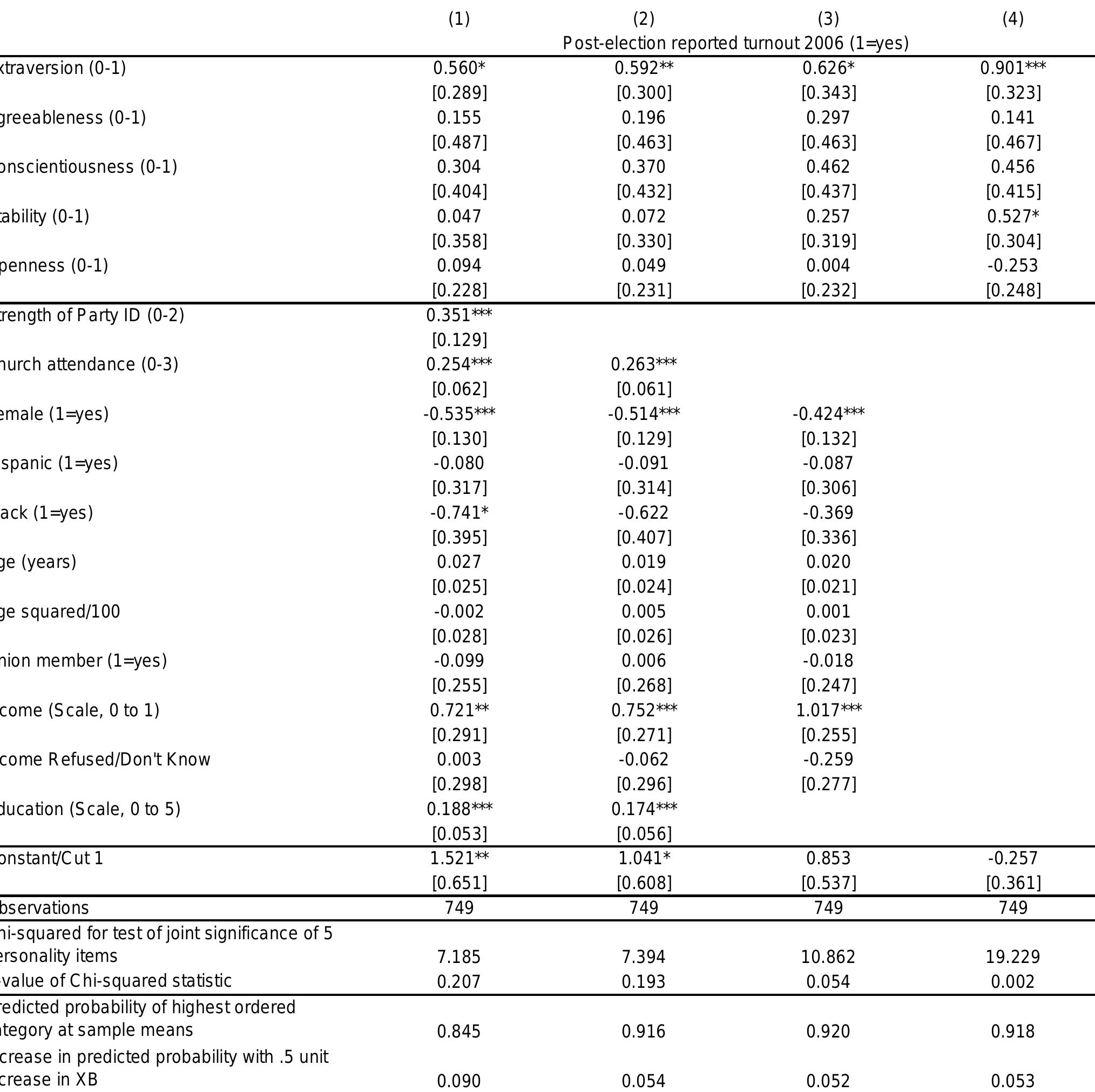
The 2006 CCES measured the propensity to vote using a retrospective self-report of turnout
(0=no, 1=yes) in the November 2006 election. Statistical estimates employing reported turnout appear in
Table 2A.
<<Tables 2A and 2B About Here>>
The specification in column (1) examines turnout as a function of personality traits and a standard
array of demographic and political controls (e.g., Rosenstone and Hansen 1993; Verba, Schlozman, and
Brady 1995). In addition to the variables shown in the table, the model also includes indicators for region
of residence (midwest, northwest, south, and west [the excluded category]). Before turning to the effects
of personality, we note that many, though not all, of the “standard” variables associated with variation in
turnout in previous work (Rosenstone and Hansen 1993, 132-3) are also strong predictors of participation
in these data. Those with stronger partisan affiliations, who attend religious services more frequently, are
wealthy, and are well educated, are more likely to report voting.
To facilitate our discussion of marginal effects in the probit context, the bottom two rows of all
tables display (1) the predicted probability of the highest ordered outcome 12 for the dependent variable (in
this case, 1=yes for reported turnout) with all variables held constant at their sample means (in this case
the baseline predicted turnout probability is .845) and (2) the effect of a .5 unit increase in XB (the
underlying linear index before the probit transformation) on that outcome. Assuming that small changes
in XB have effects that are roughly proportional to the effect of a .5 unit change, this presentation allows
the reader to estimate the marginal effect of a perturbation in any given variable on the outcome of
12
For linear models, the predicted value for the outcome of interest is simply XB.
13
interest. So, for example, increasing the strength of a respondent’s party identification by one unit has a
predicted effect of increasing reported turnout by approximately (1x(0.351/0.5))x0.09, or about 6.3
percentage points.
Focusing on the measures of personality traits (which appear as the first five variables in the
table) the estimates in column (1) show a positive relationship between reported turnout and Extraversion
which is marginally statistically significant. According to these results, a one standard deviation increase
in Extraversion (.245) is associated with a 2.5 percentage point increase in the predicted probability of
turnout. A test of the joint significance of the five personality items has a Chi-squared value of only 7.2
(p-value of .21). 13 The model specification presented in column (1) shows the effect of personality traits
in a standard model of voter turnout. However, some of the variables in this model, such as strength of
party identification, church attendance, and education level, are themselves likely caused by respondent
personality. 14 This may cause the coefficient on the personality trait measures to underestimate the total
effect of personality on turnout. For this reason, we also report the results from alternative specifications
that exclude various sets of control variables, including a specification where no controls are included. In
column (2), the estimated model excludes strength of partisan identification, while in (3) it also excludes
church attendance and education. Removing these variables increases the estimated effect of Extraversion
(the coefficient on Extraversion is about 12% larger in [3] than in [1]) and increases the Chi-squared
statistic on the joint effect of personality (to 7.4, p=.19 in [2] and to 10.862, p=.05 in [3]).
In the specification excluding all control variables in column (4), the effect of Extraversion is
61% larger than the effect observed in column (1), suggesting that the indirect effects of Extraversion on
several of the controls included in the original specification may be partially obscuring the effects of the
13
Because 2006 and 2008 were relatively good years for Democrats rather than Republicans, one might also be
concerned that these results are driven by the potential correlation between personality and partisan affiliation. For
this reason, Table A2 in the Reviewer’s Appendix repeats the analysis shown in Tables 2A, 2B, 3A, and 3B, after
adding a measure of party affiliation. Adding this control leaves the results reported here substantively unchanged.
14
For example, people who participate in politics may be more likely to join other non-political groups, like
churches.
14
personality items on reported turnout. 15 In the model that excludes control variables, we can now easily
reject the null hypothesis that the five personality items are jointly insignificant (Chi-squared 19.2, p-
value of .002). Substantively, the effect of a one standard deviation increase in Extraversion is now
associated with a 2.3 percentage point increase in reported turnout. 16
Table 2B presents the effects of personality on reported turnout based on the CT survey. Column
(1) shows the estimation results from a model with traditional controls, while columns (2)-(4) estimate the
effects on turnout when various control variables are excluded. Note that due to the larger sample size the
standard errors are much smaller than in Table 2A. Across the range of specifications, tests of the joint
significance of the five personality measures reject the null hypothesis of no effect at the .001 level. As in
Table 2A, the effects of Extraversion are positive and statistically significant. The marginal effect of a one
standard deviation increase in Extraversion is roughly similar across samples. For example, using the
column (4) specifications in tables 2A and 2B, a one standard deviation increase in Extraversion produces
a marginal increase in turnout of approximately 2.3 and 2.6 percentage points, respectively. In Table 2A
there was a suggestive positive relationship between Emotional Stability and turnout. This effect emerges
consistently in the CT sample (p<.05 in all models). Using the model in Table 2B, column (4), a one
standard deviation increase in Emotional Stability (.24) is associated with a 2.3 percentage point increase
in turnout.
B. Personality and Other Forms of Participation
We next consider the effect of personality on a set of broader measures of political participation.
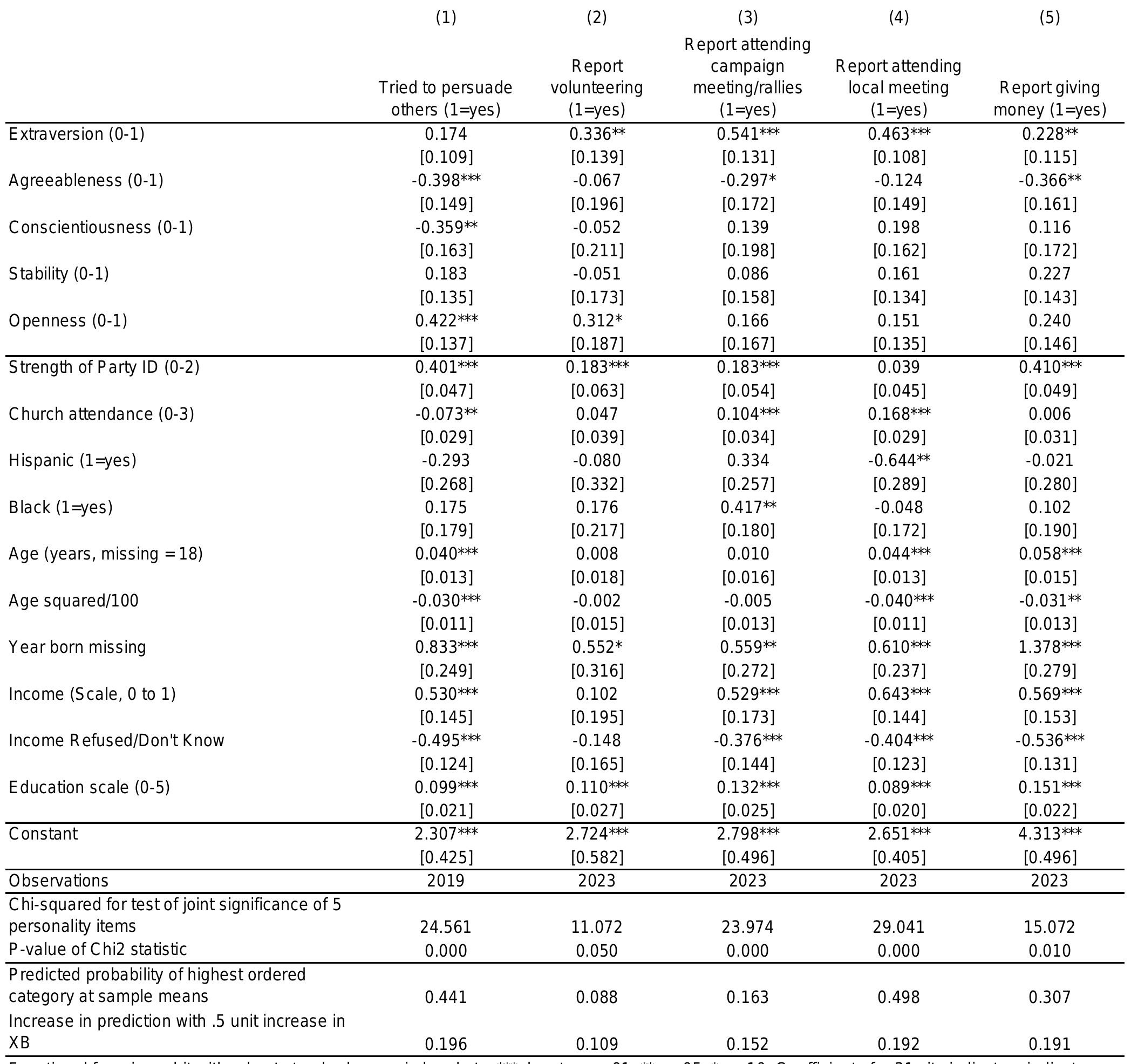
In particular, in Tables 3A and 3B, we examine the relationship between personality and efforts to
persuade others, volunteering for a campaign, attending campaign meetings/rallies, attending community
meetings, and contributing to a campaign. Each of these forms of participation is typically positively
15
In a model that includes only those control variables not reflecting choices (gender, race, age, and region), the five
personality items are also jointly significant at p<.05 and the coefficient on Extraversion is .696 (p-value of .04).
16
While the coefficient on Extraversion is substantially larger in column (4) than in column (1), the predicted
probability of turnout with variables held constant at sample means is also higher (91.8% rather than 84.5%).
Because, with the probit transformation, the marginal effect of a further increase in the latent XB index is smaller
when the baseline prediction is further from .5, the relative effect of a .5 unit increase in XB is smaller.
15
correlated with turnout, but because the acts themselves vary (e.g., privately voting versus privately
writing a check versus publicly trying to persuade others or attending a community meeting) and their
effects on the political system also differ (e.g., personal persuasion is limited to individuals one meets,
whereas money given to campaigns is fungible), the potential for a differential effect of personality on
each is also of great interest.
<<Tables 3A and 3B About Here>>
We first examine the effects of personality in the CCES sample. We begin by noting that, for all
five dependent variables we consider, we can unambiguously reject the hypothesis that the personality
items are jointly statistically insignificant (the largest p-value for the Chi-squared statistics is only .002).
This holds despite the fact that for Tables 3A (and 3B), in the interest of tractability, we report only one
model for each of the dependent variables, the model which includes the important predictors of political
participation included in prior work.
For seeking to persuade others, we find evidence that Extraversion and Emotional Stability are
strongly related to efforts to persuade, while Agreeableness is negatively correlated with doing so. For
each of these dimensions of personality, a one standard deviation increase in its score has these predicted
effects: Extraversion, increases persuasion by 6.6 percentage points; Agreeableness, decreases persuasion
by 4.6 percentage points; and Emotional Stability, increases persuasion by 4.4 percentage points. Recall
that Extraversion is associated with engagement with others and Emotional Stability with control of one’s
emotions. It is therefore reasonable that non-extraverts (introverts) and the unstable (neurotics), who
experience higher costs in personal interactions with others, are less likely to try to personally persuade
others.
In fact, we find that Extraversion is positively associated with the four participatory activities
listed in Table 3A that involve direct interaction with others (it is statistically significant at p<.10 or better
in only three, however). The only exception to the pro-participation disposition of the Extravert is
contributing to a campaign, where the effect is negative but statistically insignificant, a pattern that is not
surprising if one believes individuals who choose to participate in politics do so in ways that are most
16
pleasing to them. [This negative effect of Extraversion is not repeated in the CT survey data examined
below.] Our findings suggest that for Extraverts, participation is most enjoyable when it involves
interacting with others, which writing checks does not. Emotional Stability, by comparison, is positively
associated with all five forms of political participation listed in Table 3A (but only statistically significant
at p<.10 or better in three). In contrast to those who are neurotic, stable individuals choose to interact with
others personally and to contribute to campaigns at higher rates.
The negative correlation between Agreeableness and efforts to persuade others is also notable,
because Agreeableness is associated with modesty and unselfish behavior. By its very nature, seeking to
personally persuade others to adopt your views involves being forward and, at times, to appear self-
centered. Notably, we find no other substantively large or statistically significant relationships between
Agreeableness and the other activities listed in Table 3A. Perhaps this reflects the fact that, of the list of
participating behaviors obtained here, only individually trying to persuade others involves potential one-
on-one confrontations, whereas volunteer work and campaign and community meetings are group
interactions and giving money to a campaign does not involve any personal interaction at all.
Conscientiousness, which previous research has found to correlate with political conservatism, is
characterized by an affinity for planning, self-discipline, and regard for societal rules and norms of
appropriate behavior. While one might anticipate that planning and self-discipline would allow
individuals with this trait to direct their energies to participate in campaigns, or at least to direct their
financial resources according to their electoral desires, we find the opposite pattern. Conscientiousness is
negatively and statistically significantly associated with volunteering, attending campaign rallies and
meetings, and contributing. In particular, a one standard deviation increase in Conscientiousness is
predicted to decrease volunteering by 2.0 percentage points, attending campaign rallies and meetings by
6.1 percentage points, and contributing money to a campaign by 5.6 percentage points. Here, we suggest
that it is the concern for rules and norms among those high in Conscientiousness that is at work.
Conscientiousness is positively associated with voting (and, in unreported analysis, with saying voting is
enjoyable), but voting is a strong civic norm, to the point of being a duty of good citizens. By comparison,
17
volunteering, attending meetings, and contributing are important ways to influence political life, but are
not thought to be required of citizens. In addition, volunteering for political activities challenges norms of
non-confrontation and private deliberation. In other words, they are non-conservative acts that involve
potential challenges and unpredictable interactions.
Finally, we consider Openness, which previous research has found is correlated with political
liberalism. Across all five measures of participation, greater Openness is associated with greater
participation, and this effect is statistically significant in three cases. In particular, a one standard
deviation increase in Openness is predicted to increase volunteering by 2.3 percentage points, attending
community meetings by 4.7 percentage points, and contributing money to a campaign by 8.2 percentage
points. Psychologists have noted that those who score high on measures of Openness enjoy new
experiences and are willing to challenge convention. Choosing to persuade others or to participate in a
campaign or community event are all experiences that those who are less open to new acts are unlikely to
try. Similarly, in contrast to being Conscientious, Openness involves a willingness to question authority
and standard norms, which is an active part of campaigns that call into question the desirability of current
policies and officials.
Table 3B shows the results of a parallel analysis using the CT survey. As in the CCES sample,
Extraversion exhibits a strong positive association with most forms of political participation. In contrast
to the Table 3A result showing Extraversion was unrelated to campaign giving, in the CT sample even
this form of participation is more common among Extraverts, though for this sample extraversion does
not predict persuading others. Table 3B provides further evidence that Agreeableness may be negatively
associated with political participation. For all five forms of participation those who were more Agreeable
had lower levels of participation, with statistically significant negative effects for three of the five
dependent variables (at the .01 level for persuading others, .1 level for attending campaign meeting, .05
level for giving money). There was no consistent pattern for the results regarding Conscientiousness or
Emotional Stability. The results for Openness were similar to those reported in Table 3A. For all five
behaviors there was a positive association between Openness and higher participation, with the results
18
achieving statistical significance for two behaviors (at the .01 level for persuade others, .10 level for
volunteering).
Taken together, the findings from Tables 2A, 2B, 3A, and 3B show that personality is
systematically related to both the level and form of participation. First, the results demonstrate that the
Big Five personality traits as a whole have a behaviorally important and statistically significant
relationship to political participation. In many cases, the personality traits are jointly significant at the
.001 level. Second, our findings suggest that the relationship between personality and political
participation may be heterogeneous across forms of participation. Extraversion and Conscientiousness
stand out in this regard. Extraversion is positively associated with all forms of political activity that
involve interacting with others, but the evidence is mixed with respect to contributing money to
campaigns. Conscientiousness shows a weak positive association with turnout, but is negatively
correlated with direct involvement in organized campaigns and contributing. Emotional Stability, by
contrast, appears to be positively related, with varying degrees of magnitude and statistical significance,
to turnout as well as other forms of participation. That these participatory acts differ both in their
psychological correlates and political implications is a further reason for disaggregating the causes and
consequences of these different forms of political participation.
C. Personality, Preferences, and Opinions
Next, we consider the relationship between personality and political preferences and opinions.
Recall that the most robust relationships in prior research examining personality and political preferences
are that Openness is positively associated with support for left parties and liberalism, while
Conscientiousness is positively associated with support for right parties and conservative attitudes.
We begin by examining the fundamental question of whether personality is related to political
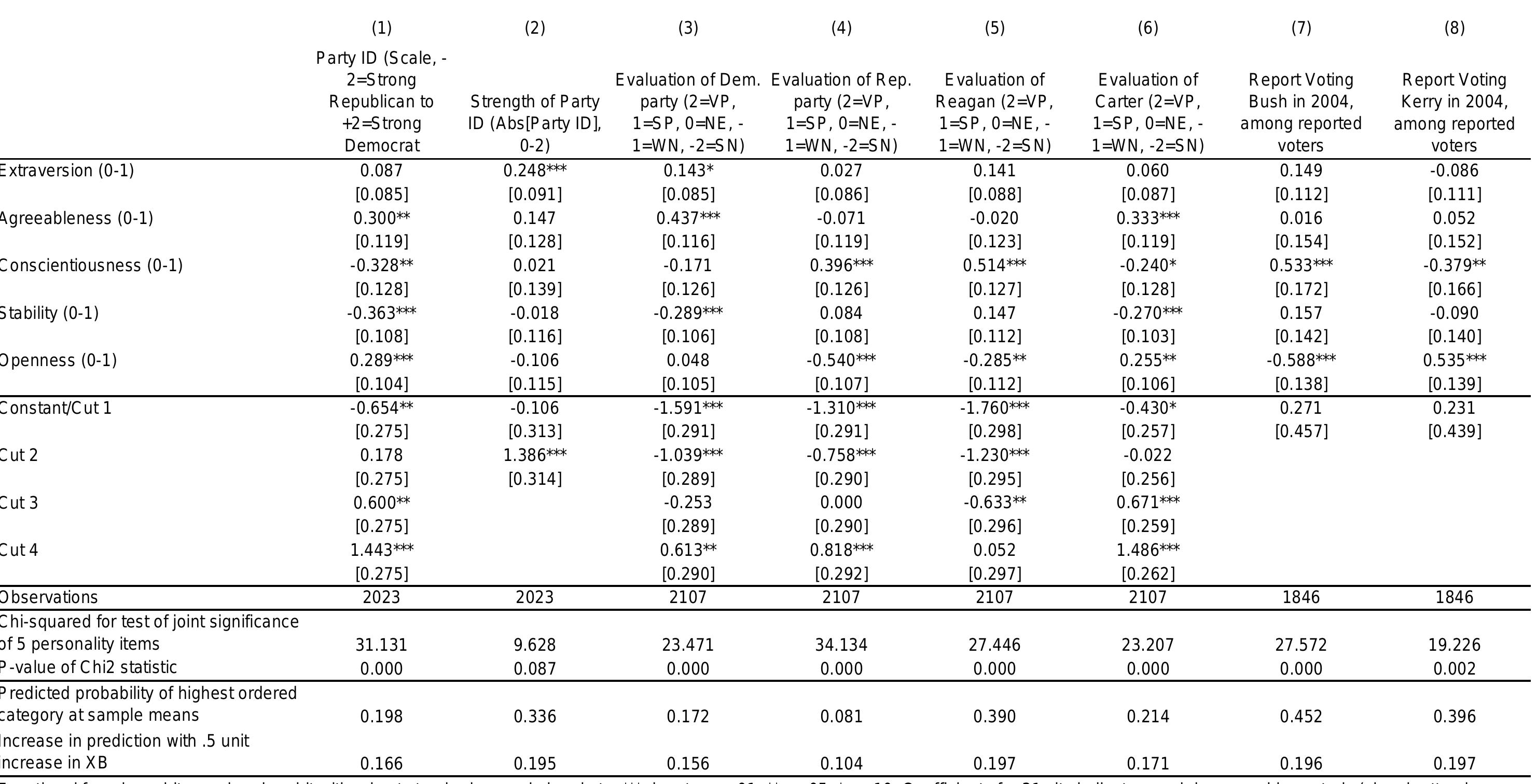
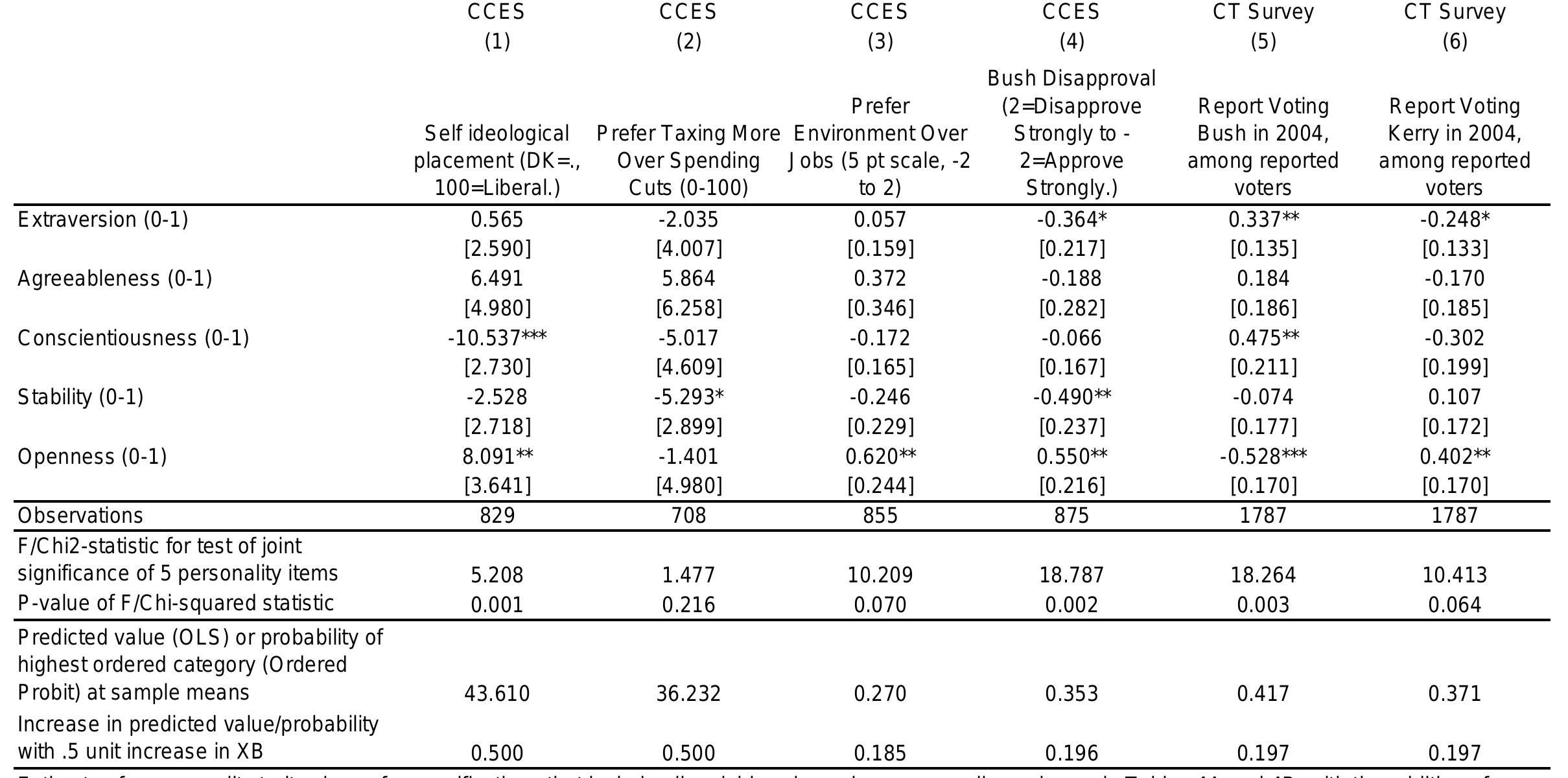
identification. Table 4A shows how personality is associated with preferences and opinions in the CCES.
In column (1) of Table 4A we present results in which we model self-reported partisan affiliation as a
function of personality, a vector of standard demographic controls, and a series of region of residence
19
indicators. We find numerous substantively important and statistically significant correlations between
personality traits and partisan affiliation, and can also easily reject the null hypothesis that partisanship is
unrelated to the five personality dimensions when considered simultaneously (Chi-squared of 42.8, p-
value < .001). Setting aside Extraversion, which appears to be unrelated to partisan affiliation, a one
standard deviation increase in each of the remaining dimensions of personality changes the predicted
probability of calling oneself a “Strong” Democrat (relative to a baseline prediction of 10.2%) by these
amounts: Agreeableness, +3.1 percentage points; Conscientiousness, -2.3; Emotional Stability, -3.0; and
Openness, +2.5. These figures represent proportional changes of between 23 and 31%. Of note, we find
correlations between partisanship and dimensions of personality (Agreeableness and Emotional Stability)
that previous research has not identified as explaining basic political leanings in the United States
(although some research has found those factors explain opinions and/or vote choice).
<<Tables 4A and 4B About Here>>
In column (2), we report the effect of personality on the strength of respondent partisan
identification. While only Agreeableness receives a marginally statistically significant coefficient, the
overall Chi-squared statistic for the joint significance of the five personality items obtains a p-value of
less than .06. This suggests that personality explains, in part, the intensity of partisan preferences.
In light of these two results, it seems clear that partisanship and personality are not independent.
Rather, when one attempts to “control for” preferences in models predicting political preferences and
opinions by incorporating party affiliation, one may actually be, to some extent, accounting for those
underlying personality factors that lead individuals to align themselves with the Democratic or
Republican parties. For this reason, as well as given our intrinsic interest in personality, in columns (3)
through (5) when we examine the correlation between personality and ideology, taxing over spending
cuts, and environmental protection over jobs, we do not include partisan affiliation as a control variable. 17
17
Models incorporating party identification appear in Table A3 in the Reviewer’s Appendix. In general, including
party affiliation reduces the direct effect of personality traits, but does not remove those effects entirely. This is
consistent with either (1) partisanship being the means by which personality affects preferences and opinions or (2)
20
For each of those measures, we find patterns that are highly similar to those seen in column (1).
In each case, we can easily reject the null hypothesis that the five personality items are jointly statistically
insignificant (all p-values are less than .001). Those who rate highly on Agreeableness and Openness see
themselves as more liberal, prefer to raise taxes rather than cut spending, and weight environmental
protection more highly than protecting jobs. By contrast, those who rate highly on Conscientiousness and
Emotional Stability are uniformly more conservative. In addition to representing substantively large
effects of changes in personality on preferences, these estimates are also statistically significant in a large
number of cases (of the 12 coefficients for these four personality items across the three dependent
variables, nine [75%] are statistically significant at p<.05).
Do these differences in basic political orientations and preferences carry over into evaluations of
contemporary political officials and voting decisions? Previous research (e.g., Schoen and Schumann
2007) has found a correlation between candidate evaluation/vote choice and both Conscientiousness and
Openness, mostly in the European context (for a notable exception, see Rentfrow et al. n.d.). In column
(6) we examine the effect of personality on evaluations of President Bush, and in column (7) we consider
the effect of personality on reported vote in the 2006 House race. 18 These results closely mirror those
about basic preferences: (1) We can reject the null hypothesis that personality is unrelated to evaluations
of Bush and voting (both p-values < .001), (2) Conscientiousness and Emotional Stability are both related
to supporting Bush and voting Republican, (3) Agreeableness and Openness are both related to
disapproving of Bush and voting Democratic (although only the effects with regard to Openness are
statistically significant). To provide a sense of the magnitude of these effects, we focus on results for vote
in the 2006 House election. The effects are quite large. A one standard deviation increase in the three
statistically significant personality traits has these effects on the predicted probability of voting
partisanship being correlated with those preference and opinions, and both are affected by personality. Extant data
do not allow these explanations to be distinguished.
18
We have also explored the correlation between personality and vote in the 2006 governor’s races. This approach,
which necessitates state-fixed effects to account for variation in candidate quality/popularity, produces results nearly
identical to those for the House vote, but with Agreeableness also statistically significant. Results available upon
request from the authors.
21
Democratic (the baseline prediction is 38.2%): Conscientiousness, -5.3 percentage points; Emotional
Stability, -5.5; and Openness, +4.9.
The findings from the CT sample are very similar to those found in the national CCES sample.
Table 4B shows the relationship between personality and party identification, strength of party
identification, evaluation of the political parties and political figures, and candidate choice in the 2004
presidential election. Agreeableness and Openness are again strongly associated with Democratic
affiliation and liberal views, while Conscientiousness and Emotional Stability are again linked to
Republican affiliation and a conservative political outlook. For the CT sample, but not the CCES,
Extraversion explains holding strong partisan beliefs, even while it does not explain well which party a
respondent prefers.
Overall, we find consistent patterns of large, statistically significant, and wide-ranging effects of
personality on basic political preferences and opinions. The strong linkage between the Big Five
personality dimensions and political attitudes suggests that conservatives and liberals appear to be
different sorts of people, not just people who happen to hold different political views. These findings
imply that personality may be an important and neglected precursor to basic political orientations and that
personality may shape (directly or indirectly) evaluations of contemporary political officials and voting
decisions.
D. Personality and Verified Measures: Participation and Party Choice
Previous research and the results reported in Tables 2-4 all rely on survey reports of attitudes and
behavior. We merged the CT survey with the Connecticut voter file, which contains information about
whether a survey respondent is registered to vote, how many recent elections the voter participated in, and
which party the registrant is affiliated with if he or she chooses to affiliate with a party. 19 These data
permit us to conduct the first analysis of personality differences that is linked to the individual’s actual
political behavior.
19
This matching process is described in the Reviewer’s Appendix.
22
Table 5 shows how personality predicts voter registration and turnout. The table shows self-
reported behavior and then actual behavior for registration, voting in 2004, and voting in 2006. We
highlight several important comparisons and contrasts between reported and actual political behavior.
First, the evidence from voter file data (columns [7], [8], and [11]-[14]) shows that Extraversion and
Emotional Stability are positively associated with voting. The results are strongest for the 2004 election,
though positive coefficients are found for the 2006 election as well. This finding confirms the basic
pattern present for self-reported turnout (columns [5], [6], [9], and [10]). Second, the relationship between
Extraversion and reported turnout is substantially stronger than the relationship between Extraversion and
actual turnout. In fact, for the 2006 election, when actual turnout is substituted for self reported voting,
the coefficient on Extraversion falls by 2/3rds. Similarly, the strong relationship between Extraversion
and registration (columns [1] and [2]) vanishes when actual registration (columns [3] and [4]) is
substituted for self reported registration status.
<<Table 5 About Here>>
Third, Conscientiousness is not associated with either registering to vote or actual voting. The
personality trait Conscientiousness includes a desire to perform one’s duty and so it is reasonable to
expect those citizens scoring highly on this trait would be more likely to adhere to social norms regarding
citizen responsibilities and therefore be more likely to vote. There was little indication of this in self-
reported data and the actual behavioral data shows that in both 2004 and 2006 more Conscientiousness
was associated with lower participation rates (not significant). Fourth, Agreeableness was not associated
with either self reported or actual voting. Openness appears to be related to a slight tendency to over-
report participation and is unrelated to actual participation level. Overall, the findings in Table 5 suggest
that personality is in fact linked to behavioral measures. The importance of personality is not merely a
reporting artifact. While the overall effect of the five personality traits on being registered is fairly weak
(p=.24 and p=.28 for columns [3] and [4], respectively), the relationship between personality and actual
voter file turnout is strong (for turnout in 2004, p=.01 in column [7] and p=.05 in column [8]; for the
turnout index p=.04 in column [13] and p=.15 in column [14]).
23
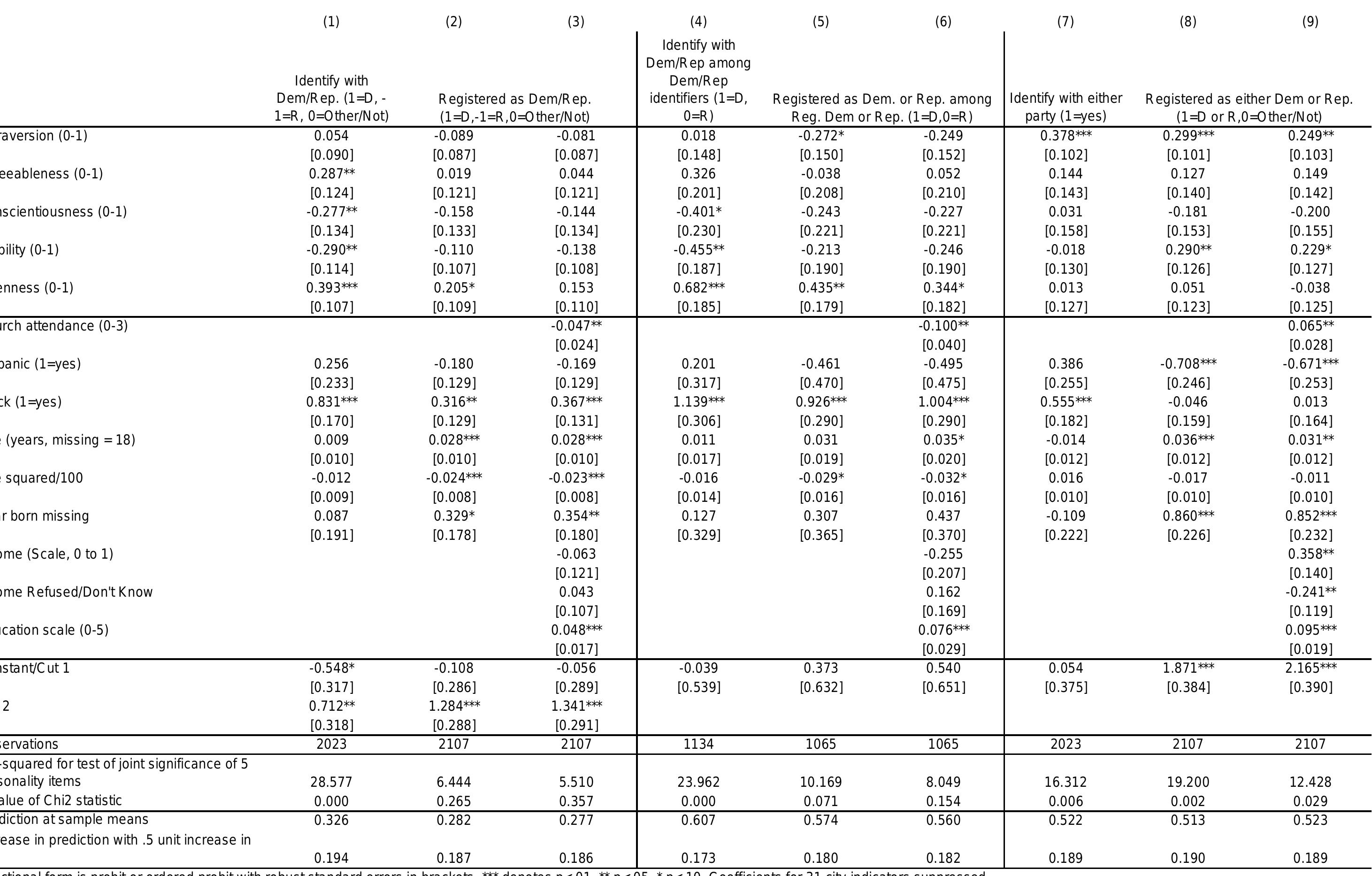
Table 6 shows the relationship between personality and party registration. While party
identification is not the same thing as party registration, for purposes of comparison we include columns
showing the relationship between party identification and personality along with parallel analyses
substituting party registration as the dependent variable. There are several interesting results. First, the
relationship between personality and party registration shown in columns (2) and (3) follows the basic
pattern of association between party identification and personality found in our earlier analysis (repeated
with a different scaling for the readers’ convenience as Table 6, column [1]). Openness is associated with
affiliation with the Democratic Party, and Conscientiousness and Emotional Stability are associated with
registering with the Republican Party. The associations between personality and party registration are
generally not statistically significant, perhaps due to noise introduced by the various considerations that
decouple party identification from registration, including failure to update registration status and
registration decisions driven by a desire to participate in particular primary elections.
<<Table 6 About Here>>
Second, when attention is restricted to the respondents that were registered to vote and also
affiliated with a major party, Openness is strongly associated with choosing the Democratic Party. The
point estimates suggest that Conscientiousness and Emotional Stability are associated with Republican
affiliation, but again the strength of the association is short of statistical significance. Third, while
Extraversion is not associated with a partisan or ideological orientation, there is weak evidence that
Extraversion leads to Republican party affiliation (columns [5] and [6]) and strong evidence that
Extraversion leads to affiliation with a major party (columns [8] and [9]). This later finding is consistent
with the result that Extraversion is associated with strong party identification (with either the Republicans
or Democrats), though this finding does not hold for the CCES sample. The results in Table 6 show that
the association of party identification with personality is roughly similar to the results obtained using a
behavioral measure of party allegiance. Together, Tables 5 and 6 demonstrate that personality predicts
actual voter behavior.
24
4. Discussion
We demonstrate that there are behaviorally important and statistically significant relationships
between personality traits and key measures of political behavior, including various forms of political
participation, political ideology, party identification, and party preferences. Our work confirms the strong
association between the personality trait of Openness and liberalism and between Conscientiousness and
conservatism, and adduces several novel findings. We show that, like Openness, Agreeableness is linked
to holding liberal views and associating with the Democratic Party, while Emotional Stability, like
Conscientiousness, is associated with being conservative and Republican. In the realm of political
participation, we find strong associations between Extraversion and modes of participation involving
interaction with others (e.g., voting, persuading others, etc.). More generally, we find substantively
important relationships between personality type and participation, and the nature of those relationships
varies across modes of participation.
Focusing on the results for political participation, Table 7 compares the magnitude of the
estimated effects of personality with the effects for several key variables that previous studies have
identified as most important in explaining patterns of political participation. In this table we calculate the
predicted change in some of the dependent variables shown in Tables 2A and 2B and 3A and 3B that is
associated with: a movement in the personality measures from one standard deviation below the mean to
one standard deviation above the mean, a one category increase in church attendance (e.g., from a few
times a month to one or more times per week), being 10 years older, having a higher income by
approximately $10,000 per year, or achieving one category greater educational attainment (e.g., move
from did not graduate high school to high school graduate).
<<Table 7 About Here>>
Examining reported turnout first, column (1) of Table 7 shows that increasing Extraversion is
associated with a 6.5 percentage point increase in predicted turnout. This effect is larger than the effects
of attending church several more times each month, being a decade older, having an income higher by
25
approximately $50,000 per year, or graduating rather than dropping out of high school. The results in
column (2) substitute actual turnout for reported turnout. Substituting actual behavior for self-reports
provides additional support for the important influence of personality on political participation. Again,
Extraversion has a large effect on turnout. The effect of an increase in Extraversion is comparable to the
effects of substantial changes in educational attainment and church attendance. Emotional Stability has a
large effect on voter turnout as well; a two standard deviation increase in Emotional Stability predicts a
change in turnout comparable to that associated with approximately seven years greater age or much
higher educational attainment, income, or church attendance.
Column (3) displays the effect of personality on whether the respondent attempts to persuade
others whether or how to vote. This dimension of political participation is of special interest if, as is often
claimed, the influence of word-of-mouth marketing is growing as traditional media becomes less
influential. For three of the five personality dimensions, the estimated association is statistically
significant and the size of the estimated effects easily exceeds the magnitude of changes in church
attendance, age, income, and education. An increase in Extraversion is associated with a 13.5 percentage
point boost in efforts to persuade others, Emotional Stability a 9 percentage point increase, and
Agreeableness a 9 percentage point reduction.
The results in columns (4) and (5) show that personality is important in predicting campaign
volunteering and campaign contributions. The estimated effect on campaign volunteering of shifts in
Extraversion, Conscientiousness, and Openness are many times larger than those associated with changes
in church attendance, age, and income. Increased Extraversion raises the probability of doing campaign
work by 1.9 percentage points and greater Openness boosts the probability by 3.1 percentage points,
while greater Conscientiousness lowers the probability by 2.8 percentage points. For campaign
contributions, we again see statistically and behaviorally important effects of Openness (a 14 percentage
point increase in the probability of contributing), Conscientiousness (a 10 percentage point decrease), and
Emotional Stability (a 7 percentage point increase). These effects are all several times as large as the 1.7
percentage point contribution rate increase associated with a $10,000 increase in income. To summarize,
26
the effect sizes we find with regard to personality and political participation are statistically significant,
and substantively large when compared to well known factors adduced to explain variation in
participation.
A striking feature of our analysis is that the personality measures we use, which are based on a
very brief, ten-item battery, appear both non-political and relatively crude. Nonetheless, they are highly
predictive. That personality measures apparently divorced from politics nevertheless are powerful
predictors suggests new insights into the way in which political participation and opinions are but one
manifestation of deeper psychological differences across individuals. The strength of our finding when
employing the TIPI is an auspicious sign, as it suggests that future investigations that use more refined
measures of personality or add additional dimensions of personality (such as the multiple “facets” of each
of the Big Five traits) might produce stronger and more nuanced results.
The results of our work can be extended in many others ways. Perhaps the most significant
limitation of the present study is that all data were collected during a single three year period. It is
possible that some unmeasured contextual variable correlated with personality and the various dependent
variables produced spurious correlations. For example, 2006 and 2008 were difficult years for
Republicans, and therefore Republicans (who are more Conscientious) might have been less inclined to
participate in politics, which is something we might erroneously ascribe to the voter’s level of
Conscientiousness. To gauge the importance of this potential problem, we examine the robustness of our
findings. For example, we assess whether the results are robust to including party identification in our
statistical models (See Tables A2 and A3). While including party identification reduces somewhat the
magnitude of the effects associated with changes in personality, in 13 of 18 cases we can still reject the
hypothesis that personality has no effect on our measures of political behavior and opinions at p<.05 or
better, and can frequently reject the null hypothesis at the .01 level. In addition, we also attempt to address
the problem of omitted variables by including both indicator variables for region and a host of other
standard control variables (see, for example, Tables 2A and 2B). Nevertheless, it would be useful to see
if, and how, the effects of personality vary across additional political contexts.
27
More generally, regression analysis only measures the association between variables; it does not
demonstrate a causal relationship between them. We have elected to interpret the demonstrated link
between personality and politics as evidence that having a certain personality type has an effect on the
individual’s political activity and political attitudes. From this we posit that if a person’s personality were
somehow changed then, holding other factors fixed, they would behave differently. It is difficult to
imagine an experimental manipulation of personality, and so of necessity we rely on statistical
associations. Nevertheless, making causal inferences from regression results is always hazardous. The
direction of causality is a generic concern, but in this context there is no evidence that causality flows in
the opposite direction from that hypothesized. That is, there is no theory which suggests voting leads to
becoming more Extraverted. It is also possible that there is some omitted variable that is linked both to
personality and also to the dependent variables. However, as our models include controls for the variables
previous research has thought important enough to be worth measuring, this concern is no more present
here than in the extant literature.
A related difficulty is the hazard to inference posed by measurement error. While the use of self-
reports in analyzing political behavior is ubiquitous, reporting error is always a danger. In our analysis, a
problem would arise if, after conditioning on the covariates, there remains a correlation between reporting
error and personality types. By including data on actual registration and turnout status we address this
concern directly.
There are several promising questions related to political behavior where further investigation of
the role of personality appears fruitful. For example, there has been extensive recent scholarship on the
relative effectiveness of different modes of voter mobilization (Gerber, Green, and Larimer 2008; Green
and Gerber 2004). While it has often been speculated that there are differential treatment effects across
individuals, it would be interesting to measure if an individual’s personality affects their responsiveness
to different mobilization techniques. Indeed, as mobilization studies move increasingly into testing social
psychological theories, such as those concerning the role of social norms and pressures in inducing
turnout, this becomes especially interesting (e.g., Gerber, Green, and Larimer 2008). It may be the case,
28
for example, that methods of mobilization that employ social pressure will work especially well for voters
who are Conscientious.
Our findings augment the existing body of evidence linking personality and political ideology and
demonstrate new connections between personality and political participation. Drawing these connections
between personality on one hand, and the behaviors of interest, on the other, is an important first step in
understanding how personality affects politics; it also raises the question of what mechanisms drive this
relationship. Some of our empirical models examine both the partial effect of personality, that is, the
effect controlling for characteristics that may themselves be related to personality, as well as models
where variables thought to be themselves influenced by personality are omitted. This is only the most
cursory effort to explore the large subject of how personality directly and indirectly affects political
actions and attitudes. This complicated story will no doubt distinguish between the indirect effects of
personality on politics, through such things as choice of religious observance, education, and community,
and the more direct effects, such as the effect of personality on moral and political values, information
processing, and information seeking. As the links between personality and these various intervening
processes are identified and measured, a richer picture of the individual will emerge in which political
activity will be situated in the context of a more holistic understanding of an individual’s activities and
beliefs in all aspects of life.
29
References
Adorno, T. W., E. Frenkel-Brunswick, D. Levinson, and N. Sanford. 1950. The Authoritarian
Personality. New York: Harper.
Alford, J.R., C.L. Funk, and J.R. Hibbing. 2005. ‘‘Are Political Orientations Genetically Transmitted?’’
American Political Science Review 99 (2):153–67.
Alford, J.R., C.L. Funk, and J.R. Hibbing. 2008. “Beyond Liberals and Conservatives to Political
Genotypes and Phenotypes.” Perspectives on Politics 6 (2):321-28.
Alford, J.R., C.L. Funk, and J.R. Hibbing. 2008. “Twin Studies, Molecular Genetics, Politics, and
Tolerance: A Response to Beckwith and Morris.” Perspectives on Politics 6 (4):793-97.
Allport, G. W. 1937. Personality: A Psychological Interpretation. New York: Holt.
Allport, G. W. 1958. “What Units Shall We Employ?” In Assessment of Human Motives, ed. G. Lindzey.
New York: Rinehart, 238-60.
Altemeyer, B., and B. Hunsberger. 1992. “Authoritarianism, Religious Fundamentalism, Quest, and
Prejudice.” International Journal for the Psychology of Religion 2 (2):113-33.
Barbaranelli, C., G.V. Caprara, M. Vecchione, and R. C. Fraley. 2006. “Voters' Personality Traits in
Presidential Elections.” Personality and Individual Differences 42 (7):1199-1208.
Beckwith, J., and C. A. Morris. 2008. “Twin Studies of Political Behavior: Untenable Assumptions?”
Perspectives on Politics 6 (4):785-92.
Bekkers, R. 2005. “Participation in Voluntary Associations: Relations with Resources, Personality, and
Political Values.” Political Psychology 26 (3):439-54.
Bouchard, T. J., Jr. 1997. “The Genetics of Personality.” In Handbook of Psychiatric Genetics, ed. K.
Blum and E. P. Noble. Boca Raton, FL: CRC Press, Inc., 273-96.
Brigham, J. C., L. J. Severy. 1976. “Personality and Attitude Determinants of Voting Behavior.” Social
Behavior and Personality 4 (1):127-38.
Caprara, G.V., C. Barbaranelli, and P. G. Zimbardo. 1999. “Personality Profiles and Political Parties.”
Political Psychology 20 (1):175–97.
Caprara, G. V., and Zimbardo, P. 2004. “Personalizing Politics: A Congruency Model of Political
Preference.” American Psychologist 59 (7):581–94.
Caprara, G. V., M. Vecchione, C. Barbaranelli, and R. C. Fraley. 2007. “When Likeness Goes with
Liking: The Case of Political Preference.” Political Psychology 28 (5):609–32.
Caprara, G. V., S. Schwartz, C. Capanna, M. Vecchione, and C. Barbaranelli. 2006. “Personality and
Politics: Values, Traits, and Political Choice.” Political Psychology 27 (1):1-28.
Carney, D., J. T. Jost, S. D. Gosling, and J. Potter. 2008. “The Secret Lives of Liberals and
Conservatives: Personality Profiles, Interaction Styles, and the Things They Leave Behind.”
Political Psychology 29:807-40.
Carmines, E.G. 1992. “Psychological Antecedents of Adolescent Political Involvement: Personal
Competence and Political Behavior.” International Journal of Adolescence and Youth 3 (1):79-
80.
Caspi, A., B. W. Roberts, and R. L. Shiner. 2005. “Personality Development: Stability and Change.”
Annual Review of Psychology 56 (1):453–84.
Charney, Evan. 2008. “Genes and Ideologies.” Perspectives on Politics 6 (2):299-319.
Cohrs, J. C., J. Maes, B. Moschner and S. Kielmann. 2007. “Determinants of Human Rights Attitudes and
Behavior: A Comparison and Integration of Psychological Perspectives.” Political Psychology 28
(4):441-69.
Dawes, C.T., and J.H. Fowler. N.d. “Partisanship, Voting, and the Dopamine D2 Receptor Gene.”
Journal of Politics. Forthcoming.
Devlin, P. 1965. The Enforcement of Morals. Oxford: Oxford University Press.
Digman, J. M. 1997. “Higher-order Factors of the Big Five.” Journal of Personality and Social
Psychology 73:1246-56.
Downs, A. 1957. An Economic Theory of Democracy. New York: Addison Wesley.
30
Duncan, L., and A. J. Stewart. 2007 “Personal Political Salience: The Role of Personality in Collective
Identity and Action.” Political Psychology 28 (2):143–64.
Fowler, J.H., L.A. Baker, and C.T. Dawes. 2008. “Genetic Variation in Political Participation.” American
Political Science Review 102 (2):233-48.
Fowler, James H., and Christopher T. Dawes. 2008. “Two Genes Predict Voter Turnout.” Journal of
Politics 70 (3):579-94.
Funder, David. 2001. “Personality.” Annual Review of Psychology 52 (1):197–221.
Gerber, A., D. P. Green, and C. W. Larimer. 2008. “Social Pressure and Voter Turnout: Evidence from a
Large-Scale Field Experiment.” American Political Science Review 102 (1):33-48.
Goldberg, L. R. 1992. “The Development of Markers for the Big-Five Factor Structure.” Psychological
Assessment 4 (1): 26-42.
Goldberg, L. R. 1993. “The Structure of Phenotypic Personality Traits.” American Psychologist 48
(1):26-34.
Golec, A., and A. Van Bergh. 2007. “Need for Cognitive Closure and Conservative Political Beliefs:
Differential Mediation by Personal Worldviews.” Political Psychology 28 (5):587-608.
Gosling, S. 2008. Snoop: What Your Stuff Says about You. New York: Basic Books.
Graziano, W. G., and N. Eisenberg. 1997. “Agreeableness: A Dimension of Personality.” In Handbook of
Personality Psychology, eds. R. Hogan, J. A. Johnson, and S. R. Briggs. San Diego, CA:
Academic Press, 795-824.
Green, D. P., and A. S. Gerber. 2004. Get Out the Vote! How to Increase Voter Turnout. Washington,
DC: Brookings Institution Press.
Hannagan, Rebecca, and Peter K. Hatemi. 2008. “The Threat of Genes: A Comment on the Evan
Charney’s ‘Genes and Ideologies’.” Perspectives on Politics 6 (2):329-35.
Hatemi, P.K., J.R. Hibbing, J.R. Alford, N. Martin and L. Eaves. 2009. “Is There of a Party is in Your
Genes?” Political Research Quarterly. Forthcoming.
Helson, R., & A. Stewart. 1994. “Personality Change in Adulthood.” In Can Personality Change?, eds. T.
F. Heatherton and J. L Weinberger. Washington, DC: American Psychological Association, 21-
40.
Herzon, F., J. Kincaid, and V. Dalton. 1978. “Personality and Public Opinion: The Case of
Authoritarianism, Prejudice, and Support for the Korean and Vietnam Wars.” Polity 11 (1):92-
113.
Hogan, R., & D. S. Ones. 1997. “Conscientiousness and Integrity at Work In Handbook of Personality
Psychology, eds. R. Hogan, J. A. Johnson, and S. R. Briggs. San Diego, CA: Academic Press,
849-70.
Huey, S. J., and J. R. Weisz. 1997. “Ego Control, Ego Resiliency, and the Five-Factor Model as
Predictors of Behavioral and Emotional Problems in Clinic-referred Children and Adolescents.”
Journal of Abnormal Psychology 106 (3):404-15.
John, O. P. 1990. “The “Big Five” Factor Taxonomy: Dimensions of Personality in the Natural Language
and Questionnaires.” In Handbook of Personality: Theory and Research, ed. L. A. Pervin. New
York: Guilford Press, 66-100.
John, O. P., E. M. Donahue, and R. L. Kentle. 1991. The Big Five Inventory--Versions 4a and 54.
Berkeley: University of California, Berkeley, Institute of Personality and Social Research.
John, O. P., S. E. Hampson, and L. R. Goldberg. 1991. “Is There a Basic Level of Personality
Description?” Journal of Personality and Social Psychology 60 (2):348-61.
John, O. P., and R. W. Robins. 1993. “Gordon Allport: Father and Critic of the Five-Factor Model.” In
Fifty Years of Personality Research, eds. K. H. Craik, R. T. Hogan, and R. N. Wolfe. New York:
Plenum, 215-36.
John, O. P., and S. Srivastava. 1999. “The Big-Five Trait Taxonomy: Theory, Measurement, and
Theoretical Perspectives.” In Handbook of Personality: Theory and Research (2nd ed.), eds. L. A.
Pervin and O.P. John. New York: Guilford.
Jost, J. T., J. Glaser, A. W. Kruglanski, and F. J. Sulloway. 2003. “Political Conservativism as Motivated
31
Social Cognition.” Psychological Bulletin 129:339–75.
Jost, J. T. 2006. “The End of the End of Ideology.” American Psychologist 61 (1):1-20.
Knutson, J. 1973. Handbook of Political Psychology. San Francisco, CA: Jossey-Bass.
Lane, R. E. 1955. “Political Personality and Electoral Choice.” American Political Science Review 49
(1):173-190.
Lane, R. E. 1959. Political Life. Glencoe: The Free Press.
Martin, N.G., L.J. Eaves, A.C. Heath, R. Jardine, L.M. Feingold., and H.J. Eysenck. 1986. “Transmission
of Social Atitudes.” Proceedings of the National Academy of Sciences 83 (12): 4364–68.
McAdams, D. P. 1996. “Alternative Futures for the Study of Human Individuality.” Journal of Research
in Personality 30 (3):374–88.
McAdams, D. P. 1995. “What Do We Know When We Know a Person?” Journal of Personality 63
(3):365-396.
McClosky, H. 1958. “Conservatism and Personality.” American Political Science Review 52 (1):27-45.
McCrae, R. R. 1996. “Social Consequences of Experiential Openness.” Psychological Bulletin 120:323-
37.
McCrae, R. R., and P. T. Costa. 1985a. “Updating Norman’s Adequate Taxonomy: Intelligence and
Personality Dimensions in Natural Language and in Questionnaires.” Journal of Personality and
Social Psychology 49:710-721.
McCrae, R. R., and P. T. Costa. 1985b. “Openness to Experience.” In Perspectives in Personality, eds. R.
Hogan and W. H. Jones. Greenwich, CT: JAI Press, 145-72.
McCrae, R. R., and P. T. Costa. 1987. “Validation of the Five-Factor Model of Personality Across
Instruments and Observers.” Journal of Personality and Social Psychology 52 (1):81-90.
Mervin, D. 1973. “Personality And Ticket Splitting In U.S. Federal And Gubernatorial Elections.”
Political Studies 21 (3):306-10.
Mondak, J. J., and Karen D. Halperin. 2008. “A Framework for the Study of Personality and Political
Behavior.” British Journal of Political Science 38 (2):335-62.
Muhlberger, P. 2000. “Moral Reasoning Effects on Political Participation.” Political Psychology 21
(4):667-95.
Ozer, D. J., and V. Benet-Martinez. 2006. “Personality and the Prediction of Consequential Outcomes.”
Annual Review of Psychology 57 (1):401-21.
Plomin, R., J. C. DeFries, G. E. McClearn, and P. McGuffin. 1990. Behavioral Genetics: A Primer. New
York: W.H. Freeman & Company.
Rentfrow, P.J., J.T. Jost, S.D. Gosling, and J. Potter. N.d. “Statewide Differences in Personality Predict
Voting Patterns in 1996-2004 U.S. Presidential Elections.” In Social and Psychological Bases of
Ideology and System Justification, eds. John T. Jost, Aaron C. Kay, and Hulda Thorisdottir. New
York: Oxford University Press. Forthcoming.
Schoen, H., and S. Schumann. 2007. “Personality Traits, Partisan Attitudes, and Voting Behavior:
Evidence from Germany.” Political Psychology 28 (4):471-98.Abstract
Schwartz, S. H. 1992. “Universals in the Content and Structure of Values: Theoretical Advances and
Empirical Tests in 20 Countries.” In Advances in Experimental Social Psychology, ed. M. Zanna.
New York: Academic Press, 1-65.
Settle, J.E., C.T. Dawes, and J.H. Fowler. 2009. “The Heritability of Partisan Attachment.” Political
Research Quarterly. Forthcoming.
Settle, J.E., C.T. Dawes, P.K. Hatemi, N.A. Christakis, and J.H. Fowler. 2008. “Friendships Moderate an
Association Between a Dopamine Gene Variant and Political Ideology.” UCSD Typescript.
Simonton, D. K. 1990. “Personality and Politics.” In Handbook of Personality, ed. L. Pervin. New York:
Guilford, 670-92.
Sniderman, P. M., and P. E. Tetlock, P. E. 1986. “Symbolic Racism: Problems of Motive Attribution in
Political Analysis.” Journal of Social Issues 42 (1):129–50.
Tellegen, A. 1985. “Structures of Mood and Personality and Their Relevance to Assessing Anxiety, with
an Emphasis on Self-report.” In Anxiety and the Anxiety Disorders, eds. A. H. Tuma and J. D.
32
Maser. Hillsdale, NJ: Erlbaum, 681-716.
Tetlock, P.E. 1983. “Cognitive Style and Political Ideology.” Journal of Personality and Social
Psychology 45 (1):118-26.
Van Gestel, S., and C. Van Broeckhoven. 2003. “Genetics of Personality: Are we Making Progress?”
Molecular Psychiatry 8:840-52.
Van Hiel, A., I. Cornelis, and A. Roets. 2007. “The Intervening Role of Social Worldviews in the
Relationship between the Five-Factor Model of Personality and Social Attitudes.” European
Journal of Personality 21 (1):131-48.
Watson, D., and L. A. Clark. 1997. “Extraversion and its positive emotional core.” In Handbook of
Personality Psychology, eds. R. Hogan, J. A. Johnson, and S. R. Briggs. San Diego, CA:
Academic Press, 767-93.
Weber, C., and C. M. Federico. 2007. “Interpersonal Attachment and Patterns of Ideological Belief.”
Political Psychology 28 (4):389-416.
Wolak, J., and G. E. Marcus. 2007. “Personality and Emotional Response: Strategic and Tactical
Responses to Changing Political Circumstances.” In The ANNALS of the American Academy of
Political and Social Science 614 (1):172-95.
33
Table 1: Summary Statistics
(1) (2)
CCES 2006 CT 2008
Variable (For duplicate listings, first variable is CCES and second is CT survey) Survey Survey
Extraversion (0-1) 0.546 0.605
[.245] [.2895]
Agreeableness (0-1) 0.720 0.789
[.1909] [.2087]
Conscientiousness (0-1) 0.777 0.856
[.1973] [.1924]
Stability (0-1) 0.709 0.756
[.2139] [.2374]
Openness (0-1) 0.736 0.718
[.193] [.2452]
Post-election reported turnout 2006 (1=yes)/Report Voting in 2006 (1=yes) 0.913 0.727
[.2822] [.4455]
Persuade others to or how to vote (1=yes)/Tried to persuade others (1=yes) 0.619 0.355
[.4859] [.4787]
Pre-election, did campaign volunteer work? (1=yes)/Report volunteering (1=yes) 0.140 0.092
[.3474] [.2889]
Post-election, attend campaign meetings/rallies (1=yes)/Report attending campaign meeting/rallies (1=yes) 0.136 0.152
[.3428] [.3589]
Post-election, attended community mtg. in last year (1=yes)/Report attending local meeting (1=yes) 0.311 0.377
[.4631] [.4847]
Pre-election, contributed to campaign? (1=yes)/Report giving money (1=yes) 0.385 0.273
[.4869] [.4457]
Party ID (Scale,-2=Strong Republican to +2=Strong Democrat) 0.055 0.312
[1.3296] [1.3245]
Self ideological placement (DK=., 100=Liberal.) 46.488
[26.7412]
Prefer Taxing More Over Spending Cuts (0-100) 39.439
[27.0687]
Prefer Environment Over Jobs (5 pt scale, -2 to 2) 0.484
[1.263]
Bush Disapproval (2=Disapprove Strongly to -2=Approve Strongly.) 0.560
[1.6426]
House Vote, 1=Dem, -1=Rep, 0=no vote/etc. 0.111
[.9005]
Evaluation of Dem. party (2=VP, 1=SP, 0=NE, -1=WN, -2=SN) 0.348
[1.2183]
Evaluation of Rep. party (2=VP, 1=SP, 0=NE, -1=WN, -2=SN) -0.336
[1.2784]
Evaluation of Reagan (2=VP, 1=SP, 0=NE, -1=WN, -2=SN) 0.771
[1.27]
Evaluation of Carter (2=VP, 1=SP, 0=NE, -1=WN, -2=SN) 0.351
[1.3082]
Report Voting Bush in 2004, among reported voters 0.418
[.4934]
Report Voting Kerry in 2004, among reported voters 0.418
[.4933]
Voter is registered 0.780
[.4142]
Voter file Turnout 2004 0.517
[.4998]
Voter file Turnout 2006 0.497
[.5001]
Church attendance (0-3) 1.074 1.425
[1.234] [1.0586]
Female (1=yes) 0.543
[.4984]
Hispanic (1=yes) 0.041 0.015
[.1989] [.1197]
Black (1=yes) 0.042 0.036
[.2014] [.1854]
Age (years)/Age (years, missing=18) 47.099 58.157
[16.1495] [17.651]
Union member (1=yes) 0.058
[.2329]
Income (Scale, 0 to 1)/Income (Scale 0-1, 1=missing/refused) 0.616 0.487
[.2672] [.3447]
Income Refused/Don't Know 0.137 0.204
[.3442] [.4033]
Education (Scale, 0 to 5) 2.559 2.917
[1.4028] [1.6137]
Observations 922 2134
Summary staistics are for respondents who completed personality battery. Standard deviations in brackets. Where two similar variable listings appear
together, first is for CCES, second is for CT Survey.
Table 2A: Personality and Turnout CCES
(1) (2) (3) (4)
Post-election reported turnout 2006 (1=yes)
Extraversion (0-1) 0.560* 0.592** 0.626* 0.901***
[0.289] [0.300] [0.343] [0.323]
Agreeableness (0-1) 0.155 0.196 0.297 0.141
[0.487] [0.463] [0.463] [0.467]
Conscientiousness (0-1) 0.304 0.370 0.462 0.456
[0.404] [0.432] [0.437] [0.415]
Stability (0-1) 0.047 0.072 0.257 0.527*
[0.358] [0.330] [0.319] [0.304]
Openness (0-1) 0.094 0.049 0.004 -0.253
[0.228] [0.231] [0.232] [0.248]
Strength of Party ID (0-2) 0.351***
[0.129]
Church attendance (0-3) 0.254*** 0.263***
[0.062] [0.061]
Female (1=yes) -0.535*** -0.514*** -0.424***
[0.130] [0.129] [0.132]
Hispanic (1=yes) -0.080 -0.091 -0.087
[0.317] [0.314] [0.306]
Black (1=yes) -0.741* -0.622 -0.369
[0.395] [0.407] [0.336]
Age (years) 0.027 0.019 0.020
[0.025] [0.024] [0.021]
Age squared/100 -0.002 0.005 0.001
[0.028] [0.026] [0.023]
Union member (1=yes) -0.099 0.006 -0.018
[0.255] [0.268] [0.247]
Income (Scale, 0 to 1) 0.721** 0.752*** 1.017***
[0.291] [0.271] [0.255]
Income Refused/Don't Know 0.003 -0.062 -0.259
[0.298] [0.296] [0.277]
Education (Scale, 0 to 5) 0.188*** 0.174***
[0.053] [0.056]
Constant/Cut 1 1.521** 1.041* 0.853 -0.257
[0.651] [0.608] [0.537] [0.361]
Observations 749 749 749 749
Chi-squared for test of joint significance of 5
personality items 7.185 7.394 10.862 19.229
P-value of Chi-squared statistic 0.207 0.193 0.054 0.002
Predicted probability of highest ordered
category at sample means 0.845 0.916 0.920 0.918
Increase in predicted probability with .5 unit
increase in XB 0.090 0.054 0.052 0.053
Functional form is probit with standard errors clustered at the state level in brackets. *** denotes p<.01, ** p<.05, * p<.10. Coefficients for 3
region indicators suppressed. Covariates, other than personality, drawn from Rosenstone and Hansen (1993), where available.
Table 2B: Personality and Turnout CT Survey
(1) (2) (3) (4)
Report Voting in 2006 (1=yes)
Extraversion (0-1) 0.338*** 0.368*** 0.408*** 0.336***
[0.116] [0.115] [0.112] [0.108]
Agreeableness (0-1) -0.180 -0.151 -0.098 -0.004
[0.160] [0.160] [0.156] [0.150]
Conscientiousness (0-1) 0.203 0.209 0.188 0.310*
[0.172] [0.170] [0.167] [0.161]
Stability (0-1) 0.305** 0.300** 0.323** 0.358***
[0.142] [0.142] [0.137] [0.134]
Openness (0-1) 0.148 0.137 0.196 -0.004
[0.141] [0.141] [0.137] [0.132]
Strength of Party ID (0-2) 0.247***
[0.048]
Church attendance (0-3) 0.188*** 0.182***
[0.031] [0.031]
Hispanic (1=yes) 0.081 0.127 0.079
[0.270] [0.265] [0.250]
Black (1=yes) 0.045 0.126 0.142
[0.187] [0.187] [0.185]
Age (years, missing = 18) 0.093*** 0.093*** 0.093***
[0.013] [0.013] [0.013]
Age squared/100 -0.063*** -0.063*** -0.062***
[0.011] [0.011] [0.011]
Year born missing 2.011*** 2.021*** 2.038***
[0.259] [0.259] [0.255]
Income (Scale, 0 to 1) 0.382** 0.387** 0.672***
[0.161] [0.160] [0.154]
Income Refused/Don't Know -0.188 -0.197 -0.365***
[0.140] [0.139] [0.135]
Education scale (0-5) 0.102*** 0.111***
[0.022] [0.022]
Constant/Cut 1 3.996*** 3.812*** 3.485*** 0.084
[0.418] [0.409] [0.399] [0.189]
Observations 2023 2023 2023 2023
Chi-squared for test of joint significance of 5
personality items 21.214 22.778 29.883 27.097
P-value of Chi2 statistic 0.001 0.000 0.000 0.000
Predicted probability of highest ordered
category at sample means 0.811 0.808 0.810 0.742
Increase in prediction with .5 unit increase in
XB 0.105 0.107 0.106 0.133
Functional form is probit with robust standard errors in brackets. *** denotes p<.01, ** p<.05, * p<.10. Coefficients for 31 city indicators
indicators suppressed. Covariates, other than personality, drawn from Rosenstone and Hansen (1993), where available.
Table 3A: Personality and Participation CCES
(1) (2) (3) (4) (5)
Pre-election, did Post-election, Post-election,
Persuade others to campaign attend campaign attended Pre-election,
or how to vote volunteer work? meetings/rallies community mtg. in contributed to
(1=yes) (1=yes) (1=yes) last year (1=yes) campaign? (1=yes)
Extraversion (0-1) 0.715*** 0.481* 0.167 0.461* -0.352
[0.228] [0.300] [0.268] [0.243] [0.237]
Agreeableness (0-1) -0.635* 0.009 -0.069 -0.073 0.190
[0.324] [0.335] [0.376] [0.267] [0.460]
Conscientiousness (0-1) 0.040 -0.837*** -1.278*** 0.182 -0.778***
[0.226] [0.229] [0.300] [0.212] [0.261]
Stability (0-1) 0.544** 0.180 0.660** 0.110 0.523*
[0.231] [0.257] [0.304] [0.209] [0.269]
Openness (0-1) 0.338 0.962** 0.515 0.651** 1.154***
[0.216] [0.374] [0.408] [0.314] [0.218]
Strength of Party ID (0-2) 0.287*** 0.401*** 0.241** -0.002 0.353***
[0.079] [0.102] [0.098] [0.075] [0.079]
Church attendance (0-3) -0.019 0.038 0.054 0.126*** 0.013
[0.043] [0.037] [0.044] [0.031] [0.036]
Female (1=yes) -0.248** 0.034 0.077 0.069 -0.136
[0.097] [0.115] [0.128] [0.100] [0.111]
Hispanic (1=yes) -0.129 -0.309 -0.139 0.024 -0.632**
[0.303] [0.280] [0.309] [0.265] [0.277]
Black (1=yes) -0.447* -0.277 -0.954** 0.058 -0.556**
[0.245] [0.286] [0.467] [0.253] [0.223]
Age (years) 0.009 -0.042** 0.031 0.005 0.023
[0.015] [0.021] [0.024] [0.017] [0.015]
Age squared/100 -0.015 0.046** -0.027 -0.010 -0.004
[0.015] [0.021] [0.025] [0.017] [0.015]
Union member (1=yes) 0.090 -0.135 0.436* -0.085 0.104
[0.204] [0.258] [0.253] [0.242] [0.147]
Income (Scale, 0 to 1) 0.354 0.171 -0.008 -0.003 0.703***
[0.236] [0.303] [0.320] [0.220] [0.215]
Income Refused/Don't Know -0.222 -0.009 -0.044 0.054 -0.390*
[0.142] [0.242] [0.249] [0.201] [0.219]
Education (Scale, 0 to 5) 0.067* 0.135*** 0.162*** 0.124*** 0.165***
[0.038] [0.027] [0.041] [0.036] [0.032]
Constant 0.944 1.834*** 2.671*** 2.006*** 2.873***
[0.606] [0.675] [0.733] [0.422] [0.359]
Observations 735 866 708 705 864
Chi-squared for test of joint significance of 5
personality items 19.576 26.161 32.253 22.885 52.555
P-value of Chi-squared statistic 0.002 0.000 0.000 0.000 0.000
Predicted probability of highest ordered
category at sample means 0.528 0.036 0.104 0.291 0.258
Increase in predicted probability with .5 unit
increase in XB 0.188 0.061 0.120 0.189 0.183
Functional form is probit with standard errors clustered at the state level in brackets. *** denotes p<.01, ** p<.05, * p<.10. Coefficients for 3 region
indicators suppressed. Covariates, other than personality, drawn from Rosenstone and Hansen (1993), where available.
Table 3B: Personality and Participation CT Survey
(1) (2) (3) (4) (5)
Report attending
Report campaign Report attending
Tried to persuade volunteering meeting/rallies local meeting Report giving
others (1=yes) (1=yes) (1=yes) (1=yes) money (1=yes)
Extraversion (0-1) 0.174 0.336** 0.541*** 0.463*** 0.228**
[0.109] [0.139] [0.131] [0.108] [0.115]
Agreeableness (0-1) -0.398*** -0.067 -0.297* -0.124 -0.366**
[0.149] [0.196] [0.172] [0.149] [0.161]
Conscientiousness (0-1) -0.359** -0.052 0.139 0.198 0.116
[0.163] [0.211] [0.198] [0.162] [0.172]
Stability (0-1) 0.183 -0.051 0.086 0.161 0.227
[0.135] [0.173] [0.158] [0.134] [0.143]
Openness (0-1) 0.422*** 0.312* 0.166 0.151 0.240
[0.137] [0.187] [0.167] [0.135] [0.146]
Strength of Party ID (0-2) 0.401*** 0.183*** 0.183*** 0.039 0.410***
[0.047] [0.063] [0.054] [0.045] [0.049]
Church attendance (0-3) -0.073** 0.047 0.104*** 0.168*** 0.006
[0.029] [0.039] [0.034] [0.029] [0.031]
Hispanic (1=yes) -0.293 -0.080 0.334 -0.644** -0.021
[0.268] [0.332] [0.257] [0.289] [0.280]
Black (1=yes) 0.175 0.176 0.417** -0.048 0.102
[0.179] [0.217] [0.180] [0.172] [0.190]
Age (years, missing = 18) 0.040*** 0.008 0.010 0.044*** 0.058***
[0.013] [0.018] [0.016] [0.013] [0.015]
Age squared/100 -0.030*** -0.002 -0.005 -0.040*** -0.031**
[0.011] [0.015] [0.013] [0.011] [0.013]
Year born missing 0.833*** 0.552* 0.559** 0.610*** 1.378***
[0.249] [0.316] [0.272] [0.237] [0.279]
Income (Scale, 0 to 1) 0.530*** 0.102 0.529*** 0.643*** 0.569***
[0.145] [0.195] [0.173] [0.144] [0.153]
Income Refused/Don't Know -0.495*** -0.148 -0.376*** -0.404*** -0.536***
[0.124] [0.165] [0.144] [0.123] [0.131]
Education scale (0-5) 0.099*** 0.110*** 0.132*** 0.089*** 0.151***
[0.021] [0.027] [0.025] [0.020] [0.022]
Constant 2.307*** 2.724*** 2.798*** 2.651*** 4.313***
[0.425] [0.582] [0.496] [0.405] [0.496]
Observations 2019 2023 2023 2023 2023
Chi-squared for test of joint significance of 5
personality items 24.561 11.072 23.974 29.041 15.072
P-value of Chi2 statistic 0.000 0.050 0.000 0.000 0.010
Predicted probability of highest ordered
category at sample means 0.441 0.088 0.163 0.498 0.307
Increase in prediction with .5 unit increase in
XB 0.196 0.109 0.152 0.192 0.191
Functional form is probit with robust standard errors in brackets. *** denotes p<.01, ** p<.05, * p<.10. Coefficients for 31 city indicators indicators
suppressed. Covariates, other than personality, drawn from Rosenstone and Hansen (1993), where available.
Table 4A: Personality and Preferences and Opinions CCES
(1) (2) (3) (4) (5) (6) (7)
Party ID (Scale,- Bush Disapproval
2=Strong Prefer (2=Disapprove
Republican to Strength of Party Self ideological Prefer Taxing More Environment Over Strongly to - House Vote,
+2=Strong ID (Abs[Party ID], placement (DK=., Over Spending Jobs (5 pt scale, -2 2=Approve 1=Dem, -1=Rep,
Democrat) 0-2) 100=Liberal.) Cuts (0-100) to 2) Strongly.) 0=no vote/etc.
Extraversion (0-1) -0.096 -0.084 -0.609 -3.938 0.022 -0.270 -0.154
[0.188] [0.193] [3.336] [4.761] [0.152] [0.176] [0.176]
Agreeableness (0-1) 0.681*** 0.342* 17.446*** 12.750 0.662* 0.460 0.397
[0.222] [0.192] [6.249] [7.677] [0.379] [0.291] [0.338]
Conscientiousness (0-1) -0.506** 0.358 -20.126*** -13.257** -0.467** -0.654*** -0.682**
[0.212] [0.248] [5.163] [5.797] [0.184] [0.207] [0.276]
Stability (0-1) -0.597*** 0.125 -12.819*** -10.857*** -0.482** -0.786*** -0.654*
[0.205] [0.212] [4.733] [4.040] [0.229] [0.285] [0.341]
Openness (0-1) 0.537** -0.240 17.431*** 6.205 0.801*** 0.821*** 0.648***
[0.226] [0.244] [4.813] [5.820] [0.226] [0.199] [0.184]
Constant/Cut 1 -2.075*** -1.527*** 88.121*** 67.668*** -1.284*** -2.401*** -1.047***
[0.322] [0.454] [7.254] [8.142] [0.464] [0.344] [0.372]
Cut 2 -1.153*** 0.189 -0.530 -1.605*** -0.529
[0.330] [0.453] [0.446] [0.346] [0.373]
Cut 3 -0.764** 0.096 -1.582***
[0.333] [0.438] [0.346]
Cut 4 0.252 0.873** -1.301***
[0.330] [0.431] [0.341]
Observations 879 867 829 708 855 875 742
F/Chi2-statistic for test of joint
significance of 5 personality items 42.846 10.646 15.730 6.333 24.467 64.434 43.612
P-value of F/Chi-squared statistic 0.000 0.059 0.000 0.000 0.000 0.000 0.000
Predicted value (OLS) or probability of
highest ordered category (Ordered
Probit) at sample means 0.102 0.230 42.480 35.783 0.293 0.407 0.382
Increase in predicted value/probability
with .5 unit increase in XB 0.119 0.176 0.500 0.500 0.189 0.197 0.197
R-squared 0.235 0.092
Functional form is OLS or ordered probit with standard errors clustered at the state level in brackets. *** denotes p<.01, ** p<.05, * p<.10. Coefficients for 3 region indicators and
demographic controls (church attendance, female, Hispanic, Black, age and age squared, union membership, income and income refused/don't know, and education) suppressed.
Table 4B: Personality and Preferences and Opinions CT Survey
(1) (2) (3) (4) (5) (6) (7) (8)
Party ID (Scale, -
2=Strong Evaluation of Dem. Evaluation of Rep. Evaluation of Evaluation of Report Voting Report Voting
Republican to Strength of Party party (2=VP, party (2=VP, Reagan (2=VP, Carter (2=VP, Bush in 2004, Kerry in 2004,
+2=Strong ID (Abs[Party ID], 1=SP, 0=NE, - 1=SP, 0=NE, - 1=SP, 0=NE, - 1=SP, 0=NE, - among reported among reported
Democrat 0-2) 1=WN, -2=SN) 1=WN, -2=SN) 1=WN, -2=SN) 1=WN, -2=SN) voters voters
Extraversion (0-1) 0.087 0.248*** 0.143* 0.027 0.141 0.060 0.149 -0.086
[0.085] [0.091] [0.085] [0.086] [0.088] [0.087] [0.112] [0.111]
Agreeableness (0-1) 0.300** 0.147 0.437*** -0.071 -0.020 0.333*** 0.016 0.052
[0.119] [0.128] [0.116] [0.119] [0.123] [0.119] [0.154] [0.152]
Conscientiousness (0-1) -0.328** 0.021 -0.171 0.396*** 0.514*** -0.240* 0.533*** -0.379**
[0.128] [0.139] [0.126] [0.126] [0.127] [0.128] [0.172] [0.166]
Stability (0-1) -0.363*** -0.018 -0.289*** 0.084 0.147 -0.270*** 0.157 -0.090
[0.108] [0.116] [0.106] [0.108] [0.112] [0.103] [0.142] [0.140]
Openness (0-1) 0.289*** -0.106 0.048 -0.540*** -0.285** 0.255** -0.588*** 0.535***
[0.104] [0.115] [0.105] [0.107] [0.112] [0.106] [0.138] [0.139]
Constant/Cut 1 -0.654** -0.106 -1.591*** -1.310*** -1.760*** -0.430* 0.271 0.231
[0.275] [0.313] [0.291] [0.291] [0.298] [0.257] [0.457] [0.439]
Cut 2 0.178 1.386*** -1.039*** -0.758*** -1.230*** -0.022
[0.275] [0.314] [0.289] [0.290] [0.295] [0.256]
Cut 3 0.600** -0.253 0.000 -0.633** 0.671***
[0.275] [0.289] [0.290] [0.296] [0.259]
Cut 4 1.443*** 0.613** 0.818*** 0.052 1.486***
[0.275] [0.290] [0.292] [0.297] [0.262]
Observations 2023 2023 2107 2107 2107 2107 1846 1846
Chi-squared for test of joint significance
of 5 personality items 31.131 9.628 23.471 34.134 27.446 23.207 27.572 19.226
P-value of Chi2 statistic 0.000 0.087 0.000 0.000 0.000 0.000 0.000 0.002
Predicted probability of highest ordered
category at sample means 0.198 0.336 0.172 0.081 0.390 0.214 0.452 0.396
Increase in prediction with .5 unit
increase in XB 0.166 0.195 0.156 0.104 0.197 0.171 0.196 0.197
Functional form is probit or ordered probit with robust standard errors in brackets. *** denotes p<.01, ** p<.05, * p<.10. Coefficients for 31 city indicators and demographic controls (church attendance,
Hispanic, Black, age and age squared, income and income refused/don't know, and education) suppressed.
Table 5: Personality and Behavioral Measures of Participation CT Survey
(1) (2) (3) (4) (5) (6) (7) (8) (9) (10) (11) (12) (13) (14)
Turnout index (generals, 2006,
Reports being registered Voter is registered Report Voting in 2004 Voter file Turnout 2004 Report Voting in 2006 (1=yes) Voter file Turnout 2006 2004, 2002, 2000)
Extraversion (0-1) 0.411*** 0.324** 0.062 0.017 0.265* 0.111 0.267** 0.204* 0.450*** 0.338*** 0.160 0.091 0.209** 0.147
[0.159] [0.165] [0.117] [0.120] [0.137] [0.155] [0.107] [0.109] [0.111] [0.116] [0.107] [0.109] [0.091] [0.092]
Agreeableness (0-1) 0.049 0.039 0.222 0.231 0.088 0.142 0.082 0.077 -0.145 -0.180 0.040 0.040 -0.019 -0.018
[0.214] [0.218] [0.160] [0.163] [0.186] [0.201] [0.150] [0.153] [0.156] [0.160] [0.151] [0.154] [0.129] [0.131]
Conscientiousness (0-1) 0.001 -0.048 -0.140 -0.159 -0.084 -0.113 -0.179 -0.201 0.236 0.203 -0.155 -0.184 -0.162 -0.184
[0.238] [0.249] [0.180] [0.181] [0.212] [0.237] [0.165] [0.166] [0.168] [0.172] [0.165] [0.167] [0.135] [0.135]
Stability (0-1) 0.331* 0.296 0.249* 0.227 0.332* 0.242 0.341** 0.313** 0.342** 0.305** 0.256* 0.209 0.237** 0.187
[0.192] [0.199] [0.142] [0.143] [0.171] [0.194] [0.136] [0.137] [0.137] [0.142] [0.135] [0.138] [0.114] [0.115]
Openness (0-1) 0.076 -0.020 -0.088 -0.124 0.361** 0.184 -0.002 -0.048 0.222 0.148 -0.054 -0.144 -0.096 -0.167
[0.201] [0.205] [0.145] [0.147] [0.168] [0.181] [0.134] [0.136] [0.136] [0.141] [0.135] [0.139] [0.113] [0.115]
Strength of Party ID (0-2) 0.263*** 0.102** 0.382*** 0.113** 0.247*** 0.099** 0.113***
[0.072] [0.050] [0.063] [0.046] [0.048] [0.046] [0.039]
Church attendance (0-3) 0.065 0.022 0.137*** 0.080*** 0.188*** 0.096*** 0.083***
[0.046] [0.033] [0.042] [0.030] [0.031] [0.030] [0.025]
Hispanic (1=yes) -0.303 -0.312 -0.489** -0.484* 0.052 0.168 -0.698** -0.683** 0.042 0.081 -0.689** -0.656** -0.685*** -0.658***
[0.298] [0.298] [0.245] [0.249] [0.305] [0.320] [0.281] [0.284] [0.255] [0.270] [0.316] [0.327] [0.248] [0.247]
Black (1=yes) 0.281 0.235 -0.280* -0.283* -0.420** -0.487** 0.014 0.008 0.111 0.045 -0.060 -0.010 -0.159 -0.138
[0.238] [0.252] [0.168] [0.169] [0.193] [0.201] [0.169] [0.172] [0.181] [0.187] [0.173] [0.174] [0.140] [0.141]
Age (years, missing = 18) 0.031* 0.021 0.071*** 0.068*** 0.064*** 0.053*** 0.053*** 0.048*** 0.098*** 0.093*** 0.084*** 0.080*** 0.082*** 0.077***
[0.017] [0.017] [0.013] [0.013] [0.015] [0.016] [0.013] [0.013] [0.013] [0.013] [0.014] [0.014] [0.011] [0.011]
Age squared/100 -0.011 -0.002 -0.046*** -0.042*** -0.038*** -0.023* -0.033*** -0.029*** -0.067*** -0.063*** -0.057*** -0.053*** -0.054*** -0.049***
[0.015] [0.015] [0.011] [0.011] [0.013] [0.014] [0.011] [0.011] [0.011] [0.011] [0.011] [0.012] [0.009] [0.009]
Year born missing 1.256*** 1.267*** 1.232*** 1.221*** 1.382*** 1.539*** 0.913*** 0.835*** 2.044*** 2.011*** 1.386*** 1.348*** 1.524*** 1.495***
[0.373] [0.383] [0.244] [0.247] [0.288] [0.306] [0.240] [0.246] [0.251] [0.259] [0.247] [0.255] [0.212] [0.219]
Income (Scale, 0 to 1) 0.235 0.218 0.755*** 0.315** 0.382** 0.270* 0.293**
[0.246] [0.165] [0.232] [0.149] [0.161] [0.151] [0.127]
Income Refused/Don't Know -0.104 -0.134 -0.736*** -0.124 -0.188 -0.060 -0.158
[0.224] [0.140] [0.197] [0.127] [0.140] [0.128] [0.107]
Education scale (0-5) 0.124*** 0.040* 0.256*** 0.055*** 0.102*** 0.121*** 0.086***
[0.033] [0.023] [0.032] [0.021] [0.022] [0.021] [0.018]
Constant/Cut 1 0.365 0.747 1.827*** 2.020*** 1.717*** 2.809*** 2.111*** 2.411*** 3.363*** 3.996*** 2.943*** 3.442*** 2.452*** 2.830***
[0.515] [0.527] [0.406] [0.410] [0.468] [0.493] [0.401] [0.404] [0.396] [0.418] [0.424] [0.433] [0.342] [0.342]
Cut 2 2.840*** 3.226***
[0.343] [0.343]
Cut 3 3.420*** 3.820***
[0.345] [0.345]
Cut 4 3.842*** 4.250***
[0.348] [0.348]
Observations 2023 2023 2023 2023 2023 2023 2023 2023 2023 2023 2023 2023 2023 2023
Chi-squared for test of joint significance of 5
personality items 11.971 6.584 6.790 6.258 17.165 5.364 15.788 10.987 37.069 21.214 6.997 4.723 11.412 8.133
P-value of Chi2 statistic 0.035 0.253 0.237 0.282 0.004 0.373 0.007 0.052 0.000 0.001 0.221 0.451 0.044 0.149
Predicted probability of highest ordered
category at sample means 0.950 0.956 0.831 0.836 0.913 0.950 0.564 0.569 0.795 0.811 0.563 0.560 0.199 0.197
Increase in prediction with .5 unit increase in
XB 0.034 0.030 0.097 0.094 0.055 0.034 0.182 0.181 0.112 0.105 0.182 0.182 0.166 0.165
Functional form is probit or ordered probit with robust standard errors in brackets. *** denotes p<.01, ** p<.05, * p<.10. Coefficients for 31 city indicators suppressed.
Table 6: Personality and Behavioral Measures of Preferences CT Survey
(1) (2) (3) (4) (5) (6) (7) (8) (9)
Identify with
Dem/Rep among
Identify with Dem/Rep
Dem/Rep. (1=D, - Registered as Dem/Rep. identifiers (1=D, Registered as Dem. or Rep. among Identify with either Registered as either Dem or Rep.
1=R, 0=Other/Not) (1=D,-1=R,0=Other/Not) 0=R) Reg. Dem or Rep. (1=D,0=R) party (1=yes) (1=D or R,0=Other/Not)
Extraversion (0-1) 0.054 -0.089 -0.081 0.018 -0.272* -0.249 0.378*** 0.299*** 0.249**
[0.090] [0.087] [0.087] [0.148] [0.150] [0.152] [0.102] [0.101] [0.103]
Agreeableness (0-1) 0.287** 0.019 0.044 0.326 -0.038 0.052 0.144 0.127 0.149
[0.124] [0.121] [0.121] [0.201] [0.208] [0.210] [0.143] [0.140] [0.142]
Conscientiousness (0-1) -0.277** -0.158 -0.144 -0.401* -0.243 -0.227 0.031 -0.181 -0.200
[0.134] [0.133] [0.134] [0.230] [0.221] [0.221] [0.158] [0.153] [0.155]
Stability (0-1) -0.290** -0.110 -0.138 -0.455** -0.213 -0.246 -0.018 0.290** 0.229*
[0.114] [0.107] [0.108] [0.187] [0.190] [0.190] [0.130] [0.126] [0.127]
Openness (0-1) 0.393*** 0.205* 0.153 0.682*** 0.435** 0.344* 0.013 0.051 -0.038
[0.107] [0.109] [0.110] [0.185] [0.179] [0.182] [0.127] [0.123] [0.125]
Church attendance (0-3) -0.047** -0.100** 0.065**
[0.024] [0.040] [0.028]
Hispanic (1=yes) 0.256 -0.180 -0.169 0.201 -0.461 -0.495 0.386 -0.708*** -0.671***
[0.233] [0.129] [0.129] [0.317] [0.470] [0.475] [0.255] [0.246] [0.253]
Black (1=yes) 0.831*** 0.316** 0.367*** 1.139*** 0.926*** 1.004*** 0.555*** -0.046 0.013
[0.170] [0.129] [0.131] [0.306] [0.290] [0.290] [0.182] [0.159] [0.164]
Age (years, missing = 18) 0.009 0.028*** 0.028*** 0.011 0.031 0.035* -0.014 0.036*** 0.031**
[0.010] [0.010] [0.010] [0.017] [0.019] [0.020] [0.012] [0.012] [0.012]
Age squared/100 -0.012 -0.024*** -0.023*** -0.016 -0.029* -0.032* 0.016 -0.017 -0.011
[0.009] [0.008] [0.008] [0.014] [0.016] [0.016] [0.010] [0.010] [0.010]
Year born missing 0.087 0.329* 0.354** 0.127 0.307 0.437 -0.109 0.860*** 0.852***
[0.191] [0.178] [0.180] [0.329] [0.365] [0.370] [0.222] [0.226] [0.232]
Income (Scale, 0 to 1) -0.063 -0.255 0.358**
[0.121] [0.207] [0.140]
Income Refused/Don't Know 0.043 0.162 -0.241**
[0.107] [0.169] [0.119]
Education scale (0-5) 0.048*** 0.076*** 0.095***
[0.017] [0.029] [0.019]
Constant/Cut 1 -0.548* -0.108 -0.056 -0.039 0.373 0.540 0.054 1.871*** 2.165***
[0.317] [0.286] [0.289] [0.539] [0.632] [0.651] [0.375] [0.384] [0.390]
Cut 2 0.712** 1.284*** 1.341***
[0.318] [0.288] [0.291]
Observations 2023 2107 2107 1134 1065 1065 2023 2107 2107
Chi-squared for test of joint significance of 5
personality items 28.577 6.444 5.510 23.962 10.169 8.049 16.312 19.200 12.428
P-value of Chi2 statistic 0.000 0.265 0.357 0.000 0.071 0.154 0.006 0.002 0.029
Prediction at sample means 0.326 0.282 0.277 0.607 0.574 0.560 0.522 0.513 0.523
Increase in prediction with .5 unit increase in
XB 0.194 0.187 0.186 0.173 0.180 0.182 0.189 0.190 0.189
Functional form is probit or ordered probit with robust standard errors in brackets. *** denotes p<.01, ** p<.05, * p<.10. Coefficients for 31 city indicators suppressed.
Table 7: Comparative Magnitudes of Personality and Demographic Effects on Participation CT Survey and CCES
(1) (2) (3) (4) (5)
CCES CT Survey CCES CCES CCES
Pre-election, did Pre-election,
Post-election reported Persuade others to or campaign volunteer contributed to
Variable Change turnout 2006 (1=yes) Voter file Turnout 2004 how to vote (1=yes) work (1=yes) campaign? (1=yes)
Extraversion 6.53* 4.70* 13.58** 1.90* -5.54
Agreeableness 1.53 1.33 -9.33** 0.05 2.40
From 1 standard deviation below mean
Conscientiousness 2.99 -2.98 0.66 -2.77** -9.79**
to 1 standard devation above it
Stability 0.15 5.78** 8.94** 0.67 7.13*
Openness 0.89 -0.09 5.21 3.13** 14.25**
+1 scale unit (e.g., a few times per month
Church Attendance 5.17** 3.18** -0.82 0.34 0.52
to one or more times per week)
Age/Age squared + 10 years, from 46 to 56 5.08** 7.90** -2.46** 0.24 6.45**
Income +1 scale unit (Approx. $10,000) 1.21** 0.92** 0.99 0.11 1.67**
+1 unit (e.g., Did not graduate high
Education 4.54** 2.15** 2.75* 1.05** 5.22**
school to high school graduate)
Note: Entries are calculated using a model including all controls shown in column (1) of Tables 2A and 2B. Cell entries are percentage point changes with other variables held constant at
sample means. Bold coefficients are statistically significant in estimated model, except for age and age squared, where statistical significance is of marginal effect, with * denoting p<.10 and
** denoting p<.05.
Appendix
Variable Coding and Question Wording
2006 CCES
Personality: (See Section 2)
Reported turnout (post-election): In any election some people are not able to vote because they are sick or
busy or have some other reason, and others do not want to vote. How about you? Did you vote in the
election held on Tuesday, November 7, 2006? (0 = no; 1 = yes)
Persuade others to or how to vote (post-election): During the past three months, did you try to persuade
anyone else to vote or how to vote? (0 = no; 1 = yes)
Campaign volunteer work (pre-election): Since January of 2004, the last national election year, have you
worked as a volunteer - that is, for no pay at all or for only a token amount for a candidate running for
national, state, or local office? (0 = no; 1 = yes)
Campaign meetings/rallies (post-election): We would like to find out about some of the things people do
to help a party or a candidate win an election. During the recent election campaigns, did you attend any
meetings or election rallies for any candidate or political party during the recent election campaigns? (0 =
no; 1 = yes)
Attend community meeting in last year (post-election): During the past twelve months, did you attend a
meeting about an issue facing your community or schools? (0 = no; 1 = yes)
Contribute to campaign (pre-election): Since January of 2004, did you contribute MONEY to an
individual candidate, party group, a political action committee, or any other organization that supported a
candidate or a ballot proposition? (0 = no; 1 = yes)
Party identification (pre-election): Generally speaking, do you think of yourself as a …? (-2 = Strong
Republican; -1 = Weak/Lean Republican; 0 = Independent; 1 = Weak/Lean Democrat; 2 = Strong
Democrat)
Partisanship strength (pre-election): Rescale of party identification item (0 = non-partisan; 1 = weak/lean
partisan; 2 = strong partisan)
Self ideological placement (pre-election): One way that people talk about politics in the United States is
in terms of left, right, and center, or liberal, conservative, and moderate. We would like to know how you
view the parties and candidates using these terms. The scale below represents the ideological spectrum
from very conservative (0) to very liberal (100). The most centrist American is exactly at the middle (50).
Where would you place yourself? If you are not sure, or don’t know, please check [don’t know/not sure].
Prefer taxing more over spending cuts (post-election): If your state were to have a budget deficit this year
it would have to raise taxes on income or sales or cut spending, such as on education, health care, welfare,
and road construction. What would you prefer more raising taxes or cutting spending? Choose a point
along the scale from [100] 100% tax increases (and no spending cuts) to [0] 100% spending cuts (and no
tax increases). The point in the middle means that any the budget should be balanced with equal amounts
of spending cuts and tax increases. If you are not sure, or don’t know, please check [don’t know/not sure].
Prefer environment over jobs (pre-election): Some people think it is important to protect the environment
even if it costs some jobs or otherwise reduces our standard of living. Other people think that protecting
the environment is not as important as maintaining jobs and our standard of living. Which is closer to the
way you feel, or haven’t you thought much about this? (-2 = much more important to protect environment
even if lose jobs and lower standard of living; -1 = environment somewhat more important; 0 = about the
same; 1 = economy somewhat more important; 2 = much more important to protect jobs even if
environment worse)
Bush disapproval (pre-election): Do you approve or disapprove of the way George W. Bush is handling
his job as president? (-2 = strongly approve; -1 = somewhat approve; 0 = not sure; 1 = somewhat
disapprove; 2 = strongly disapprove)
House vote (post-election): For whom did you vote for U.S. House of Representatives? (-1 = Republican;
0 = No Vote/Others; 1 = Democrat)
Church attendance (pre-election): How often do you attend formal religious services? (0 = almost never
or never; 1 = less than once a month; 2 = a few times a month; 3 = once a week or more)
Female: 0 = male; 1 = female
Hispanic: 0 = non-Hispanic; 1 = Hispanic
Black: 0 = non-black; 1 = black
Age: 18-89 (years)
Union member: 0 = no; 1 = yes
Income: 1 = less than $10,000; 2 = $10,000-$14,999; 3 = $15,000-$19,999; 4 = $20,000-$24,999; 5 =
$25,000-$29,999; 6 = $30,000-$39,999; 7 = $40,000-$49,999; 8 = $50,000-$59,999; 9 = $60,000-
$69,999; 10 = $70,000-$79,999; 11 = $80,000-$99,999; 12 = $100,000-$119,999; 13 = $120,000-
$149,999; 14 = $150,000 or more ; 15 = prefer not to say. Recoded in a 0 to 1 scale as ((CATEGORY#-
1)/14)
Income Refused/Don’t Know: 0 unless category 15 for Income question.
Education: What is the highest level of education you have completed? (0 = did not graduate from high
school; 1 = high school graduate; 2 = some college, but not degree (yet); 3 = 2-year college degree; 4 = 4-
year college degree; 5 = postgraduate degree (MA, MBA, MD, JD, PhD, etc.)
2008 CT Survey
Personality: (See Section 2)
2006 Voting: Do you remember whether or not you voted in the 2006 gubernatorial election between
Republican Jodi Rell and Democrat John DeStefano? (0 = no; 1 = yes)
2
Persuade others: Here is a list of things some people do during elections. Which if any did you do during
the last year? Talked to other people to persuade them to vote for a particular candidate? (0 = no; 1 = yes)
Volunteer: In the last 2 years, have you worked as a volunteer - that is, for no pay at all or for only a token
amount for a candidate running for national, state, or local office? (0 = no; 1 = yes)
Campaign meetings/rallies: In the last 2 years, did you go to any political meetings, rallies, speeches, fund
raising dinners, or things like that in support of a particular candidate? (0 = no; 1 = yes)
Community meeting: During the past two years, did you attend a meeting about an issue facing your local
community or schools? (0 = no; 1 = yes)
Contribute: In the last 2 years, did you contribute MONEY to an individual candidate, party group, a
political action committee, or any other organization that supported a candidate or a ballot proposition? (0
= no; 1 = yes)
Partisanship: Same as CCES.
Evaluations of Democrats, Republicans, Reagan, and Carter: Now I’m going to read you the names of
several public figures and organizations, and I’d like you to rate your feelings toward each one as either
very positive, somewhat positive, neutral, somewhat negative, or very negative. If you don’t know the
name, please just say so. [Names: Former President Ronald Reagan, Former President Jimmy Carter, The
Democratic Party, The Republican Party.] (2=Very positive, 1=somewhat positive, 0=neutral, -
1=somewhat negative, -2=very negative.)
2004 Vote Bush/Kerry: Putting aside how you currently feel about President Bush and Senator John
Kerry, do you remember whether or not you voted in the 2004 presidential election between Republican
George Bush, Democrat John Kerry, and Green candidate Ralph Nader? If Voted: Which one did you
vote for? For all analysis, non-voters are coded as missing.
Registration Status/Voter File Turnout: Coded 1 if voter appears as being registered in voter file, turnout
coded 1 if voter file shows voter voting in a given election, 0 if no turnout or no record in voter file.
Church Attendance: How often do you attend religious services? 1. Never, 2. Less than Once a Year, 3.
Once a Year, 4. Several Times a Year, 5. Once a Month, 6. 2-3 Times a Month, 7. Nearly Every Week, 8.
Every Week, 9. More than Once a Week. Scaled as 3*(Response-1)/8.
Hispanic/Black: What racial or ethnic group or groups best describes you? 1. White, 2. Black, 3. Asian, 4.
Native American, 5. Hispanic. Hispanic=1 if response = 5 and Black=1 if response=2, 0 otherwise for
both.
Income: I am going to read you a list of income categories. Please tell me which category best describes
the. total income of all members of your family living in your house in 2006 before taxes. This figure
should include salaries, wages, pensions, dividends, interest, and all other income. Please stop me when I
get to your family's income. 1. $30,000 or less, 2. More than $30,000 and less than $60,000, 3. More than
$60,000 and less than $90,000, 4. More than $90,000 and less than $120,000, 5. More than $120,000 and
less than $150,000, 6. More than $150,000, 7=Refused/Don’t Know. Scaled as (Response-1)/6.
Income Refused/Don’t Know: 0 unless category 7 for Income question.
3
Education: What is the highest grade of school or year of college you have completed? 1. Did not
graduate from high school, 2. High school graduate, 3. Some college, but no degree (yet), 4. 2-year
college degree, 5. 4-year college degree, 6. Postgraduate degree (MA, MBA, MD, JD, PhD, etc.). Scaled
as (Response-1).
Method for merging administrative records to 2008 CT Survey
CT survey respondents were merged to Connecticut’s administrative voter file records by Catalist, Inc.,
using information provided on the survey sampling frame. These data included the selected individual’s
name, phone number, and address. To verify that the individual surveyed was the person listed on the
sampling frame, the CT survey requested information about the respondent’s age, first name, and the
street number of their address. Catalist provided us with a list of records that matched on any of the data
from the sampling frame. We then used the survey data to assess the quality of matches, delete improper
matches (e.g., two individuals with the same name but dramatically different ages or names), and identify
the correct individual when there were many potential matches. In certain rare cases where multiple
individuals appeared as viable matches (e.g., a respondent who refused to provide his or her name, but did
provide an age and address that matched two people in a household), we included both records as matches
and weighted the records accordingly in our statistical analysis. (So, for example, in a case with 2 matches
we assigned each a weight of .5, whereas respondents matched to only a single administrative record—or
none at all—had a weight of 1.)
4
Table A1: Correlation Among Personality Traits
2006 CCES
Extraversion Agreeableness Conscientiousness Stability Openness
Extraversion 1.000
Agreeableness 0.109 1.000
Conscientiousness 0.110 0.245 1.000
Stability 0.104 0.317 0.323 1.000
Openness 0.324 0.209 0.130 0.224 1.000
2008 CT Survey
Extraversion Agreeableness Conscientiousness Stability Openness
Extraversion 1.000
Agreeableness 0.041 1.000
Conscientiousness 0.096 0.127 1.000
Stability 0.101 0.235 0.229 1.000
Openness 0.233 0.124 0.139 0.175 1.000
Table A2: Robustness, Personality and Participation
2006 CCES
(1) (2) (3) (4) (5) (6)
Post-election Persuade Persuade Persuade Persuade Persuade
reported turnout others to or how others to or how others to or how others to or how others to or how
(1=yes) to vote (1=yes) to vote (1=yes) to vote (1=yes) to vote (1=yes) to vote (1=yes)
Extraversion (0-1) 0.547* 0.730*** 0.730*** 0.730*** 0.730*** 0.730***
[0.281] [0.228] [0.228] [0.228] [0.228] [0.228]
Agreeableness (0-1) 0.083 -0.693** -0.693** -0.693** -0.693** -0.693**
[0.470] [0.329] [0.329] [0.329] [0.329] [0.329]
Conscientiousness (0-1) 0.375 0.094 0.094 0.094 0.094 0.094
[0.418] [0.232] [0.232] [0.232] [0.232] [0.232]
Stability (0-1) 0.084 0.585** 0.585** 0.585** 0.585** 0.585**
[0.357] [0.233] [0.233] [0.233] [0.233] [0.233]
Openness (0-1) 0.046 0.295 0.295 0.295 0.295 0.295
[0.229] [0.225] [0.225] [0.225] [0.225] [0.225]
Observations 749 735 735 735 735 735
Chi-squared for test of joint significance of 5
personality items 6.447 21.018 21.018 21.018 21.018 21.018
P-value of Chi-squared statistic 0.265 0.001 0.001 0.001 0.001 0.001
Predicted probability of highest ordered
category at sample means 0.855 0.531 0.531 0.531 0.531 0.531
Increase in predicted probability with .5 unit
increase in XB 0.085 0.187 0.187 0.187 0.187 0.187
Estimates for personality traits shown for specifications that include all variables shown in column (1) of Table 2A, with the addition of partisanship.
Full results available upon request. Robust standard errors in brackets.
2008 CT Survey
(1) (2) (3) (4) (5) (6)
Report
attending
Tried to Report campaign Report
Report Voting in persuade volunteering meeting/rallies attending local Report giving
2006 (1=yes) others (1=yes) (1=yes) (1=yes) meeting (1=yes) money (1=yes)
Extraversion (0-1) 0.339*** 0.175 0.338** 0.545*** 0.463*** 0.228**
[0.116] [0.110] [0.139] [0.131] [0.108] [0.115]
Agreeableness (0-1) -0.166 -0.411*** -0.075 -0.323* -0.126 -0.368**
[0.160] [0.150] [0.196] [0.173] [0.150] [0.161]
Conscientiousness (0-1) 0.190 -0.346** -0.040 0.168 0.200 0.119
[0.172] [0.164] [0.212] [0.200] [0.163] [0.172]
Stability (0-1) 0.292** 0.202 -0.039 0.113 0.162 0.231
[0.143] [0.136] [0.174] [0.158] [0.134] [0.143]
Openness (0-1) 0.159 0.405*** 0.297 0.126 0.149 0.236
[0.141] [0.137] [0.187] [0.167] [0.136] [0.147]
Observations 2023 2019 2023 2023 2023 2023
Chi-squared for test of joint significance of 5
personality items 20.744 24.141 10.776 24.245 29.049 15.174
P-value of Chi2 statistic 0.001 0.000 0.056 0.000 0.000 0.010
Prediction at sample means 0.810 0.443 0.088 0.164 0.498 0.307
Increase in prediction with .5 unit increase in
XB 0.106 0.196 0.109 0.152 0.192 0.191
Estimates for personality traits shown for specifications that include all variables shown in column (1) of Table 2B, with the addition of partisanship.
Full results available upon request. Robust standard errors in brackets.
Table A3: Robustness, Personality and Preferences and Opinions
CCES CCES CCES CCES CT Survey CT Survey
(1) (2) (3) (4) (5) (6)
Bush Disapproval
Prefer (2=Disapprove Report Voting Report Voting
Self ideological Prefer Taxing More Environment Over Strongly to - Bush in 2004, Kerry in 2004,
placement (DK=., Over Spending Jobs (5 pt scale, -2 2=Approve among reported among reported
100=Liberal.) Cuts (0-100) to 2) Strongly.) voters voters
Extraversion (0-1) 0.565 -2.035 0.057 -0.364* 0.337** -0.248*
[2.590] [4.007] [0.159] [0.217] [0.135] [0.133]
Agreeableness (0-1) 6.491 5.864 0.372 -0.188 0.184 -0.170
[4.980] [6.258] [0.346] [0.282] [0.186] [0.185]
Conscientiousness (0-1) -10.537*** -5.017 -0.172 -0.066 0.475** -0.302
[2.730] [4.609] [0.165] [0.167] [0.211] [0.199]
Stability (0-1) -2.528 -5.293* -0.246 -0.490** -0.074 0.107
[2.718] [2.899] [0.229] [0.237] [0.177] [0.172]
Openness (0-1) 8.091** -1.401 0.620** 0.550** -0.528*** 0.402**
[3.641] [4.980] [0.244] [0.216] [0.170] [0.170]
Observations 829 708 855 875 1787 1787
F/Chi2-statistic for test of joint
significance of 5 personality items 5.208 1.477 10.209 18.787 18.264 10.413
P-value of F/Chi-squared statistic 0.001 0.216 0.070 0.002 0.003 0.064
Predicted value (OLS) or probability of
highest ordered category (Ordered
Probit) at sample means 43.610 36.232 0.270 0.353 0.417 0.371
Increase in predicted value/probability
with .5 unit increase in XB 0.500 0.500 0.185 0.196 0.197 0.197
Estimates for personality traits shown for specifications that include all variables shown in corresponding columns in Tables 4A and 4B, with the addition of
partisanship. Full results available upon request. Robust standard errors in brackets.