Methodological Aspects of Interpretation
and Translation Research
Daniel Gile
INALCO and CEEI (ISIT)
1. Introduction
Because of their importance in the development of culture and because they
involve language, interpretation and translation have been the focus of much
reflection and have generated a large body of literature, from St. Jerome and
Calvin to Catford, Nida, Mounin, Steiner, not to mention countless other less
well-known authors. However, most of the writings on I/T are normative or
philosophical, and scientific research in the field is very recent, only several
decades old. One of the driving forces behind the development of I/T research
were efforts in the field of machine translation, which started in the fifties,
dwindled temporarily and later regained momentum. Other vectors of
This is an offprint from: translation research include the increasing use of mathematical methods and
statistics in behavioural and linguistic sciences and the interest psychologists and
Sylvie Lambert and Barbara Moser-Mercer (eds) psycholinguists have taken in I/T.
Bridging the Gap: Empirical research in simultaneous interpretation Many practitioners reject the idea of scientific research on translation and
interpretation: some fear these disciplines may lose the aura of mystery
John Benjamins Publishing Company
surrounding their profession if dissected under a microscope; others do not
Amsterdam/Philadelphia
believe science can shed much light on the processes and interactions involved;
1994
whereas others appear to fear that their intuitive theories and position in
(Published as Vol. 3 of the series
academia, or even that their social status may be threatened by scientific studies
BENJAMINS TRANSLATION LIBRARY) of I/T. As put very lucidly by Shlesinger (1989):
ISBN 90 272 2144 8 (Eur.)/1-55619-481-1 (US) ...those describing interpretation from the practitioner's standpoint are
© Copyright 1994 - John Benjamins B.V. sometimes prone to a certain lack of detachment which surfaces in these writings
in the form of a sense of awe at an impossible job incredibly done.
No part of this book may be reproduced in any form, by
print, photoprint, microfilm or any other means, without
written permission from the publisher.
�40 DANIEL GILE METHODOLOGICAL ASPECTS OF RESEARCH 41
and by Stenzl (1983): 2.1. In I/T, Input and Output can be Observed and Recorded Under
Particularly Favourable Conditions
We are quite pleased when psychologists confirm that ours is a complex job
which requires a number of highly developed skills, but we are perhaps less In translation, both input and output are entirely contained in written
inclined to document the limits of our skills and to face the occasions when we
did not properly understand a speaker or were unable to adequately render a documents, providing an extraordinarily favourable observation and recording
message even if we had understood it. condition from the research angle. In simultaneous interpretation, input comes
essentially through the interpreters' earphones and can therefore be observed
However, other practitioners and many I/T teachers have been fostering 'real and recorded. However, some interpreters stress that visual input is important
research* so as to be able to test intuitions and go beyond them through to them, but as yet, this claim is still unsupported experimentally (Anderson
observation and experimentation (in the field of interpretation, see for example 1979). The need for such visual input could be observed and recorded by way
Stenzl 1983, Arjona-Tseng 1989, as well as Gran and Taylor 1990). of video cameras placed in the interpretation booth, for example. With regard
Interpretation and translation can be studied under a wide variety of angles: to the interpretation output as it reaches the audience, it is entirely contained in
the economics of I/T, market development of I/T, the psychology of translators the message sent to the listeners' earphones, and is therefore easy to observe
and interpreters, their sociology, their health, etc. This paper deals with and to record. In consecutive interpretation, the visual components of both
research on and around I/T processes, which raises more I/T specific input and output are more important and more difficult to record because the
methodological issues. The subject has been discussed by Toury (1991) in an relevant visual field is larger, but it could nonetheless still be captured to a
article with a rather theoretical view of the issues and focusing on translation. certain extent.
The present paper tackles more practical issues in research methodology and
leans essentially towards interpreting, though most comments also apply to 2.2. Processes are NOT Easy to Observe and Record
translation.
In written translation, it is possible to observe some parts of the processes
involved, such as the reading and writing as well as the documentary and
2. Basic I/T Characteristics and Their Implications on Research terminological 'research'. In some cases, intermediary target language texts
may be observed as well. But the actual mental process of translation remains
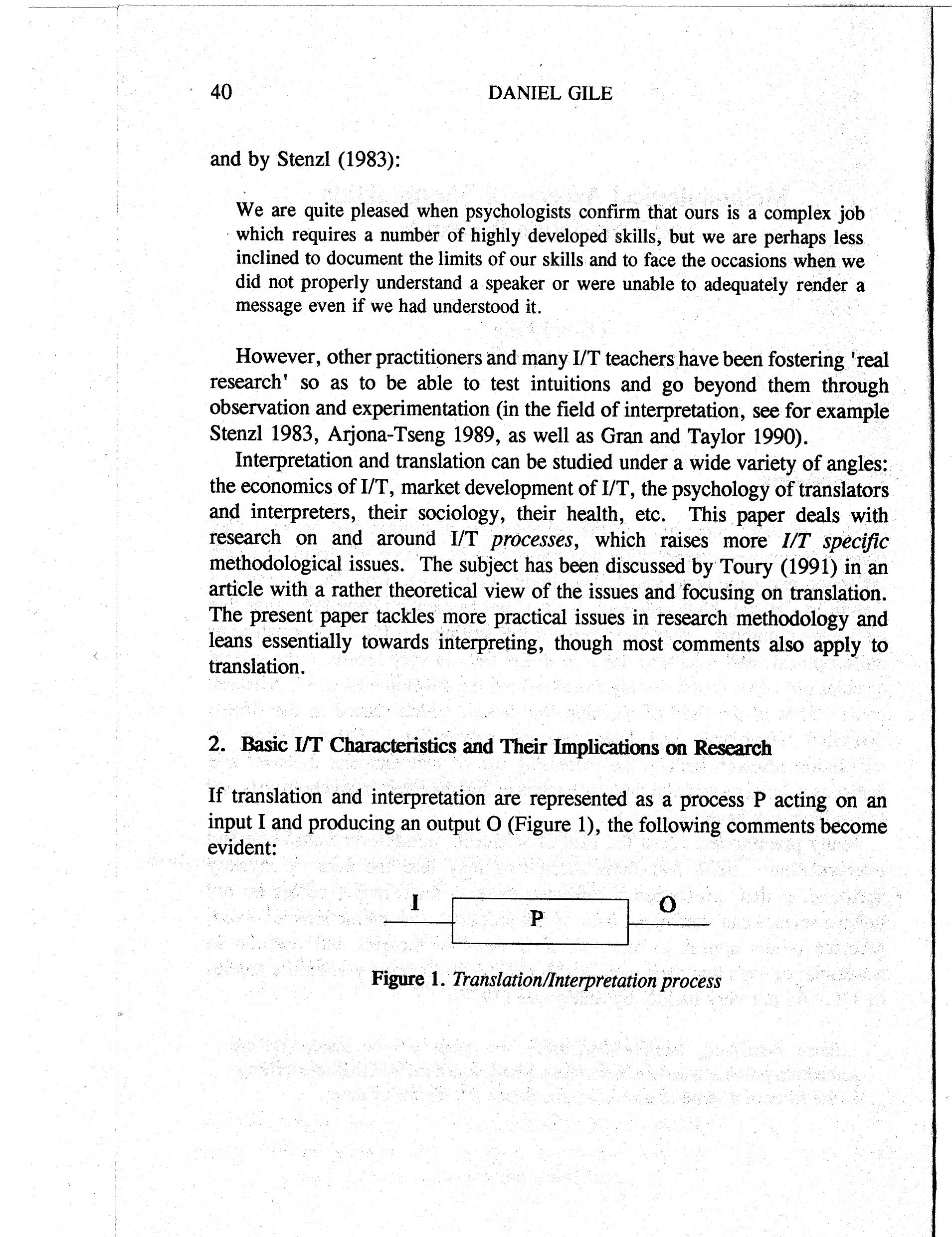
If translation and interpretation are represented as a process P acting on an invisible. Even the Thinking Aloud Protocols used in research on translation
input I and producing an output O (Figure 1), the following comments become are only a reflection of the mental processes involved (Krings 1986). Similarly,
evident: in consecutive interpretation, it is possible to observe and record the note-taking
part of the process and to monitor interpreters listening and providing their oral
rendition, but the mental interpretation process itself is invisible.
I O
2.3. Although Many Rules on Output, Including Relations between Output and
Figure 1. Translation/Interpretation process Input Have Been Described, Much of the Process LeadingfromInput to Output
Remains Unknown
This third principle is a corollary of the second. Given the invisible nature of
the processes, they can be explored only by inference. There is a large
consensus on the general directions, if not on the precise quantitative
assessment, of I/T quality parameters, such as fidelity, linguistic correctness,
�42 DANIEL GILE METHODOLOGICAL ASPECTS OF RESEARCH 43
stylistic and terminological acceptability (see discussion below). There are also (except when a TV monitor is used, as is often the case in satellite conferences
certain widely-accepted operational rules regarding I/T preparation strategies, and for TV interpretation).
documentary and terminological 'research*, problem-solving tactics, etc.
However, most of the I/T processing which does not involve conscious
decision-making, i.e. the reading and speech recognition operations, the
unconscious inferencing during comprehension of source language speech or With respect to scientific research on I/T, these basic characteristics suggest
text, the meaning-to-language or language-to-language retrieval of target the following methodological principles:
language terms and structures, remains largely unknown. Research in speech a) The most logical way to undertake any study of I/T mental processes
production and comprehension in psycholinguistics, studies on reading and would be through the study of correlations between input and output or input
experiments and models on attention in cognitive psychology as well as some and .process product. As Hoffstaedter puts it, "A critical point in the
artificial intelligence research, particularly as applied to machine translation, investigation of mental processes is...that the processes themselves can never
certainly do contribute their share of ideas. However, at this time, no single be observed directly...their investigation is always based on the PRODUCTS
paradigm is fully accepted nor accounts for all phenomena observed in I/T of such processes" (Hoffstaedter 1987, quoted in Toury 1991).
processes. This comes as no surprise, given that the study of language b) Because of variability, general conclusions regarding I/T mental
comprehension and production, both in the oral and the written mode, is still processes can only be drawn on the basis of observations covering a wide range
in a developmental phase. Furthermore, I/T processes also involve language- of variables and parametric values. This means that empirical studies, both
switching, processing capacity constraints and linguistic interference between observational and experimental, need to be plentiful before data can be
the source and target languages. considered as being representative of more than a limited population of
practitioners and of more than a limited range of environmental I/T conditions
2.4. I/T Situations and Operations are Highly Variable and tasks.
Until now, not only have there been few scientific studies of I/T, but, as
Variability in I/T is striking, even to the casual observer. Variability is a noted by Toury (1991) regarding translation, and by Gile (1990a) and others,
salient feature of I/T in communication situations with respect to subject matter, with respect to interpretation, most studies were limited to very small samples
source language material and speeches, content density and logic, linguistic of subjects, languages and text or speech types. Generalizations are therefore
quality, the range of working conditions, differences between individual still premature.
translators and interpreters in terms of talent, training, experience, working c) Observational studies are the logical starting point. They are
methods and motivation. This variability can also be observed in the same methodologically simple, as input and output can be easily observed and
individual who does the same translation or interpretation twice, during training recorded without influencing translators' and interpreters' behaviour, whereas
in I/T schools for example, as well as in the rare case when professionals are experimental studies may produce data unrepresentative of I/T if not conducted
required to interpret or translate the same source language speech or text twice. with proper methodological care and sufficient know-how. Moreover,
observational studies are inexpensive, because material requirements are
2.5. I/T Operational Environments are Fairly Simple generally limited to photocopies of documents and cassette tapes. In some
cases, video cameras and video-players may also be necessary, but no complex,
Technically speaking, in the case of translation, 'physical' I/T environments are expensive and sensitive equipment and no carefully prepared settings are
easily described as consisting of a chair, a desk, paper and pencil, a typewriter required.
or a computer, and sometimes a dictating machine. For consecutive d) Experimental studies are technically easier to carry out in I/T than in
interpretation, they include any room or space where two persons meet and hold most other fields of human behaviour. In translation, the fact is obvious, since
a discussion. For simultaneous interpretation, a booth with electronic material requirements for experiments are limited to 'source texts' which can
equipment as well as an electronically equipped meeting room are required be controlled at will. In consecutive interpretation, material requirements
�44 DANIEL GILE METHODOLOGICAL ASPECTS OF RESEARCH 45
involve space and at least one 'speaker' and one 'client'. In the case of motivated, represent an especially valuable human resource. Moreover, they
simultaneous interpretation, a meeting room, an electronically-equipped booth, can gain a lot from the exercise and the careful scrutiny of their work, which
at least one 'speaker' and an audience are required. But in all these cases, it is part of the process, provided ethical rules and respect for them are observed.
is technically easy to create an experimental environment that is quasi-identical However, caution is called for when using them in experiments or observational
to actual field conditions. As pointed out by cognitive psychologist Flores studies of professional translation or interpretation. They can be used when
d'Arcais (1978): "...after all, there are probably very few "real life" situations sufficient evidence is available to indicate that they are comparable to
which are more similar to a laboratory psychological experimentation than the professionals in the type of behaviour under study. When no such evidence
situation of an interpreter in a conference booth...". exists, one possible suggestion might be to combine samples of professionals
In spite of these rather favourable conditions for its scientific study, I/T was and students, enabling comparisons between the two, and possibly accumulating
not scientifically researched until approximately three decades ago. Since then, data on comparability or non-comparability. This has indeed been done, though
several theses and dissertations, as well as a number of studies and papers have not with this aim in mind, in Dillinger's (1989) and Viezzi's (1989) recent
been devoted to the subject. A significant proportion of these suffer from studies, not to mention studies having the specific objective of comparing
methodological weaknesses. The following is an attempt to present those which students' and experienced professionals' performance (see for example Pinter,
occur most frequently. 1969).
3.2. Materials
3. Major Methodological Issues and Problems in I/T Research
Similarly, investigators have conducted experiments using input materials which
3.1. Subjects in I/T Experimentation were very different from materials found in the field. This problem is more
tangible in interpretation than in translation, since written translation is
Access to translators and interpreters for research purposes may be difficult for performed on a wide sample of texts, whereas interpretation is performed on
geographic reasons, because of a lack of physical availability of practitioners, speech types occurring in a smaller number of communication situations.
for professional reasons (confidentiality of translated material), and for personal Therefore, although interpreting sentences read out of context or written
reasons: many translators and interpreters do not appreciate having their work material not intended for oral communication may deepen insight on aspects of
carefully scrutinized by anyone but their clients. Researchers therefore tend to language comprehension and production or on other aspects of language-related
take as subjects either I/T students or 'bilinguals', that is, non-practitioners skills, both processes and results may be quite different from those that occur
having knowledge of languages. in actual interpretation. For example, in a recent paper (1990), Dillinger
This strategy is widely challenged by practitioners, especially in the field of defended the texts he used for an earlier experimental study of comprehension
conference interpretation (see for example Gile 1990a). A professional's in simultaneous interpretation (1989) against a critic who challenged the validity
approach and appropriate working methods in I/T are the result of training, of these texts, written especially for the experiment rather than taken from an
experience and selection: not only do they have to be acquired and fine-tuned, authentic conference. Dillinger's reaction was:
but some students may never become professional translators or interpreters
because they prove incapable of mastering and/or applying them. There may One might ask...why this would make a difference. No one knows what the
be very significant differences in the way professionals on the one hand, and differences are (if there are any) between the texts used here and the sorts of
students or amateur translators/interpreters on the other, perform I/T tasks, and texts found in actual conference situations. The hypothesis that the texts are
experiments conducted with the latter subjects may not be representative of the different and the processes involved in comprehending and interpreting them are
activity to be examined. qualitatively different because one text was presented to an audience and the
other was not is not only unsupported by any evidence, but also seems entirely
This does not mean that no I/T studies using students or amateurs as subjects implausible (p.43).
should be undertaken. Students, who are readily available, numerous and
�46 DANIEL GILE METHODOLOGICAL ASPECTS OF RESEARCH 47
No scientific evidence indicated the existence of such a difference, but Error counts have been used to evaluate quality in general, and fidelity in
interpreters report reacting to factors that have not yet been quantified or even particular. However, researchers have had difficulties in such endeavours.
specifically identified. Those who engage in research themselves have stressed One specific example is that of Henri Barik (1969), whose definition of errors
time and time again the need to use experimental materials and conditions as includes linguistic transformations not necessarily considered as errors in an
close as possible to field conditions because of this. In Dillinger's case, since interpreter's mind (see Gile 1989). It would seem that Barik did not consult
the whole validity of the experiment relies on the speeches, we feel that starting interpreters when defining errors. The question is not so much whether his
out with the assumption that there is no difference constitutes a methodological definition is better than that of the practitioners' ; the point is that the latter aim
error. to reduce the number of errors as they see them and may do nothing to try to
reduce the number of errors as defined by Barik, in which case his error count
3.3. Experimental Conditions and Tasks may be uncorrelated with the difficulty of the task.
Bank's definition of errors has also been challenged by Gerver (1976) as
Along the same lines, one might note that experimental studies have been being "purely subjective" (Gerver applied this qualifier to his own definition as
conducted under conditions or with tasks somewhat far removed from field well), and by Stenzl (1983) as too vague. Stenzl reports that when she tried to
conditions, including translation into and from languages which are not the replicate Barik's results and to identify errors in his transcripts according to his
practitioners1 usual active or passive languages or 'translation' of random own definitions, she found that her data did not agree with his.
sequences of words (Treisman 1965). Another quality assessment problem resides in language acceptability
Again, experimenters may argue that no evidence points to a significant evaluations. Not only are both the sensitivity and standards of native speakers
difference between such tasks and authentic translation or interpretation. Again, highly variable, as illustrated in Gile (1985), but no evidence is available
when no evidence or rationale in favour or against is available, the best policy regarding the sensitivity and standards of delegates in international conferences
seems to take as a starting point the hypothesis that the general feeling of I/T or the quality standards aimed for by practitioners while interpreting.
practitioners may be right. One should not forget that many research decisions The very basic question of quality definition in interpretation has only been
are partly made on the basis of intuitive, scientifically unsubstantiated dealt with intuitively and prescriptively until very recently. The International
knowledge of the subject or phenomenon under study. Association of Conference Interpreters (AIIC) tried to organize meetings with
interpretation users in order to elicit some kind of feedback, but these attempts
3.4. Quantification and Quality Assessment were never very successful. The most straightforward scientific way of
collecting data on actual quality perception delegates would clearly be by way
Scientific researchers in I/T still hear practitioners say that translation and of questionnaires or interviews (Gile, 1983). The first study along such lines
interpretation cannot be measured because they are "akin to the arts" or very was conducted in Trieste by Meak (1983). Another was carried out by Buehler
complex and "cannot be reduced to formulas". A thorough discussion of this (1986), a third by Kurz (1989), and a fourth by Gile (1990c). But in view of
issue is beyond the scope of this paper. However, it may be appropriate to the variability mentioned earlier, these studies constitute only a beginning and
stress that quantification in the behavioural sciences is not tantamount to much replication and further studies are definitely required before quality of
attempting to equate a behaviour with a set of equations or figures. The idea interpretation can be said to be understood. Methodologically, quality
is to find indicators that can be 'measured', if only approximately, and yield assessment of translation seems less daunting, at least as regards non-literary
data that will contribute to a better knowledge of the phenomenon. In this translation, because language standards relating to formal written texts are
respect, many indicators seem to be relevant to I/T, depending on the aspect of easier to identify and because variables and parameters of reception conditions
interpretation or translation under study: translation speed, translation costs, are less complex in translation than in interpretation. However, as pointed out
source text length to target text length ratio, etc. In quality assessment, one by Stenzl (1983), Gerver's method of having interpretation assessed by 2 judges
common indicator is the number of language errors in a target language text or who "...had experience of marking translation from the French, up to a first
speech; another is the number of 'translation errors'. year University standard..." and who then corrected interpretation transcripts
�48 DANIEL GILE METHODOLOGICAL ASPECTS OF RESEARCH 49
(1976), is likely to be a poor reflection of the reactions of delegates sitting in rejection applicable - see for instance Hansen, Hurwitz and Madow 1953 and
the conference room. Snedecor and Cochran 1967); neither are we referring to cases in which non-
professionals are selected for experiments on professional practice. The
3.5. Drawing Conclusions problem is that even when professionals are given tasks that can be considered
valid as I/T tasks, even in observational studies, which deal by definition with
Experimental design and conclusion-drawing issues are not much different in real I/T tasks, researchers tend to extrapolate somewhat uncautiously.
I/T from what they are in other disciplines of the behavioural sciences. Most One such example can be found in Dillinger's (1989) general conclusions on
specific methodological difficulties and flaws seem to occur because of the interpretation based only on a single set of experiments with a total of 24
researchers1 background. The examples discussed below illustrate this fact, but subjects, working on two speeches in only two languages. Another example
do not point at difficulties inherent to I/T research as such. involves Seleskovitch (1975) making general statements on interpretation on the
The most basic difficulties in I/T conclusion drawing are related to the basis of a single experiment with a total of 12 subjects working in the
validity of experiments with respect to professional I/T, as explained above consecutive mode on two English speeches. Inter alia, she considers that
regarding subjects, materials, environmental conditions, tasks and evaluations. deverbalization is an established fact because in her experiment, with the
Methodological weaknesses associated with this type of validity are found exception of some specific types of words, notes taken by interpreters do not
mostly in research undertaken by non-practitioners of I/T, because they may not list "word-equivalents" in the target language. Other possible explanations are
be aware of specific I/T rules and effects in speech or text production standards, not considered. This weakness is not linked to sophisticated methodology or
strategies and tactics. highly specialized knowledge and can be spotted by analysis of the logic of her
For instance, some non-interpreting researchers engaged in interpretation conclusions.
research may be unaware that interpreters may deliberately opt to change the Toury (1991) mentions other weaknesses in the rationale of I/T researchers.
surface structure of a sentence or select words which are morphologically The most striking example he refers to is a study by Sandrock (1982) on the use
remote from the source language so as to avoid linguistic interference. In other of the Thinking Aloud Process (TAP) in translation research: a comparison was
words, a deviation from the source language structure may mean the interpreter made between two translations of the same text, one traditional and the other
is controlling the situation, whereas the selection of target language structures resulting from a verbalization and TAP process. The problem, as pointed out
similar to source language structures indicates that the interpreter may be short by Toury, is that one translation was produced by a learner of English, and the
of processing capacity. Similarly, the use of one word as opposed to another other was given as a "Model translation" in a manual. It is therefore possible,
which resembles the corresponding source language word, could be an and even plausible, that differences resulted not only from differences in the
indication that the interpreter has sufficient processing capacity left to processes, but also from differences in the translation expertise of the authors
consciously resist linguistic interference, a fact which should not be mistaken of the two target language texts.
for an indication of failure to find the 'right' word. One can point out in this
context that the interpreters' view of fidelity may be quite different from that
of the translators', since they deal with externally-paced message reception, as 4. Strategies for I/T Research
opposed to internally-paced visual reception. This may lead to errors both in
quality assessments and in evaluations of difficulty. Barik's approach to errors I/T research has been making some headway over the past decade or so, mostly
is a good case in point, as mentioned above. because of importation of experimental methods from other disciplines (Toury
A second major weakness in I/T research involves extrapolation. The flaws 1991), As Toury also points out, the implementation of such methods as well
referred to here are not the technical problems caused by 'convenience ai observational methods in I/T is still suffering from weaknesses. We believe
sampling' in statistical inference ('convenience sampling1 is the selection of that proper scientific research is required, because too many widely accepted
subjects because they are available, as opposed to random sampling-based ideas are based solely on intuitive personal speculation and have resulted in
methods which make inferential mathematics and hypothesis rejection or non-
�50 DANIEL GILE METHODOLOGICAL ASPECTS OF RESEARCH 51
some stagnation in I/T, as also noted by Toury (1991 - see also a discussion of but a formal agreement between institutions offering I/T research training at the
the problem in Gile 1990a). graduate or doctoral level, which would allow their students to choose board
However, we do not share Toury's view that empirical methods require members as M. A. or Ph.D. supervisors outside their school, could have distinct
"translational hypotheses" to be tested. Scientific investigation in most fields advantages.
starts with exploration of reality in the field, that is with observational studies.
Systematic observation of reality is a valuable scientific act per se (see 4.2. Research Programs
Fourastié 1966), which should not be snubbed by more fashionable
experimentation, which practically "haunts" the scientific scene (Toury 1991). Besides training, actual research programs would be helpful in improving the
Another type of experimenting, known as open experimenting, consists in overall situation, and I/T schools seem once again to be in the best position to
generating controlled conditions not in order to test a specific hypothesis, but foster such programs. One obvious possibility is to involve research trainees
for the purpose of examining the resulting situation as a whole and trying to in programs as described above in actual research. Another approach is the
make inferences on that basis. Open experimenting is also very valuable (see "thesis" required at the end of basic I/T training in some schools, such as the
Gile 1990b). In our view, the most fundamental reasons for methodological Scuola Superiore di Lingue Moderne per Interpreti e Traduttori in Trieste.
weaknesses, as discussed above, lie in what can be summarized as insufficient Such "theses" are a good opportunity for students to carry out actual research,
expertise in scientific research on the part of I/T practitioners engaged in as demonstrated by several theses published in Gran and Taylor (1990) and in
research (were they better trained, I/T researchers outside I/T could avoid most The Interpreter's Newsletter.
of their own errors by reading their work and cooperating with them). In research programs of this type, schools have an opportunity to replicate
We believe that improvement of the situation can be accelerated by observations and experiments, which is a good way to corroborate results and
appropriate strategies. Some suggestions are formulated below with this goal to enlarge samples.
in mind. "Institutional strategies" aim at creating a favorable I/T research
environment by the action of I/T schools, associations and governmental 4J. Interdisciplinary Contacts
agencies entrusted with I/T responsibilities. "Personal strategies" are proposed
to individual researchers who wish to engage in I/T research. Another role of institutions with respect to I/T research is to establish and
improve interdisciplinary contacts. This can be done by inviting scientists from
4.1. Institutional Strategies Other disciplines such as linguistics, philosophy of science, and psychology, to
lecture to students or to participate in I/T research projects. This can also be
Highest priority should clearly be given to research training. The logical forum done by actively fostering information exchanges, for instance by sending such
for such training would be the postgraduate I/T schools attached to universities. scientists information about I/T studies and projects which could be of interest
Clearly, interdisciplinary cooperation is required at least in the early stages to them*
of methodological training of I/T students and practitioners for research. We
believe the programme should include some concepts from the philosophy of 4,4» Dissemination of Information in I/T Research Circles
science, training in statistics for the social sciences and the presentation of
research methods used in behavioural sciences. At a later stage, the I/T The situation of translation and interpretation research differs greatly with
teaching staff could adapt the concepts and methods to I/T research. respect to dissemination of information. The translation research community
Since there are I/T instructors with a scientific background who teach at il much Older, larger, wealthier, and better organized. There are numerous
various locations, pooling together I/T research expertise through "international ttmslation journals and an increasing number of conferences dealing with
I/T research advisory boards", possibly specialized in translation or trtittSlation studies. Furthermore, translator researchers have traditionally kept
interpretation, may provide institutions and individuals with better consultative in touch with the academic communities of linguists, philosophers, literature
services and research guidance. The activity of such boards could be informal,
�52 DANIEL GILE METHODOLOGICAL ASPECTS OF RESEARCH 53
scholars, and more recently, have been drawing the attention of the artificial - Research design and methods: Unless they are sure to be able to rely on
intelligence community. their advisors for close monitoring and methodological help, budding I/T
Interpretation researchers are still to a large extent isolated and unaware of researchers should aim at very simple design and methods. Observational
each other's work, though much headway has been made in the past few years Studies and "open experimenting" (in which a situation is generated and
with the Trieste school's initiatives, in particular its seminar on interpretation observed but no statistical inferencing for hypothesis-testing purposes is
training (Gran and Dodds 1989) and the launching of an interpretation journal, done) are methodologically simpler that the more traditional hypothesis-
The Interpreter's Newsletter. Another effort is underway through the creation, testing. Inferential statistics are often challenging, even for experienced
in 1990, of the Paris-based IRTIN, or International Interpretation Research and researchers: see for example Gore and Altman (1982) for a wide discussion
Theory Information Network, which publishes a bulletin twice a year. The of the issues. It is interesting to note that in a study of 149 medical papers
International Association of Conference Interpreter's Research Committee also published in several journals, only 28% were judged of acceptable statistical
endeavours to foster dissemination of information on interpretation research and quality (Schor and Karten 1966). It is therefore easier and at least as valid
is due to publish a rather extensive interpretation bibliography soon. to use descriptive statistics rather than inferential statistics, though analyses
Multi-centre contacts have been a reality in I/T for many years, but multi- cannot be as fine as with inferential statistics (see a discussion of the issue
centre research is still to come. This, along with replication, is a good way of in Gile 1989 and 1990c).
overcoming sample size and sample diversity (in particular as regards - Drawing conclusions: Bearing in mind the weaknesses discussed earlier in
languages) limitations. Because so little empirical research has been carried out this paper, I/T practitioners should be very careful in drawing conclusions
to date, simple projects which cost little and which are easy to coordinate are and extrapolating. Unlike researchers in most other disciplines, when they
still very valuable. engage in I/T research, they are required to deal objectively and without bias
with an activity in which they are intimately involved in their daily life and
regarding which they have developed their own intuitive ideas. Again, the
S. Strategies for Individuals presence of non-I/T scientists as advisors can be very valuable, as their
views are more objective and their thinking more in line with the Cartesian
5.1. Strategies for I/T Practitioners discipline of scientific reasoning.
I/T practitioners with no research training or background, wishing to engage in
I/T research can do so because much can still be done with very simple 6. Strategies for Non-Practitioners
methods. The following guidelines may be useful in such an endeavour:
- The selection of research projects: Research topics should be well defined Ntott*practitioner I/T researchers do not have to overcome personal involvement
and not overly ambitious. A completed project can be extended or followed Ilid are already familiar with and experienced in scientific thinking. This does
up, but many initial projects are never completed because sights are set too ll§t prevent them from having preconceived ideas about I/T, but scientific
high. The methods, potential difficulties and ways around them as well as discipline probably makes it easier to examine them more objectively on the
a timetable should be clear from the start. The advice of more experienced basis of scientific data. On the other hand, like the public at large, they often
I/T researchers should be very useful in this respect. Consider tfaey are familiar with I/T because of their experience with school
- Research advisors: Pending the arrival of a generation of well-trained I/T 'translation1 as part of foreign language learning or because they have had some
researchers, it seems advisable to have two advisors, one from I/T and the occasional experience in translating and interpreting. Such experience is often
other from science, preferably from psychology or linguistics, even if only fallacious, a§ school translation and amateur translating and interpreting may be
one of them is the official advisor. Of course, each advisor must be open- p l t i different from professional practice as regards strategies, tactics, user
minded enough to welcome the contribution of the other. Institutional action expectations etc. This deceptive sense of familiarity may explain partly the fact
along the lines advocated above may be of help in this respect. that many non-I/T practitioners who engaged in I/T research did not consult
� 54 DANIEL GILE METHODOLOGICAL ASPECTS OF RESEARCH 55
practitioners before and during their study on methodological questions, which Qll©, D. 1990a. "Scientific Research vs. Personal Theories in the Investigation of
resulted in errors as discussed in Toury (1991) and in this paper. Interpretation". L. Gran and C. Taylor, eds. Aspects ofApplied and Experimental
For all these reasons, we believe it is essential for investigators coming into Research on Conference Interpretation. Udine: Campanotto Editore. 28-41.
I/T to consult with practitioners. Special attention should be given to the first Oîli, D. 1990b. "Observational Studies and Experimental Studies in the Investigation
three items mentioned in the section on methodological issues and problems in Of Interpretation". Paper presented at the Scuola Superiore di Lingue Moderne per
an earlier part of this paper, namely subjects, materials, experimental conditions Interpreti e Traduttori, Universita degli Studi di Trieste, March 19, 1990.
and tasks, as this is where critical comments from practitioners may prove to (Mimeo.).
be most useful. Oil©, D. 1990c. "L'Evaluation de la Qualité de l'Interprétation par les Délégués: Une
Etude de Cas". The Interpreter's Newsletter 3. 66-71.
Qll©, D. 1990d. "Research Proposals for Interpreters". L. Gran and C. Taylor, eds.
Aspects of%Applied and Experimental Research on Conference Interpretation. Udine:
References Campanotto Editore. 226-236.
§or©, S.M. and Altman, D.G. 1982. Statistics in Practice. London: British Medical
Anderson, L. 1979. Simultaneous Interpretation: Contextual and Translation Aspects. Association.
Concordia University, Montreal, Canada. [Unpublished Masters' Thesis.] Qritt, L, and Dodds, J. 1989. The Theoretical and Practical Aspects of Teaching
Arjona-Tseng, E. 1989. "Preparing for the XXIth Century" (Keynote speech). Conference Interpretation. Proceedings of the First International Symposium on
Proceedings of the Twentieth Anniversary Symposium on the Training of Teachers Conference Interpreting at the University of Trieste. Udine: Campanotto Editore.
of Translation and Interpretation, Monterey Institute of International Studies, Qnn» L, and Taylor, C. 1990. Aspects of Applied and Experimental Research on
Monterey, California. Conference Interpretation. Udine: Campanotto Editore.
Barik, H.C. 1969. A Study in Simultaneous Interpretation. University of North Hlfttin, M., Hurwitz, W. and Madow, W. 1953. Sample Surveys Methods and
Carolina, Chapel Hill. [Unpublished Doctoral Dissertation.] Theory. New York, London and Sydney: John Wiley & Sons, Inc.
Buehler, H. 1986. "Linguistic (Semantic) and Extra-linguistic (Pragmatic) Criteria for Mofhtaadter, P. 1987. "Poetic Text Processing and its Empirical Investigation".
the Evaluation of Conference Interpretation and Interpreters". Multilingua 5. 231- Poetics 16. 75-91.
Hun, I. 1989. "Conference Interpreting: User Expectations". ATA - Proceedings of
Dillinger, M. 1989. Component Processes of Simultaneous Interpreting. McGill the 30th Annual Conference. Medford, NJ: Learned Information Inc. 143-148.
University, Montreal, Canada. [Unpublished Doctoral Dissertation.] IflflgS» H.P. 1986. Was in den Koplen der Ubersetzer vergeht. Tubingen: Narr.
Dillinger, M. 1990. "Comprehension During Interpreting: What Do Interpreters MîfÉ, L. 1983. La Selezione dellTnformazioneper ITnterpretazione Simultanea della
Know that Bilinguals Don't?". The Interpreter's Newsletter 3. 41-58. Llteratura Medica. Trieste, Universita degli Studi di Trieste, Scuola Superiore di
Flores d'Arcais, G.B. 1978. "The Contribution of Cognitive Psychology to the Study Lingua Moderne per Interpreti e Traduttori. [Unpublished monograph].
of Interpretation". D. Gerver and W. H. Sinaiko, eds. Language Interpretation and Pltltir» I, 1969. Der Einfluss der Uebung und Konzentration auf Simultanés Sprechen
Communication. New York and London: Plenum Press, Nato Conference Series und Hdren. University of Vienna. [Unpublished Doctoral Dissertation].
385-402. llfldfOek, U. 1982. Thinking-Aloud Protocols (TAPs - Ein Instrument zur
Fourastié, J. 1966. Les Conditions de l'Esprit Scientifique. Paris: Gallimard. DekomposltiondesKomplexenProzesses'Ubersetzen'). Kassel: Gesamthochschule
Gerver, D. 1976. "Empirical Studies of Simultaneous Interpretation: A Review and Kiilêl. (Mimeo.).
a Model". R. Brislin, ed. Translation. New York: Gardner Press. 165-207. iillStovitch, D. 1975. Langage, Langues et Mémoire. Paris: Minard.
Gile, D. 1983. "Aspects Méthodologiques de l'Evaluation de la Qualité du Travail en SUningtr» Miriam. 1989. Simultaneous Interpretation as a Factor in Effecting Shifts
Interprétation Simultanée". META 28:3. 236-243. in the Position of Texts on the Oral-Literate Continuum. Tel-Aviv University.
Gile, D. 1985. "La Sensibilité aux Ecarts de Langue et la Sélection d'Informateurs ^Unpublished Masters' Thesis.]
dans l'Analyse d'Erreurs". The Incorporated Linguist 24:1. 29-32. Stfhor» S. and Karten, I. 1966. "Statistical Evaluation of Medical Journal
Gile, D. 1989. La Communication Linguistique en Réunion Multilingue - Les MmumW, JAMA 195. 1123-1128.
Difficultés de la Transmission Informationelle en Interprétation Simultanée. Sntisaof, Q.W. and Cochran, W.G. 1967. Statistical Methods, 6th Edition. Ames,
Université de Paris III. [Unpublished Doctoral Dissertation.] taWii The Iowa State University Press.
�56 DANIEL GILE
Ste
^ 1 , J C ; l 983 * Simultaneominterprétation - Groundwork Towards a Comprehensive
Model. University of London. [Unpublished Masters' Thesis.]
Toury G. 1991. "Experimentation in Translation Studies: Achievements, Prospects In die \\\ NJ AMINS TRANSLATION LIBRARY the following titles have been published
and some Pitfalls". Sonja Tirkonnen-Condit. ed. Empirical Research in Translation fliUN fur or arc scheduled to appear in the course of 1994:
%U"%Z?ltural *tudies: Selected P*P™ of the TRANSIF Seminar, Savonlinna !. SA( iEK, Juan C: Language Engineering and Translation: Consequences of automation,
1988. Tubingen: Gunter Narr. 45-66. IW.
Treisman, A. 1965. "The Effects of Redundancy and Familiarity on Translation and L SNEI .1,-1 IORNBY, Mary, Franz POCHHACKER and Klaus KAINDL (eds): Trans-
lation Studies: An interdiscipline. Selected papers from the Translation Congress, Vie-
3® 379* B a C k a N a d V e a n d F ° r e i g n L a n g u a g e "- BritishJourml of Psychology 56. nna, 0-12 September 1992. 1994.
Viezzi, M. "Information Retention as a Parameter for the Comparison of Sight 3, LAMBERT, Sylvie and Barbara MOSER-MERCER (eds): Bridging the Gap: Empiri-
Iranslation and Simultaneous Interpretation: An Experimental Study" The cal research in simultaneous interpretation. 1994.
y
Interpreters'Newsletter 2. ' 4, T( HIRY, ( iidcon: Descriptive Translation Studies — and beyond. 1994.
5, POLLHRUP, Cay and Annette LINDEGAARD (eds): Teaching Translation and
hltwprvtiHfi 2: Insights, aims, visions. Selected papers from the Second Language Inter^
national Conference, Elsinore, 4-6 June 1993. 1994.
�


 Daniel Gile